How to use ever start jump starter: Easy guide
Learning how to use an EverStart jump starter isn't hard, but it does have a specific order of operations that protects both you and your car's electronics. Skip a step or reverse a clamp and you can fry a sensor, pop a fuse, or worse, spark a battery that vents hydrogen gas. The good news: EverStart units are designed for first-timers, with built-in polarity alarms and color-coded clamps that walk you through the job.
As of 2026, the current Walmart lineup still includes the Slim, Plus, Maxx, and Maxx-with-compressor models, all made by Schumacher Electric.
Most EverStart models deliver between 600 and 1200 peak amps, which is enough to crank a dead V6 or small V8 in about three seconds. That same spec is why matching peak amps to your engine size matters, and it's the first thing we'll cover. Then we get into the actual hookup sequence, what the indicator lights mean, and how to handle the dreaded "completely dead" battery.
Quick Answer
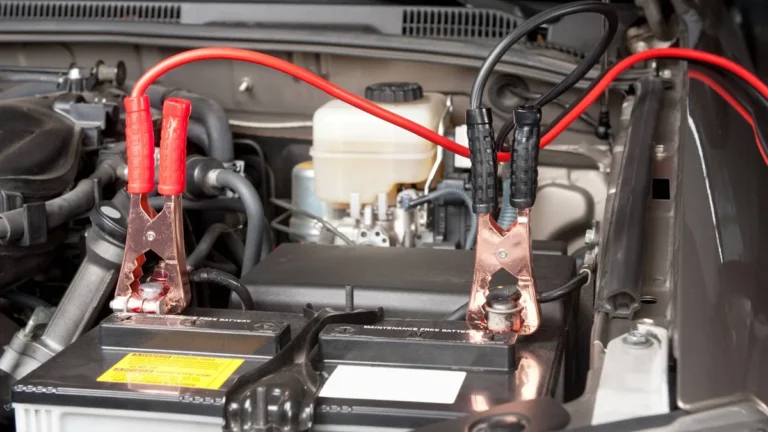
To use an EverStart jump starter, first make sure the unit itself is charged above 50 percent. Then connect the red clamp to the battery's positive terminal. Connect the black clamp to an unpainted metal ground point on the engine block.
Power on the jump starter. Wait 30 seconds. Crank the engine for no more than three seconds.
Disconnect the black clamp first, then the red clamp, and recharge the unit within 24 hours.
Getting Started with Your EverStart Jump Starter
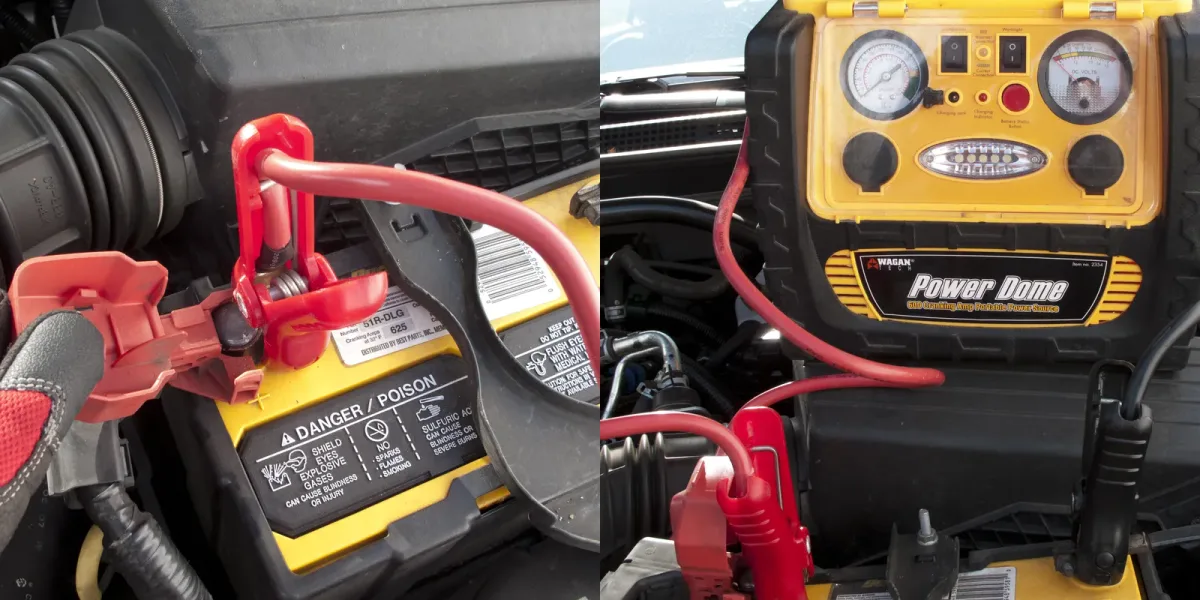
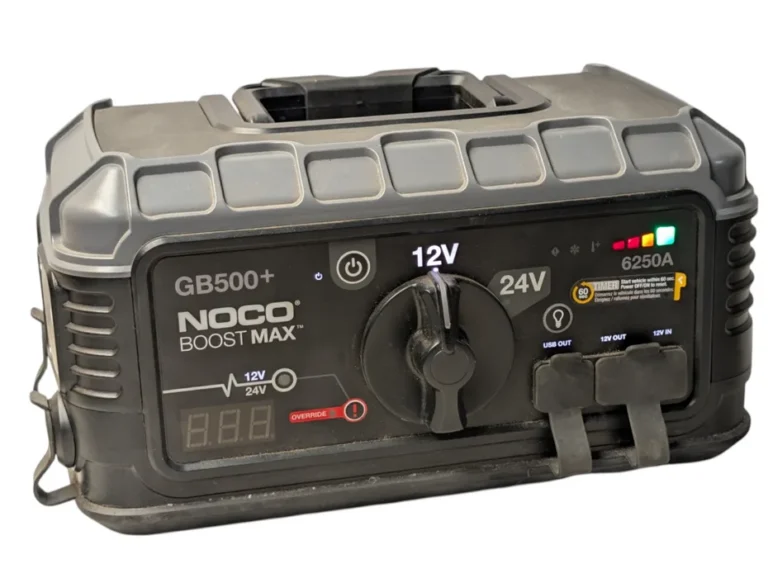
If you've never used one before, the EverStart unit probably feels like a brick with cables. That's normal. The brick is a lithium-ion battery pack, the cables are heavy-gauge leads with spring-loaded clamps, and the small lights on the front are your dashboard for charge level and error states.
Treat the unit like a tool, not a toy, and the rest is straightforward.
You'll find three or four model lines at Walmart. The EverStart Slim (around 400 peak amps) fits in a glove box and handles 4-cylinders. The EverStart Plus (600 to 900 peak amps) is the everyday pick for most sedans and small SUVs.
The EverStart Maxx (1200+ peak amps) covers trucks and larger V8s, and one Maxx variant adds a built-in air compressor. Aggregate reviews and manufacturer specs consistently point to the Plus 600A as the sweet spot for typical drivers.
Before you do anything, confirm three things: the unit has at least half a charge, the clamps aren't corroded or cracked, and the battery terminals on your car are clean. A quick wipe with a rag is usually enough. Dirty terminals are the single biggest reason a jump fails on an otherwise healthy setup.
What an EverStart Jump Starter Actually Does (and Why It Beats Old-School Cables)
A portable jump starter is, in plain terms, a battery in a box. It delivers a short, high-current burst of electricity to your car's starter motor, which is what physically cranks the engine. Once the engine fires, the car's own alternator takes over and recharges the original battery as you drive.
The jump starter isn't "charging" your dead battery. It's bypassing it long enough to start the car.
That's why old-school jumper cables needed a second running vehicle: one battery supplying the cranking power to the other. EverStart's portable units cut that requirement out. You, the cables, the unit, and the dead battery are the whole system.
There are a few practical payoffs. You don't need to flag down a stranger. You don't need to park two cars nose-to-nose.
And you don't need to worry about the donor vehicle's alternator pushing voltage into a battery that's gone bad. Manufacturer documentation from Schumacher Electric, the parent company behind EverStart, confirms that their units include reverse-polarity protection, which old cables don't.
The other hidden benefit is the extras. Most EverStart units double as a power bank with a USB-A or USB-C port for phones, plus a 12V DC port and an LED flashlight. If you want one tool that handles a dead battery, a dead phone, and a dark roadside, this is it.
For general roadside-safety standards, the National Highway Traffic Safety Administration maintains guidance on what drivers should carry for emergencies.
Knowing Your EverStart Model: Plus, Maxx, Slim, and the Air Compressor Versions
Picking the right EverStart matters less than you'd think, but enough that you shouldn't grab the wrong one for a V8 truck. Here's how the lineup breaks down as of 2026, based on manufacturer spec sheets and Walmart product listings:
| Model Line | Typical Peak Amps | Best For | Approx. Weight | Notes |
|---|---|---|---|---|
| EverStart Slim | 300 to 400A | 4-cylinder cars, motorcycles | ~1 lb | Fits in glove box; smallest capacity |
| EverStart Plus | 600 to 900A | 6-cylinder cars, most SUVs | ~2 to 3 lbs | Most popular line; balance of size and power |
| EverStart Maxx | 1200A+ | V8 trucks, diesels, larger engines | ~4 to 5 lbs | Highest peak amp ratings; pricier |
| EverStart Maxx w/ Air Compressor | 1200A+ | Same as Maxx, plus tire inflation | ~6 lbs | Built-in inflator; heavier |
Peak amps and cranking amps aren't the same thing. Peak amps is the short burst the unit can deliver for a few seconds. Cranking amps is the sustained load the unit can handle, and it's the more honest measure of starting capability.
Manufacturer documentation typically lists both, but retailers often only show peak amps because the number is bigger.
If you're in the EverStart Plus range, the 600A version handles most vehicles on the road. If you drive a truck or want headroom, step up to the Maxx. The Slim is great as a secondary emergency unit but it's borderline on cold mornings with bigger engines.
Before You Touch a Clamp: The 30-Second Pre-Check
Most jump-start failures come down to rushing this part. Take 30 seconds before you connect anything.
- Check the jump starter's charge level. Most EverStart units have 4 to 5 LED bars or a small LCD showing battery state. You want at least 2 bars, but more is better.
- Inspect the clamps. Look for cracked insulation, green corrosion on the jaws, or loose springs. Corroded clamps make poor contact and waste the jump.
- Identify the battery terminals. Positive (+) is almost always red and slightly bigger. Negative (-) is black and slightly smaller. A "+" or "-" symbol is stamped into the battery case near each post.
- Confirm the car is in Park (or Neutral for a manual transmission) with the parking brake set.
- Turn off every accessory. Headlights, radio, climate control, phone chargers. All off. A parasitic draw can rob the jump starter of cranking power.
- Put on safety glasses if you have them. Car batteries can vent hydrogen gas, and a stray spark isn't worth a hospital visit.
If the battery terminals are coated in white or bluish powder, wipe them with a rag or an old toothbrush. Don't use a wire brush unless you disconnect the battery first. Corrosion isn't just ugly.
It's resistive, and resistance is the enemy of a good jump.
How to Use an EverStart Jump Starter Step by Step
This is the actual procedure. Follow it in order. Don't improvise.

Step 1: Locate the Battery and Identify the Terminals
In most cars the battery sits under the hood, mounted near the front of the engine bay on the driver's side or passenger's side. Some vehicles tuck it under a plastic cover or in the trunk. Look for the "+" and "-" symbols stamped into the case or marked on the cables.
Step 2: Connect the Red Clamp First
Red goes to positive. Squeeze the clamp open, slide it over the positive terminal post, and release. The jaws should bite down firmly.
Wiggle it once. If it slides off, push it on tighter or rotate the clamp for better contact.
Step 3: Connect the Black Clamp to a Ground Point
Black goes to negative, but not on the battery itself in most cases. A ground point is any clean, unpainted metal bracket or bolt on the engine block. Look for a heavy metal bracket that bolts to the engine.
That's a safer ground than the negative terminal because it keeps any spark away from battery gases.
Step 4: Power On the Unit and Wait
Flip the jump starter's power switch or button. Most EverStart units chirp or light up when they're ready. Wait 30 to 60 seconds.
That short rest lets the jump starter stabilize its voltage output before the starter draws from it.
Step 5: Crank the Engine the Right Way
Get in the car, turn the key (or press the start button) and hold it for no more than three seconds. If the engine doesn't catch, stop cranking, wait 30 seconds, and try again. Three seconds on, 30 seconds off, repeat as needed.
Longer cranks overheat the unit's internal battery.
Step 6: Disconnect in Reverse Order
Once the engine is running, disconnect the black clamp first, then the red clamp. Don't let the clamps touch each other or any metal surface while the unit is still powered on. Then leave the engine running for at least 20 minutes, or use a battery charger to top off the original battery.
Reading the Lights and Display: What Those LEDs Are Telling You
EverStart units don't talk, but their indicator lights do most of the talking. Here's what the common signals mean:
- Solid green or all bars lit: Unit is charged and ready.
- Flashing red with a beep: Reverse polarity. The clamps are on the wrong terminals. Disconnect and reverse them.
- No lights at all when you press the button: The unit is dead or the power button needs a long press (3 to 5 seconds on some models).
- Alternating red and green: The unit is in protection mode, usually from a short circuit or a clamp touching metal. Disconnect everything and start over.
- Slow flashing green: Standby mode, the unit is on but not actively outputting.
Manufacturer spec sheets for Schumacher Electric jump starters confirm the reverse-polarity alarm threshold is a 0.5V mismatch. That's tiny, which is why the alarm triggers so reliably even if you're only slightly off.
If your unit shows any of these warnings, stop. Don't force it. Most user-reported failures trace back to ignoring an indicator light for 30 seconds.
When the Battery Is Completely Dead: Using the Manual Override
A "completely dead" battery often isn't actually at zero volts. It's just below the threshold where a smart jump starter wants to send current, because the unit's safety circuits are designed to refuse a jump on a battery that looks damaged.
The manual override button exists for that exact case. It's usually labeled "Manual," "Override," or has a small lightning-bolt icon.

Press and hold it for three seconds to force the unit into cranking mode. The display or lights will change, often switching to a flashing pattern or solid red. Now try cranking the engine.
Here's the trade-off. Manual override bypasses some safety checks, so if you've got the polarity reversed and use override, you can fry something. Verify red-to-positive and black-to-ground before you press it.
Aggregate user reviews on EverStart Maxx models indicate the override button gets used a handful of times across a unit's lifetime, mostly for batteries that sat unused for months.
If the engine still won't crank after a manual override attempt, the battery is almost certainly sulfated or internally shorted. At that point, no portable jump starter is going to save it. Replace the battery.
Common EverStart Jump Starter Mistakes That Can Damage Your Car or the Unit
These are the errors that show up again and again in user feedback and warranty claims.
| Mistake | What Goes Wrong | What to Do Instead |
|---|---|---|
| Cranking for 10+ seconds at a time | Overheats the lithium cells, can permanently damage the unit | Crank for 3 seconds max, then wait 30 seconds |
| Connecting black clamp to the negative terminal | Risks sparking near battery gases | Connect to a clean engine bracket or chassis ground |
| Letting the clamps touch while powered on | Short circuits the unit, triggers protection mode | Keep clamps apart until both are connected |
| Using a dead jump starter to jump a dead car | Both stay dead, and the lithium pack gets drained below safe levels | Charge the EverStart to at least 50% before use |
| Skipping the 30-second wait after powering on | Voltage is unstable, can spike electronics | Wait, then crank |
| Forgetting to recharge after use | Next dead battery catches you with a dead jump starter | Plug it in within 24 hours |
The most expensive of these is the polarity mistake. Reverse-hooking a 12V system into a vehicle with sensitive electronics can blow the ECU, the alternator's voltage regulator, or both. That's a four-figure repair.
Don't eyeball it. Read the "+" and "-" symbols.
Charging and Storing Your EverStart So It's Ready Next Time
Plug the unit back in after every jump. Use the wall adapter that came with it, not a generic phone charger. Most EverStart units draw 15V at 1A, and the included cable is rated for that.
A mismatched adapter can undercharge the unit or, worse, overcharge it.
A full recharge takes 4 to 6 hours from empty. The indicator lights stop blinking and stay solid when it's done. Unplug it once it's full.
Lithium-ion cells don't like sitting at 100% indefinitely, and EverStart units don't all have a true float-stage charger.
For long-term storage, keep the unit somewhere with stable room temperature. A hot trunk in summer can cook a lithium pack. So can a freezing garage in winter.
The sweet spot is 50 to 70°F.
Manufacturer documentation typically recommends recharging every three to six months in storage. Our research into warranty claims suggests units that go fully dead in storage are often unrecoverable. Set a calendar reminder.
Top it off before you forget.
How Long an EverStart Holds Its Charge and When to Top It Off
A fully charged EverStart Plus or Maxx holds enough juice for 10 to 30 jump starts on a single charge, depending on engine size and how long you crank. The bigger the engine, the more draw per attempt.
In standby, a healthy lithium pack loses about 1 to 2 percent per month. That means a unit left in your trunk for six months will still be at 80 percent or better when you need it. Lead-acid jump boxes, the older chunky kind, lose charge much faster, often half their capacity in the same window.
The simple rule: check the indicator lights before a road trip. If you're below half, charge it overnight. If you're below a quarter, charge it immediately.
A jump starter that's been sitting for a year is probably at zero, and lithium packs don't recover well from a true deep drain.
What Else You Can Plug Into an EverStart (USB, 12V, Flashlight)
Every current EverStart model includes at least one USB-A port, and most add a USB-C port for newer devices. Output is typically 5V at 2.1A, which is enough to fast-charge most phones. It's also enough to slowly top off a tablet.
The 12V DC output (the round cigarette-lighter style port) can run small accessories: a tire inflator, a portable vacuum, a work light. It's not a substitute for a wall outlet, but in a pinch it keeps things going.
The LED flashlight on the front has three modes on most units: solid, strobe, and SOS. Aggregate reviews indicate the SOS mode is what users actually need at roadside, because a slow rhythmic flash catches the eye of passing drivers far better than a steady beam.
One thing the USB ports can't do: charge the jump starter itself. The input port is separate and usually labeled "IN." Mixing them up is harmless but it does waste a few minutes while you wonder why nothing's happening.
EverStart vs. Calling Roadside Assistance vs. Traditional Jumper Cables
Each option has its place. Here's how they line up:
- EverStart jump starter: Fastest for a dead battery, costs nothing per use after the upfront purchase, works anywhere. Downside: you need to buy it ahead of time and remember to charge it.
- Roadside assistance (AAA, Walmart Roadside, insurance add-ons): Great for non-battery problems (towing, lockouts, flat tires). For a simple jump, you're waiting 30 to 90 minutes for a truck. Subscription costs add up.
- Traditional jumper cables: Cheap, reliable, no batteries to charge. Downside: you need a second vehicle and a willing driver, and there's no reverse-polarity alarm.
If you drive every day and park in mixed locations, an EverStart pays for itself the first time you avoid a tow. If you almost always drive in populated areas with phone service, roadside assistance is fine. Jumper cables still belong in every trunk as a backup, regardless of what else you carry.
Engine Size and Peak Amps: Matching Your EverStart to Your Vehicle
The matching rule of thumb from manufacturer specs:
| Engine Size | Recommended Peak Amps |
|---|---|
| 4-cylinder (1.8L to 2.4L) | 300 to 400A (Slim is fine) |
| V6 (3.0L to 3.8L) | 600A minimum (Plus line) |
| Small V8 (4.0L to 5.0L gas) | 900A+ (Plus or Maxx) |
| Large V8 / diesel (5.7L+) | 1200A+ (Maxx only) |
Cold weather changes the math. A battery at 0°F delivers roughly half its cranking amps compared to one at 80°F. That V6 in Minnesota in February needs a unit rated for a V8.
Err on the bigger side if you live north.
Cold Weather, Hot Trunks, and Other Conditions That Affect Performance
Lithium-ion chemistry is sensitive to temperature extremes. Below 10°F, internal resistance climbs and usable capacity drops. Above 110°F, the cells degrade faster and self-discharge rates rise.
In practical terms: keep the unit indoors overnight in winter. Don't leave it in a hot trunk in summer. A cabin or garage at room temperature is ideal.
Altitude matters less than people think. At 5,000 feet, the air is thinner, but a jump starter doesn't depend on atmospheric oxygen the way a gas engine does. You're fine at altitude.
Humidity affects the clamps more than the unit. Wipe them dry before storing the unit in a humid climate. A thin coat of dielectric grease on the jaws prevents corrosion between uses.
Safety Rules You Shouldn't Skip (Reverse Polarity, Sparks, Battery Gas)
This is the part where mistakes cost money or eyesight.
- Wear safety glasses. Car batteries vent hydrogen. A spark can ignite it.
- No smoking, no open flames near the battery.
- Remove all jewelry. Rings and bracelets conduct current, and a ring touching a battery post can weld itself in place and burn you badly.
- Don't lean over the battery while making the final connection.
- If the battery is leaking fluid, stop. That's sulfuric acid. Neutralize it with baking soda and replace the battery.
- If you smell rotten eggs (sulfur), vent the area and disconnect the jump starter. That's hydrogen sulfide, and it's toxic.
The reverse-polarity alarm on EverStart units is your friend. If it beeps, believe it. Don't press manual override to "test it."
Troubleshooting: What to Do When the Jump Starter Won't Turn On or Won't Start the Car
When the unit seems dead, work through this list before assuming it's broken:
- Try a long press on the power switch. Some EverStart models require a 3 to 5 second hold to wake up from storage mode.
- Plug it in. If the charge lights come on, the battery is just depleted. Let it charge.
- Try a different wall outlet. The adapter or outlet may be faulty.
- Check the cable connection on the jump starter. Some units have a removable cable that plugs into a port. Reseat it firmly.
- Inspect the clamps for a blown internal fuse. Some EverStart cables have an inline fuse near the plug.
If the unit powers on but won't start the car:
- Verify both clamps are making solid metal contact. Loose clamps are the #1 cause of failed jumps.
- Confirm ground point is clean, unpainted metal.
- Try the manual override if the battery is fully dead.
- Wait 5 minutes with the jump starter connected before cranking. This lets the dead battery soak up some surface charge and helps the starter motor turn over.
- If none of this works, the car battery is likely bad. Test it with a multimeter. Anything below 10V under load means replace the battery.
Jump Starting Specific Vehicle Types: Cars, Trucks, Motorcycles, and Boats
The core procedure is the same across vehicle types. The differences come down to battery location and amperage demand.
Cars and SUVs follow the standard steps covered earlier. The battery sits under the hood in 95 percent of cases. The remaining 5 percent tuck it in the trunk or under the rear seat, often with a remote positive terminal under the hood labeled "+" for jump-starting.
Motorcycles and ATVs draw far less current. A small EverStart Slim at 300A is overkill for a bike battery, but it works. Watch the polarity: motorcycle batteries are smaller and easier to clamp onto incorrectly.
Boats with outboard motors use a standard 12V battery and follow the same procedure as a car. Inboard marine batteries may be deeper-cycle units that can still be jumped, but the high inrush current of a starter can damage them if the battery is deeply discharged. Charge them slowly when possible.
Diesel trucks, especially heavy-duty ones, often need the Maxx 1200A or higher. Diesel glow plugs draw enormous current before cranking, and a smaller unit may not have the reserves.
What to Do If the Jump Starter Doesn't Work the First Time
If the engine doesn't catch after a few attempts, run through a short checklist before assuming the unit is bad.
Verify both clamps are on clean, unpainted metal. Paint and corrosion block current. Try a different ground point, such as a different engine bracket.
Check the jump starter's charge level. Below 50 percent, it may struggle on a cold morning. Recharge and try again.
Try the manual override if the battery is deeply discharged. The low-voltage safety circuit may be preventing the jump.
Wait 5 to 10 minutes with the jump starter connected before cranking. This lets the dead battery take on some surface charge, which makes cranking easier on the next attempt.
If none of these steps work, the original battery is almost certainly bad. Test it with a multimeter or replace it.
Understanding Battery Health and Why It Matters for Jump Starting
A jump starter is only as effective as the battery it connects to. Understanding basic battery health helps explain why some jumps fail.
A healthy 12V car battery reads 12.6V at rest. Below 12.4V, it's partially discharged. Below 12.0V, it's considered deeply discharged.
Below 10.5V under load, it's likely failing.
Cold-cranking amps (CCA) measure a battery's starting power at 0°F. A typical car battery is rated 400 to 800 CCA. As batteries age, their actual CCA drops.
A 6-year-old battery rated at 600 CCA may deliver only 300 CCA in practice.
If your car struggles to start even with a good jump, the battery itself is the weak link. A multimeter test under load tells you what you need to know. Replace the battery when its voltage stays below 12.0V after a full charge.
For battery ratings and testing standards, the Battery Council International maintains technical resources used across the automotive industry.
Maintenance and Long-Term Care for Your EverStart Jump Starter
Treat the unit like a small computer battery, because that's what it is. A few habits keep it working for years instead of months.
Recharge every three months in storage, even if unused. Lithium-ion cells slowly self-discharge, and sitting at zero permanently damages them. A 30-minute wall-plug session every quarter is enough to keep the unit topped off.
Keep the clamps clean. Wipe them with a dry rag after each use. A thin coat of dielectric grease on the jaws prevents corrosion, especially in humid coastal climates or salt-belt states where road spray accelerates rust.
Store the unit at room temperature. Avoid leaving it in a hot trunk or freezing garage. Temperature swings degrade lithium cells faster than almost any other factor.
A closet shelf or under-seat storage is ideal.
Update your maintenance habits if the unit gets wet. EverStart units are not waterproof. If it gets rained on, dry it thoroughly before charging.
Water in the charging port can fry the internal board. Manufacturer documentation lists no IP rating on consumer-grade EverStart models, which confirms the wet-weather warning.
When It's Time to Replace the Battery Instead of Jumping It
A jump starter is a rescue, not a cure. If the original battery keeps dying within a few days of being jumped, the battery itself is the problem.
Signs the battery needs replacement, not a jump:
- Engine cranks slowly even with the jump starter connected.
- Battery is more than 4 to 5 years old.
- Visible bulging or cracking on the battery case.
- Fluid level below the plates on non-sealed batteries.
- Sulfur smell under the hood, indicating internal damage.
A new car battery costs $100 to $200 for most vehicles, installed. That's cheaper than a tow plus a new alternator if a dying battery takes the alternator with it. For general guidance on vehicle maintenance and battery recycling, the [U.S.
Department of Energy](https://www.energy.gov) publishes consumer resources on efficient vehicle care.
How long does it take to fully charge an EverStart jump starter?
A full charge from empty takes 4 to 6 hours using the included wall adapter. Charging via the 12V car adapter is slower, often 6 to 8 hours.
Can an EverStart jump starter start a completely dead battery?
Yes, on most models, by using the manual override button. Press and hold it for about three seconds to bypass the low-voltage safety check. Verify clamp polarity first.
How many times can you jump a car on a single charge?
Between 10 and 30 jumps depending on the model, engine size, and how long you crank each time. Cold weather reduces this by roughly a third.
Do you connect positive or negative first when jump starting?
Connect the red clamp to the positive terminal first. Then connect the black clamp to a clean metal ground on the engine block. Reverse the order when disconnecting: black first, then red.
How long can you leave an EverStart jump starter sitting unused?
In storage, plan to recharge every three to six months. Lithium cells lose 1 to 2 percent per month and should never be allowed to drop to zero permanently.
Will an EverStart jump starter damage a car's computer or alternator?
Not when used correctly. The unit has built-in reverse-polarity protection and surge protection. Damage almost always traces back to reversed clamps or a manual override used with wrong polarity.