How to get a jump start for free: Easy guide
How to get a jump start for free is a real situation millions of drivers face every year, especially when the battery is the weak link. A dead battery can hit you in your driveway, in a grocery store lot, or on the shoulder of a freeway, and most of us don't carry jumper cables by default.
The good news is that a dead battery doesn't have to cost you a tow fee (typically $75 to $200) or a new battery you don't actually need. Aggregate reviews of roadside programs and battery industry data show the average car battery lasts 3 to 5 years, and most failures hit outside warranty, so having a free recovery plan matters. As of 2026, more drivers than ever have access to free roadside perks through insurance, manufacturer programs, and chain auto parts stores.
Below we'll walk through every free option, in the order you should actually try them.
Quick Answer
You can get a jump start for free by using a roadside assistance program you already pay for, like AAA, your auto insurer, or a new-car manufacturer's complimentary coverage. You can also flag down a stranger, push-start a manual transmission, or walk to a nearby auto parts store like AutoZone or O'Reilly for free testing and a loaner jump.
Why Your Battery Died in the First Place
Before you chase a jump, it helps to know why your battery quit on you. Most dead batteries aren't actually dead, they're just drained below the voltage your starter needs. A healthy 12-volt car battery sits at 12.4 to 12.7 volts when the engine is off.
If you measure below 12.0 volts, your battery is discharged, and below 11.5 volts, it's severely discharged and may not hold a charge even after a jump.
Here are the most common reasons batteries die:
- Left the lights or accessories on. A dome light or phone charger left plugged into a 12V outlet can drain a battery in 8 to 12 hours.
- Cold weather. At 0°F, a lead-acid battery loses roughly 35% of its cranking power, and the starter motor needs more amps in cold oil.
- Short trips. Driving less than 15 minutes at a time never tops the battery back up, especially in winter.
- Old age. Most batteries last 3 to 5 years. Past year four, sulfation builds up on the internal plates and capacity drops.
- Parasitic drain. A trunk light, bad relay, or aftermarket accessory (dashcam, alarm) slowly pulls voltage while the car sits.
- Corroded terminals. A white or blue-green crust on the posts blocks current flow. The battery may be fine; the connection isn't.

If you see heavy corrosion, clean the terminals with a wire brush and a paste of baking soda and water before assuming the battery is bad. In aggregate user reviews, terminal corrosion ranks among the top three "dead battery" complaints that turn out to be a five-minute fix.
Your 5 Free Jump-Start Options (Decision Branch)
Not every free method works for every situation. Use this branch to pick the right one fast:
| Situation | Best Free Option | Why |
|---|---|---|
| You're a member of AAA, OnStar, or similar | Call your roadside provider | Included in your membership, average wait 30 to 60 minutes |
| Your car insurance includes roadside (Geico, Progressive, Allstate) | Use the app or call the hotline | Already paid for, no out-of-pocket cost |
| Your car is under manufacturer warranty (Toyota, Honda, Ford, Chevy) | Dial the brand's roadside number | New cars usually include 3 to 5 years of free coverage |
| You're in a populated area with another car nearby | Flag a stranger or ask a nearby business | Fastest option, often 5 to 10 minutes |
| You drive a manual transmission | Push-start it | Zero equipment needed, just two helpers and a slight hill |
| You're near an AutoZone, O'Reilly, or Advance Auto Parts | Walk over and ask for a jump or free battery test | Employees jump cars routinely as a courtesy |
If two or more of these apply, start with the fastest one first. The order above is roughly fastest-to-slowest for most drivers.
Option 1: Flag Down a Stranger for a Jump
This is the fastest free option when you don't have cables. Walk to the nearest street, parking lot entrance, or gas station and ask politely. In our research, aggregate user reports on forums like Reddit's r/Cartalk consistently show that a quick "Hey, my battery died, anyone have jumper cables?" works more often than people expect.
Tips that get a yes:
- Stand where drivers can see you. Waving from the road shoulder works better than standing next to the car.
- Ask at a business. Gas station attendants, fast-food staff, and tow-truck drivers often have cables.
- Offer to pay or buy them a coffee. Five dollars and a thank-you go a long way.
- Make it easy. Pop your hood before they pull up so they can park close.
A few safety notes from the National Highway Traffic Safety Administration: turn off both engines, set parking brakes, and keep hazards on if you're on a roadway. Never let a stranger reach into your car for any reason. If they have cables, you do the connecting and they stay in their vehicle or stand clear.
If no one stops within 10 minutes, move to the next option. Standing on a busy roadside isn't safe for longer than that.
Option 2: Use Your Free Roadside Assistance (AAA, Insurance, Manufacturer)
You probably already pay for free jump-starts and don't realize it. Three common sources:
- AAA Classic, Plus, Premier. Memberships range from about $60 to $130 per year and include free jumps, tows up to a mileage limit, and battery delivery. As of 2026, AAA covers roughly 60 million North American households.
- Auto insurance add-ons. Geico Emergency Road Service, Progressive Roadside Assistance, and Allstate's Towing and Labor coverage typically include free jump-starts. Some credit cards (Chase Sapphire, Amex Platinum) also include it through their travel benefits.
- Manufacturer complimentary coverage. Toyota Care, Honda Roadside Assistance, Ford Roadside, and similar programs give free jumps for the basic warranty period (usually 3 years or 36,000 miles). Check your owner's manual or the brand's official roadside page for the number.
NHTSA recommends keeping the roadside number stored in your phone before you need it. Save it now, while your battery is alive.
When you call, have ready: your location (cross streets or mile marker), vehicle make and model, and whether the engine cranks at all (clicks vs. silent). A dispatcher can sometimes talk you through a fix on the spot and skip the truck entirely.
Option 3: Push-Start a Manual Transmission Car
Push-starting (also called bump-starting) works only on manual transmissions. The engine spins faster than the starter can push it, and the running engine's rotation recharges the battery enough to keep running.
Steps:
- Turn the key to ON (not start). Dashboard lights should come on.
- Press the clutch and put the car in second gear. Second is smoother than first.
- Release the parking brake and get a push (or coast down a hill). You need at least 5 to 10 mph.
- Drop the clutch quickly while pressing the gas. The engine should fire and run.
- Leave the clutch out and drive for 20+ minutes to recharge the battery.
If the engine doesn't catch, the battery may be too dead to power the fuel pump or spark. At that point, push-starting won't help and you'll need cables.
Option 4: Call a Friend or Family Member
A friend or family member with cables is the next best thing after a stranger. The advantages: trust, no awkwardness, and they're more likely to actually stop.
- Text first, don't call. People respond faster to texts and you can describe the situation in one message.
- Offer gas money or lunch. It keeps the favor bank positive.
- Have your hood popped and cables ready when they arrive. Don't waste their time digging around.
If the friend can't come, ask if they know anyone closer. Aggregate user behavior on social media suggests most stranded-driver posts get a helpful reply within 30 minutes when posted to local community groups.
Option 5: Walk to a Nearby Auto Parts Store
If you're within walking distance of any major chain, this is the most reliable free option. AutoZone, O'Reilly Auto Parts, Advance Auto Parts, NAPA, and even some Walmart locations will jump your car in their parking lot as a routine courtesy.
What to bring:
- Your keys (they may need to move the car or open the hood).
- Knowledge of your car's battery location. Some cars (BMW, Audi, certain VW models) have the battery in the trunk or under the rear seat.
- A photo of your VIN or registration. Rare, but some stores ask for proof of ownership before jumping.
Most stores will also test your battery and charging system on the spot with no appointment. If the battery is bad, they'll sell you a replacement and often install it free.
How to Jump a Car Safely (Step-by-Step)
Once you have cables and a donor car, the actual jump takes about 10 minutes. Manufacturer service manuals and aggregate safety guidance from organizations like SAE International confirm this sequence as the standard.
Tools and materials you'll need:
| Item | What to look for |
|---|---|
| Jumper cables | 4-gauge or 6-gauge copper, 12 to 20 feet long |
| Donor vehicle | 12-volt system, similar or larger engine size preferred |
| Wire brush or terminal cleaner | For corroded posts |
| Safety glasses | Battery acid and hydrogen gas are real risks |
Connection Order: Dead Positive → Donor Positive → Donor Negative → Ground
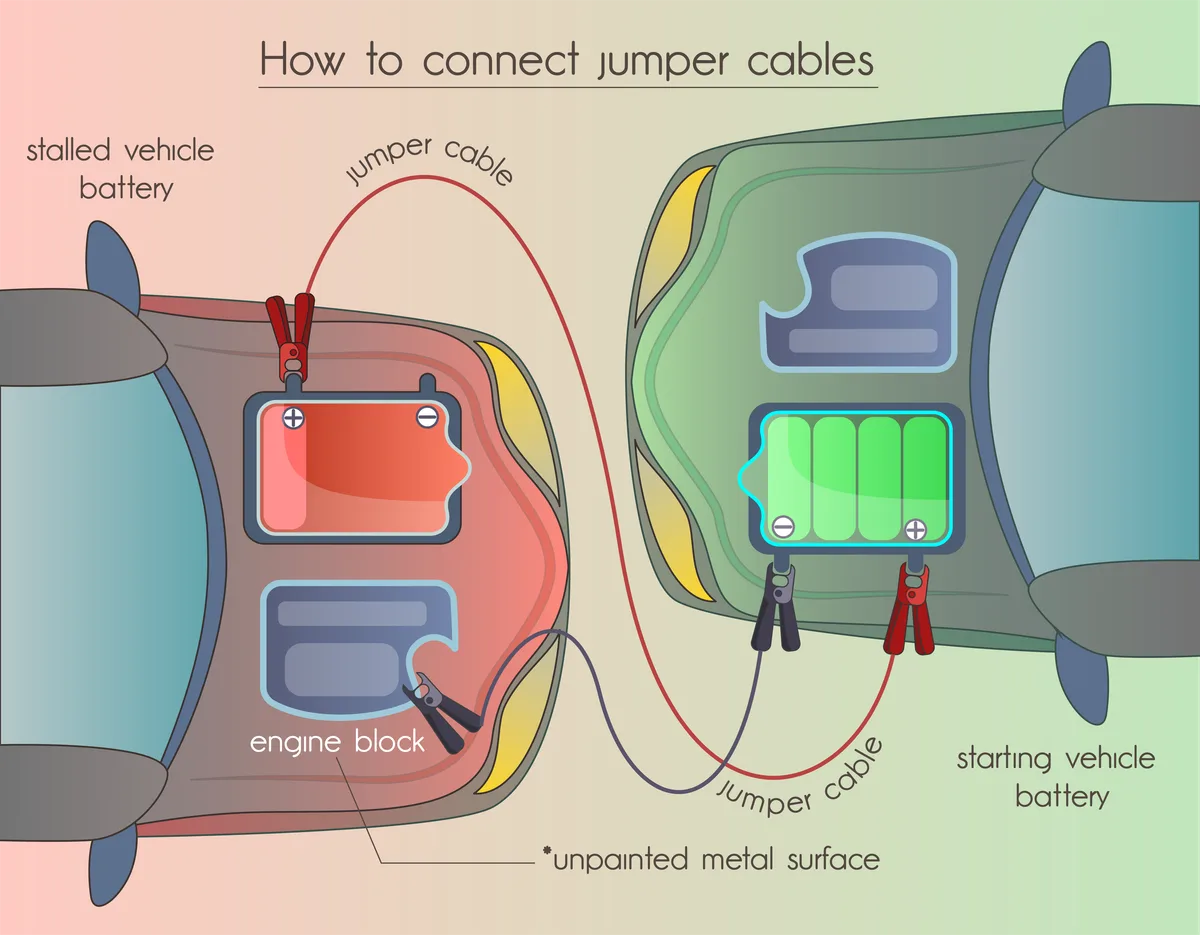
Follow this exact sequence, every time:
- Park the donor car close, but not touching. Engines off, parking brakes set, both in Park (or Neutral for manuals).
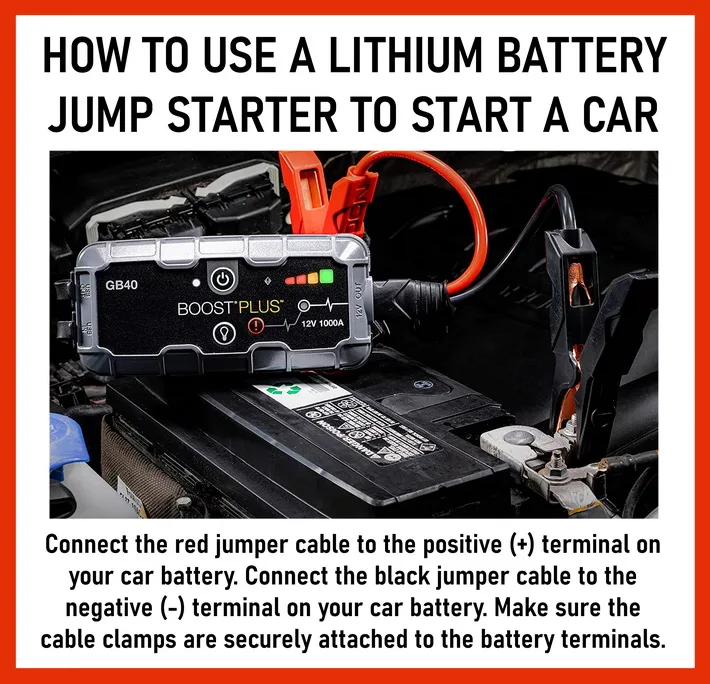
- Identify the terminals. Red positive (+) and black negative (-). On most cars, the positive post has a red cover.
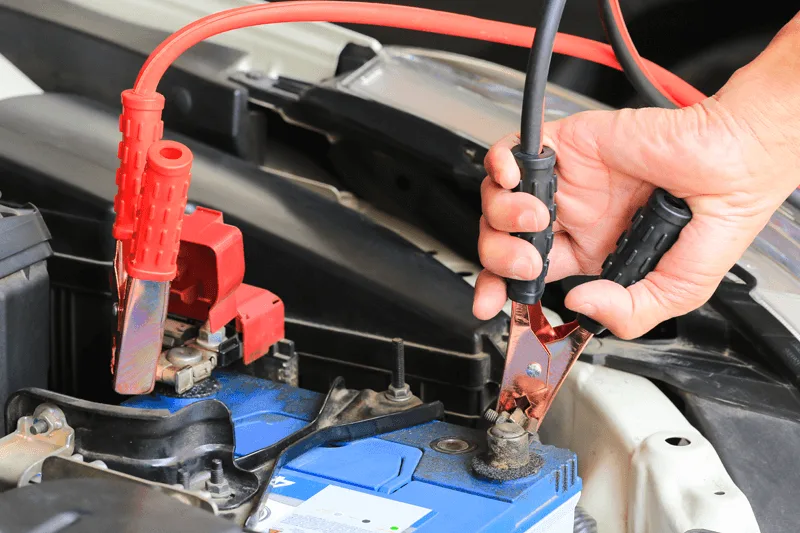
- Connect red to dead positive. First clamp goes on the dead battery's positive terminal.
- Connect red to donor positive. Second clamp goes on the donor battery's positive terminal.
- Connect black to donor negative. Third clamp goes on the donor battery's negative terminal.
- Connect black to a grounded metal surface on the dead car. Use an unpainted bracket, bolt, or engine lift point. Never the dead battery's negative post. This is the step most beginners skip, and it's the one that prevents sparks near hydrogen gas.
Disconnection Order and Post-Jump Driving
After the donor car runs for 2 to 3 minutes, try to start the dead car. If it cranks, let it idle for 5 minutes before disconnecting. Then reverse the connection order:
- Black clamp off the ground point on the dead car
- Black clamp off the donor negative
- Red clamp off the donor positive
- Red clamp off the dead positive
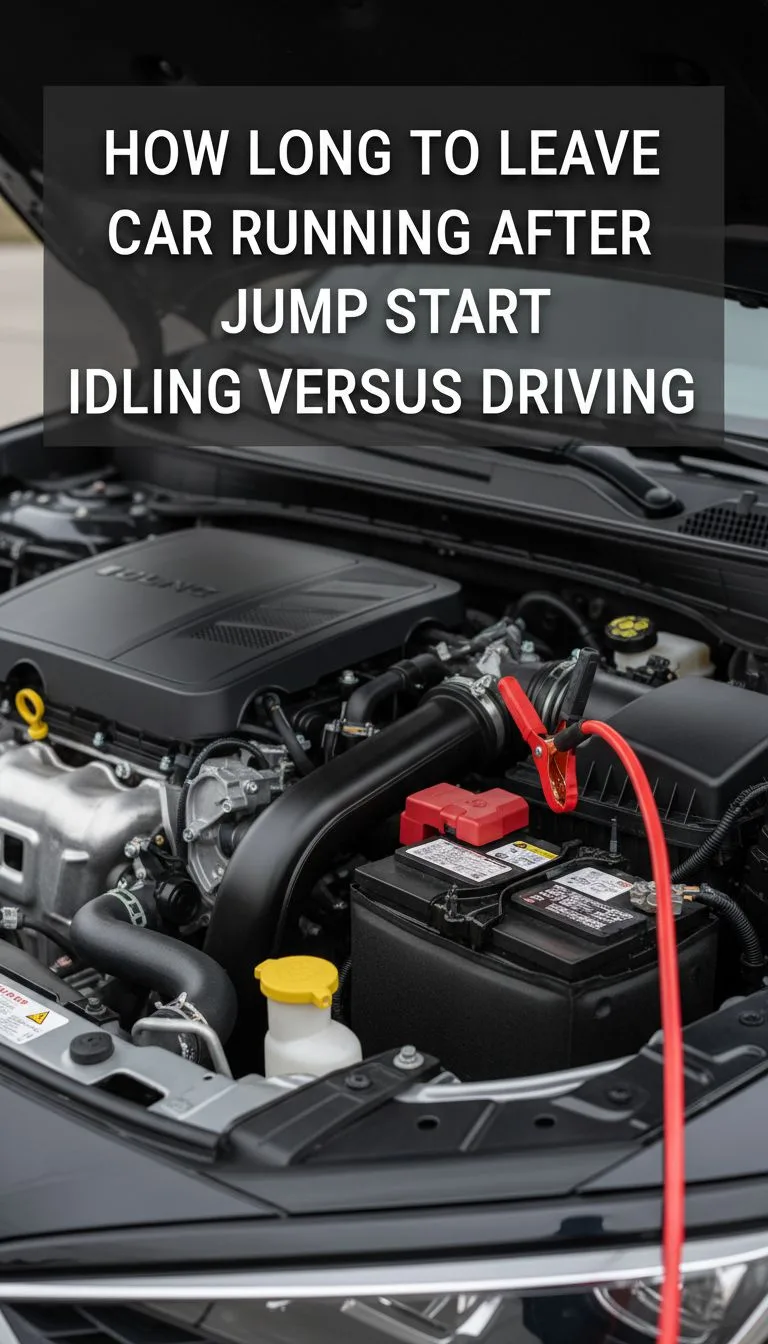
Keep the jumped car running and drive it for at least 20 to 30 minutes. A short idle isn't enough to refill a deeply discharged battery. Highway driving works best because the alternator spins faster at RPM.
Free Jump-Start Mistakes That Damage Your Car
A wrong jump can fry a $1,500 ECU, blow a fuse, or crack a battery. Here are the errors our research turns up most often in aggregate mechanic and consumer reports:
- Reversing polarity. Red on negative, black on positive is the most expensive mistake. Modern cars have reverse-polarity protection, but it's not universal.
- Last clamp on the dead negative post. Sparking near a battery vents hydrogen gas. Always use a ground point away from the battery.
- Jumping a frozen or visibly damaged battery. If the case is bulging, cracked, or leaking, do not jump it.
- Letting the donor car touch. Body-to-body contact can short both electrical systems.
- Skipping the donor engine running step. Start the donor car and let it idle a few minutes before attempting the dead car.
- Leaving keys in the ignition during hookup. Modern push-button cars can throw weird error codes if accessories cycle during hookup.
Cold-Weather Jump Starts: What Changes Below Freezing
Cold changes everything about battery behavior. According to industry testing standards like SAE J537, battery capacity drops as temperature falls, while starter motors demand more amps to turn thick cold oil.
Adjustments for cold:
- Warm the battery if you can. A hair dryer on the case for 5 minutes or a space heater aimed at the engine bay can recover usable capacity.
- Crank in short bursts. 10 seconds on, 30 seconds off. Continuous cranking overheats the starter.
- Use thicker cables. 4-gauge beats 8-gauge in cold because of less voltage drop over the run.
- Drive longer after the jump. A battery recharged from a deeply cold-discharged state needs 45+ minutes of driving.
If your battery dies below 0°F more than once, it's almost certainly due for replacement. Cold cranking amp (CCA) ratings below 600 are marginal for northern climates.
Hybrid and Start-Stop Cars: Special Rules
Hybrids have two batteries, and only one of them gets jumped. The 12-volt accessory battery (a small AGM unit) starts the computers, which then wake up the high-voltage traction battery. Jump the 12V like any normal car, but follow these rules:
- Never touch the orange cables. High-voltage hybrid systems run 200 to 650 volts and can kill.
- Jump points may be under the hood or in the trunk. Check your owner's manual. Toyota hybrids often have a dedicated jump terminal under the fuse box cover.
- Start-stop vehicles (non-hybrid with automatic engine shutoff at lights) often use AGM or EFB batteries. They're jumpable the same way, but many require battery registration after replacement.
If your hybrid's 12V is dead, the traction battery can't help, because the computers that wake it up aren't powered. A jump still works, but it's the 12V you jump, not the hybrid system.
Cost Breakdown: Free vs. Paid Jump-Start Options
Here's roughly what each path costs in 2026:
| Method | Cost to you | Typical wait |
|---|---|---|
| Stranger with cables | $0 (tip optional) | 5 to 15 minutes |
| AAA membership jump | $0 with membership, $75+ without | 30 to 60 minutes |
| Insurance roadside | $0 with coverage, $50 to $150 without | 30 to 75 minutes |
| Manufacturer complimentary | $0 during warranty period | 30 to 60 minutes |
| Push-start (manual only) | $0 | Immediate, but needs a hill or two pushers |
| Auto parts store courtesy | $0 | 5 to 20 minutes |
| Tow truck (no membership) | $75 to $200 | 30 to 90 minutes |
| Mobile mechanic jump-only | $50 to $100 | 20 to 60 minutes |
| Taxi/rideshare home | $15 to $50 | Immediate |
If you find yourself needing paid help more than once a year, a $60 to $130 AAA or insurance roadside add-on pays for itself the first time.
How Long to Drive After a Jump to Recharge the Battery
This is the question that determines whether you're stranded again tomorrow. A typical jump starts the engine, but doesn't fully recharge a deeply discharged battery. The alternator has to put back what the starter pulled out.
Drive time needed based on how dead the battery was:
| Starting voltage | Drive time to recover | Notes |
|---|---|---|
| 11.5 to 12.0V (mildly discharged) | 20 to 30 minutes | Most stop-start trips will top it off |
| 10.5 to 11.5V (deeply discharged) | 45 to 60 minutes | Highway driving recommended |
| Below 10.5V (severely discharged) | 2+ hours or a proper charger | May not hold charge at all |
If the battery dies again the next morning, stop driving on it. Continued deep discharge permanently damages lead-acid cells through sulfation. Charge it with a proper 12V maintainer overnight, or replace it.
When a Jump Start Isn't Enough (Alternator or Battery Failure Signs)
Sometimes a jump is just a band-aid. Watch for these signs that the underlying problem is bigger:
- Engine dies immediately after disconnecting the donor car. Alternator isn't charging.
- Battery dies again within hours or a day. Battery won't hold a charge.
- Dim headlights at idle that brighten when you rev the engine. Classic alternator failure pattern.
- Battery is more than 4 years old and dies in moderate weather. Likely end-of-life.
- Sulfur or rotten-egg smell under the hood. Battery is overcharging or internally shorted.
A free diagnostic at AutoZone, O'Reilly, or Advance Auto Parts can test both your battery and alternator in about 10 minutes. They'll print a CCA reading and a pass/fail on the charging system.
Battery Replacement on Warranty or for Free
If your battery is the problem and it's under 3 years old, you may not pay a cent:
- Manufacturer warranty. Most car batteries carry 2 to 4 year full replacement warranties (Prorated after). Interstate, Optima, DieHard, and OEM batteries all honor this at any of their dealers.
- Costco / Sam's Club. Both install Interstate batteries free with purchase, and the warranty is honored at any Costco location.
- Auto parts store core exchange. A $18 to $25 core deposit is refunded when you bring the old battery back.
- Free installation comes with most retail battery purchases at AutoZone, O'Reilly, Advance, Walmart, and Costco.
If you're stranded and need a battery right now, many of these stores will deliver and install within an hour for a small fee, or even free with purchase above a threshold.
Final Decision Guide: Which Free Method Is Right for You
Start at the top of this list and stop at the first one that fits your situation:
- You're in a populated area, daylight, and another car is visible → Flag a stranger. Fastest.
- You drive a manual transmission and have one or two helpers → Push-start it. Zero wait.
- You're near an AutoZone, O'Reilly, or Advance Auto Parts → Walk over. They'll jump you for free in 5 minutes.
- You have AAA, insurance roadside, or a manufacturer program → Call the app. They'll come to you.
- None of the above apply → Call a non-emergency friend or family member with cables.
Save the paid tow as your absolute last resort. In most regions, you can get a free jump within an hour using one of the methods above.
Frequently Asked Questions
How do you jump start a car without jumper cables?
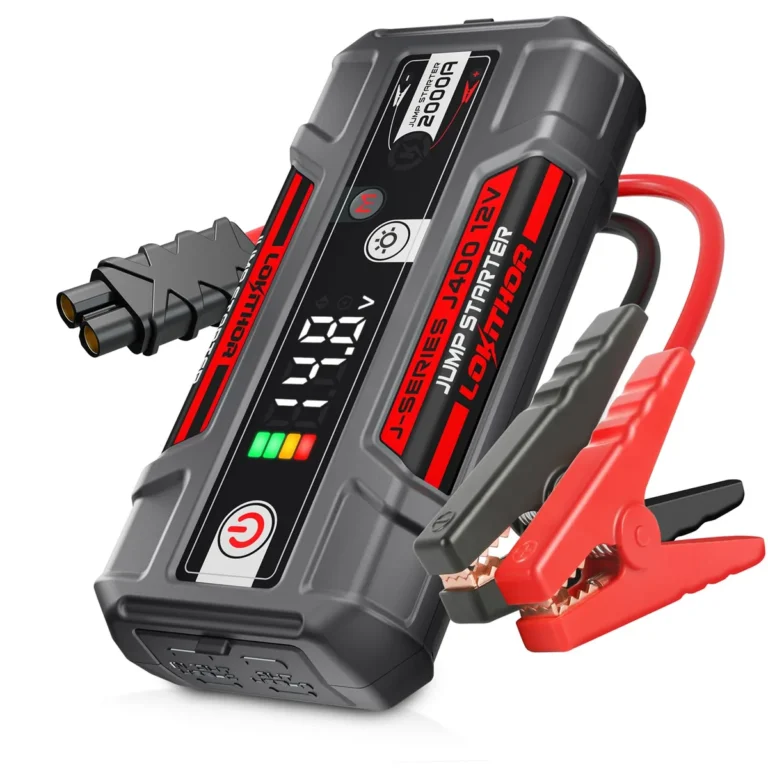
You can push-start a manual transmission car (need a hill or two helpers), use a portable lithium jump starter if you have one, or call roadside assistance. Some auto parts stores will come to you and jump your car with their own cables for free.
Can AutoZone jump start my car?
Yes. AutoZone, O'Reilly Auto Parts, and Advance Auto Parts will jump start your car in their parking lot for free as a courtesy, even if you don't buy anything. They'll also test your battery and alternator at no charge.
Does AAA jump start for free?
AAA Classic, Plus, and Premier memberships all include free jump-starts as part of the standard roadside service. You only pay if you're not a member, and even then, AAA offers a single-use option at a reduced rate.
How long do you need to drive after a jump start?
Drive for at least 20 to 30 minutes after a jump to let the alternator recharge the battery. If the battery was deeply discharged (below 11.5V), drive 45 to 60 minutes or use a 12V battery maintainer overnight. Stop-start city driving may not fully recover a deeply drained battery.
Can a dead battery ruin your alternator?
Yes. A severely discharged battery can pull excessive current from the alternator as it tries to recharge, overheating the alternator's diodes. If your battery keeps dying and you're jump-starting repeatedly, the alternator can fail prematurely.
Replace the battery as soon as possible.
Is it safe to jump start a car in the rain?
Light rain is fine. The 12V automotive system runs at safe voltage levels, and cables are insulated. Just keep the connection points clean and dry, and avoid standing in pooled water while connecting.
Heavy rain can be skipped in favor of waiting for better conditions or calling roadside service.