How to jumpstart a car using a jump starter
A dead battery never shows up at a good time. You turn the key, hear a click, and the whole day tilts on its side. Knowing how to jumpstart a car using a jump starter turns that moment from a crisis into a five-minute fix you handle yourself.
The good news is the process is straightforward once you respect the sequence. Modern portable lithium jump packs typically deliver 800 to 2000 peak amps from a unit smaller than a paperback book, and they're built around safety standards like UL 2743 that govern spark-proof clamps and reverse-polarity protection. As of 2026, every reputable unit on the market includes that circuitry, so the risk is less about the gear and more about getting the order of operations right.
Quick Answer
A portable jump starter powers a dead car battery through heavy-duty clamps in a strict sequence. Power off the unit, connect red to the dead battery's positive (+) terminal, then connect black to a clean metal ground away from the battery. Power the jump starter on, crank the engine for up to 5 seconds, and disconnect in reverse order.
Why the Right Jump-Start Order Matters
The order isn't a formality. It's the difference between a clean start and a fried ECU, a blown internal fuse, or a battery that pops its top from hydrogen gas igniting near a spark. Lead-acid batteries vent hydrogen continuously, especially when discharged, and a single clamp slip can ignite it.
Modern vehicles run sensitive electronics that don't tolerate voltage spikes. A reverse-polarity hookup can push current backward through circuits designed to only receive it. That's where reverse-polarity protection earns its keep, but only if the unit actually has it and it's working.
The right order also protects the jump starter itself. Lithium cells in a jump pack degrade if you crank an engine that's mechanically bad for too long. Knowing when to stop trying matters as much as knowing how to start.
Check Your Jump Starter First (Charge, Clamps, Mode)
Before you walk to the car, look at the pack in your hand. Aggregate user reviews consistently report one failure mode above all others: people grabbed a jump starter that hadn't been topped off since last winter. A pack sitting at 30% won't crank a V8 in January.
Charge Level
Most lithium jump starters show charge state through 3 to 5 LED bars or a small percentage display. You want at least 50% for a confident start on a typical 4-cylinder, and 75% or more for a V6 or V8. Below that, voltage sag under cranking load can drop the pack below its protection threshold and shut it down mid-crank.
Clamp Condition
Open the clamp jaws and look at the copper teeth. Watch for green corrosion, bent jaws, frayed cable insulation near the hinge, or loose pins where the cable meets the clamp. A clamp that doesn't bite firmly will arc under load, which generates heat and can weld itself to the terminal.
Mode Switch and Indicators
Many jump starters have a "Force" or "Override" mode for batteries that read below a normal voltage floor. Leave it off until you know you need it. Standard mode is safer and works on the vast majority of dead-but-not-deeply-discharged batteries.
A 60-second pre-check saves you from kneeling in a parking lot with a dead pack and a half-connected car.
Inspect the Car Battery Before You Clamp Anything
The battery tells you a lot before you touch a clamp. A two-minute inspection can reveal problems that make jumping unsafe or futile.
Visual Checks
Pop the hood and look at the battery directly. Watch for cracks, swelling, heavy corrosion, frost, or loose terminal covers.
A cracked or swollen battery is unsafe to jump. Stop and call for service. A frozen battery is also a hard stop.
Jumping a frozen battery can crack the case internally and vent acid when current flows. Let it thaw fully at room temperature first.
Identifying the Terminals
The positive terminal is marked with a plus sign (+) and a red cap or ring. The negative terminal has a minus sign (−) and a black cap or ring. If markings are worn off, follow the thick cable.
The positive side typically runs to the starter or fuse box, while the negative side bolts to the chassis or engine block.

Choosing the Right Ground Point
Where you connect the negative clamp matters more than most guides admit. A remote ground point is safer than the battery's negative terminal.
The negative terminal is a spark risk. Even a "dead" battery holds residual charge, and hydrogen gas vents from the vent caps on most flooded lead-acid batteries. A spark at the negative post can ignite that gas.
Moving the connection to a remote ground point puts the spark well away from the battery.
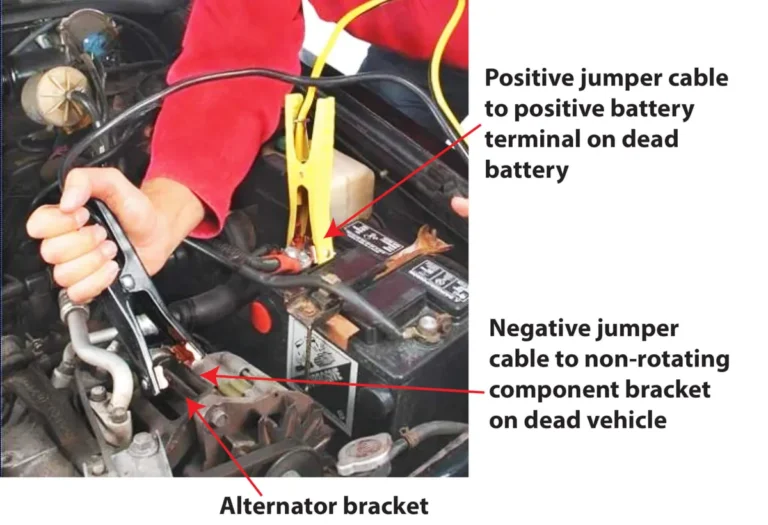
You're looking for three qualities in a ground point: unpainted, bare metal; a solid, stationary part of the engine or chassis; and a spot clear of belts, fans, and hot exhaust. Common picks include the engine lifting bracket, a bolt on the engine block, or the alternator bracket.
Avoid the fuel lines, throttle body, moving accessories like the A/C compressor bracket, and painted surfaces. Per SAE J1495 guidance for traditional jump starting, a ground point away from the battery is preferred for the same reason.

How a Portable Jump Starter Works
A portable jump starter is a compact lithium battery with smart wiring and heavy-duty clamps. It stores energy the same way your phone does, then dumps it in a controlled burst when you need it.
Lithium iron phosphate (LiFePO4) or lithium-ion cells sit in a 3S or 4S configuration. The pack's internal circuitry steps that up to the 12V your car's electrical system expects. A battery management system (BMS) watches voltage, current, and temperature on every cell and shuts the pack down if anything drifts out of safe range.
The clamps are rated for hundreds of amps of inrush current. Most modern clamps include reverse-polarity protection, spark suppression, and a microcontroller that only allows current to flow once it confirms a valid connection. If you clamp red to negative and black to positive, nothing happens, and you get an LED warning.
Step-by-Step: How to Jumpstart a Car Using a Jump Starter
Phase 1: Prep (60 Seconds)
- Park the car in Park or Neutral with the parking brake set.
- Turn off headlights, HVAC, radio, and any plugged-in accessories.
- Remove the key from the ignition.
- Confirm the jump starter is powered off before clamping.
Phase 2: Connect (90 Seconds)
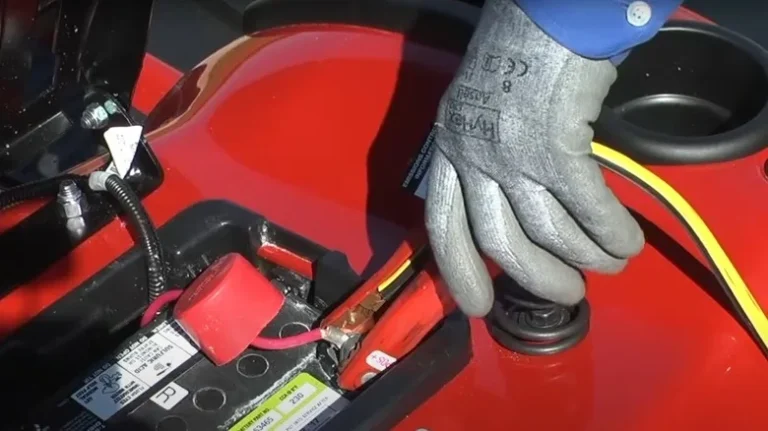
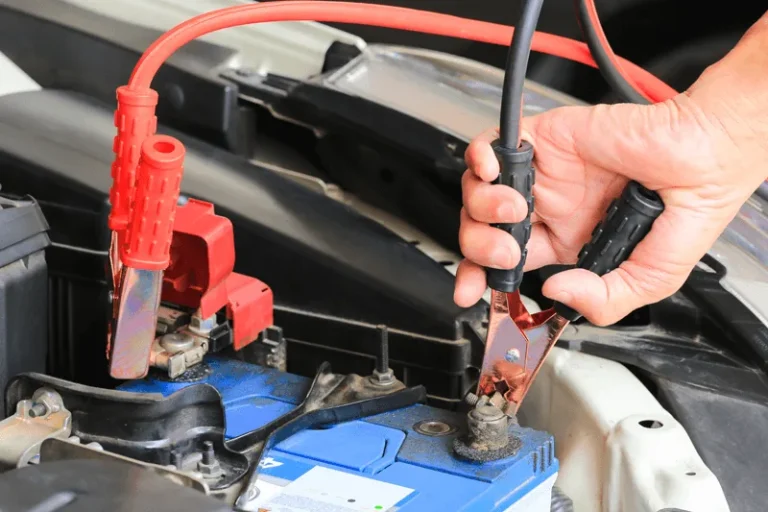
- Connect the red clamp to the dead battery's positive (+) terminal.
- Connect the black clamp to a clean, unpainted metal ground point.
- Verify polarity one more time. Red to plus. Black to ground.
- Power on the jump starter.
Phase 3: Crank
- Turn the key or press the start button.
- Crank for up to 5 seconds.
- If the engine doesn't fire, wait 30 to 60 seconds and try again.
- Don't exceed 3 to 4 crank attempts in a row.
Phase 4: Disconnect
- Leave the engine idling.
- Power off the jump starter.
- Disconnect the black clamp from the ground point first.
- Disconnect the red clamp from the positive terminal.
- Store the jump starter.
Phase 5: Recharge the Car's Battery
- Let the car idle for 15 to 20 minutes, or drive for 30+ minutes.
- Avoid shutting off the engine until the alternator has put real time on it.
- If the car won't restart after this, the battery is likely failed.
| Step | Action | Time Limit |
|---|---|---|
| Connect clamps | Red to +, black to ground | 90 sec |
| Crank | Turn key or press start | 5 sec per try |
| Rest between tries | Pause | 30 to 60 sec |
| Disconnect | Black first, then red | 30 sec |
| Recharge car | Idle or drive | 15 to 30 min |
The actual cranking is the shortest part of the whole sequence.
Cranking Procedure: How Long, How Often, When to Stop
Per SAE J1495 standard guidance, no single crank should exceed 10 seconds. For jump pack use, 5 seconds is the safer practical ceiling.
Between cranks, give the jump pack at least 30 to 60 seconds to recover voltage internally. Lithium cells rebound fast compared to lead-acid, but they still sag under load.
Three failed crank attempts in a row means the problem isn't the battery. Continuing to crank can drain the jump pack, overheat the starter, or mask a real issue. Common non-battery causes include fuel issues, ignition problems, mechanical failure, or immobilizer lockout.
Disconnecting the Jump Starter Safely
The order is exact: black clamp first, then red. If you reverse it, you risk a spark at the positive terminal near hydrogen vents.
Keep the clamps from touching each other or any metal surface after removal. A momentary short can blow the unit's internal fuse or trip protection.
Power off the jump starter before storage. Some units stay in a low-current "ready" state that slowly drains the battery over weeks.
Jumpstarting in Cold Weather
Cold cuts lithium capacity hard. A pack that delivers 1500 peak amps at 70°F may only put out 900 to 1000 at 0°F. That's chemistry, not a defect.
Pre-warm the jump starter indoors before walking outside. Use the highest-capacity pack you own. Expect a longer crank or two attempts before the engine fires.
A frozen battery is a separate problem. Water inside expands as it freezes, cracking the case. Jumping a frozen battery can rupture it, leak acid, or cause a small explosion.
Bring the battery inside to thaw or wait for a warm day.
Jumpstarting Diesels, Trucks, and Larger Engines
Diesels demand more cranking amps because they have higher compression ratios. A 6.7L Power Stroke or 6.6L Duramax can draw 800 to 1000 amps during cold cranking. A pocket-sized 1000-amp jump pack won't cut it.
For diesel trucks, you want a heavy-duty jump box with at least 3000 peak amps. Many compact lithium packs are only rated up to 3.0L diesel, which excludes most half-ton and three-quarter-ton pickups.
Glow plugs add a pre-crank current draw. Turn the key to "on" for 10 to 15 seconds before cranking. The dash "Wait to Start" light tells you when it's ready.
Jumpstarting AGM, EFB, and Start-Stop Vehicles
AGM (absorbed glass mat) and EFB (enhanced flooded battery) batteries are common in vehicles with start-stop systems. They jump the same way as flooded batteries but tolerate the process better.
A successful jump often clears start-stop warnings after a drive cycle, but a battery that's too far gone may need replacement to restore full function.
Jumpstarting Hybrid and Start-Stop Systems (What Changes)
Hybrid vehicles still use a 12V battery to power computers, lights, and accessories. If the 12V battery dies, the car won't wake up. You jump the 12V posts the same way as a conventional car.
Many hybrids hide the 12V battery under the rear cargo floor or behind a side panel. Some expose dedicated jump-start terminals under the hood. Check the owner's manual before you start.
Never touch the high-voltage orange cables on a hybrid powertrain. They're typically 200V or higher.
Common Mistakes That Damage the Jump Starter or Car
Reverse polarity: Red to negative, black to positive. The protection circuit may save you, or it may not.
Cranking too long: 5 seconds max per attempt. Sustained high-draw cranking stresses both the starter motor and the jump pack's cells.
Skipping the ground point: Going black to the negative battery post works, but it's the sparkiest spot on the car.
Loose clamps: A clamp that wiggles isn't conducting. Tighten it until it bites firmly.
Jumping a frozen or cracked battery: Don't. The acid leak and explosion risk aren't worth it.
Using a pack that's too small: A 400-amp pack can't crank a 5.7L Hemi. Match the pack to the engine.
Leaving the jump pack connected after the engine fires: Disconnect once the alternator is doing the work.
Forgetting to recharge the jump pack: Top it off after every use.
Safety Rules: Hydrogen Gas, Reverse Polarity, and Sparks
UL 2743, the standard governing portable lithium jump starters, requires reverse-polarity protection on all compliant units. Look for the UL mark on the unit or in the documentation.
No smoking, no open flames, no grinding or welding near the battery. The spark from a clamp connection is the most common ignition source for hydrogen gas.
Sulfuric acid from a cracked battery can cause serious burns. Safety glasses and gloves are cheap insurance. Battery Council International guidance treats PPE as mandatory for service work.
Even sealed batteries vent under fault conditions. A well-ventilated work area lets any leaked gas dissipate. Run the engine only in open or ventilated spaces to avoid carbon monoxide buildup.
Recharging and Storing Your Jump Starter
Plug it in as soon as you're home. Most lithium packs take 3 to 6 hours from a wall outlet, or 1 to 2 hours from a USB-C PD source.
Even unused, lithium packs lose a few percent per month through the BMS. A top-up every 90 to 180 days keeps cells healthy.
Store at room temperature. A climate-controlled closet or workbench is ideal. Most manufacturers recommend storing at 50 to 80% charge, not full.
A well-maintained lithium jump starter delivers 500 to 1000 cycles over its service life. A neglected one delivers 100.
Jump Starter vs. Jumper Cables vs. Roadside Service
| Option | Best For | Time to Resolve |
|---|---|---|
| Portable jump starter | Solo drivers, frequent travelers | 5 minutes |
| Jumper cables | Two-car households, rural areas | 10 to 15 minutes |
| Roadside service | Non-battery issues, towing needs | 30 to 90 minutes |
A jump starter is the right call for the common dead-battery case. Jumper cables are a backup. Roadside service is the safety net for situations beyond a flat battery.
Choosing the Right Jump Starter
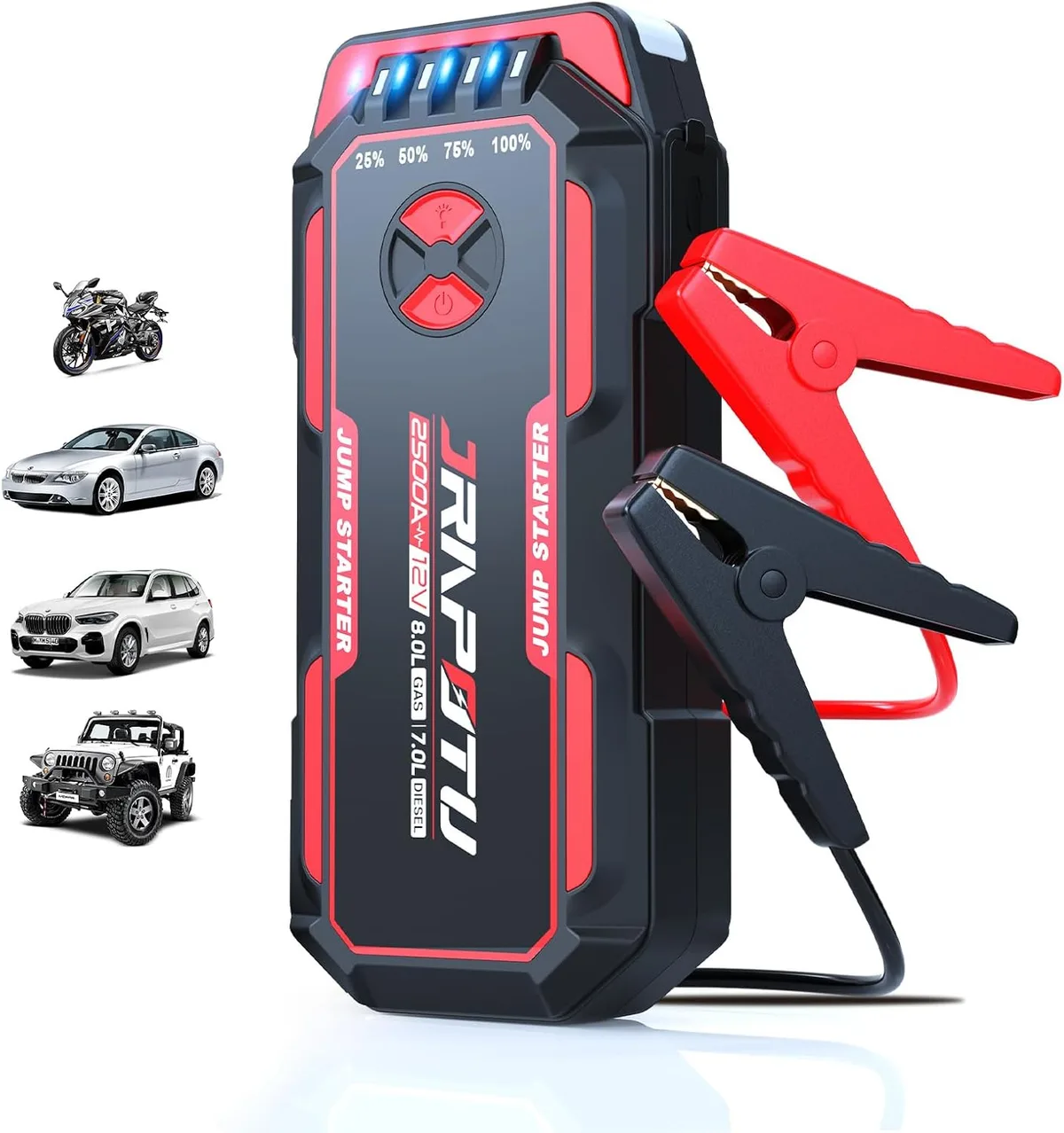
Match peak amps to your largest engine. 1000 to 1500 peak amps covers most 4-cylinder and small V6 vehicles. 2000 to 3000 covers most V8 gas engines. 4000+ is the floor for diesel trucks.
LiFePO4 packs last longer and handle temperature extremes better than standard lithium-ion. Look for the UL 2743 mark. If you live below freezing, look for packs rated to operate at −20°C (−4°F).
Pick the features you'll actually use. USB outputs turn the jump pack into a phone or laptop charger. Built-in flashlights help at night.
Pro Tips From Roadside Technicians
Top off monthly in winter. Cold-weather users who recharge their pack every month rarely get caught flat.
Label your clamps. Red tape on red, black tape on black. This speeds up the connection in low light and prevents polarity mistakes.
Keep it in the car, not the house. A jump starter in your closet doesn't help in a parking lot.
Test it on a healthy battery first. The first time you use a jump pack shouldn't be on a dead battery in a storm.
Buy one step up. The price difference between a 1500A and a 2500A pack is small, and the headroom pays off the first time you need to jump something bigger than you planned.
What to Do If the Engine Still Won't Start
You've done everything right, and the engine still won't fire. Don't panic, and don't keep cranking.
Quick Diagnostic Tree
- Fast clicking, no crank: Battery still too weak, or ground connection poor. Try one more crank after tightening clamps.
- Single click, no crank: Possible bad starter solenoid or starter motor. The jump worked, but the starter isn't engaging.
- No sound at all: Loose clamp, dead jump pack, or bad ground. Recheck connections.
- Cranks normally but doesn't fire: Fuel, spark, or immobilizer problem. The jump did its job; the problem is elsewhere.
- Cranks slowly and dies: Alternator may have failed, or battery is so dead it can't sustain the starter.
If nothing works after three attempts, call roadside assistance. You've reached the limit of what a portable jump starter can do.
What to Do If Your Jump Starter Won't Work
No LED response means the pack is fully discharged or the power button is broken. Try a different charging cable and plug it in for 30 minutes. If still nothing, the internal BMS may have tripped.
LEDs on but no current delivery usually means reverse polarity detected or a voltage mismatch. Recheck both clamps.
Pack beeps or flashes an error: Most units flash an error pattern matched to a code in the manual. Common ones include reverse polarity, over-temperature, short circuit, or low pack voltage.
Pack cranks once then shuts off: Cell voltage sag tripped the protection circuit. The pack is too low for the engine size.
If the car clicks but doesn't crank after a clean connection, the problem is the starter, not the pack.
Frequently Asked Questions
How long does it take to jumpstart a car with a portable jump starter?
The actual cranking takes 5 seconds or less if the battery is just discharged. The full procedure takes 5 to 10 minutes for a first-timer and under 5 minutes once you've done it a few times.
Can you jumpstart a car with a dead battery using a jump starter?
Yes, that's exactly what jump starters are built for. A deeply discharged battery may need a second crank attempt after a 60-second rest, and the jump pack should have at least 50% charge.
Is it safe to jumpstart a car in the rain?
Light rain is fine. The voltage involved (12V DC) isn't dangerous to humans, and modern jump starters are sealed against splashing. Heavy rain or standing water is a different matter; wait for a sheltered spot.
How many times can you jumpstart a car with one jump starter charge?
Most lithium jump starters rated 1000 to 2000 peak amps deliver 10 to 40 jump-starts per charge. A small 4-cylinder may take 30 jumps, while a large V8 diesel may only get 5 to 8.
Can a jump starter damage a car's computer or ECU?
Reverse polarity or a voltage spike from incorrect use can. Following the correct clamp order and using a UL 2743-certified unit with reverse-polarity protection virtually eliminates that risk.
Do I need to replace my car battery after a jump start?
Not necessarily. If the car starts easily and restarts after sitting, the battery is probably fine. If it struggles to restart after a 30-minute drive, the battery is likely failing and should be load-tested at an auto parts store.
Can I take a lithium jump starter on a plane?
Per FAA PackSafe guidance, lithium battery jump starters under 100 watt-hours are allowed in carry-on luggage only. Units between 100 and 160 watt-hours require airline approval. Always check the watt-hour rating on the unit's label before flying.
Final Recommendation
Buy a quality jump starter matched to your engine, keep it charged, learn the clamp order once, and a dead battery becomes a five-minute inconvenience instead of a stranded afternoon. The five-minute investment pays off the first time you avoid a tow truck wait.