What is jump start mtg: The complete guide
If you've typed "what is jump start mtg" into a search bar, you've probably already hit the wall everyone hits. The word means two completely different things in Magic, and Wizards of the Coast doesn't exactly shout about the difference. One is a rules keyword printed on individual cards.
The other is a stand-alone tabletop product line sold in booster boxes. Both are popular, both are still in print, and confusing them is the single biggest reason players end up with the wrong expectation at the table.
As of 2026, Jumpstart has shipped in three retail waves (2020, 2022, and the Jumpstart: Historic Horizons digital release on MTG Arena). The Jump-Start rules keyword appears on dozens of cards across Standard, Pioneer, and Modern. Below, we'll break the whole thing apart, starting with the mechanic on the card, then opening up the booster product, so you walk away knowing exactly which one your playgroup keeps asking about.

Quick Answer
Jump-Start in Magic: The Gathering is a rules keyword on instants and sorceries. It lets you cast the card from your graveyard by discarding a card and paying a reduced mana cost.
Jump-Start is a one-shot, single-use alternate casting option, not a free spell.
It's printed on cards like Chandra's Embercat and Magma Opus, and has no relation to the Jumpstart booster product line.
Jumpstart (one word) is a preconstructed booster product line sold by Wizards of the Coast since 2020.
The Two Things "Jump-Start" Refers To (Don't Mix These Up)
This is the core confusion, so let's clear it once and for all.
The first thing, "Jump-Start" (hyphenated), is a rules keyword. It's text on a card that gives you an alternate casting option. You'll see it on instants and sorceries like Chandra's Embercat, Draconic Intervention, and Tibalt's Rager.
The card has one normal casting cost and one Jump-Start cost printed right below the rules text.
The second thing, "Jumpstart" (no hyphen), is a physical product Wizards of the Coast first released in 2020. Each Jumpstart booster is a self-themed half-deck of 20 cards. You open two boosters, shuffle them together, and play.
No deckbuilding, no drafting, no fuss.
Both are excellent. Both are beginner-friendly. But if you buy the product expecting a rules keyword, or read a mechanic on a card expecting a booster box, you'll be deeply confused.
From here on, we'll treat them in order: the mechanic first, the product second.
Quick ID Cheat
- Card mechanic: hyphenated "Jump-Start." Lives on instants and sorceries. Often red, occasionally multicolored.
- Product line: "Jumpstart" as one word. Sold in booster boxes of 24 packs. Designed for 1v1 or two-player free-for-all.
The Rules Mechanic: How Jump-Start Works on a Card
Jump-Start reads, in plain English, something like: "You may cast this card from your graveyard by discarding a card and paying its mana cost minus [X]." You can only do it if the card is in your graveyard, you can only do it at the speed the card normally has (sorcery timing for sorceries, instant timing for instants), and you can only do it once per card.
That last bit is critical. Jump-Start is not Flashback. Flashback gives you an alternate cost with no discard attached, and it tends to be more flexible in mana cost.
Jump-Start, in exchange for being usable as a normal spell first, asks you to jump through hoops: put the card in your yard, discard a card to your yard, then pay a discounted mana cost.
A few corner cases worth flagging:
- Timing: Sorceries with Jump-Start can still only be cast at sorcery speed, even from the graveyard. Instants keep instant speed.
- One-shot: Once you cast it from the graveyard via Jump-Start, the card exiles itself. You can't re-Jump-Start the same card twice.
- No copy from graveyard: Cards like Kiki-Jiki or Lutri can't copy a Jump-Start spell from the yard. The cast still happens, but the rules treat it as an alternate cast, not a re-cast of the spell.

Reading a Jump-Start Spell Step by Step
- Check the card type. Jump-Start appears on instants and sorceries. Planeswalkers, creatures, and artifacts don't get it.
- Read the Jump-Start reminder text. It'll show the mana cost minus a number, plus the requirement to discard a card.
- Confirm it's in your graveyard. The card must have hit the bin through normal play first.
- Declare you're using Jump-Start. This is a separate decision from casting the card normally. Choose at the moment you cast it.
- Discard a card to your graveyard. Any one card from your hand.
- Pay the discounted mana cost. The "minus X" cost. If you can't, you can't use Jump-Start this time.
- The spell resolves as written. The card exiles after it resolves.
Reading a Jump-Start Spell (Cost, Timing, Restrictions)
Jump-Start reads as a templated ability, so most cards follow the same shape. The template goes: "Jump-Start, [cost]." That [cost] is the second cast path. The first path is the normal mana cost at the top-left of the card.
What the Discount Looks Like in Practice
| Card | Mana Cost | Jump-Start Cost |
|---|---|---|
| Chandra's Embercat | 1R | Discard a card, then R |
| Tibalt's Rager | 1R | Discard a card, then R |
| Draconic Intervention | 3W | Discard a card, then 1W |
| Magma Opus | 3UR | Discard a card, then 1UR |
Notice the pattern: Jump-Start is usually 2 generic mana cheaper than the regular cost, plus a card discard. That discount is consistent across most Jump-Start cards, so when you see a new one, you can roughly guess the alternate cost without re-reading.
Three Hard Restrictions
- Graveyard required. You cannot Jump-Start from your hand or library.
- One use per card. Cast it from the graveyard once and it exiles.
- Same speed as original. Instants stay instant-speed, sorceries stay sorcery-speed, even from the graveyard.
Players regularly ask if Jump-Start works in the first couple of turns. The answer is almost always no, because the card has to hit the graveyard first, which requires either self-mill, a discard outlet, or a death trigger.
Why Jump-Start Demands a Graveyard (and How to Feed It)
Jump-Start doesn't put the spell in your graveyard for you. That has to happen through normal Magic first. Cards get there through several common routes:
- Self-mill. Cards like Faithless Looting (when it was legal), Thirst for Discovery, or any "look at the top X, put them in your graveyard" effect.
- Discard outlets. Anything that lets you discard for value, like Liliana of the Veil, or even a cheap loot spell.
- Death triggers. Your own creatures dying, or your opponent's removal spells hitting your yard-bound threats.
- Your opponent's spells. Hand disruption like Thoughtseize forces the discarded card into the graveyard, where it can later be cast if it has the mechanic.
The graveyard requirement is also the reason Jump-Start is much stronger in formats with cheap looting and self-mill. In Pioneer, decks like Izzet Phoenix and Rakdos Midrange use Jump-Start cards as value engines precisely because they already fill the graveyard for other reasons.
Practical Tip on Feeding the Graveyard
Don't build a deck with only Jump-Start spells and expect them to function. Pair them with at least four self-milling or looting effects. The graveyard is the second resource, and without it, the discount is just stranded text.
Best Jump-Start Cards Worth Knowing
Jump-Start has shown up on dozens of cards since its debut. A few have become real format players. Others are casual kitchen-table fun.
Here's the short list worth memorizing.
Cards That See Competitive Play
- Chandra's Embercat. Cheap red creature-side enabler. Often used in burn and prowess shells that want a 1-drop with upside.
- Draconic Intervention. White spot removal that recurs. Pioneer sideboards occasionally run this for control mirrors.
- Magma Opus. High-cost, high-impact sorcery. Strong in slower Izzet shells where casting it twice is realistic.
- Ox of Agonas. Creature that draws and discards when it dies. While it doesn't have Jump-Start itself, it pairs with them in rakdos midrange decks.
- Hidetsugu Consumes All. A two-for-one sweeper-discard hybrid in Rakdos colors. Cast it twice and you've torn a hand apart.
Cards Built for Casual Tables
- Tibalt's Rager. Cheap red creature that pings when discarded. Great for casual red decks that want pressure and reach.
- Repeated playable sorceries with Jump-Start. Look for anything in your collection with the text on it. The mechanic is balanced for casual play, so even the "bad" ones are fun.
How to Spot a Good Jump-Start Card
A useful Jump-Start card has three traits. The front-half (normal cast) is already reasonable. The back-half (Jump-Start) solves a problem your deck has.
The discount on Jump-Start is significant enough to matter. If any of those three legs is weak, the card is usually a casual-only pick.
Jumpstart the Product: What Comes in a Booster Pack
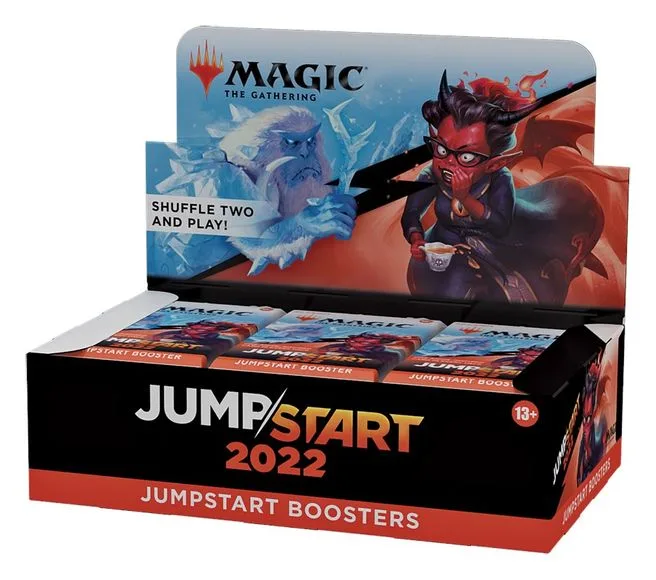
Now the second half of the keyword. Jumpstart (one word) is a tabletop product line first sold by Wizards of the Coast in 2020. Each booster contains a 20-card themed half-deck.
You and your opponent (or teammate) open two boosters, shuffle them together, and play.
What's in Each Booster
| Component | Notes |
|---|---|
| 20 cards total | Pre-selected theme |
| 1-2 rares or mythics | Slot depends on theme |
| Lands included | Typically 4-5 basic lands |
| 20-card sleeve-friendly size | Designed to pair with another booster |
The 2020 release contained 121 different themes. Jumpstart 2022 reprinted most of them, with five-color themes added for variety. Both retail products remain widely available as of 2026, though secondary market prices on certain themes have crept up because of individual chase rares.
How the Pairs Work
Each theme is designed to function as a self-contained half-deck. Open a "Dragons" booster, and you'll get a curve of red and colorless dragon-flavored cards. Pair it with "Phyrexians" and you have a 40-card Mardu-ish battle.
The system is brilliant for new players who don't yet know how to build a mana curve.
Why Players Like It
Jumpstart removes the three biggest barriers to a first night of Magic: deckbuilding, mana bases, and rulebook intimidation. You open, you shuffle, you play. Most booster pairs produce a coherent 40-card deck that plays like a real Limited deck without the seven-round tournament commitment.
Reprint and Rotation Note
Themes printed in 2020 Jumpstart are not Standard-legal. They are designed for casual play. Jumpstart 2022 reprints are likewise casual-only.
If you want to use the cards in constructed formats, only the individual cards' own format legality applies, not the Jumpstart format.
Jumpstart vs. Commander Precons vs. Challenger Decks vs. Draft
Jumpstart is one of several "open and play" entry points Wizards sells. Each serves a different kind of player.
| Product | Best For | Game Length | Power Level |
|---|---|---|---|
| Jumpstart booster | First-night players, family games | 15-25 min | Casual |
| Commander Precon | Multiplayer, long games | 45-90 min | Casual to mid |
| Challenger Deck | FNM and competitive players | 20-30 min | High |
| Draft / Sealed | Booster-drafting players | 60 min + | Format-dependent |
Jumpstart wins on speed and accessibility. Commander wins on social play and replay value. Challenger decks win on competitive ready-out-of-the-box performance.
Draft wins on the actual Limited experience.
Who Each Is Right For
- Jumpstart is right for a household of two or three players who want a quick game after dinner, or for a parent introducing a kid to Magic without the rulebook shock.
- Commander precons are right for groups that want multiplayer and don't mind 60+ minute games.
- Challenger decks are right for players who want to walk into Friday Night Magic and compete without brewing.
- Draft and Sealed are right for players who like the puzzle of building from random boosters.
Jumpstart on MTG Arena vs. Paper Magic
Wizards launched a digital Jumpstart format on MTG Arena in 2021 with Jumpstart: Historic Horizons, a 46-theme, 738-card release designed for Historic play. Players queue into the format on Arena, get two random half-decks, and play best-of-one or best-of-three matches.
Key Differences
| Feature | Paper Jumpstart | Arena Jumpstart |
|---|---|---|
| Themes available | 121 themes (2020), 121 (2022) | 46 themes (Historic Horizons) |
| Format legality | Casual only | Historic ranked and casual |
| Replay value | High | Lower (theme pool is smaller) |
| Current availability (2026) | Yes, both retail boxes | Removed from Arena client in 2023 |
Players still ask whether they can play Arena Jumpstart in 2026. Per Wizards of the Coast support pages, the original Jumpstart: Historic Horizons event was removed from the Arena client during the 2023 client update, though the cards themselves remain legal in Historic. Some third-party Jumpstart-style events have appeared in player-run formats, but the official queue is gone.
For more on MTG Arena's current event offerings, the official MTG Arena support portal maintains an up-to-date list of playable formats and queues.
Jump-Start in Constructed: Where It Actually Wins Games
The Jump-Start keyword shines in decks that already value the graveyard. Pure creature decks without self-mill rarely want it. In Rakdos Midrange, Izzet Phoenix, and various Phoenix-adjacent shells, the mechanic adds a layer of repeatability that pure burn or pure control can't match.
Format-by-Format Breakdown
- Standard. A few Jump-Start cards see play, mostly in red aggressive decks and Rakdos midrange.
- Pioneer. The mechanic shows up in Izzet Phoenix variants and Rakdos Midrange. Magma Opus has seen Pioneer sideboard play.
- Modern. Less common. The format has access to far better graveyard payoffs like Past in Flames.
- Legacy / Vintage. Niche. The format has too many better graveyard cards for Jump-Start to compete.
For current format legality, the Wizards of the Coast Gatherer database and the official MTG formats page remain the most reliable references. They list each card's legal formats and any active bans.
Where It Underperforms
Jump-Start struggles in any deck that doesn't put cards in the graveyard naturally. If your deck is creatures, burn spells, and counterspells with no discard or mill, you won't get value out of Jump-Start cards. You'll just have expensive uncastable text.
Pros and Cons of Building Around Jump-Start
Like any mechanic, Jump-Start has tradeoffs. Here's the honest version.
Pros
- Repeatability. You cast the spell twice from the same card slot.
- Discounted second cast. Saves 2-3 mana, often more on higher-cost spells.
- Pairs with existing graveyard strategies. Phoenix, Rakdos Midrange, and self-mill decks already want the yard full.
Drawbacks
- Requires setup. No graveyard, no Jump-Start.
- Costs a card. Discarding a hand card is real tempo loss in aggro.
- One-shot. Each card exiles after the graveyard cast.
For an honest read: Jump-Start rewards deckbuilders who already plan for the graveyard and punishes deckbuilders who try to slot it in without support.
Mistakes Players Make With Jump-Start
Most mistakes fall into three buckets.
- Forgetting the discard. Players try to cast Jump-Start cards from the yard without discarding a card. The mechanic doesn't work that way. You must discard.
- Expecting Flashback rules. Flashback and Jump-Start look similar but read differently. Flashback often costs a flat rate with no discard. Jump-Start always requires the discard.
- Building without graveyard support. Decks that don't mill or loot will have dead Jump-Start text sitting in the graveyard.
A fourth, rarer mistake is misreading mana cost minus. Jump-Start costs the mana cost minus the listed amount, not minus the full mana cost. If the printed mana cost is 3R and the Jump-Start discount is 2, the Jump-Start cost is R.
Who Should Play Jumpstart or Use the Jump-Start Mechanic
The mechanic and the product both have their audience.
Jump-Start Mechanic
Right for deckbuilders who already include self-mill, looting, or discard in their shells. Wrong for pure aggro without the graveyard setup. If your deck already has 6+ graveyard-filling cards, Jump-Start cards become valuable upgrades.
Jumpstart Product
Right for first-time players, families, and casual groups who want quick games. Wrong for players who want a high-powered, tournament-ready deck. Commander precons and Challenger decks serve those players.
Jumpstart Pricing, Booster Math, and What's Worth Buying
Jumpstart boosters have fluctuated in price on the secondary market. As of 2026, retail prices remain around MSRP for sealed product, with single themes ranging from a few dollars to over $20 depending on chase rares.
What Drives the Price
- Chase rares. Certain themes contain rares that see constructed play. Those themes command a premium.
- Reprint cycles. Jumpstart 2022 reprinted most themes from 2020, which has kept prices reasonable for casual buyers.
- Secondary market conditions. Like all Magic products, Jumpstart pricing follows the broader singles market.
For casual players, the practical advice is simple: buy a sealed box, draft it with friends. You'll get more value out of the experience than you will from cherry-picking singles.
Expert Tips for Squeezing Value Out of Jump-Start
A few patterns help, whether you're playing the mechanic or the product.
For the Mechanic
- Audit your graveyard fill rate. If your deck puts cards in the yard 3+ times a game, Jump-Start is worth running.
- Pair with flashback or retrace. Cards that recur spells synergize with Jump-Start spells because they refill your yard.
- Watch for the discard tempo. In aggro, the discard cost can be too slow. In midrange and control, it's usually fine.
For the Product
- Buy the box. Single booster purchases usually cost more per pack than a sealed box.
- Pair wisely. Two synergistic themes beat two random themes every time.
- Save the rare slot. The two rares per pack are usually the most valuable singles in the booster. Sleeve them if you plan to play casually.
Where to Buy Jumpstart or Jump-Start Singles
For the booster product, your local game store is the safest bet. Most stores price at or slightly below online retail. For singles, the Wizards of the Coast Gatherer database remains the canonical card lookup, and any reputable secondary marketplace will list current singles pricing.
A Quick Buying Checklist
- Sealed product: Buy from LGS or authorized retailers.
- Singles: Cross-check prices on at least two sources.
- Theme hunting: Avoid buying loose boosters if you want a specific theme. The variance is real.
How to Build a Budget Jump-Start Deck on MTG Arena
Arena lets you test Jump-Start shells for the price of wildcards. A typical budget Pioneer-style shell with two Jump-Start spells runs 4-6 rares and a stack of uncommons.
Sample Budget Skeleton (Rakdos Midrange-style)
- 4x looters (Ox of Agonas, Faithless Looting equivalent)
- 2x Jump-Start spells (Chandra's Embercat, Draconic Intervention)
- 12-16x removal and threats
- 20-24x lands
This is a starting point, not a tuned list. The point is that two Jump-Start cards plus four graveyard enablers is enough to feel the mechanic in action.
Jump-Start and Casual Formats Beyond Constructed
Jump-Start shows up outside tournament Magic too. Cube designers love the mechanic for its flexibility. Pauper builds sometimes run a Jump-Start common.
Even Commander decks slot in Jump-Start spells when they want graveyard redundancy.
Where Else You'll See It
- Cube drafts. Set designers include Jump-Start cards as value picks.
- Pauper. A few commons carry the mechanic in budget lists.
- Commander. Repeatable spells fit long multiplayer arcs.
- Brawl on Arena. Historic-legal Jump-Start cards occasionally sneak into singleton shells.
Common Misconceptions About Jump-Start
A few myths deserve a quick correction.
Myth 1: Jump-Start Is a Free Spell
It isn't. You pay a discounted mana cost and discard a card. That discard is real value lost.
Myth 2: Jumpstart Is Tournament Legal
The booster format is casual-only. Individual cards follow their own set's legality.
Myth 3: Jump-Start and Flashback Are the Same
They're different mechanics. Flashback has no discard requirement. Jump-Start always discards.
Myth 4: You Can Jump-Start from Hand
No. The card must be in the graveyard first.
Long-Term Outlook for Jump-Start and Jumpstart
Wizards of the Coast continues to print Jump-Start cards in Standard sets. The mechanic has become a regular part of red and Rakdos design space. Jumpstart the product has been reprinted twice and may see a third wave if demand holds.
What to Watch
- New Jump-Start cards in Standard releases.
- A potential Jumpstart 2026+ reprint wave.
- MTG Arena's rotating event offerings.
For the most current rules text and product info, the Wizards of the Coast official MTG site is the source.
Frequently Asked Questions
Is Jump-Start the same as Jumpstart?
No. Jump-Start (hyphenated) is a rules keyword on cards. Jumpstart (one word) is a tabletop product line sold by Wizards of the Coast.
They are different things.
Can you Jump-Start more than once per card?
No. Jump-Start exiles the card after the graveyard cast resolves. You only get one alternate cast per copy.
Does Jump-Start work from any zone other than the graveyard?
No. The mechanic only functions if the card is in your graveyard.
Is Jumpstart legal in Standard?
The Jumpstart format itself is casual-only. The individual cards inside a Jumpstart booster may be Standard-legal depending on their set and current ban list, but the booster-pack pairing format is not a sanctioned Standard format.
What was Jumpstart: Historic Horizons?
A digital release for MTG Arena in 2021 that adapted the Jumpstart booster-pair format into a playable Historic queue. The official event was removed from Arena in 2023, but the cards remain legal in Historic.
Is Jumpstart good for beginners?
Yes. It's one of the best beginner products Wizards has released, because it skips deckbuilding and lands entirely.
Do Jump-Start spells get exiled or go to the graveyard after they resolve?
They exile. Once cast from the graveyard via Jump-Start, the card is exiled after resolving. It doesn't return to the graveyard for a second use.
Can you copy a Jump-Start spell with Kiki-Jiki or a similar effect?
No. Copy effects that require casting don't trigger on Jump-Start because it's an alternate cast, not a fresh cast of the spell. The card resolves as written, and that's it.
Is Jumpstart the same as Jump-In?
No. Jump-In is a separate beginner product Wizards of the Coast released for MTG Arena. It's a digital-only format with simpler rules, designed for new Arena players.
Jumpstart, by contrast, is a physical and digital booster-pair format.
What's the rarest Jump-Start card in Standard right now?
Among the most-played Jump-Start cards, Magma Opus remains the standout mythic. It sees sideboard or maindeck play in certain Izzet shells and is reprinted periodically, though it's still a high-value pickup in casual binder trades.
How many Jumpstart themes are there total?
Jumpstart 2020 shipped 121 themes, and Jumpstart 2022 reprinted 121 themes (some identical, some adjusted) plus added a few five-color options. Combined, players can draw from roughly 240 unique theme designs, with overlap on the popular ones.
Can you build a Jump-Start deck for tournament play?
The Jump-Start mechanic itself can be used in any sanctioned deck where the cards are legal. The Jumpstart product format is casual-only and is not sanctioned for tournament play.
The Verdict on Jump-Start and Jumpstart
Pick the one that fits your goal. Use the Jump-Start mechanic on cards if you already run a graveyard deck in Pioneer or Standard. Buy the Jumpstart product if you want a fast, friendly first game with no setup.
Both are great at what they do, and most Magic players end up enjoying both at different points in their journey.