How to jump start a dead battery with another car
A dead battery is one of those problems that always shows up at the worst time. The good news is that learning how to jump start a dead battery with another car is one of the most useful skills any driver can have, and it doesn't take a mechanic to do it right. With a basic set of jumper cables and a willing donor vehicle, you can usually be back on the road in under fifteen minutes.
The actual fix hasn't changed much in decades. A healthy 12-volt automotive battery delivers roughly 12.6 volts at full charge, and a dead one drops below 11.8 volts. Connecting it in parallel with a running donor car lets the donor's alternator push current into the dead battery until there's enough cranking power to start the engine.
Per SAE International's J537 standard, automotive 12V systems are designed to handle this kind of parallel boost, which is why the procedure has stayed consistent across gas and diesel vehicles for years. As of 2026, the basic process is the same, though modern cars with start/stop systems and AGM batteries add a few extra considerations we'll cover below.
Quick Answer
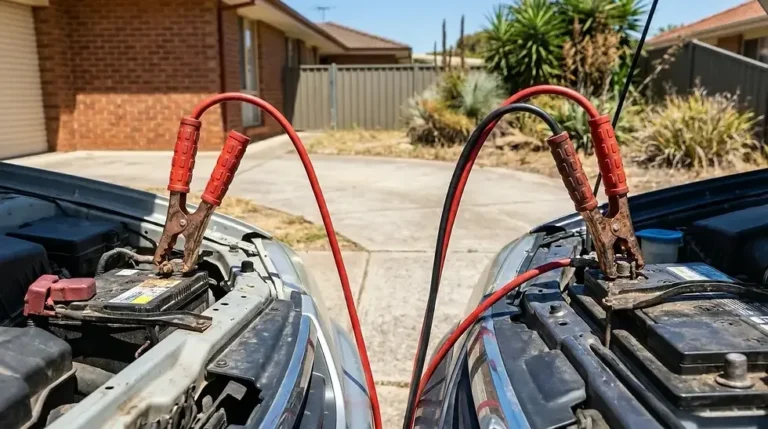
Connect a red jumper cable clamp to the dead battery's positive terminal. Connect the other red clamp to the donor battery's positive terminal. Connect a black clamp to the donor battery's negative terminal.
Connect the final black clamp to an unpainted metal ground on the dead car. Start the donor car and let it idle two to five minutes. Try starting the dead car.
Once it starts, disconnect cables in reverse order and drive for at least twenty minutes.
Why Your Car Won't Start (And How to Know It's the Battery)
The first thing to figure out is whether the battery is actually the problem. Cars fail to start for a handful of reasons, and jumping a battery that isn't the issue wastes time and can mask a bigger problem.
A dead battery usually shows clear signs:
- Clicking sound when you turn the key, but the engine doesn't crank
- Dim or flickering dashboard lights
- Electronics work weakly or not at all
- Engine cranks slowly, like it's struggling
- Nothing happens at all when you turn the key
A fully charged 12V battery sits at about 12.6 volts. Below 11.8 volts, it doesn't have enough cranking power to start most engines. If a jump start works but the car dies again shortly after, the alternator is the more likely culprit.
The alternator charges the battery while the engine runs, and a bad one won't keep the system topped up.
Cold weather makes dead batteries far more common. Engine oil thickens, the battery's chemical reaction slows, and cranking demands go up. That's why winter is the peak season for jump starts in the northern US, Canada, and the UK.
The Core Idea: How a Jump Start Actually Works
A jump start isn't really "charging" the dead battery. It's using the donor car's running electrical system as a temporary power source so the dead car's starter motor can spin the engine.
Here's the short version: the donor car's alternator produces around 13.7 to 14.7 volts while the engine is running. When you connect the two batteries in parallel with jumper cables, current flows from the stronger system into the weaker one. After a few minutes, the dead battery has enough surface charge to help crank the engine.
Once the dead car's engine starts, its own alternator takes over. From that point on, the goal is to keep the engine running long enough to recharge the battery. That means driving for twenty to thirty minutes, not just idling in the driveway.
Two important details:
- A jump start is a boost, not a fix. If the battery is sulfated, internally shorted, or simply worn out (most last three to five years), a jump gets you going but the problem returns.
- Modern cars with AGM (absorbed glass mat) batteries or start/stop systems still jump the same way, but you should follow the owner's manual for any designated remote jump points. Many newer vehicles have specific posts under the hood specifically to avoid connecting directly to the battery.
Before You Start: Condition Checks That Change the Game
A few quick checks before you connect anything can save you from a wasted effort or a dangerous mistake.
Is the Battery Actually Safe to Jump?
Look at the battery itself. If you see any of these, do not try to jump it:
- Cracks in the case
- Bulging or swelling sides
- Leaking fluid
- A sulfur or rotten egg smell
- Ice or frost on the case (a frozen battery can crack or explode when current is applied)
If the battery looks damaged, call for a tow instead. A failed jump on a cracked battery can splash sulfuric acid or trigger a small explosion from hydrogen gas buildup.
Is the Donor Car the Right Size?
You can jump a small four-cylinder with a mid-size SUV donor without issue. For larger engines, especially diesel trucks, the donor battery should have enough cranking amps to support the boost. As a general rule, if the donor starts and runs normally, its battery has plenty of reserve to help another car.
Is There Corrosion on the Terminals?
White, blue, or green powdery buildup on the battery terminals blocks electrical contact. If you see heavy corrosion, clean it off with a wire brush or a baking soda and water paste before connecting. Poor contact is one of the most common reasons a jump start fails on the first try.
What You Need: Cables, a Donor Car, or a Jump Box
You have three main options for the power source. Most drivers keep traditional jumper cables in the trunk, but portable jump starters have become a popular alternative.
| Option | What It Is | Best For | Trade-Offs |
|---|---|---|---|
| Jumper cables + donor car | Heavy-gauge cables with alligator clamps, paired with another running vehicle | Home, parking lot, any time another driver is willing to help | Requires a second car; cables can be bulky |
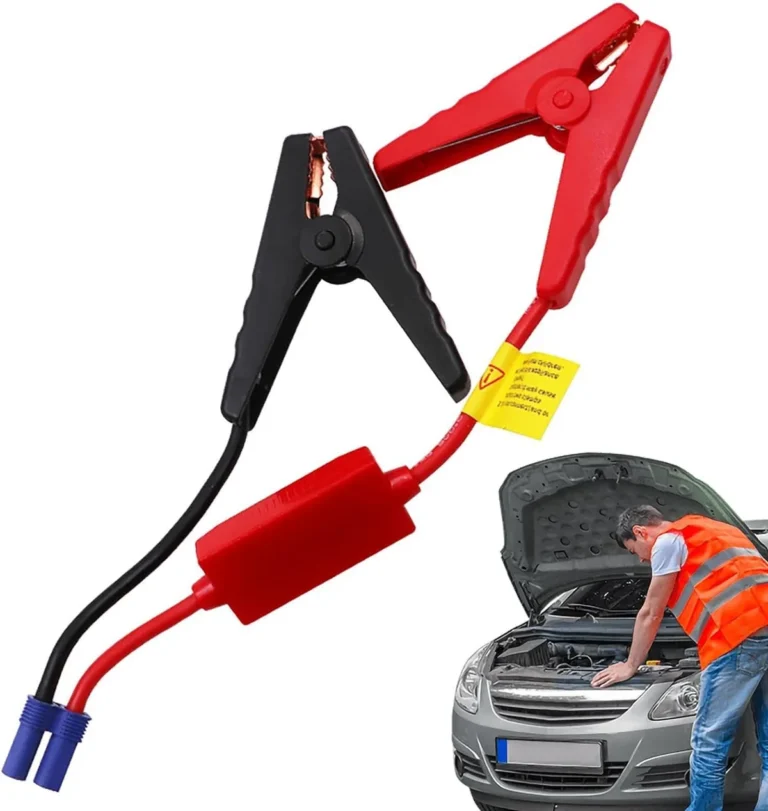
| Portable jump starter | Compact lithium battery pack with built-in clamps | Solo drivers, remote areas, late-night emergencies | Needs to be kept charged; capacity limits engine size |
| Battery charger (trickle or smart) | AC-powered charger plugged into a wall outlet | Overnight recovery at home | Not useful roadside; takes hours |
Cable gauge matters more than most people think. Lower gauge numbers mean thicker wires and better current flow. 4 AWG cables handle the highest current and work well for larger engines, 6 AWG is a solid all-purpose choice, and 8 AWG is fine for most four-cylinder cars. Per Batteries Council International specifications, group-size batteries follow standardized terminal layouts, so any standard jumper cable set fits any standard automotive battery.
For portable jump starters, peak amp ratings between 1,000 and 3,000 amps cover most gas and small diesel engines. Look for units with reverse polarity protection and spark-proof clamps, especially if you're new to the process.
Jump Starting With Another Car: The Step-by-Step Workflow
Once your prep checks are done and you've got your cables and a donor vehicle, the actual jump is straightforward. The whole process takes five to fifteen minutes from setup to driving away.
Step 1: Position the Cars
Park the donor car close enough that the cables reach comfortably. Nose-to-nose or side-by-side both work. The cars should not be touching.
Turn off both ignitions. Set both parking brakes. Remove the key from the dead car if it's not already out.
Step 2: Identify Terminals and Ground Point
Pop the hoods. Find the positive terminal on each battery. It's marked with a "+" symbol and usually has a red cover.
The negative terminal is marked with a "-" and usually has a black cover. On the dead car, also locate an unpainted metal engine bolt or bracket away from the battery. This is your ground point.
Step 3: Make the Connections (In Order)
This is the part that matters most. The order protects you and the cars' electronics.
- Red clamp to positive terminal on the dead battery
- Red clamp to positive terminal on the donor battery
- Black clamp to negative terminal on the donor battery
- Black clamp to the ground point on the dead car (not the dead battery's negative terminal)
The ground-on-dead-car step is the safety move. It keeps any spark away from the dead battery, where hydrogen gas can be present.
Step 4: Start the Donor Car
Start the donor vehicle and let it idle for two to five minutes. Revving the engine slightly to around 1,500 to 2,000 RPM helps push a little more current across.
Step 5: Try Starting the Dead Car
Turn the key or push the start button. If the engine cranks and starts, let it run. If it doesn't, wait another two to three minutes and try again.
Multiple short attempts are better than holding the key in the start position for a long crank.
The Connection Order That Protects Both Cars
The order isn't arbitrary. It follows the logic of grounding the spark in the safest possible place. If you connect the negative cable directly to the dead battery's negative post, any spark at the moment of connection happens right next to the battery, where hydrogen gas may have built up.
A four-step sequence is the standard approach used across manufacturer guidance:
| Step | Cable | Connect To | Why |
|---|---|---|---|
| 1 | Red | Dead battery positive (+) | Establishes the live side first |
| 2 | Red | Donor battery positive (+) | Completes the positive circuit |
| 3 | Black | Donor battery negative (−) | Connects the ground side at the source |
| 4 | Black | Unpainted metal on dead car | Puts any spark away from the battery |
Reverse the order when disconnecting. Remove the black from the ground, then black from the donor, then red from the donor, then red from the dead battery. Never let the clamps touch each other or any metal surface while the other end is still connected to a battery.
What to Do If the Dead Car Still Won't Start
A failed first attempt is common. It doesn't necessarily mean the battery is shot.
Quick Troubleshooting Checklist
- Are the clamps making solid metal-to-metal contact? Wiggle them and re-seat.
- Is the ground point actually unpainted metal? Scrape off paint if needed.
- Did the donor car run long enough? Give it a full five minutes at 1,500 RPM.
- Is the dead battery frozen, swollen, or cracked? If yes, stop and call a tow.
- Are the headlights completely dead? The battery may be too far gone to accept a charge.
If It Cranks Slowly but Won't Fire
Let the donor run longer. Five to ten minutes of charge time helps a deeply discharged battery recover enough cranking amps. Cold weather makes this worse, so in winter, expect to wait longer.
If You Hear a Click but No Crank
This usually means the battery has just enough power to engage the solenoid but not enough to turn the engine. More charging time usually fixes it. If the click keeps repeating with no progress, the battery is likely sulfated or internally shorted and a jump won't help.
Jump Starting Mistakes That Cost You Thousands
Most jump start failures come from a handful of repeated mistakes. Some are just annoying. Others can damage the donor car's alternator, the dead car's ECU, or both.
Reversed Polarity
Connecting red to negative and black to positive is the single most expensive mistake. Modern cars have sensitive control modules that don't tolerate reversed voltage. Repair bills for a fried ECU or BCM (body control module) can run $1,000 to $3,000.
Always double-check the +/- markings before you clamp.
Connecting the Final Black Clamp to the Dead Battery
It's tempting to finish the circuit at the negative post, but that's where hydrogen gas collects. Use an engine ground instead. This single habit prevents most jump-start sparks from happening near the battery.
Skipping the Donor Idle Time
Jumping immediately after connecting cables puts too much load on the donor battery. A two to five minute idle lets the donor's alternator pre-charge the dead battery enough to share the cranking load.
Letting the Cables Snap or Whip
A loose clamp that comes off a live terminal while current is flowing can arc, spark, or whip into your hand. Keep clamps seated firmly, and never let a connected cable dangle where it could contact a moving belt or fan.
Jump Starting a Hybrid or EV Incorrectly
Hybrids and EVs have a low-voltage 12V auxiliary battery that can be jumped just like a normal car. The high-voltage battery pack, with its bright orange cables, is a different system entirely and must never be touched. The 12V battery is usually in the trunk or under the hood, and the owner's manual will show its location.
Safety Rules: Batteries, Sparks, and Sensitive Electronics
Batteries look harmless but they pack real energy. A typical car battery can deliver 400 to 600 amps of cranking current, more than enough to weld metal or cause serious burns.
Eye and Hand Protection
Safety glasses are not optional. Battery acid is corrosive, and a cracked case under boost can spit fluid. Gloves add grip and protect against accidental contact with terminals.
No Flames, No Sparks, No Smoking
Charging a battery releases hydrogen gas. One stray spark near the vent caps is all it takes for a flashback. Keep matches, lighters, and cigarettes well away from the engine bay during the process.
Watch for Hot Electronics
Modern cars route power through dozens of modules. If the donor car's alternator surges during connection, that spike travels through both cars. A surge-protected jump starter reduces this risk, but with traditional cables, the key is steady idle and clean connections.
Don't Lean Over the Battery
Stand to the side when making the final connection. If anything does go wrong, you want to be out of the splash zone.
Know When to Stop
If the dead battery gets hot, swells, smells strongly of sulfur, or hisses, disconnect immediately and wait for professional help. These are signs of internal damage or thermal runaway.
Jumper Cables vs. Portable Jump Starter: Which Should You Use
Both options work. The right choice depends on how you drive, where you drive, and how often you want to depend on another person.
Traditional Jumper Cables
Cables are cheap, last for years, and don't need recharging. The downside: you need a second vehicle and a willing driver. In a remote area or at 2 AM in an empty lot, that may not be an option.
Portable Jump Starters
Lithium jump boxes have dropped in price and size over the last decade. A typical 1,000 to 2,000 peak amp unit weighs 2 to 4 pounds and fits in a glove box. The trade-off: you must keep it charged.
Most hold a charge for six to twelve months between uses, and recharging takes a few hours from a wall outlet or car USB port.
Who Each Option Is Best For
| Situation | Best Choice |
|---|---|
| Daily commuter with roadside assistance | Cables are fine, or a small jump box as backup |
| Frequent solo driver, rural area | Portable jump starter, 1,500+ peak amps |
| Family fleet, multiple drivers | Both. Cables for home, jump box for the glove box |
| Classic car or seasonal vehicle | Trickle charger at home, jump box in the trunk |
| Diesel truck or large SUV | Heavy-duty 4 AWG cables or a high-amp jump box |
Special Cases: Manual Transmissions, Hybrids, and Modern Cars
A few vehicle types need small adjustments to the standard routine.
Manual transmission cars can sometimes be push-started instead of jumped. Put it in second gear, have someone push the car to about 5 mph, then release the clutch while turning the key. This only works with a healthy battery that has just enough charge to run the fuel pump.
A completely dead battery won't fire the engine this way.
Modern cars with start/stop systems and AGM batteries follow the same connection order, but check the owner's manual for a remote positive jump post. Many late-model vehicles have a dedicated terminal under the hood specifically to avoid placing clamps directly on the battery sensor. Using the right post protects the battery monitoring system from current spikes.
After the Jump: How to Make Sure It Actually Worked
The engine started. Now what? Don't shut it off right away.
Drive for at least twenty to thirty minutes to let the alternator recharge the battery. Idling in the driveway isn't the same. Alternators produce more current at driving RPM than at idle.
If the car dies again the next morning, the battery isn't holding a charge. Either it's sulfated from sitting too long, or there's a parasitic drain pulling power while the car is off. A common culprit is a trunk light, glove box light, or aftermarket accessory wired directly to constant power.
How to Tell If You Need a New Battery Instead
A jump start is a fix for a temporary drain, not a worn-out battery. Here's how to tell the difference:
- The car starts fine after a jump and stays running. The battery is probably okay. Check for what drained it.
- The car needs jumping again within a day or two. The battery is likely failing. Most auto parts stores will test it for free with a load tester.
- The car struggles to start in warm weather too, not just cold. Cold weather exposes weak batteries, but a healthy one should handle it. If yours can't, replacement time is close.
Average battery life is three to five years. If yours is in that window and showing weakness, a new battery is cheaper than another tow.
Pro Tips From Mechanics Most People Never Hear
A few habits separate the people who jump start cars smoothly from the ones who fight with corroded cables for twenty minutes.
Keep a small wire brush in the trunk. A quick scrub of the terminals before clamping can be the difference between a successful jump and a no-start. Many "bad" jump attempts trace back to green corrosion blocking contact.
Wrap the final black clamp connection in a rag. If the clamp slips off the ground point, the rag gives you a moment to react before the metal hits anything. Mechanics do this reflexively.
If the cables get warm during the connection, that's normal. If they get hot, something is wrong. Stop, disconnect, and check for a short or reversed clamp.
Replace jumper cables every five to seven years. The copper strands inside the insulation corrode slowly, and you can't see it from outside. Old cables often look fine but deliver only half their rated current.
Frequently Asked Questions
How long does it take to jump start a dead battery?
Most jump starts take five to fifteen minutes total, including two to five minutes of donor car idle time before the first attempt. If the dead battery is deeply discharged, give the donor an extra five minutes before trying again.
Can I jump start a car in the rain?
Yes. Water doesn't interfere with a 12V automotive jump start. The voltage is too low to be a shock risk through wet skin.
Just keep connections tight and avoid standing in pooled water while making them.
Will jump starting damage the donor car's alternator?
In modern cars, a brief jump start is well within the alternator's design limits. Risk only appears with prolonged cranking attempts, reversed polarity, or a severely shorted dead battery pulling excessive current. A normal successful jump causes no measurable wear.
How long should I drive after a jump start?
Drive for at least twenty to thirty minutes at normal RPM. That gives the alternator enough time to put meaningful charge back into the battery. Short trips or extended idling won't fully recharge a deeply discharged battery.
Can a completely dead battery be jump started?
Sometimes. A battery below roughly 10 volts may need ten to fifteen minutes of donor charging before it has enough surface charge to crank. If the battery is internally shorted or frozen, no amount of jump time will help, and a replacement is the only real fix.