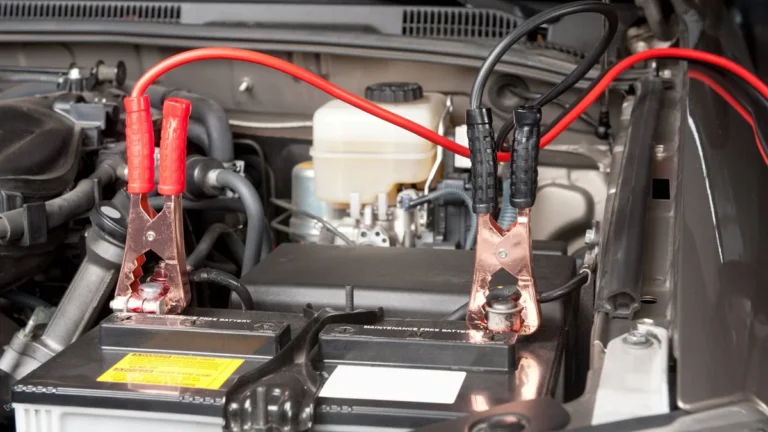
What amp jump starter do i need: Top guide
If you're staring at jump starter listings wondering what amp jump starter do i need, you're not alone. Most buyers overspend on features they don't need or undersize the unit and end up stranded anyway. The right call comes down to engine displacement, fuel type, and climate, not the biggest number on the box.
Manufacturers rate jump starters two ways: peak amps (a short burst) and cranking amps (sustained output). SAE J537 testing protocols measure sustained cranking performance, which matters far more than the headline "3000A" figure. As of 2026, a quality 1500A to 2500A peak lithium unit handles most gasoline engines, while diesels need 3000A or more.
Match that to your vehicle first, then worry about the rest.
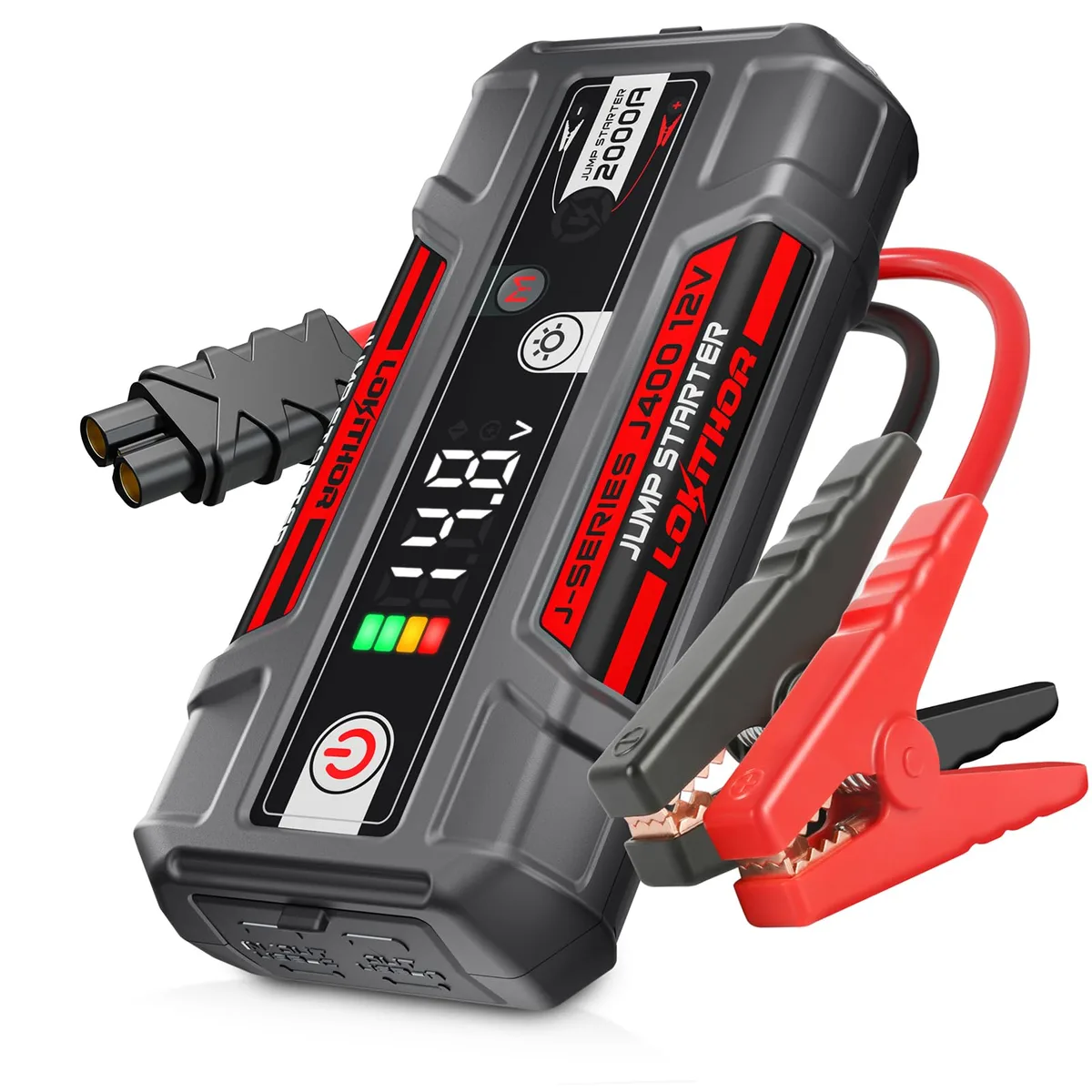
Quick Answer
Most gasoline cars need 1000 to 2500 peak amps. Most diesels need 3000+ peak amps. Always size to engine displacement and climate.
Why Engine Size Is the First Thing That Should Drive Your Decision
Here's the deal: a jump starter delivers current to spin your starter motor, which has to crank fast enough to fire combustion. Bigger engines need more cranking amps because the motor is physically larger and the cylinders create more compression resistance. A 1.5-liter 4-cylinder barely breaks a sweat at 150A.
A 6.7-liter Power Stroke diesel demands 600A or more just to spin.
Manufacturer specifications consistently group recommendations by engine size rather than vehicle class, because displacement is what actually matters. So if you're shopping blind, ignore the marketing and grab your engine's liter rating.
A quick rule from aggregate user reviews and spec guides:
- 4-cylinder gas (1.5L to 2.5L): 1000 to 1500 peak amps minimum
- V6 gas (3.0L to 4.0L): 1500 to 2000 peak amps minimum
- V8 gas (4.6L to 6.2L): 2000 to 3000 peak amps minimum
- Light-duty diesel (3.0L to 5.0L): 3000 to 4500 peak amps minimum
- Heavy-duty diesel (6.0L+): 4500 to 6000+ peak amps minimum
If you undersize the unit, the jump starter's internal BMS often cuts power before cranking completes. That means a no-start and a dead jump starter in your trunk.
Peak Amps vs. Cranking Amps: The Number That Actually Matters
Peak amps are the short burst a battery can deliver for about 1 to 2 seconds. Cranking amps (CA) and cold cranking amps (CCA) measure sustained output over 30 seconds at a specific temperature, usually 32°F for CA and 0°F for CCA. SAE J537 is the industry standard that defines these tests.
So which one should you look at? Cranking amps. They're the real-world number that determines whether your engine turns over on a cold morning.
A unit might advertise "3000A peak" but only deliver 750A of cranking current. That gap is where buyers get burned. Premium manufacturers like Antigravity, NOCO, and Clore Automotive list both numbers.
Budget brands often only list peak, which is why reviews flag them as unreliable.
Here's a comparison to keep handy:
| Rating Type | What It Measures | Why It Matters | Typical Honest Spread |
|---|---|---|---|
| Peak Amps | 1-2 second burst | Marketing headline | 2x to 4x higher than cranking |
| Cranking Amps (CA) | 30 sec at 32°F | Real-world starting | The number to compare |
Cold cranking amps use the same test at 0°F, which matters if you live anywhere north of the Sun Belt. Battery output drops roughly 20% at 32°F and up to 40% at 0°F, so the colder your climate, the more headroom you want.
The Quick Decision Table: Match Amperage to Your Vehicle
This is the table most buyers wish they had before buying. Match your vehicle type and engine size to a recommended peak amp minimum, and you've eliminated 90% of the guesswork.
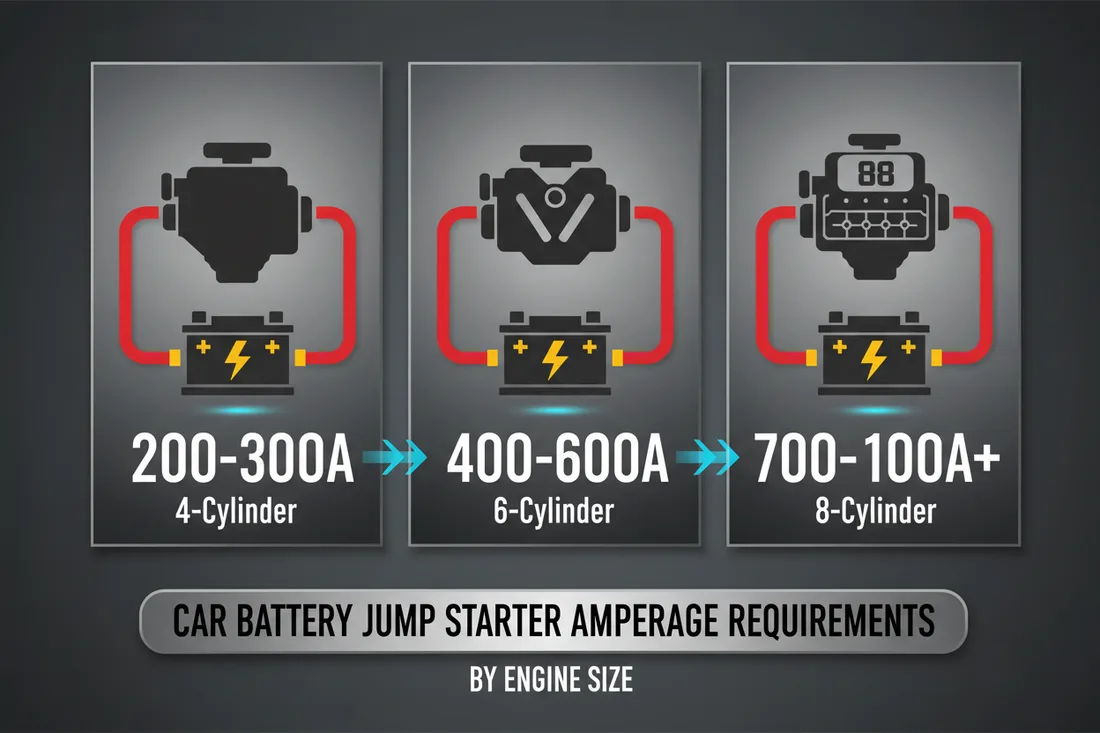
| Vehicle / Engine | Minimum Peak Amps | Recommended Peak Amps | Notes |
|---|---|---|---|
| Motorcycle / Scooter (under 1.5L) | 300A | 500A to 800A | Compact units work, just check connector fit |
| 4-Cyl Gas (1.5L to 2.5L) | 1000A | 1500A to 2000A | Most daily drivers land here |
| V6 Gas (3.0L to 4.0L) | 1500A | 2000A to 2500A | Common in SUVs and trucks |
| V8 Gas (4.6L to 6.2L) | 2000A | 2500A to 3500A | Trucks, muscle cars, full-size SUVs |
| Small Diesel (3.0L to 5.0L) | 3000A | 3500A to 4500A | Light-duty pickups and vans |
| Heavy-Duty Diesel (6.0L+) | 4500A | 5000A to 6000A+ | HD trucks and commercial equipment |
| Marine / Boat Engine | 1500A | 2000A to 3000A | Account for dampness and corrosion |
If your vehicle sits between two categories, round up. A 400A safety margin won't hurt anything except maybe your wallet, and it's better than the no-start alternative.
Gasoline Engine Requirements (4-Cyl, V6, V8, Big Block)
Gasoline engines are the easy case. Compression ratios are lower, glow plugs aren't a factor, and battery demands are predictable by displacement.
A typical 2.4L 4-cylinder needs about 150 to 200A of cranking current once warmed up. A 5.0L V8 needs 250 to 350A. Multiply by roughly 1.5x to 2x for cold-weather starting, and you're in the right ballpark for sustained cranking demand.
Real-world reviews from NOCO, Antigravity, and Schumacher owners consistently show that a 1500A peak lithium unit reliably starts most 4-cylinder and small V6 engines, even in winter. A 2000A peak unit is the sweet spot for V6 and small V8 engines. Anything 2500A and up covers V8 and V10 gas applications with headroom.
Big block engines (7.0L+) push into heavy-duty territory. If you're running a V10 Triton or a big block Chevy, don't cheap out. You want a commercial booster pack or a 3000A+ lithium unit from a reputable maker.
Here's a quick decision rule: if your gas engine is 5.0L or smaller, a 2000A lithium jump starter covers you. If it's 5.0L or larger, step to 2500A minimum.
Diesel Engine Requirements (Light-Duty to Heavy-Duty Pickups)
Diesels are where sizing gets serious. Compression ratios run 15:1 to 20:1, which means the starter motor fights much harder to turn the engine. Add glow plug draw on cold starts, and a small jump starter simply won't cut it.
Light-duty diesels (3.0L Power Stroke, 3.0L EcoDiesel, 2.8L Duramax) typically demand 400A of cranking current once warm. In freezing weather, that climbs to 600A or more before you even factor in glow plugs pulling 50A to 100A on initial key-on.
Heavy-duty diesels are a different animal. A 6.7L Cummins or Power Stroke needs 600A to 800A of sustained cranking current. A 7.3L IDI or older mechanical diesel can pull even harder because injection pumps add parasitic load.
Here's how to size up:
- 3.0L to 3.5L diesel: 3000A peak minimum, 4000A preferred
- 5.0L to 6.0L diesel: 4500A peak minimum
- 6.0L+ diesel: 5000A to 6000A peak, ideally a commercial booster
If you live where winter regularly drops below freezing, step up one level. Cold oil thickens, batteries weaken, and diesels are notoriously hard to start when cold. The extra headroom pays for itself the first time you're stranded in a parking lot at 5 a.m.
Diesel owners should also look for jump starters with higher clamp output ratings. A unit rated for 3000A peak but using 8-gauge wire will choke under sustained draw. Look for 4-gauge or 2-gauge cables, and clamps rated at 600A minimum.
What About Motorcycles, ATVs, Lawn Equipment, and Small Boats?
Small engines don't need massive amperage, but they do need the right form factor. A 600A peak lithium pack is overkill for a Harley but won't fit in a saddlebag. Smart buyers match the unit to the use.
Motorcycles and ATVs use batteries in the 8Ah to 20Ah range. Stock cranking demands are 80A to 200A. A compact 400A to 800A peak lithium unit handles nearly every bike, ATV, and side-by-side on the market.
Many riders prefer the smaller size for the storage tradeoff.
Lawn tractors and small equipment fall in a similar range. A 300A to 500A unit is plenty, and often the same jump starter used for a motorcycle doubles as a lawn mower saver.
Boats are trickier because of marine batteries, corrosion, and dual-battery setups. A 2000A peak jump starter is the practical minimum for inboard and sterndrive marine engines. The bigger concern with boats is waterproofing and corrosion resistance.
Look for an IP65 or higher rating if your jump starter lives on board.
One practical tip from aggregate user reviews: if you own multiple vehicle classes, buy one unit sized for the largest engine. You can use a 2000A unit on a motorcycle, but you can't use a 600A unit on a truck. Upsizing covers everything.
Lithium-Ion vs. Lead-Acid vs. Ultracapacitor: Battery Type Changes Everything
The battery chemistry inside the jump starter affects weight, cold-weather performance, lifespan, and price. Each has a real trade-off, and the "best" depends on your climate and use case.
Lithium-ion (LiFePO4 or standard Li-ion) is the current standard. Units are compact, hold charge for months, and deliver high peak amps in a small package. The downside is cold-weather performance.
Standard lithium-ion loses significant capacity below freezing, while LiFePO4 handles cold better but costs more. If you live in a northern climate, look specifically for LiFePO4 chemistry.
Lead-acid jump starters are the old-school commercial units. They're heavy, often 20 to 30 pounds, but they deliver serious sustained cranking amps. Fleets and shops still prefer them because they tolerate abuse and work in extreme cold.
For a consumer buyer, though, the weight alone is usually a deal-breaker.
Ultracapacitor jump starters are a newer category. They don't store much energy, but they can draw residual charge from a weak battery and amplify it for a jump. They work in extreme cold and have nearly unlimited cycle life.
The downside is they need at least some voltage in the dead battery to function, so they're useless for a fully dead or removed battery.
A simple decision tree: portable all-around use means lithium-ion (LiFePO4 if cold climate). Commercial-grade sustained cranking means lead-acid booster pack. Extreme cold and longevity means ultracapacitor.
Cold Weather, Hot Climates, and Why Temperature Changes the Amperage You Need
Battery chemistry reacts to temperature in ways that matter for jump starting. Cold reduces available capacity, while heat accelerates degradation but doesn't limit output as severely.
Cold-weather performance follows a rough rule: a battery loses about 1% of capacity per degree Fahrenheit below 32°F. At 0°F, a fully charged battery delivers roughly 60% of its rated output. Jump starter batteries follow the same curve.
If your climate regularly hits single digits, you need a unit with more headroom than the minimum recommendation.
LiFePO4 chemistry outperforms standard lithium-ion in cold. Operating windows of -20°C to 60°C (about -4°F to 140°F) are common for LiFePO4 jump starters. Standard lithium-ion can struggle below 14°F and may refuse to deliver full power below freezing.
Hot climates are less of an immediate problem for output, but they shorten battery lifespan. Storing a jump starter in a car trunk in Phoenix summer heat degrades lithium cells faster than storing it indoors. If you live in a hot region, remove the unit from the vehicle and store it indoors when not in use.
UL certification confirms the units meet thermal safety standards, but chemistry longevity is a separate concern.
Must-Have Safety Features You Shouldn't Skip (Reverse Polarity, Spark-Proof Clamps, IP Rating)
Safety features aren't optional add-ons. They're the difference between a clean jump and a fried ECU.
Here are the non-negotiables:
- Reverse polarity alarm: Alerts you if you've swapped positive and negative clamps. Hooking up backward can fry the jump starter, the battery, or your vehicle's electronics.
- Spark-proof clamps: Prevents sparking when you make the connection. A spark near a battery can ignite hydrogen gas venting from the cells.
- Short-circuit protection: Cuts power if the clamps touch each other or a grounded surface.
- Over-current protection: Limits output if the unit is pushed beyond its rating.
- IP rating (for outdoor/boat use): IP65 or higher resists water spray and rain. Indoor use doesn't need this.
Reverse polarity protection is the single most important safety feature. Vehicle ECUs and infotainment systems can cost more than the jump starter itself. A $50 unit without it is a gamble you don't want to take.
Common Mistakes When Sizing a Jump Starter (And Why Undersizing Fails)
Most jump starter failures trace back to one of three mistakes. Knowing them in advance saves the headache of learning them in a parking lot.
Mistake 1 is trusting peak amps only. A "3000A peak" claim with no cranking amps rating usually means the unit delivers 800A of sustained current. By the time the engine turns over for 5 seconds, the BMS may throttle output further.
Read the spec sheet, not the box.
Mistake 2 is skipping the temperature factor. A jump starter that fires a 5.0L V8 in July may refuse to start the same engine in February. Cold saps capacity, and undersized units hit the cutoff first.
Mistake 3 is buying by vehicle class instead of engine size. "Fits trucks" marketing means nothing. A 4-cylinder Tacoma and a 6.2L F-250 are both "trucks," but their starting demands are wildly different.
A jump starter that can't deliver enough sustained current will trip its protection circuit mid-crank. The result is a clicking starter, a dead jump starter, and you still needing a tow.
How to Use a Jump Starter Without Damaging Your Battery or ECU
Modern vehicles have sensitive electronics. The Engine Control Unit, infotainment system, and various sensors can all be damaged by voltage spikes or reverse polarity. The right hookup procedure matters as much as the right unit.

Step by step:
- Turn off the jump starter and the vehicle's ignition.
- Connect the red (positive) clamp to the dead battery's positive terminal.
- Connect the black (negative) clamp to an unpainted metal ground on the vehicle chassis or engine block, not the negative terminal. Grounding away from the battery reduces spark risk near venting gas.
- Power on the jump starter and wait 30 to 90 seconds for the voltage to stabilize.
- Crank the engine for no more than 5 seconds. If it doesn't start, wait 60 seconds before trying again to let the jump starter cool.
- Once the engine starts, disconnect the black clamp first, then the red clamp. Leave the engine running for at least 20 minutes to recharge the battery, or drive for 30 minutes.
If the engine doesn't start after 3 to 4 attempts, the battery is likely beyond jump starting and needs replacement. Continued cranking just overheats the jump starter's BMS.
Reading the Spec Sheet: Cable Gauge, Clamp Quality, and Real-World Output
Cable thickness, clamp design, and internal BMS quality separate a $50 unit from a $200 unit with identical headline amps.
Cable gauge is the thickness of copper inside the cables. Lower numbers mean thicker wire. For a 2000A peak unit, look for 6-gauge or thicker.
Heavy-duty 4000A+ units need 2-gauge or 1-gauge. Thin cables choke current and overheat under load.
Clamp quality affects contact resistance. Weak springs mean poor contact, which generates heat and reduces delivered current. Look for strong jaw tension and copper or copper-plated jaws.
Insulated handles are a basic safety requirement.
BMS quality is hard to judge without disassembly. The simplest signal is reputation. Clore Automotive, NOCO, Antigravity, and Schumacher have decades of track records.
No-name brands with identical spec sheets often cut corners on the BMS to hit lower cost.
Charging, Storage, and How to Keep Your Jump Starter Ready When You Need It
A jump starter is useless if it's dead when you need it. Lithium units self-discharge at roughly 3% to 5% per month. A fully charged unit left in a trunk for six months may not have enough juice to crank a V8.
Best practices:
- Top off the charge every 60 to 90 days if the jump starter lives in the vehicle
- Store indoors at room temperature when possible, especially in extreme climates
- Recharge fully after each use to extend battery cycle life
- Avoid storing in direct sunlight since heat degrades lithium cells
If you use the jump starter to charge phones or run accessories, discharge adds up. A 10,000 mAh unit sounds like a lot until you remember it takes roughly 2,000 mAh to crank a small engine.
How Many Jumps Per Charge and What That Means for Road Trips
Most consumer lithium units deliver 10 to 40 jumps per charge. A 1500A unit might start a 4-cylinder 30 times but only manage 8 to 10 starts on a V8.
For road-trip planning, this matters more than peak amps. A weekend camping trip in a 5.0L truck could deplete a smaller unit after a few failed starts.
Rule of thumb:
- Small unit (1000A to 1500A peak): 15 to 25 starts on a 4-cylinder, 5 to 10 on a V8
- Mid-size unit (2000A to 2500A peak): 20 to 40 starts on a 4-cylinder, 10 to 20 on a V8
- Large unit (3000A+ peak): 30+ starts even on V8 and diesel
Charge the unit the night before departure and bring a USB-C cable for in-vehicle recharging.
Lithium-Ion Cold Weather Performance and Why It Matters Up North
Lithium-ion batteries lose capacity below freezing. At 32°F, output drops roughly 20%. At 0°F, you lose about 40%.
Standard lithium-ion jump starters may refuse to deliver full current below 14°F, which is exactly when dead batteries happen most often.
LiFePO4 chemistry handles cold better. Operating ranges of -4°F to 140°F are typical. If you live north of the I-70 corridor, choose LiFePO4 specifically.
The price premium is worth it the first time you get stranded at a trailhead in February.
Store the unit indoors overnight in winter. A jump starter warmed to room temperature delivers rated performance. One pulled from a freezing car may not.
Jump Starter vs. Battery Charger: Which One Do You Actually Need?
These tools solve different problems and most buyers confuse them. A jump starter delivers a burst to start a dead vehicle. A battery charger slowly replenishes a depleted battery over hours.
If your battery is dead because you left the lights on, a jump starter fixes it in 5 minutes. If your battery is dead because it's old and won't hold a charge, a charger won't help. You need a new battery.
Fleet drivers and commuters who park for weeks benefit from a maintainer (trickle charger). It keeps the battery topped off without overcharging. Daily drivers rarely need one.
Quick rule: jump starter for emergencies, charger for maintenance, replacement battery for anything older than 5 years.
Smart Features Worth Paying For (and Ones to Skip)
Built-in flashlights, USB charging ports, and air compressors sound useful. Some are. Most aren't worth paying extra for.
A flashlight is genuinely handy during a roadside emergency. Most units include one at no cost. USB power banks add weight and drain the battery you need for jumping.
Skip them unless you camp often.
Air compressors are a separate category. Don't expect 100 PSI tire inflation from a jump starter compressor. They're slow and noisy.
Buy a dedicated tire inflator if you need one.
LCD displays showing voltage and battery health are useful. They let you confirm charge level before relying on the unit. Budget indicators (red/yellow/green lights) are fine but less informative.
What Warranty Coverage Actually Tells You
Warranty length reflects manufacturer confidence. Clore, NOCO, and Antigravity offer 1 to 2 year warranties. No-name brands often claim "lifetime" but exclude the battery, which is the only part that fails.
Read the warranty terms. "1 year warranty" with a 30-day return window is common. UL-certified units from established brands honor claims without hassle.
Register the product after purchase. It speeds up any future claim and confirms your unit is genuine.
When to Skip the Jump Starter Entirely
Sometimes the right answer isn't a jump starter. If your battery is over 5 years old, a jump just delays the inevitable replacement. Test the battery first at any auto parts store for free.
If the starter motor itself is failing, no jump starter will help. A clicking sound with full power at the clamps points to the solenoid or starter, not the battery.
If you're stranded and the jump starter doesn't start it after 3 tries, stop and call roadside assistance. The issue is bigger than a dead battery.
Frequently Asked Questions
How many amps do I need to jump start a V8?
A V8 gasoline engine typically needs 2000A peak minimum, with 2500A being safer for cold climates or larger displacements (5.7L+). Manufacturer specs from NOCO and Antigravity confirm this range across their mid-tier product lines.
Can a 1500A jump starter start a diesel?
A 1500A peak unit can start small diesels in warm weather, but it's risky. Light-duty diesels (3.0L) need at least 3000A peak for reliable cold-weather starting. Going below that risks BMS cutoff mid-start.
Will a lithium jump starter work in freezing weather?
Standard lithium-ion loses significant capacity below 32°F and may fail entirely below 14°F. LiFePO4 chemistry handles cold better, working down to -4°F or lower. For northern climates, choose LiFePO4 specifically.
How many times can I jump start a car before the unit dies?
Most consumer lithium units deliver 10 to 40 jumps per charge, depending on engine size. A 2000A unit typically gives 10 to 20 starts on a V8 and 20 to 40 on a 4-cylinder. Larger capacity units push these numbers higher.
Is reverse polarity protection really necessary?
Yes. Without it, connecting the clamps backward can fry the vehicle's ECU or infotainment system, costing thousands to repair. UL-certified units with reverse polarity alarms are worth the modest price premium.
How do I know what amp jump starter I need for my specific vehicle?
Check your engine displacement and fuel type. Gasoline 4-cylinders and V6s typically need 1500A to 2000A peak. V8s need 2000A to 3000A.
Diesels need 3000A or more regardless of cylinder count.
Can a too-powerful jump starter damage my car?
No, oversized jump starters are safe. The BMS limits current to what your vehicle draws. Undersized units are the real risk, since they cut power mid-crank or fail to start the engine at all.
Should I worry about lithium battery safety in hot weather?
Yes, for longevity. Lithium cells degrade faster when stored above 100°F. Remove the unit from the trunk in summer heat and store it indoors.
UL-certified jump starters include thermal protection against immediate overheating during use.
How long does a jump starter hold its charge when not used?
Lithium jump starters retain 60% to 80% charge after 6 months of storage. Lead-acid units lose charge faster and may need monthly top-offs. Check the unit every 60 to 90 days and recharge if the indicator drops below 50%.
Can I fly with a jump starter in my luggage?
Carry-on lithium jump starters must be under 100Wh per FAA rules. Higher capacity units can fly in checked baggage with airline approval. Lead-acid jump starters are not permitted on commercial flights due to spill risk.
Final Verdict: How to Pick the Right Jump Starter in 30 Seconds
Match engine size first. 4-cylinder gas: 1500A peak. V6 gas: 2000A peak. V8 gas: 2500A peak.
Diesel: 3000A+ peak.
Then match climate. Mild: standard lithium-ion. Cold: LiFePO4 with IP65 rating.
Then check safety features. Reverse polarity, spark-proof clamps, UL certification. Skip any unit missing these.
Spend $80 to $200 on a reputable brand. That price band delivers the safety and performance most buyers actually need. Below $50, you're gambling on quality.
Above $300, you're paying for features most won't use.