How to choose a jump starter: Honest Review
You've probably seen those pocket-sized jump starters online and thought, "Do those actually work?" The honest answer is yes, most of them do, but only if you pick the right one for your specific vehicle. Knowing how to choose a jump starter isn't about finding the most expensive unit on the shelf. It's about matching the power, the chemistry, and the size to the car you drive and where you drive it.
Lithium jump starters have dropped to as low as $40 for a basic 1,000A unit as of 2026, and premium 3,000A models now include built-in tire inflators and USB-C PD ports. The problem is that more amps on the box doesn't always mean more real-world starting power, and a unit that's perfect for a Civic will leave a diesel truck stranded. Let's walk through the actual decision logic so you end up with a unit that works the first time you need it.
Quick Answer
To choose a jump starter, match its cranking amps to your engine size. Pick lithium for compact cars and trucks under 6.0L gas. Pick LiFePO4 for cold climates and longevity.
Pick lead-acid for heavy diesel. Add reverse-polarity protection and clamps that fit your terminals. Finally, size the unit to your storage space and how often you'll use it.
What "How to Choose a Jump Starter" Actually Means (and Why the Wrong Pick Is Worse Than No Pick)
Most buying guides throw a spec sheet at you and call it a day. That's a problem because jump starter specs are written in marketing language, not engineering language. A box that says "2,000 peak amps" might only deliver 400 cranking amps in real-world conditions.
That's the number that matters when your engine is cold and your battery is dead.
The wrong pick plays out in three common ways. You buy something underpowered and it clicks uselessly when you need it. You buy something overpowered and you've spent $200 on a brick you can't store easily.
Or you buy something with cheap clamps and it sparks, trips its own safety circuit, or worse, damages your car's electronics.
A good decision follows a simple logic. Figure out what your engine actually needs. Decide which battery chemistry fits your climate and storage.
Then narrow down by size and features. Skip any of those steps and you'll either overpay or under-prepare.
The Core Decision Variables You Need to Lock In First
Before you look at any product page, answer four questions about yourself. Your answers narrow down 90% of the choices on the market.
Your Engine Size and Fuel Type
This is the starting point for everything. A 1.5L four-cylinder needs far less power than a 6.2L V8 or a 6.7L diesel. Cranking amps scale with engine displacement, and fuel type matters because diesel engines compress air at much higher ratios and demand more starting torque.

As a rough baseline drawn from manufacturer recommendations:
- 4-cylinder gas (1.5L, 2.5L): 150, 300 cranking amps is plenty
- V6 gas (3.0L, 4.0L): 300, 500 cranking amps
- V8 gas (5.0L, 6.2L): 400, 700 cranking amps
- Diesel (any size): 600+ cranking amps, often 1,000+
If you drive a hybrid or a car with start-stop technology, your 12V battery is smaller but your electronics are sensitive. Look for units with soft-start circuitry and clean power delivery rather than raw amps.
Your Climate and How Often You'll Actually Need It
Cold weather kills two things at once. Your car's battery output drops, and cheap lithium jump starters lose usable capacity below freezing. If you live anywhere that regularly hits 20°F or below, this matters more than any other spec on the box.
LiFePO4 chemistry handles cold better than standard lithium-ion and lasts 2, 4 times longer in cycle life. Lead-acid jump starters are the most cold-tolerant but weigh 15, 25 lbs and need monthly charging.
Frequency matters too. If you're buying a jump starter for "just in case," a compact lithium unit that holds 80% charge for 6, 12 months is fine. If you're a rideshare driver or fleet operator starting dead batteries weekly, prioritize cycle life and faster recharge times.
How You Want to Use It Beyond Jump-Starting
Modern jump starters double as power banks, flashlights, and sometimes tire inflators. Decide now whether those extras are useful or bloat. A 2,000A unit with a built-in 150 PSI air compressor is genuinely helpful if you also have aging tires.
The same unit is dead weight if you already own a separate inflator.
How Much Trunk or Cab Space You Can Spare
A heavy-duty 30Ah lead-acid booster can weigh as much as a car battery. A pocket lithium unit fits in a glove box. Be honest about storage, because a jump starter that's too heavy to leave in the car is a jump starter you won't have when you need it.
Peak Amps vs. Cranking Amps: The Spec That Actually Matters
Here's where most buyers get lost. Peak amps is the maximum instantaneous current a unit can output for a fraction of a second. Cranking amps (CA) and cold cranking amps (CCA) are sustained output over 30 seconds at 32°F or 0°F respectively.
Peak amps look impressive on a box. A unit advertising "3,000 peak amps" might only deliver 600 cranking amps. That's the number that matters when you're cranking a cold engine.
The Battery Council International (BCI) defines these ratings under standardized test conditions. Per BCI testing standards, cranking amps measure sustained output at 32°F (0°C), while CCA measures the same at 0°F (-18°C). When you're comparing units, ignore peak amps entirely and compare CA or CCA numbers only.
If a manufacturer doesn't publish cranking amps, that's a red flag. Reputable brands like NOCO, Antigravity, and Clore Automotive list both numbers clearly. Budget brands often skip this because the real figure would look unimpressive next to competitors' peak amp claims.
A quick rule of thumb: take the manufacturer's peak amp number and divide by 3 to 5 to estimate real cranking performance. A "2,000 peak amp" unit typically delivers 400, 600 cranking amps. Use that divided number against your engine's needs and you'll be in the right range.
Lithium-Ion, LiFePO4, or Lead-Acid: Which Chemistry Fits You
Battery chemistry sounds like a spec sheet detail, but it actually decides how your jump starter behaves in the real world. Each has trade-offs, and the "best" one depends on your situation rather than some universal ranking.
Lithium-Ion (Standard Li-ion)
This is what most pocket jump starters use. It's light, compact, and cheap to manufacture. A 1.5 lb lithium unit can deliver enough cranking power for most passenger cars.
The downside is cold-weather performance. Standard Li-ion cells lose significant capacity below freezing, and in extreme cold they may refuse to deliver their rated current at all. Cycle life is also shorter, typically 300, 500 full discharge cycles before noticeable degradation.
If you live in a temperate climate, drive a small-to-mid-size car, and want something you can toss in a glove box, standard lithium-ion is the right call. Just don't leave it in a hot car trunk in summer, because heat kills Li-ion cells faster than cold does.
LiFePO4 (Lithium Iron Phosphate)
LiFePO4 is a step up in both safety and longevity. It handles a wider temperature range, lasts 1,000, 2,000+ cycles, and is far less prone to thermal runaway than standard Li-ion. If a LiFePO4 cell is damaged, it tends to smolder rather than explode.
The trade-offs are weight and price. LiFePO4 jump starters cost roughly 30, 50% more than equivalent Li-ion units and weigh a bit more for the same capacity. But for cold-climate drivers, off-grid users, or anyone who'll use the unit frequently, the longer lifespan and better cold tolerance justify the premium.
Lead-Aid (Sealed AGM)
The old-school choice. Lead-acid jump starters are heavy, often 15, 25 lbs, but they're nearly indestructible and work in extreme cold. Fleet mechanics and diesel truck owners have used them for decades for good reason.
They're also cheap per amp and recover well from deep discharge. The problems are size and maintenance. You need to recharge them every 1, 3 months or they'll sulfate and die.
They're also too heavy to leave in a passenger car casually.
For diesel trucks, heavy equipment, or anyone who needs maximum cold-weather reliability and doesn't mind the bulk, lead-acid still makes sense. For everyone else, lithium has effectively replaced it.
| Chemistry | Best For | Cold Tolerance | Cycle Life | Typical Weight |
|---|---|---|---|---|
| Lithium-Ion | Everyday drivers, compact storage | Fair (loses capacity below 20°F) | 300–500 cycles | 1–3 lbs |
| LiFePO4 | Cold climates, frequent use, longevity | Good (works to -10°F) | 1,000–2,000 cycles | 2–5 lbs |
| Lead-Acid (AGM) | Diesel trucks, heavy-duty, extreme cold | Excellent | 200–400 cycles | 15–25 lbs |
Picking the Right Size Class (Pocket, Mid-Size, Heavy-Duty)
Size classes aren't standardized across brands, but they cluster into three rough categories based on output, weight, and price. Matching the size to your vehicle and storage space is the easiest way to avoid overbuying.

Pocket / Mini Boosters (400–1,000 peak amps)
These weigh under 2 lbs, fit in a glove box or center console, and typically handle 4-cylinder and small V6 engines. They're also the cheapest, often $30, $70.
The limits show up in three places: weak cold-weather performance, smaller clamps that don't fit all battery terminals, and fewer safety features. They're also more likely to be "one-shot" units that need recharging after a single jump.
Good for: compact cars, sedans, mild climates, backup emergency use.
Mid-Size Boosters (1,000–2,000 peak amps)
This is the sweet spot for most drivers. A mid-size unit weighs 2, 5 lbs, fits in a trunk, and handles most V6 and V8 gas engines plus light diesel applications. Expect to pay $70, $150.
Mid-size units usually include better clamps (often full-copper, spark-proof), reverse polarity protection, USB charging ports, and an LED flashlight. Many also add a small air compressor or higher-output USB-C PD port.
Good for: most SUVs, trucks, daily drivers, mixed climates, anyone who wants one tool that does multiple jobs.
Heavy-Duty Boosters (2,000+ peak amps)
These are designed for diesel trucks, fleet vehicles, and commercial use. They often use lead-acid or large LiFePO4 packs and weigh 10+ lbs. Prices run $150, $400+.
Heavy-duty units crank large diesel engines repeatedly without overheating. They also tend to have the longest cycle life and the most robust safety systems. The trade-off is weight and price, and you'll need dedicated storage space.
Good for: diesel trucks, large displacement engines, fleet and commercial use, repeated jump-starting in a workday.
The Decision Logic in Plain Terms
If you drive a 4-cylinder or small V6 in a temperate climate, pocket size is fine. If you drive anything bigger or face cold winters, step up to mid-size. If you drive a diesel or need commercial reliability, go heavy-duty.
Anything beyond heavy-duty for personal use is usually overspec.
Match the Jump Starter to Your Vehicle Type
Engine size gives you the amp requirement, but vehicle type adds extra considerations. A motorcycle battery is different from a truck battery. A marine engine sits unused for months.
A start-stop car has sensitive electronics. Here's how to adjust your pick for each.
Compact Cars and Sedans
Most 4-cylinder cars need 150, 300 cranking amps to start. A 1,000A pocket unit will handle this with room to spare. The main consideration is storage, because sedan trunks are smaller and you'll want something light enough to actually leave in the car.
Avoid the cheapest units with no reverse polarity protection. Modern cars have enough electronics that a reverse-connection mistake can fry a sensor or the ECU.
SUVs, Trucks, and Large V8s
Large-displacement engines need sustained cranking power, not just peak amps. A V8 truck might draw 400+ amps for several seconds during a cold start. Look for mid-size to heavy-duty units with at least 500 cranking amps.
If your truck has a diesel engine, jump straight to the heavy-duty category. Gasoline V8s in passenger trucks can usually get by with a strong mid-size unit, especially if you live in a mild climate.
Diesel Engines
Diesel engines are the most demanding starting loads you'll encounter in passenger vehicles. They require high cranking amps (often 600+), sustained output, and reliable cold-weather performance. A cheap lithium unit will struggle with anything beyond a small 4-cylinder diesel.
LiFePO4 or lead-acid are the safer choices for diesel. Make sure the unit explicitly lists diesel compatibility, because not all jump starters are rated for the compression ratios diesel engines demand.
Motorcycles and Powersports
Motorcycle batteries are small, typically 10, 20Ah, and don't need much cranking current. A pocket jump starter works fine, but the clamps may be too large for motorcycle battery terminals. Look for units with smaller clamp jaws or adapters, or use a battery tender-style connector.
Boats and Marine Applications
Marine batteries often sit unused for months and may be deeply discharged when you finally need to start. Marine environments also expose equipment to salt air and humidity. Look for units with IP ratings (water and dust resistance) and higher capacity to deal with deeply discharged batteries.
Start-Stop and Hybrid Vehicles
These vehicles have smaller 12V batteries (often AGM or lithium) and very sensitive electronics. Standard jump-starting works, but the power delivery needs to be clean and the voltage stable. Look for units with soft-start or "12V sensitive mode" features, and avoid ultra-cheap units with poor voltage regulation.
The Universal Warning
If your vehicle has a battery management system (BMS) or is a recent model year, check the owner's manual before jump-starting. Some manufacturers specify particular procedures or warn against certain jump starter types. Skipping this check can void warranties or damage electronics.
How to Read a Jump Starter Spec Sheet Without Getting Sold To
Spec sheets are designed to make every unit look strong. Your job is to strip the marketing away and compare like-for-like numbers. Here's how to read one without getting snowed.
The three numbers that actually matter are battery capacity (in mAh or Wh), cranking amps (CA or CCA), and clamp rating. Capacity tells you how many jumps you can do per charge. Cranking amps tells you whether the unit can start your engine.
Clamp rating tells you how safely and reliably it connects.
Ignore peak amps for comparison, since two manufacturers test this differently. Ignore inflated cycle life claims unless they specify depth of discharge tested. And ignore "works in -40°F" claims unless the unit has cold-weather chemistry certifications, because most standard lithium cells fail well before that.
Look instead for warranty length, safety certifications (UL, CE, FCC, RoHS), and whether the manufacturer publishes real cranking amp figures. Reputable brands publish all three. Budget brands often publish only peak amps because the real numbers wouldn't compare well.
A useful test: if a spec sheet doesn't list CA or CCA, treat the unit as a mid-tier option at best. You don't know what you're getting.
Must-Have Safety Features (and the Ones You Can Skip)
Every modern jump starter should have reverse polarity protection. This is non-negotiable. If you connect the clamps backwards, the unit simply won't deliver power.
Skipping this feature risks frying your car's ECU, which costs far more than any jump starter.
Spark-proof clamps are the second must-have. Standard jumper cables spark when they touch the terminal. Spark-proof designs prevent that, which matters when you're working near a battery that may be off-gassing hydrogen.
Cheap clamps spark. Better ones don't.
Overcurrent, overvoltage, and short-circuit protection round out the safety basics. UL certification means the unit has been tested to published safety standards. The UL safety certification program covers lithium battery products specifically, so a UL-listed jump starter has cleared independent testing.
The features you can skip include built-in radios, Bluetooth speakers, and overly elaborate LCD screens. These add cost, complexity, and failure points without making the unit start your car any better.
Multi-Function Boosters: When a Built-In Air Compressor, Flashlight, or USB Bank Is Worth It
Multi-function units combine a jump starter with a 150, 200 PSI tire inflator, an LED flashlight, and a USB power bank. They're popular because they consolidate several emergency tools into one box. Whether that's worth it depends on your situation.
The tire compressor is the most useful add-on. Tires lose pressure slowly over time, and a built-in inflator means you don't need a separate device. Aggregate user reviews show this feature gets used far more than the flashlight or USB ports.
If your tires are older or you do a lot of highway driving, this is genuinely helpful.
The flashlight is fine for emergencies but rarely impressive. A 200-lumen LED is enough to see what you're doing under the hood at night. Anything beyond that is overkill.
USB power banks are useful if your phone is your navigation, communication, and emergency tool. A USB-C PD port that delivers 30, 60W can charge a laptop in a pinch. Standard USB-A ports are slower but fine for phones.
The downsides are weight and repair risk. A multi-function unit has more parts that can fail. If the compressor dies, you may have to replace the whole unit.
If you're buying multi-function, expect to pay $100, $200 and accept the bulk.
A practical rule: only buy multi-function if you'll actually use the extras. If you already own a tire inflator and a power bank, skip the bundled version and get a simpler, lighter jump starter for less.
Cold Weather, Hot Trunks, and Other Climate Traps
Climate affects jump starters in two ways: how well they work when you need them, and how long they last in storage. Both matter.
Cold weather is the bigger performance issue. Standard lithium-ion cells lose 20, 40% of their usable capacity below 20°F. In extreme cold (below 0°F), some cheap units won't deliver any current at all.
If you live in a cold climate, LiFePO4 or lead-acid is the safer pick.
A useful trick: keep the jump starter inside the cabin, not the trunk. Trunks are colder in winter and hotter in summer. A unit stored at room temperature will perform better and last longer than one exposed to extreme swings.
Heat is the bigger lifespan issue. Lithium cells degrade fastest at high temperatures. A jump starter left in a hot trunk in summer can lose 30% of its capacity in a single season.
If you must store it in the car, put it in an insulated bag or under a seat rather than in direct sun.
Humidity and salt air matter too. Corrosion on clamp jaws increases resistance, which reduces effective cranking amps. Store the unit somewhere dry, and wipe the clamps down periodically if you're in a coastal climate.
A simple climate checklist:
- Cold winters (below 20°F regularly): LiFePO4 or lead-acid, store inside the cabin
- Hot summers (above 100°F regularly): avoid trunk storage, use insulated bag
- Coastal or humid: wipe clamps monthly, store unit dry
- Variable climate: LiFePO4 chemistry handles both ends better than standard Li-ion
Step-by-Step: How to Actually Jump-Start a Car the Right Way
Even the best jump starter fails if you use it wrong. The procedure below is the standard sequence recommended by most vehicle manufacturers and follows the same polarity order as traditional jumper cables.
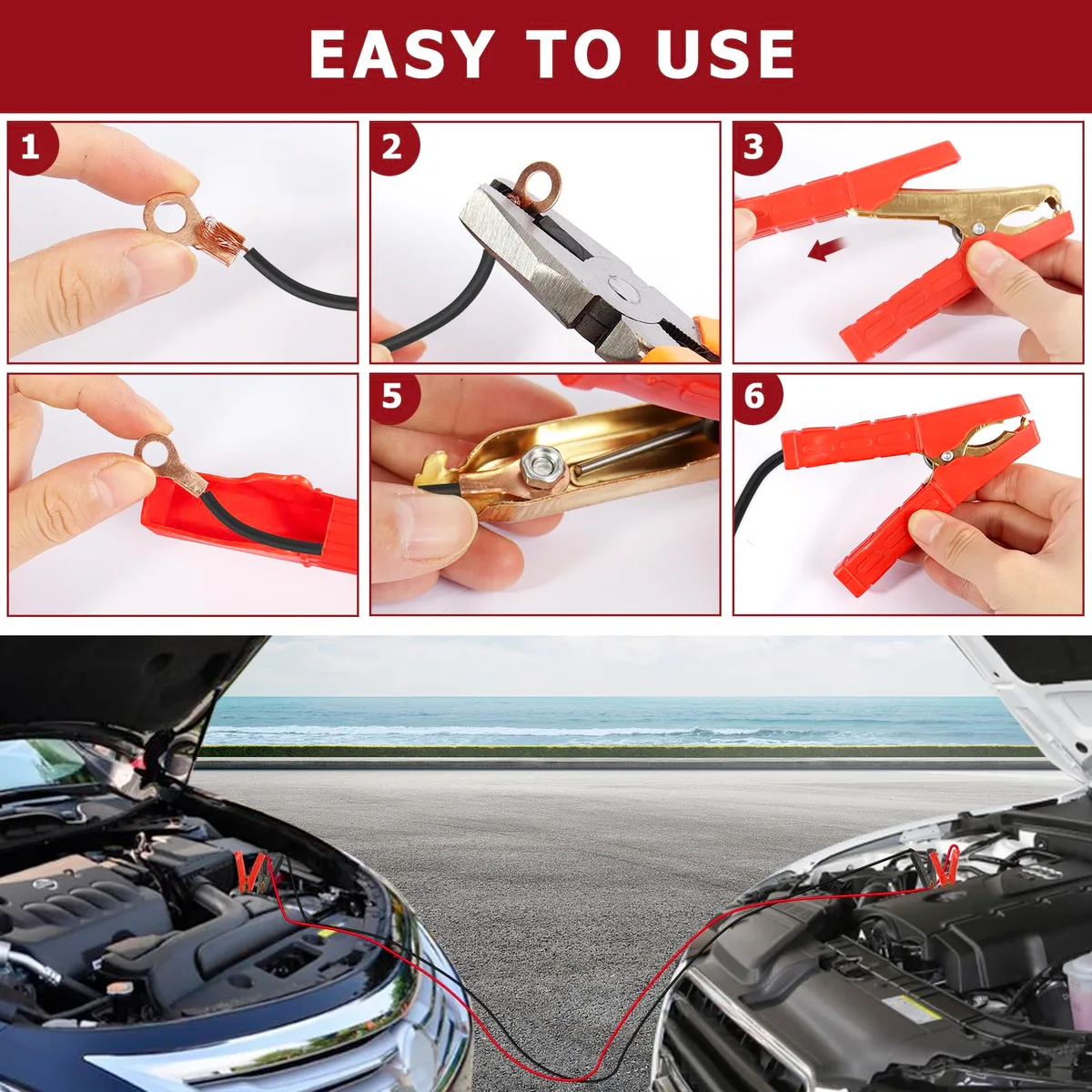
Step 1: Confirm the jump starter is charged. A unit at 50% or below may not have enough current to crank a stubborn engine. Most units have LED indicators or an LCD showing state of charge.
Step 2: Identify the positive and negative terminals. Positive is marked with a "+" and usually has a red cover. Negative is marked with a "-" and usually has a black cover.
If the terminals are corroded, brush off the corrosion first with a wire brush.
Step 3: Connect the red clamp to the positive terminal. Make sure the jaw seats firmly on the metal post, not on the plastic housing.
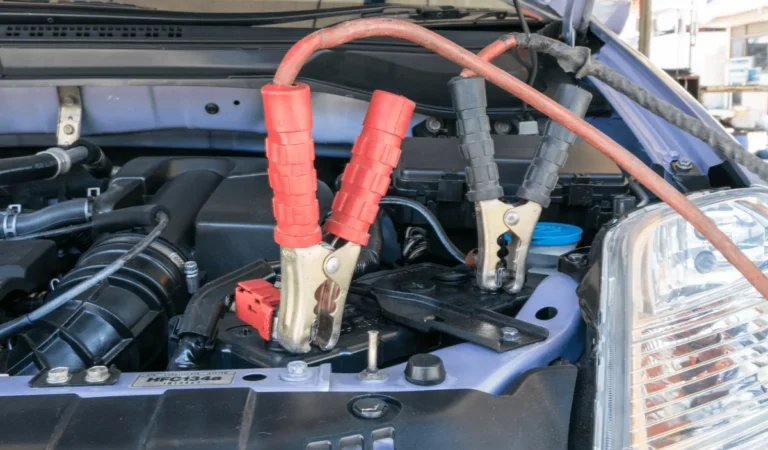
Step 4: Connect the black clamp to a grounded metal point on the engine block, away from the battery. A bare bolt, bracket, or engine lift point works. Don't connect directly to the negative terminal if you can avoid it, because any spark will sit right over the battery.
Step 5: Power on the jump starter. Most units have a manual switch or auto-detect mode that activates when both clamps are connected correctly.
Step 6: Crank the engine for 3, 5 seconds, then stop. If the engine doesn't start, wait 30, 60 seconds before trying again. Repeated cranking overheats the jump starter's internal cells and reduces the chance of success.
Step 7: Once the engine starts, disconnect the black clamp first, then the red clamp. Keep the clamps apart so they don't touch each other or any metal surface.
Step 8: Let the engine idle for at least 10, 15 minutes, or drive for 20+ minutes, to recharge the vehicle's battery. A jump starter gives the engine a start, but it doesn't replace the alternator's job of recharging the battery.
If the engine doesn't start after three attempts, the battery is likely too far gone or there's a different problem (bad starter, fuel issue, alternator failure). Continuing to crank risks damaging the jump starter.
For more on vehicle battery safety and handling, the U.S. Department of Transportation covers transport and disposal rules that apply if your jump starter's internal cells ever need replacing.
Mistakes That Kill Jump Starters (and Sometimes Cars)
Most jump starter failures trace back to a handful of recurring mistakes. Knowing them ahead of time saves you from being stranded or paying for an avoidable repair.
The biggest mistake is buying based on peak amps alone. A "3,000 peak amp" unit with no published cranking amps is a black box. It might work, or it might click uselessly when your battery is dead and it's 10°F outside.
The second is skipping maintenance. Jump starters left for months at low charge sulfate (lead-acid) or drop into deep discharge (lithium), both of which permanently damage the cells. Recharge every 1, 3 months even if you never used it.
The third is reversing the clamps. This is what reverse polarity protection exists to prevent. If your unit doesn't have it, don't buy it.
A reversed connection on a modern car can fry body control modules, which cost $500+ to replace.
The fourth is cranking too long. Holding the start for 20, 30 seconds overheats the jump starter's internal cells and usually doesn't help anyway. Three to five seconds, then rest.
Repeat up to three times, then stop and diagnose.
The fifth is storing the unit in a hot car. Heat degrades lithium cells fast. If you live somewhere warm, bring the unit inside overnight or store it in an insulated bag.
Caring for Your Jump Starter So It Works When You Actually Need It
A jump starter is like a fire extinguisher: useless if it's dead when you need it. Maintenance is mostly about keeping the battery in a healthy state of charge.
Recharge the unit every 1, 3 months, even if you never used it. Lithium cells self-discharge at roughly 2, 5% per month, so a unit stored for six months may be at 50, 70% charge when you finally need it.
Test the unit twice a year by jump-starting your own car (when the battery is healthy but the engine is cold) or by checking the voltage output with a multimeter. Most units should read 12.5, 13.2V at full charge.
Keep the clamps clean. Wipe them with a dry cloth and check for corrosion every few months. Corroded clamps increase resistance and reduce the actual current reaching the battery.
Store in a cool, dry place. Inside the cabin is better than the trunk, especially in extreme climates. Avoid leaving the unit in direct sun or freezing temperatures for extended periods.
Price Tiers and What You Really Get at Each Level
Price doesn't always track performance, but it does track features and build quality. Here's what each tier actually delivers.
Budget ($30, $60): Basic pocket units with 800, 1,500 peak amps. Fine for compact cars in mild climates. Usually lack reverse polarity protection and have shorter cycle life.
Expect 1, 2 years of regular use before noticeable degradation.
Mid-range ($60, $150): The sweet spot for most drivers. Better cranking amps (200, 500+), reverse polarity protection, spark-proof clamps, USB charging ports, and longer warranties. LiFePO4 options start appearing at the top of this range.
Premium ($150, $300+): Heavy-duty output, LiFePO4 chemistry, built-in air compressors, USB-C PD ports, and rugged construction. Worth it for diesel trucks, fleet use, or anyone who wants a 5, 10 year service life.
Jump Starter vs. Jumper Cables vs. Roadside Assistance vs. Battery Tender
These four tools solve overlapping but different problems. Knowing which one you actually need avoids buying duplicates.
Jumper cables are cheapest and never run out of power, but require a second vehicle. Useless if you're alone in a parking lot. Jump starters solve the "alone" problem but require maintenance and have a finite lifespan.
Roadside assistance memberships (AAA-style) cover jump-starts plus towing, lockouts, and flat changes. Worth it if you drive an older car in an area with long tow distances. For a younger car with a healthy battery, a $60 jump starter pays for itself in one avoided service call.
Battery tenders maintain a battery's charge during long storage (classic cars, motorcycles, lawn equipment). They don't jump-start a dead battery; they prevent one from dying in the first place. A common pairing is a jump starter for emergencies plus a tender for long-term storage.
A practical setup for most drivers: a mid-range jump starter in the trunk, plus a battery tender if you own a vehicle that sits for weeks at a time. Skip the roadside membership unless you tow often or drive a high-mileage vehicle.
Safety and Compliance Notes
Three rules cover most safety concerns. Always connect positive first, never smoke near a battery, and never crank longer than five seconds without a rest. Reverse polarity is the only failure mode that can cost you a repair bill, so check the clamps twice before powering on.
If you're flying with a jump starter, the U.S. Department of Transportation lithium battery rules cap carry-on units at 100Wh and require airline approval for anything between 100Wh and 160Wh. Larger packs can't fly at all.
Disposal matters too. Lithium batteries don't go in regular trash. Most home improvement stores and auto parts retailers accept spent jump starters for recycling.
Real Scenarios Worth Thinking Through
A 4-cylinder sedan owner in a temperate climate who parks in a garage: a $60, $90 pocket lithium unit, recharged every three months, will outlast the car's battery.
A diesel truck owner in rural Wyoming: a $200+ LiFePO4 heavy-duty unit stored in the cab, recharged monthly, is the only reliable choice.
A rideshare driver doing 200 miles a day: cycle life matters most. A LiFePO4 mid-size unit with 1,000+ cycle rating beats a cheaper lithium unit that degrades after 18 months.
A weekend motorcyclist: a pocket unit works for both the bike and the occasional dead car battery, as long as the clamps fit the motorcycle terminals.
Pro Tips That Actually Matter
Buy from brands that publish cranking amps, not just peak amps. That's the only honest spec for real-world starting.
Buy clamps before you buy features. Clamp quality matters more than a built-in flashlight or compressor. Cheap clamps spark, lose contact, and corrode fast.
Buy the next size up if you live somewhere cold. Underpowered units fail when you need them most, and cold only makes it worse.
Buy a unit with USB-C PD if you carry a laptop on the road. The same port that charges your MacBook can power a small inverter or run a tire inflator.
Final Recommendation: Your Three-Question Jump Starter Decision Guide
If you've read this far, you already know more about jump starters than most buyers. Here's the shortest possible path to a decision.
Question 1: What engine do you drive? Small 4-cylinder or V6 gas in a mild climate, go pocket or mid-size lithium. V8 or diesel, go mid-size to heavy-duty LiFePO4 or lead-acid.
Question 2: Where do you store it? Trunk in a hot or cold climate, pick LiFePO4 or lead-acid. Cabin storage in a mild climate, standard lithium is fine.
Question 3: Do you want extras? Yes, get a multi-function unit with an air compressor and USB-C PD. No, get a simpler unit and save $50, $80.
Three answers in, you've narrowed down the market to 5, 10 viable units. Pick the one with the best clamp quality, the longest warranty, and a brand that publishes real cranking amp figures. That's the unit to buy.
Frequently Asked Questions
How many amps do I need to jump-start my car?
Match cranking amps to engine size. A 4-cylinder gas needs 150, 300 amps, a V6 needs 300, 500, and a V8 or diesel needs 500, 700+ for reliable cold starts.
Can a jump starter damage my car's electronics?
It can if the unit lacks reverse polarity protection and you connect the clamps backwards, or if the unit outputs dirty voltage that confuses sensitive modules. Modern units with proper safety circuitry are safe for most vehicles.
How long does a jump starter hold its charge?
Lithium units typically hold 50, 80% charge for 6, 12 months in storage. Lead-acid units lose charge faster and need recharging every 1, 3 months to avoid sulfation damage.
Can I take a jump starter on a plane?
Yes, within limits. Per FAA and IATA rules, lithium battery packs under 100Wh can go in carry-on luggage. Packs between 100Wh and 160Wh require airline approval.
Anything larger must go in checked baggage or is prohibited entirely.
How many times can a jump starter start a car on one charge?
Most mid-size lithium units can start a car 10, 30 times on a full charge, depending on engine size and how dead the battery is. Heavy-duty units often deliver more, while pocket units may only manage 3, 5 starts before recharging.
Will a jump starter work in extreme cold?
Standard lithium-ion units lose significant capacity below 20°F and may fail entirely below 0°F. LiFePO4 and lead-acid units handle cold much better. Storing the unit inside the cabin, rather than the trunk, also helps.
How long do lithium jump starters last?
Standard lithium-ion units last 300, 500 charge cycles, typically 2, 3 years of regular use. LiFePO4 units last 1,000, 2,000 cycles, often 5, 8 years. Storage conditions matter as much as cycle count.