How to jump start toyota camry hybrid: Honest Review
Learning how to jump start a Toyota Camry Hybrid is easier than most owners expect, but it does work a little differently than a regular gas car. Your Camry actually runs two batteries, a 12V auxiliary battery and a high-voltage traction battery, and jumping the wrong one can mean a trip to the dealer. The good news: the jump points are designed to be reached without touching any high-voltage cables, and the whole job takes about 10 minutes with a donor car or a portable jump starter.
Per Toyota's published owner documentation, the 12V auxiliary battery sits in the trunk on most Camry Hybrid generations, but the jump-start terminals live up front under the hood. As of 2026 model years, this layout hasn't changed for the XV70 or newer trims, so the procedure below applies to almost every Camry Hybrid on US roads today.
Quick Answer
Jump starting a Toyota Camry Hybrid means boosting the 12V auxiliary battery, not the high-voltage hybrid battery. Pop the hood and locate the red-capped positive terminal in the fuse box. Clamp the positive jumper cable there.
Clamp the negative cable to an unpainted metal ground point. Start the donor car. Wait 5 to 10 minutes.
Press the Camry's brake and push the start button. The high-voltage system will then come online on its own.
Why Jump-Starting a Camry Hybrid Is Different
A conventional car has one 12V battery that does everything: crank the starter motor, run accessories, power the ECU. A Camry Hybrid runs two completely separate electrical systems, and that changes everything about how you jump it.
The high-voltage traction battery, usually a lithium-ion or nickel-metal hydride unit, sits under the rear seat and runs the hybrid powertrain through the inverter. It's the orange-cable system you may have seen warnings about. That system self-starts the gas engine through the hybrid motor, and it's dangerous to touch directly.
The 12V auxiliary battery is what wakes everything up. It powers the computers, the Smart Key system, the interior lights, and the dashboard. When it dies, your Camry won't go into READY mode, no matter how much charge sits in the high-voltage pack.
The 12V battery doesn't crank an engine in a traditional sense. It just signals the hybrid system to switch on.
That's why a dead 12V battery can leave you stranded even with a fully charged hybrid battery. The smart key won't be recognized. The brake won't feel normal.
The push-button start does nothing. Most owners assume something major has failed, but it's almost always a 12V problem you can solve in your driveway.
The Camry Hybrid's Dual-Battery System Explained
What the 12V Battery Does
The 12V auxiliary battery on a Camry Hybrid is typically an absorbed glass mat (AGM) unit rated around 12.6 volts when fully charged. It powers the hybrid system control computers, the Smart Key fob recognition system, the dashboard, infotainment, and interior lights. It also runs the relay that closes the high-voltage contactors.
If any of these can't wake up, the READY light won't come on, and the car won't move. Manufacturer documentation from Toyota confirms the 12V battery also runs the DC-DC converter, which steps down high-voltage pack power to charge the 12V while driving. That charging link is why a healthy 12V battery can last 4 to 6 years on a Camry Hybrid.
What the High-Voltage Battery Does
The traction battery stores energy for the electric motors and powers the vehicle in EV mode at low speeds. It runs at several hundred volts DC, routes through an inverter, and uses bright orange cables throughout the vehicle. Toyota marks every high-voltage component with warning placards.
You never jump this battery. You never clamp cables to it. You never open the orange-cable service disconnect unless you're a certified technician.
Where the 12V Battery Lives on Each Generation
| Generation | Model Years | 12V Location |
|---|---|---|
| XV50 | 2012-2017 | Trunk, right side under carpet |
| XV70 | 2018-2024 | Trunk, under cargo floor panel |
| XV80 | 2025+ | Trunk, right side compartment |
Even though the 12V battery itself sits in the trunk, you don't need to access it to jump the car. The under-hood fuse box has a dedicated jump-start terminal.
Signs Your Camry Hybrid's 12V Battery Is Dead
A dying 12V battery usually gives you warnings before it quits. Aggregate owner reports and forum patterns point to a few common symptoms.
The Smart Key doesn't unlock the car on the first try, or you have to press the fob against the start button to get a response. The interior lights flicker or look dim. The dashboard lights up but the READY indicator never shows.
You hear a click from the fuse box but nothing else happens. None of the hybrid system warning lights come on because the computer never wakes up to detect them.
If the car was sitting for 2 to 4 weeks without being driven, the 12V battery likely drained on its own. Toyota's hybrid system uses a small amount of standby power even when parked, especially if the smart key is left inside or near the vehicle.
Cold weather accelerates the problem. A 12V battery that tested fine in October can fail to wake the hybrid computers in January when temperatures drop below freezing. Heat is even worse for AGM batteries long term, which is why Camry Hybrid batteries often fail earlier in Arizona, Texas, and Florida than in milder climates.
If you're seeing any of these symptoms once, a boost gets you home. If you're seeing them weekly, the 12V battery is probably at the end of its life and needs replacement.
What You'll Need Before You Start
You don't need much. Most of what you need is probably already in the car, or in a neighbor's driveway.
Tools and Materials
- Jumper cables (4 to 6 gauge, at least 12 feet long)
- A donor vehicle with a healthy 12V battery
- Safety glasses and gloves
- The Camry owner's manual (optional, but the jump point diagram helps)
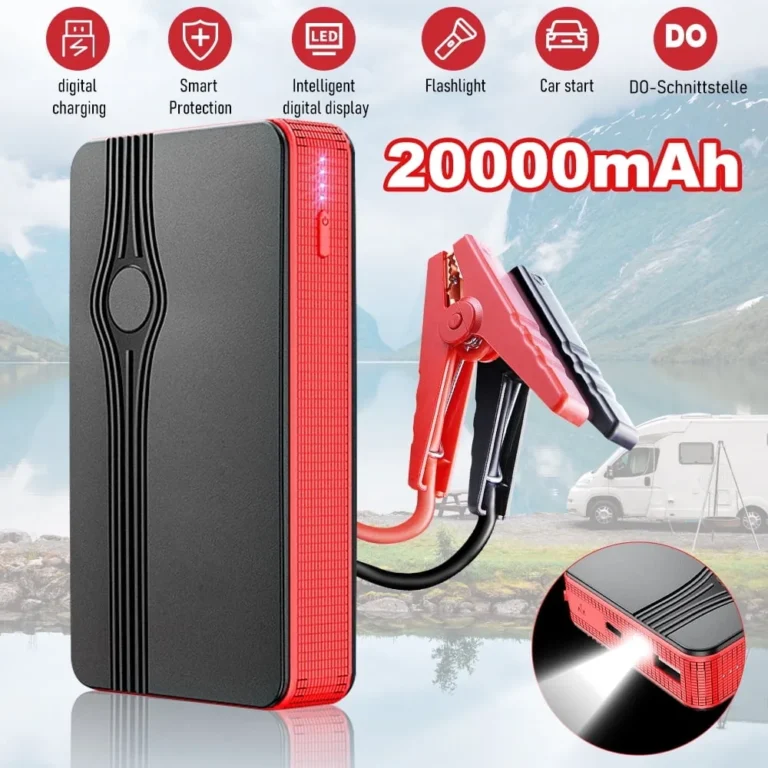
- A portable lithium jump starter rated for at least 1,000 amps (alternative to a donor car)
If you're using a portable jump starter, make sure it's fully charged before you head out. Most lithium units hold their charge for 3 to 6 months in storage, but a dead jump starter defeats the purpose.
Locating the Jump Points on a Camry Hybrid
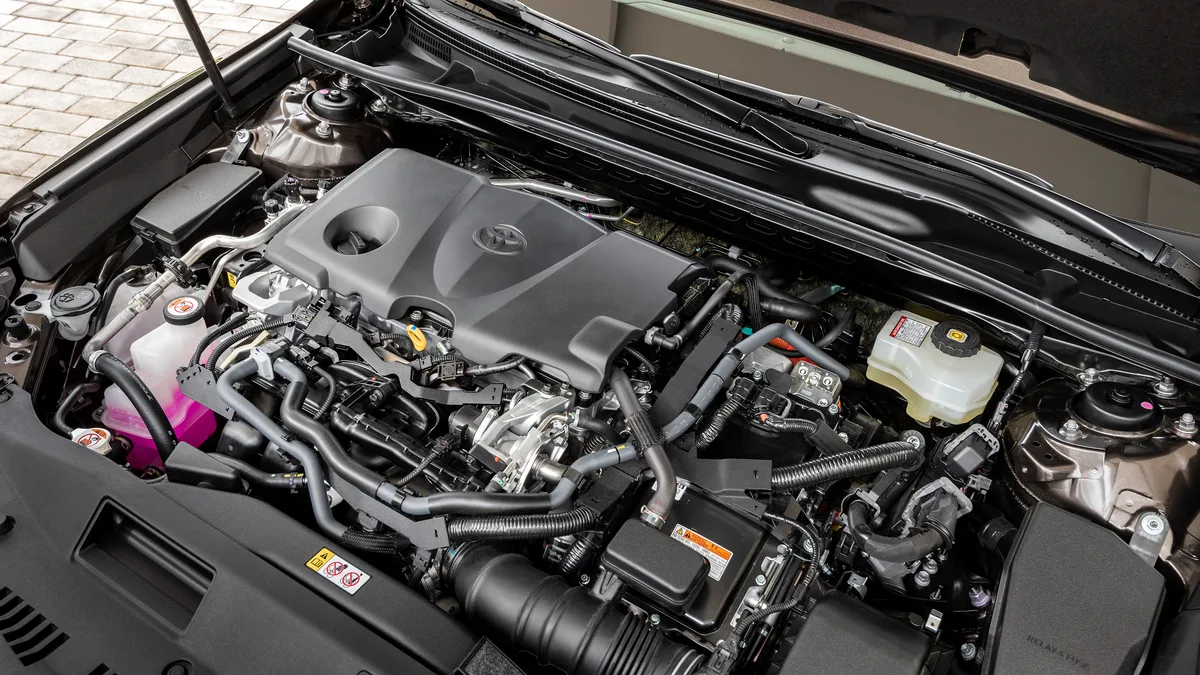
Pop the hood, and you'll see the engine cover with the Toyota logo. Pull the prop rod if your model uses one. The fuse box sits on the driver's side near the firewall.
Where the Positive Terminal Is
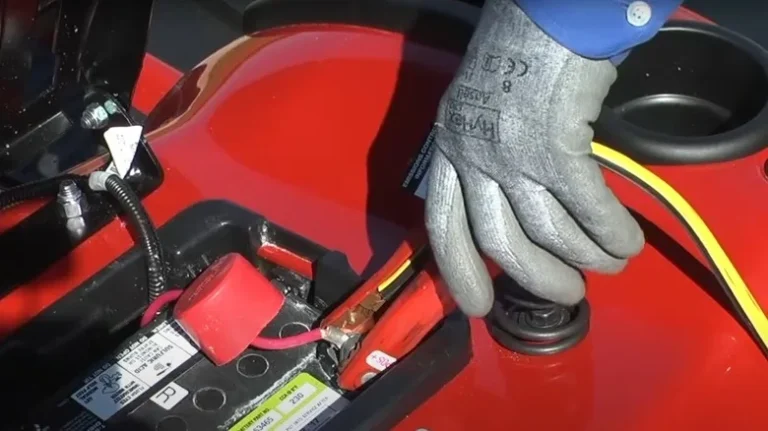
Open the fuse box lid. Look for a red plastic flip-up cover on the left side of the box. Lift it, and you'll see a metal stud designed to clamp a jumper cable directly.
This is the dedicated positive jump-start terminal, and it routes to the 12V battery through heavy-gauge wiring.
Where the Ground Point Is
There's no negative terminal in the engine bay, on purpose. Toyota wants you to use a remote ground point to avoid sparks near the 12V battery in the trunk.
Look for an unpainted metal bracket or bolt on the engine block or chassis. A common spot is the metal strut tower bolt on the driver's side. Any clean, unpainted, rust-free metal point works.
Why the Trunk Battery Has No Jump Posts
The 12V battery sits in the trunk, but Toyota didn't add remote jump posts there. The under-hood terminal runs a dedicated cable back to the battery through the firewall. You don't need to pop the trunk, fold down seats, or pull back carpet to jump a Camry Hybrid.
Step-by-Step: Jump-Starting With a Donor Vehicle
This is the safest and most common way to bring a Camry Hybrid back to life. Plan about 10 to 15 minutes for the whole process.
- Park the donor car close, but don't let the vehicles touch. Both cars in Park, parking brakes engaged, ignitions off.
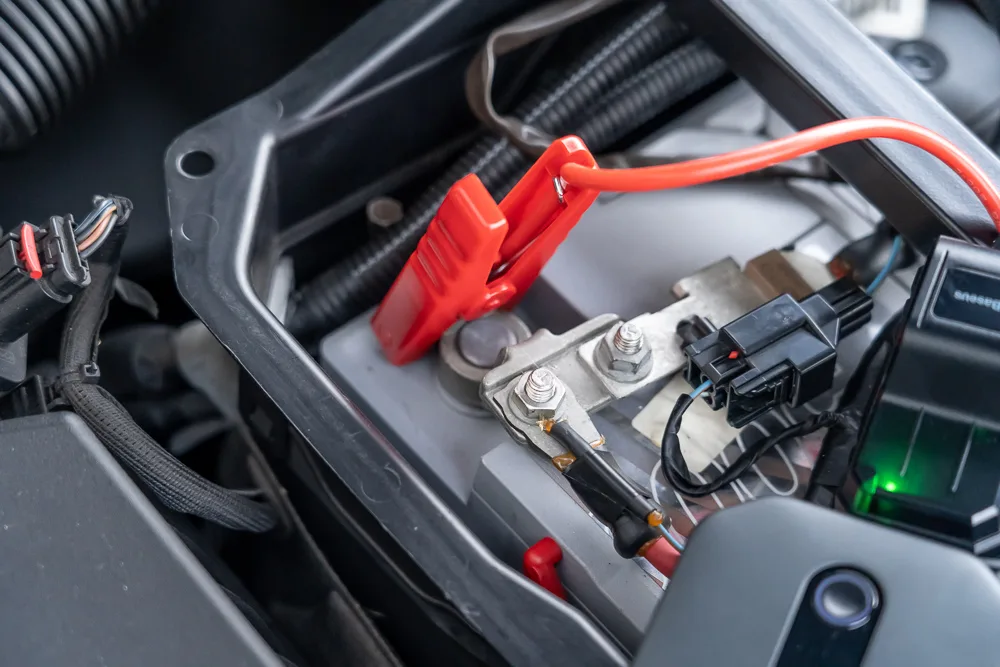
- Open the Camry's hood and locate the red-capped positive terminal in the fuse box.
- Connect the red (positive) clamp to the Camry's positive terminal.
- Connect the other red clamp to the donor vehicle's positive battery post.
- Connect the black (negative) clamp to the donor vehicle's negative battery post.
- Connect the last black clamp to an unpainted metal ground point on the Camry.
- Start the donor vehicle and let it idle for 5 minutes to send a charge through the cables.
- With your foot on the Camry's brake pedal, press the start button. The dashboard should light up and the READY indicator should appear.
- If the Camry doesn't go READY on the first try, wait another 5 minutes and try again.
- Once the Camry is in READY mode, disconnect the cables in reverse order: ground on the Camry, negative on donor, positive on donor, positive on Camry.
Don't turn off the Camry right away. Drive it for at least 30 minutes to let the hybrid system's DC-DC converter recharge the 12V battery. A short idle in the driveway won't do it.
Step-by-Step: Jump-Starting With a Portable Jump Starter
A portable jump starter is the better option if you're parked alone in a lot or a garage. The steps are almost identical, but you skip the donor car.
- Make sure the jump starter is fully charged. Most have an LED indicator showing battery level.
- Connect the red clamp to the Camry's positive terminal under the hood.
- Connect the black clamp to an unpainted metal ground point.
- Turn on the jump starter.
- Wait 30 seconds for the jump starter to detect the load and stabilize output.
- Press the Camry's brake pedal and push the start button.
- Once READY appears, turn off the jump starter before disconnecting.
- Remove the black clamp first, then the red clamp.
Lithium jump starters rated for 1,000 to 2,000 peak amps handle the Camry Hybrid 12V system easily. Anything under 800 amps may struggle on a cold day or a deeply discharged battery.
What to Do After a Successful Jump
A successful jump gets you driving, but it doesn't fix the underlying problem if the 12V battery was already weak. Here's what to do in the next 24 hours.
Reset Lost Settings
A dead 12V battery wipes out stored memory in the radio, clock, and ECU. You'll likely need to reset the clock, re-enter radio presets, and in some cases reinitialize the power windows. To reset the windows, hold each window switch in the up position for 5 seconds after the door is fully closed.
The auto-up feature should come back.
Drive the Car to Recharge
Take a 30 to 60 minute drive at highway speeds if possible. The DC-DC converter charges the 12V battery from the high-voltage pack while the hybrid system runs. Short trips and idle-only sessions don't put enough energy back.
Watch for Warning Lights
A check engine light or hybrid system warning light may appear after a jump. This usually clears on its own after a few drive cycles. If the light stays on after 3 days of normal driving, get the codes read at a dealer or independent shop.
Test the Battery
Stop by any auto parts store for a free battery load test. This tells you if the 12V battery can still hold a charge or if replacement is the next step. Most stores will test it in under 10 minutes while you wait.
If the 12V battery fails the load test, plan on a replacement. Most Camry Hybrid 12V batteries run $180 to $350 for the part, plus 30 to 60 minutes of labor if a shop handles it.
Common Mistakes That Can Damage Your Hybrid System
Most jump-start failures on Camry Hybrids come down to a few predictable errors. Avoid these, and you'll save yourself a tow to the dealer.
Mistake: Connecting Cables to the High-Voltage System
The orange cables under the hood are not jump points. They're part of the high-voltage inverter circuit, and clamping a 12V booster to them can blow the inverter, damage the DC-DC converter, or both. Repair costs run $3,000 to $6,000 on average.
Mistake: Connecting Negative to the 12V Battery Negative
There's no negative post under the hood for a reason. Hooking the black clamp directly to the 12V battery's negative terminal in the trunk creates a spark risk near battery gases. Always use a remote chassis ground.
Mistake: Trying to Push-Start a Hybrid
A Camry Hybrid has no starter motor, and the hybrid system can't engage through motion the way a manual transmission can. Pushing or rolling the car to "start" it does nothing. You need a 12V boost to wake the computers first.
Mistake: Revving the Donor Engine
High RPM on the donor vehicle doesn't speed up the boost. The 12V system charges at the same rate whether the donor idles at 700 RPM or 2,500 RPM. Just let it idle and wait.
Mistake: Driving Only a Short Distance Afterward
A 5-minute drive to the grocery store won't recharge a depleted AGM battery enough to restart the car later. You need at least 30 minutes of continuous driving to put meaningful charge back.
Safety Rules Around the High-Voltage Battery
The hybrid battery system is genuinely dangerous. It operates at several hundred volts DC, and DC current causes muscle contraction that doesn't release. Treat every orange wire, orange conduit, and component labeled "HIGH VOLTAGE" as live.
What to Never Touch
- Orange high-voltage cables anywhere in the vehicle
- The service disconnect plug under the rear seat (orange handle)
- The inverter assembly mounted near or behind the engine
- The high-voltage battery pack itself
What You Can Safely Do
- Touch the 12V battery terminals after disconnecting the negative cable
- Use jumper cables on the under-hood positive terminal and a chassis ground
- Drive the car normally once the READY light is on
If You Smell Something Burning or See Smoke
Stop driving immediately. Turn off the hybrid system. Exit the vehicle.
Do not attempt to disconnect the 12V battery. Call roadside assistance or a flatbed tow. A smoking or hissing hybrid battery can ignite, and water on a high-voltage battery creates its own hazards.
For official guidance on hybrid vehicle emergency response, NHTSA publishes first responder procedures that mirror what owners should know.
Jump-Starting vs. Battery Replacement: How to Decide
A jump start buys you time. A battery replacement solves the problem. Knowing which one you need saves money and prevents a second roadside emergency.
Choose a Jump Start If
- The 12V battery is less than 3 years old
- The car sat for several weeks without use
- You left an accessory on (interior light, phone charger)
- The car starts normally after the boost and runs fine
Choose a Replacement If
- The 12V battery is more than 4 years old
- You've needed multiple jumps in the past 6 months
- The battery won't hold a charge after a 60-minute drive
- The car struggles to recognize the smart key even after a successful jump
What a New 12V Battery Costs
| Option | Typical Cost (2026) | Notes |
|---|---|---|
| AGM 12V battery (part only) | $180-$280 | OEM spec for Camry Hybrid |
| Dealer installation | $120-$200 | Includes system registration |
| Independent shop | $80-$140 | Cheaper but verify AGM rating |
Always replace with the same battery group size and AGM chemistry. A flooded lead-acid battery won't last in the trunk location because the hybrid system's charging profile expects AGM.
Why Your 12V Battery Keeps Dying
If you've jumped the car more than once, something is pulling the battery down faster than the system can recharge it. Common culprits include a stuck relay in the DC-DC converter, an aftermarket accessory wired directly to 12V (dashcam, radar detector, phone charger), a failing smart key fob that keeps the car awake, a weak hybrid battery that won't hold enough charge for the converter to run, or corroded battery terminals on the trunk-mounted 12V.
Have a shop run a parasitic draw test if the problem repeats. The test measures how much current the car pulls while parked, and anything over 50 milliamps means something isn't sleeping properly.
Frequently Asked Questions
Can you jump start a Camry Hybrid from another Camry Hybrid?
Yes. The procedure is identical to jumping from any donor vehicle. Both cars are 12V systems at the jump points, so any working 12V donor works fine.
Just make sure the donor is off before you connect the cables.
How long does it take to charge a dead Camry Hybrid 12V battery?
Plan on 5 to 10 minutes of donor-vehicle idling before the Camry will go READY. After that, drive for at least 30 minutes to put meaningful charge back. A fully depleted AGM battery may need several hours of driving over multiple days to recover to full capacity.
Will jump starting a Camry Hybrid void the warranty?
No. Toyota's warranty covers 12V battery replacement under the hybrid system warranty for 8 years or 100,000 miles in most US states, and 10 years or 150,000 miles in CARB-compliant states. Jump starting is a normal maintenance procedure and doesn't void coverage.
What happens if you connect jumper cables wrong on a Camry Hybrid?
Reversing polarity can blow fuses, damage the DC-DC converter, or fry the hybrid system computer. Typical repair costs run $1,500 to $4,000. If you hear a pop or see sparks while hooking up, stop and check the connections before touching the start button.
Can a Camry Hybrid be towed if the 12V battery is dead?
Yes, but only on a flatbed. Towing a Camry Hybrid with the front wheels on the ground can damage the hybrid transmission because the electric motors can spin without lubrication. Flatbed towing or dolly towing the front wheels off the ground is the safe method.
Do you need to replace the 12V battery more often on a Camry Hybrid?
Slightly more often than a conventional car in hot climates. The AGM battery is sealed and maintenance-free, but heat accelerates the chemical breakdown. In moderate climates, expect 4 to 6 years.
In hot climates like Arizona or Florida, 3 to 4 years is more typical.
Decision Guide: DIY, Roadside Help, or Dealer Service
The right choice depends on where you are, what you have, and how comfortable you are under the hood.
DIY Works Best If
- You have jumper cables or a charged portable jump starter
- You can safely position the donor vehicle or you're parked alone
- The 12V battery is less than 4 years old
- You've done a 12V jump on a regular car before
Call Roadside Assistance If
- You're on a busy highway or unsafe location
- You don't have cables and no other driver is nearby
- The car makes clicking noises but doesn't respond to a jump attempt
- You're unsure which terminal is which
Go to the Dealer If
- The 12V battery is more than 4 years old and needs replacement
- You see hybrid system warning lights after the jump
- The car won't go READY even after 15 minutes of connected charging
- You smell anything sweet or burning from the high-voltage system
AAA reports that 12V battery issues are one of the top three roadside calls for hybrid owners. Most get resolved in under 30 minutes, and very few require a tow. Knowing your jump points and keeping a portable jump starter in the car makes the whole process almost routine.