How big of a jump starter do i need: Easy Guide
How big of a jump starter do I need? The short answer depends on your engine size, your climate, and how dead your battery is. Most passenger cars do fine with a 1,000-peak-amp lithium unit.
Trucks and diesels need more. Get the math wrong and you'll either waste money on overkill or watch a too-small unit click uselessly on a cold morning.
The real sizing comes down to cold cranking amps (CCA), which the Battery Council International defines as the number of amps a battery can deliver at 0°F for 30 seconds while holding above 7.2 volts. If your vehicle's battery calls for 600 CCA, your jump starter needs to clear that bar with room to spare. As of 2026, lithium-ion and LiFePO4 units are the mainstream picks, and the ratings have gotten more honest.
Let's walk through how to land on the right number for your specific setup.
Quick Answer
Match your jump starter to your engine size. Small 4-cylinder engines need about 400 to 600 peak amps. Mid-size V6 engines need 800 to 1,000.
V8 and diesel engines need 1,000 to 2,000 peak amps. Add 20 to 30 percent if you live in a cold climate.
Why Jump Starter Size Isn't One-Size-Fits-All
Peak amp ratings on jump starters range from 400 to over 4,000. That's a 10x spread, and most buyers land somewhere in the middle without much thought. The problem is that "middle" doesn't mean "right."
If you buy a compact 600-peak-amp unit for your F-250 with the 6.7L Power Stroke, it might crank the engine on a warm day in Phoenix. Put that same setup in a Minnesota February at negative 10°F, and the starter will just click. The chemistry gets sluggish, the oil thickens, and the battery's already half-dead.
You need overhead.
On the flip side, dropping $400 on a 3,000-amp commercial unit for your Civic is overkill. It works, sure. But you're hauling around extra weight, paying for capacity you'll never use, and often paying a premium for features like an air compressor that you don't need.
Aggregate reviews show that most buyers overspend by about 30 to 50 percent because they're guessing at "more is better."
The fix is to size the unit to three things: engine displacement, fuel type (gas vs. diesel), and your coldest operating temperature. Once you've got those three nailed down, the answer gets surprisingly specific.
The Three Numbers That Actually Matter (Peak Amps vs. Cranking Amps vs. CCA)
Most jump starter listings throw around "amps" like it's one number. It's not. There are three different ratings, and confusing them is the fastest way to buy the wrong unit.
Peak amps is the maximum burst a jump starter can deliver for a few seconds. It's the big number on the box, and it's the most misleading. Peak amps happen for a moment, not long enough to actually crank most engines.
Budget brands inflate this number hard.
Cranking amps (CA) is what the unit can sustain for 30 seconds at 32°F. This is closer to a real-world rating, but it's still measured at a relatively warm temperature.
Cold cranking amps (CCA) is the gold standard. It's measured at 0°F over 30 seconds, which mirrors what your starter actually pulls on a cold morning. SAE International's J537 standard governs how this gets tested.
Here's the practical breakdown:
| Rating | What It Measures | Why It Matters |
|---|---|---|
| Peak Amps | Max burst (1-3 seconds) | Marketing number, often inflated |
| Cranking Amps (CA) | Sustained at 32°F | Better real-world indicator |
| Cold Cranking Amps (CCA) | Sustained at 0°F | Most accurate for cold starts |
When you're sizing, look for the CA or CCA rating on the spec sheet, not just the peak amp number. If a brand only lists peak amps, that's a red flag. Reputable manufacturers like NOCO, Antigravity, and Clore Automotive publish all three.
Match the Jump Starter to Your Engine Size
Engine displacement is the single biggest factor in determining your jump starter size. Here's how the math typically breaks down based on manufacturer specifications and aggregate user data.
Gasoline Engines: Small, Mid, and Large
A general rule of thumb from industry guidance: you need about 1 amp of cranking power per cubic inch of engine displacement for a gas engine at moderate temperatures.
- 4-cylinder (1.5 to 2.5L / 90 to 150 cubic inches): 400 to 600 peak amps is the sweet spot. Anything more is wasted capacity.
- V6 (3.0 to 4.0L / 180 to 240 cubic inches): 800 to 1,000 peak amps. This is where most SUVs and trucks fall.
- V8 (5.0 to 6.2L / 300 to 380 cubic inches): 1,000 to 1,500 peak amps. Don't go below 1,000 if you're running a big-block.
- V10 / large displacement (6.5L+): 1,500 to 2,000+ peak amps. These are work trucks and specialty vehicles.
Diesel Engines: Why They Need Roughly Double
Diesels are a different beast. They compress air at much higher ratios, which means the starter motor works harder. As a rule, diesel engines need about twice the cranking amps of a comparable gas engine.
A 6.7L Power Stroke in moderate weather wants at least 1,500 peak amps. In cold weather, you're looking at 2,000 or more.
The glow plugs also draw current during startup, which adds to the load. If you drive a diesel, plan on going up at least one size class from where the gas equivalent would land you.
Motorcycles, ATVs, and Small Powersports
Small engines don't need much. A 250 to 600 peak amp unit will handle most motorcycles, ATVs, and UTVs. The bigger concern with powersports is the battery size.
Many motorcycles run small batteries that drain fast, so a lower-capacity jump starter with a gentle output curve is actually better than a massive unit.
Cold Weather Changes Everything
Cold cuts battery capacity roughly in half. At 0°F, a lead-acid battery delivers about 50 percent of its rated CCA. Lithium batteries handle cold better, but they still lose output below freezing.
If you live anywhere that sees temperatures below 20°F regularly, here's what changes:
- Bump your amp rating by 20 to 30 percent. A car that needs 600 peak amps in Texas wants 800 in Wisconsin.
- Look for a unit rated for low-temperature operation. Some lithium chemistries won't deliver full power below 14°F. LiFePO4 handles cold better than standard lithium-ion.
- Keep the jump starter warm. Storing it in the cab instead of the trunk helps. Cold-soaked units underperform even if they're rated for it.
Manufacturers like Antigravity and NOCO publish operating temperature ranges in their spec sheets. Aggregate user reviews confirm that storing the unit indoors and using it within minutes of pulling it out makes a measurable difference in cold-weather performance.
The flip side matters too. Extreme heat (above 110°F) degrades lithium battery life over time. If you're in Arizona or Texas, don't leave a jump starter baking in the trunk every day.
Bring it inside overnight.
Your Jump Starter Sizing Checklist (5 Questions to Answer First)
Before you commit to a size, run through this quick checklist. It takes about 30 seconds and saves you from buying the wrong unit.
- What's your engine size? 4-cylinder, V6, V8, or diesel? Check the owner's manual or the spec sticker under the hood.
- What's the fuel type? Gasoline or diesel? If diesel, plan on roughly double the amp rating.
- What's the coldest temperature you'll see? If you regularly face sub-20°F mornings, add 20 to 30 percent overhead.
- Is the battery fully dead or just weak? A deeply discharged battery takes more cranking time. A weak battery that just needs a bump might start on less.
- Do you want it to double as a power bank or air compressor? Multi-function units cost more but consolidate gear.
If you can answer those five, you've effectively got a shopping list. Skip the guesswork.
Step-by-Step: How to Figure Out Your Minimum Amp Requirement
Here's the decision logic in plain steps.
Step 1: Look up your engine's required CCA. Open your owner's manual or check the label on your current battery. It will list a CCA number, often between 500 and 1,000 for most passenger vehicles.
Step 2: Add 20 percent headroom. Your jump starter should deliver at least 20 percent more than the battery's CCA rating. If your battery calls for 600 CCA, look for a jump starter rated at 720 CCA or higher.
Step 3: Adjust for climate. If you're in a cold region, bump that number up another 20 to 30 percent. A 720 CCA target becomes 850 to 940 in Minnesota.
Step 4: Adjust for diesel if needed. Double the final number for diesel engines. A 940 CCA target for a gas V8 becomes roughly 1,800 for a comparably sized diesel.
Step 5: Find the peak amp equivalent. Most manufacturers list peak amps on the front of the box but bury the CA or CCA in the spec sheet. As a rough conversion, divide the peak amp number by 1.5 to 2 to get a realistic CA estimate. A 1,500 peak amp unit typically delivers around 750 to 1,000 CA.
If that math feels like a lot, jump to the chart below for a shortcut.
Sizing Chart by Engine Type and Climate
Here's a quick reference table based on manufacturer specs and aggregate user data from 2025-2026. Use it as a starting point, not gospel.
| Engine Type | Mild Climate (Above 30°F) | Cold Climate (Below 30°F) |
|---|---|---|
| 4-Cyl Gas (1.5-2.5L) | 400-600 peak amps | 600-800 peak amps |
| V6 Gas (3.0-4.0L) | 800-1,000 peak amps | 1,000-1,200 peak amps |
| V8 Gas (5.0-6.2L) | 1,000-1,500 peak amps | 1,500-2,000 peak amps |
| Diesel (any size) | 1,500-2,000 peak amps | 2,000-3,000+ peak amps |
| Motorcycle / ATV | 250-600 peak amps | 400-800 peak amps |
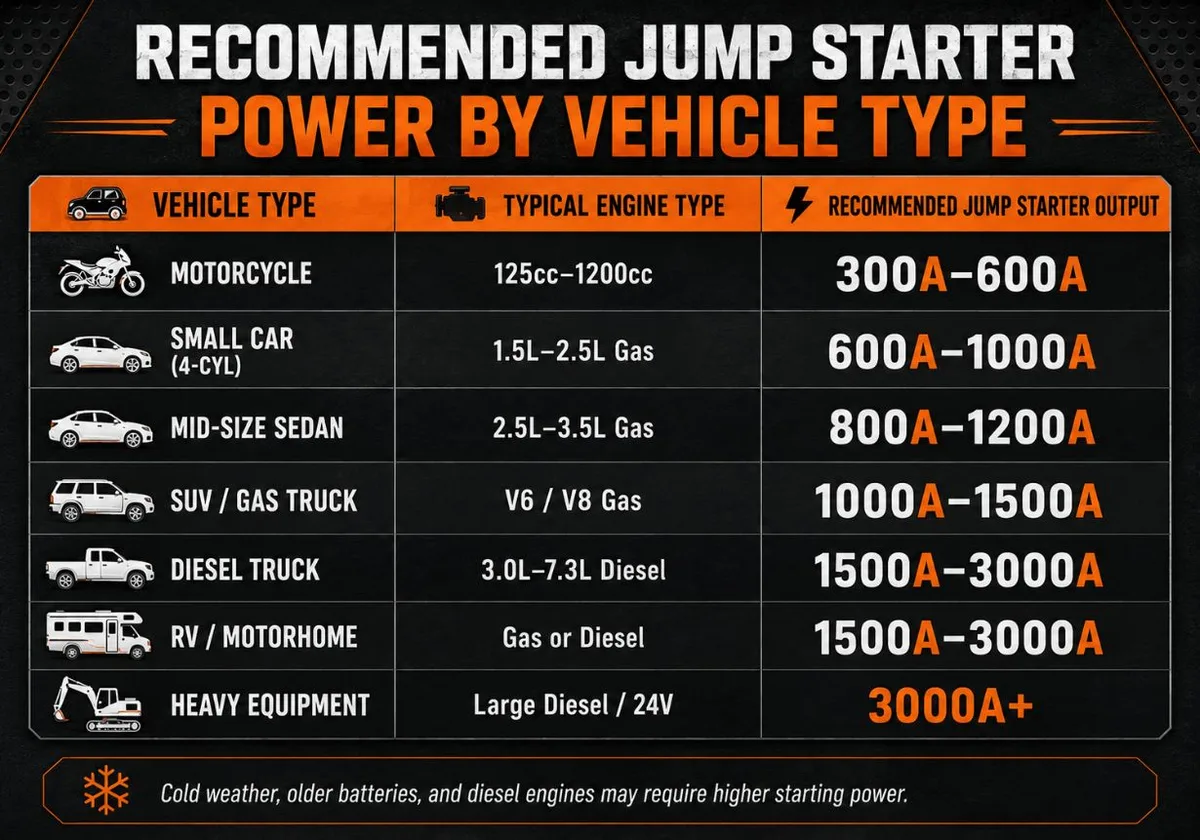
If you're between sizes, go bigger. The cost difference between a 1,000 and 1,500 peak amp unit is usually $30 to $50, and the extra capacity buys you cold-weather margin and longer battery life per charge.
Common Mistakes When Sizing a Jump Starter
Most buyers don't undersize on purpose. They just don't know what to look for. Here are the errors that show up again and again in verified buyer feedback.
Buying based on peak amps alone. Peak amp numbers are inflated across the industry. A 2,000 peak amp unit from a no-name brand might deliver less real-world cranking power than a 1,200 peak amp unit from a reputable maker.
Forgetting about cold weather. If you've only ever jump-started in mild weather, you don't know what your unit can do in February. Cold cuts capacity hard, and the same unit that works great in Dallas might fail in Denver.
Underestimating diesel. Diesel engines are far more demanding at startup. A jump starter that handles a 5.0L gas V8 will not necessarily handle a 5.0L Cummins. The compression ratios and glow plug draw make a real difference.
Cheaping out on clamps. The clamps matter as much as the battery. Cheap clamps have thin cables, weak springs, and poor contact. They heat up under load and can melt.
Look for copper-clad clamps with at least 6-gauge cable.
Skipping the recharge habit. A jump starter left in a trunk for two years will be dead when you need it. Top off the charge every 3 to 6 months, even if you haven't used it.
Peak Amps vs. Cranking Amps: The Marketing Trap
Let's dig into this because it costs people money. The peak amp rating is the number manufacturers splash across the front of the box. It represents the absolute maximum current the unit can push for a few seconds, often under ideal lab conditions.
In real-world use, your starter motor pulls sustained current for 3 to 10 seconds per crank. The peak amp burst happens in the first fraction of a second, then the current settles to a lower, sustained level. That sustained level is what actually cranks the engine.
It's closer to the CA or CCA rating.
Here's the trap: a $40 budget unit might advertise "2,000 peak amps!" while a $150 name-brand unit lists "1,000 peak amps." The cheap one looks like a steal. But if you look at the fine print, the budget unit delivers 400 CA while the premium unit delivers 800 CA. The premium unit wins every time.

How to spot the fakes: if a brand only lists peak amps and won't publish CA or CCA, walk away. Reputable manufacturers like NOCO, Antigravity, DeWalt, Schumacher, and Clore Automotive publish all three numbers. They have nothing to hide.
Manufacturer specifications indicate that a unit rated for 1,000 CA can typically start any gasoline engine up to a V8 in moderate weather. That's the number to shop by, not the flashy peak amp figure on the front of the box.
Lithium-Ion vs. LiFePO4 vs. Lead-Acid: Which Chemistry Fits Your Situation?
Battery chemistry matters more than most buyers realize. The three main options each have real tradeoffs.
Lithium-ion (LiPo or NMC) is the most common. It's lightweight, compact, and affordable. The downside is cold-weather performance.
Below about 14°F, standard lithium-ion delivers noticeably less current. If you live in a warm climate and want the lightest unit possible, this is your pick.
LiFePO4 (lithium iron phosphate) handles cold better and lasts roughly 2x to 3x more charge cycles than standard lithium-ion. It's slightly heavier and costs more, but for cold-climate drivers and frequent users, it's the smarter long-term buy. Aggregate user reviews consistently show LiFePO4 units holding capacity after 1,000+ charge cycles.
Lead-acid jump starters are the old-school choice. They're cheap, they work in extreme cold, and they're heavy. A typical lead-acid unit weighs 15 to 20 pounds versus 2 to 4 pounds for a lithium equivalent.
They're still used in professional settings and for very large engines, but for most consumers, lithium or LiFePO4 makes more sense.
| Chemistry | Weight | Cold Performance | Cycle Life | Best For |
|---|---|---|---|---|
| Lithium-ion (NMC) | Lightest | Poor below 14°F | 300-500 cycles | Warm climates, occasional use |
| LiFePO4 | Medium | Good to 0°F | 1,000-2,000 cycles | Cold climates, frequent use |
| Lead-Acid | Heaviest | Excellent | 200-300 cycles | Commercial, extreme cold |
Features Worth Paying For (and the Ones to Skip)
Not every feature adds value. Here's what actually matters and what's just marketing fluff.
Worth paying for:
- Reverse polarity protection. This stops the unit from frying if you clip the cables backward.
- Spark-proof clamps. Safer connection, especially in dim conditions.
- A built-in voltmeter or status display. Shows remaining charge and battery health.
- USB-C and 12V outputs. Doubles as a power bank for phones and small devices.
- A quality carrying case. Protects the unit and keeps cables organized.
Skip if you want to save money:
- Built-in air compressors. They're convenient, but they rarely match the quality of a standalone compressor. If you need one for tires, buy a real compressor.
- Excessive peak amp ratings above 3,000. Diminishing returns for most drivers.
- Proprietary charging cables. Standard USB-C is easier to replace.
UL-certified units go through additional safety testing for short-circuit and overcurrent protection. Per UL safety standards, certified units have independent verification of their safety claims. That's worth a few extra dollars.
Safety Features You Shouldn't Compromise On
A jump starter is a high-current device. Mistakes can fry electronics, melt cables, or in rare cases, start a fire. These features are non-negotiable.
- Reverse polarity protection: shuts the unit down if you connect the clamps to the wrong terminals.
- Spark-proof technology: prevents sparks at the moment of connection.
- Overcurrent protection: stops the unit from pushing more amps than it's rated for.
- Short-circuit protection: protects the unit if the clamps accidentally touch each other.
- Overcharge protection: prevents damage to the internal battery if you leave it plugged in too long.
If your unit lacks these, it's not a deal, it's a hazard.
How to Actually Use a Jump Starter Once You've Picked the Right Size
Having the right size is only half the battle. Using it correctly matters too. Here's the workflow in plain steps.
- Turn off the jump starter and the vehicle. All accessories off, keys out of the ignition.
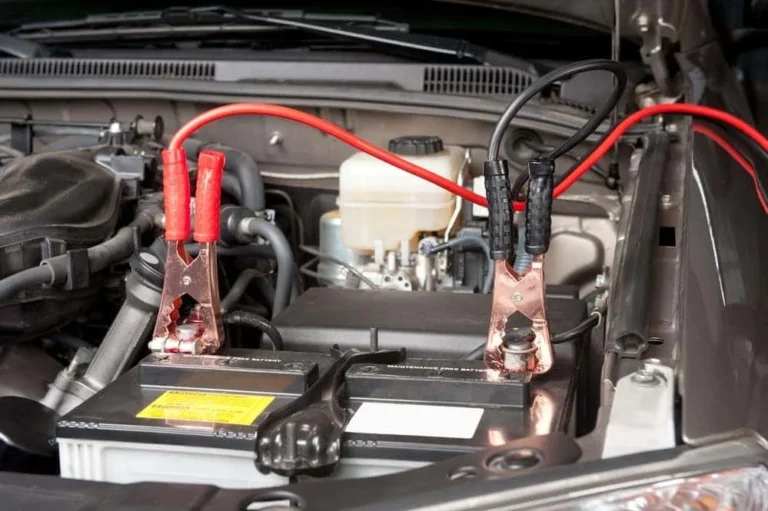
- Connect the red (positive) clamp to the dead battery's positive terminal.
- Connect the black (negative) clamp to an unpainted metal surface on the engine block. Not the negative terminal, a ground point. This reduces sparking near the battery.
- Power on the jump starter. Wait for the status light to confirm a good connection.
- Crank the engine for 3 to 5 seconds. If it doesn't start, wait 15 to 30 seconds before trying again. Multiple short attempts beat one long one.
- Once the engine starts, disconnect the black clamp first, then the red. Let the vehicle run for at least 15 minutes to recharge the battery.
If the engine doesn't start after 3 to 4 attempts, the jump starter is likely undersized, the battery is beyond recovery, or there's a deeper electrical issue. Don't keep cranking. You can overheat the unit or damage the starter motor.
Long-Term Care: Keeping Your Jump Starter Ready When You Need It
A jump starter that sits dead in your trunk is worthless when you actually need it. Storage habits matter.
Charge it every 3 to 6 months. Lithium batteries slowly self-discharge. If you let it sit for a year, it'll be dead. Set a calendar reminder or just plug it in when the seasons change.
Store it indoors in extreme temperatures. Heat degrades lithium batteries over time. Cold temporarily reduces output. A climate-controlled garage or closet is ideal.
Inspect the clamps and cables before each use. Look for corrosion, cracking, or exposed wire. Damaged clamps can fail under load.
Test it once a year. Most units have a self-test button or a battery level indicator. Run the test. If the charge has dropped significantly, top it off.
Aggregate user reviews consistently show that units maintained on a regular charge schedule last 5+ years. Neglected units often fail within 2.
Jump Starter vs. Jumper Cables vs. Battery Charger: Which Wins?
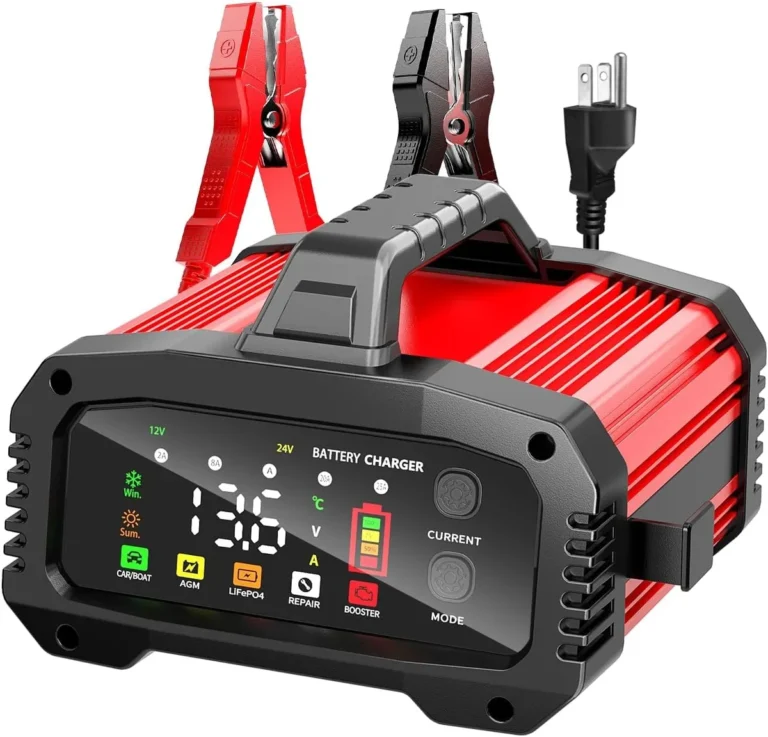
Each tool has a job. Jumper cables need a second vehicle. They're free (if you already own them) and work in any weather, but you need a good Samaritan nearby. Jump starters are self-contained. No second car needed, which is the whole point. Battery chargers are slow.
They trickle-charge over hours and don't deliver the instant burst a starter needs.
For most drivers, a portable jump starter is the right pick. It's the only option that works when you're alone in a parking lot at 2 a.m.
Final Recommendation: Picking Your Size Without Overthinking It
If you've made it this far, the answer is probably staring you in the face. Gas V6 or smaller, mild climate? A 1,000-peak-amp lithium unit is your sweet spot.
V8 or cold climate? Step up to 1,500 to 2,000 peak amps. Diesel or work truck?
Plan on 2,000-plus, ideally in LiFePO4. Buy from a brand that publishes CA and CCA ratings, not just peak amps. Top off the charge every few months.
You'll be fine.
Frequently Asked Questions
What size jump starter do I need for a 6.0L V8?
You need at least 1,000 peak amps for a 6.0L gas V8 in mild weather. In cold climates below 30°F, bump that to 1,500 to 2,000 peak amps. Look for a unit that publishes CA or CCA, not just peak amp numbers.
Can a jump starter be too powerful for a car?
No. A jump starter with more amps than you need will still work fine. The vehicle only pulls what it requires.
The downsides are extra cost, extra weight, and a larger unit to store. Oversizing by 20 to 30 percent is smart. Oversizing by 2x or more is just money wasted.
How many cold cranking amps do I need in a jump starter?
Match or exceed your battery's CCA rating by at least 20 percent. If your battery calls for 600 CCA, your jump starter should deliver 720 CCA or higher. In cold climates, add another 20 to 30 percent on top of that.
Will a 1000 amp jump starter start a dead battery?
Yes, in most cases. A 1,000 peak amp unit can start any gas engine up to a V8 with a moderately discharged battery. If the battery is fully dead (below 10 volts), you may need a higher-rated unit or a few extra cranking attempts to bring the battery back to life.
How long does a portable jump starter hold its charge?
Most lithium jump starters hold a charge for 6 to 12 months when idle. After that, they slowly self-discharge. Top off the charge every 3 to 6 months to keep the unit ready when you need it.
Lead-acid units self-discharge faster and may need monthly top-offs.