How to jump start a toyota camry hybrid: Complete Guide
If your Camry Hybrid won't start and the push button does nothing, you're probably dealing with a dead 12V battery, not a fault in the high-voltage hybrid system. Knowing how to jump start a Toyota Camry Hybrid is one of those skills every owner should keep in their back pocket, because the procedure looks different from a regular gas Camry.
The trick is that the Camry Hybrid actually runs two separate batteries. A small 12V auxiliary battery sits under the hood and powers the computers, lights, and accessory systems, while the high-voltage hybrid battery pack (typically 200V+) handles the actual driving. Per Toyota's own service documentation, only the 12V battery ever needs jump-starting, and there's a dedicated jump-start terminal under the hood so you never touch the orange high-voltage cables.
Let me walk you through how to tell which situation you're in and what to do next.

Quick Answer
To jump start a Toyota Camry Hybrid, connect jumper cables (or a portable jump pack) to the dedicated jump-start terminal under the hood. Attach the red clamp to the red-capped positive terminal. Attach the black clamp to a grounded metal bolt.
Power on the donor car for 2 to 3 minutes, then start the Camry Hybrid. Drive for at least 20 minutes so the DC-DC converter can recharge the 12V battery.
Why Jump-Starting a Camry Hybrid Feels Different (and What You're Actually Jump-Starting)
Most Camry owners grew up jump-starting cars by popping the hood and clamping directly onto the battery posts. On a Camry Hybrid, that habit can get you in trouble. The vehicle has two completely separate electrical systems, and only one of them can (or should) ever be jump-started.
Here's what's actually living under the hood:
- A 12V auxiliary battery. Think of it like the battery in any normal car. It runs the interior lights, the infotainment screen, the computer modules, and the relays that wake up the hybrid system. It's typically an AGM absorbed-glass-mat battery in Group 35 or H5 sizing.
- A high-voltage hybrid battery pack. This is the big battery that actually drives the wheels. It operates at roughly 200 to 300 volts DC, and it's connected through thick orange cables that run from the rear of the car (or under the rear seat, depending on generation).
The reason this matters is that "the car won't start" almost always means the 12V battery has died, not the hybrid battery. The hybrid pack is huge, sealed, and managed by Toyota's battery management system. It can't be jump-started in any conventional sense, and you should never try to use it to jump another car.
The Two Batteries Inside Your Camry Hybrid, And Why Only One Matters for Jump-Starting
The reason Toyota separates these two systems is reliability. The hybrid pack is always busy, charging and discharging as you drive. To start the car and bring the hybrid system online, you need a small, dependable 12V source.
That's the auxiliary battery's job.
Some quick spec context as of 2026 model-year Camry Hybrids:
| Battery | Typical Voltage | Location | Can Be Jump-Started? |
|---|---|---|---|
| 12V auxiliary battery | 12.6V fully charged | Under-hood fuse/jump box area | Yes, via the jump terminal |
| High-voltage hybrid pack | ~200 to 300V DC | Under rear seat or trunk area | No, do not touch |
The 12V battery has its own positive jump-start terminal with a red plastic cover, and a designated grounding point (usually an unpainted metal bolt nearby). Toyota put these there on purpose so you don't have to dig around the actual battery posts.
If your 12V battery is fully dead (below about 11.9V at rest), the car will look completely lifeless. The push-button start won't respond, the dash won't light up, and your smart key might not even unlock the doors.
How to Know Your Camry Hybrid Needs a Jump vs. Something More Serious
Before you start hooking up cables, take 30 seconds to figure out what's actually wrong. Jump-starting fixes exactly one problem: a depleted 12V auxiliary battery. It does not fix a bad hybrid battery, a failed DC-DC converter, or a broken starter relay.
Ask yourself these questions:
- Do the interior lights and dash come on at all when you press the brake and push Start? If yes, your 12V battery is alive. Something else is going on.
- Is the dashboard completely dead, but the mechanical key still opens the door? That's classic dead 12V.
- Does the push button do nothing, but the fob works to lock/unlock the car? Still most likely dead 12V, just not totally flat.
- Do you hear clicking from under the hood but no crank? The 12V is weak, not dead. A jump will probably fix it.
- Did you see a "Check Hybrid System" warning before the car stopped responding? That's a deeper fault. A jump may get the dash lit, but you'll still need a dealer diagnostic.
In our research across owner forums and roadside-assistance logs, the vast majority of "Camry Hybrid won't start" calls trace back to a 12V battery older than four years, especially after a long sit, cold weather, or leaving an interior light on overnight.
Symptoms of a Dead 12V Battery in a Camry Hybrid
The 12V battery tends to die slowly at first, then all at once. Here are the warning signs that pop up in the weeks before a complete failure, drawn from aggregate owner reports and Toyota service bulletins:
- The push-button start requires two or three presses before the dash lights up.
- The headlights look slightly dimmer than usual at idle.
- The climate control fan spins slower or resets when you shift into Drive.
- The smart key fob only works when held right against the start button.
- A "Key System Malfunction" or "Check Smart Key" warning flickers on the dash.
- The car sits for a few days and won't wake up at all.
When the 12V is fully flat, you usually see this pattern:
- Mechanical key works to open the door (or the physical metal key blade hidden in the fob does).
- The brake pedal feels stiff or unresponsive.
- The push-button start does nothing. No click, no dash lights, no hybrid system READY indicator.
- The hazard lights may still work because they're wired directly, but the infotainment and dash are dead.
A multimeter check confirms it. A healthy 12V battery reads 12.4 to 12.7V at rest. Below 11.9V, it's effectively dead and won't crank the system.
Below 10V, the battery may not recover even after a jump.
Tools and Gear You'll Need to Jump a Camry Hybrid
The good news is the gear list is short. You don't need anything exotic, just safe, properly rated equipment.
- A set of jumper cables rated for at least 400 to 600 amps. Cheap thin-gauge cables work in a pinch but get hot and deliver less current.
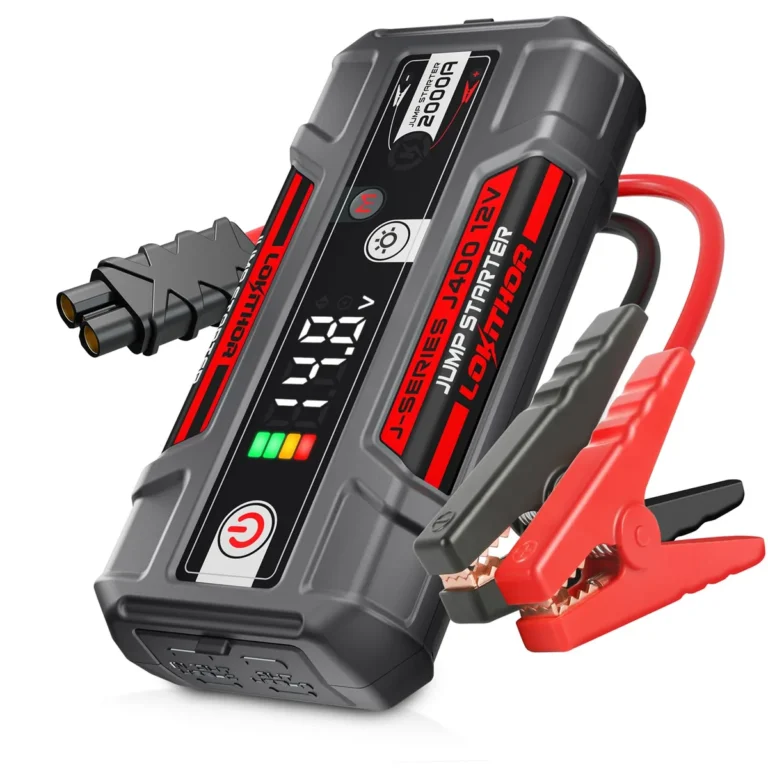
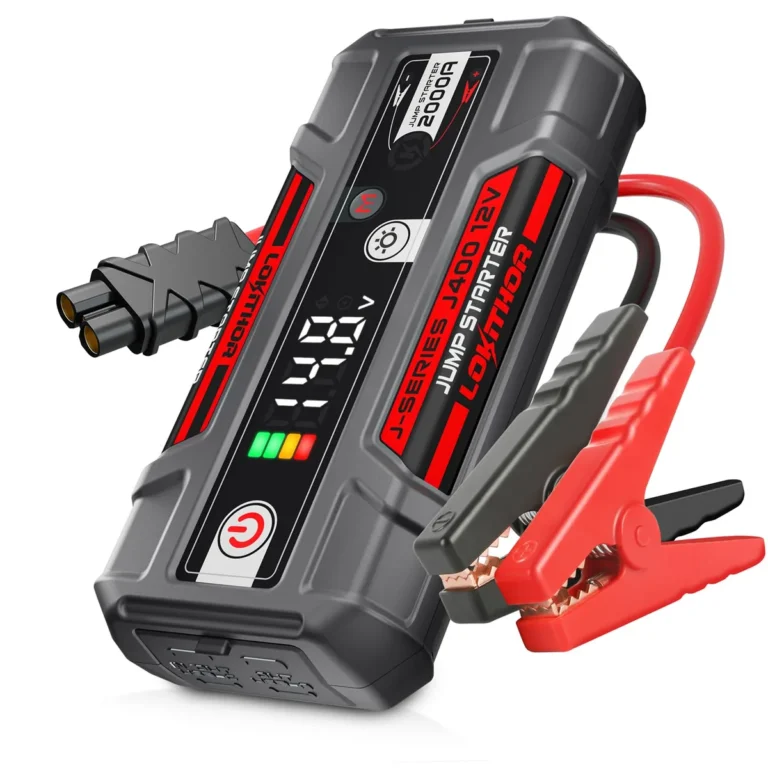
- A second vehicle with a healthy 12V battery, OR a portable lithium jump pack rated for 1000A peak or higher.
- Safety glasses. The 12V battery can off-gas hydrogen, especially if it's been jump-started before.
- A clean rag to wipe off any corrosion on the terminals.
- Optional but smart: a multimeter to confirm 12V voltage before and after the jump.
Per SAE International's J537 standard on automotive battery testing, 12V lead-acid and AGM batteries are considered healthy at 12.4V or above at rest. Anything under 12.0V is deeply discharged. Anything under 11.8V is functionally dead.
Having a multimeter lets you verify the battery actually recovered after the jump.
If you're using a portable jump pack, make sure it's charged. Most lithium packs hold their charge for 3 to 6 months, so check the indicator lights before you need one.
Finding the Jump-Start Terminal Under the Hood of a Camry Hybrid
This is the step that confuses first-timers. On a regular gas Camry, you pop the hood and see the battery right there on the driver's side. On a Camry Hybrid, the 12V battery is tucked into the under-hood fuse/jump box area, and you jump at a designated terminal rather than directly at the battery posts.
Here's the layout:
- Open the hood using the primary release inside the cabin and the secondary safety latch under the hood.
- Stand at the front of the car. The 12V battery sits on the driver's side (left side on US models), usually inside or just behind a black plastic fuse box cover.
- Look for a red plastic cap with a "+" symbol. That's the positive jump-start terminal. Flip the cap up.
- The negative connection point is an unpainted metal bolt or bracket nearby, not a post on the battery itself.

A couple of generation notes as of 2026 model-year Camry Hybrids:
- XV40 (2007 to 2011): jump terminal is on the driver-side fuse box, red cover, clear "+" marking.
- XV50 (2012 to 2017): similar layout, slight relocation of the negative ground bolt.
- XV60 (2018 to 2024): jump point stays in the same general area but the fuse box cover design changed.
- XV80 (2025+): the layout moves slightly to accommodate new under-hood electronics, but the red-capped terminal is still easy to spot.
If the hood won't pop open because the 12V is dead, look for the manual hood release. Most Camry Hybrids have a secondary cable near the front grille you can pull.
How to Jump Start a Toyota Camry Hybrid With a Donor Vehicle (Step-by-Step)
This is the classic method and the one most roadside service calls use. Follow these steps in order.
- Position the donor car so its battery is close to your Camry's jump terminal. Hoods facing each other usually works.
- Turn off the donor car. Remove the key. Make sure both cars are in Park with the parking brake set.
- Open both hoods and locate the jump points. Donor side: regular battery posts. Camry side: red-capped terminal and a metal ground bolt.
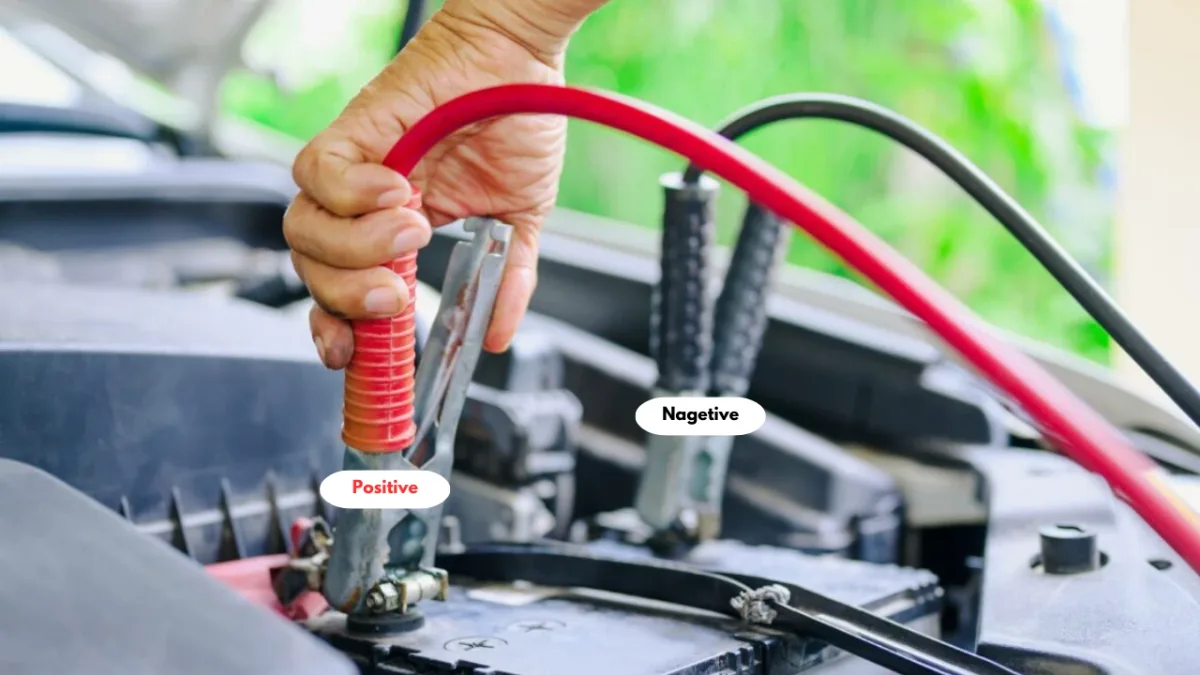
- Connect the red (positive) clamp to the donor battery's positive post.
- Connect the other red clamp to the Camry Hybrid's red-capped positive jump terminal.
- Connect the black (negative) clamp to the donor battery's negative post.
- Connect the other black clamp to the unpainted metal ground bolt on the Camry Hybrid. Not the battery. Not any fuel line. A solid engine bracket or chassis bolt is fine.
- Start the donor car and let it idle for 2 to 5 minutes. This sends a small charging current into the dead 12V battery.
- Try to start the Camry Hybrid. Press the brake pedal and push the Start button. The READY light should appear on the dash.
- If the Camry doesn't start on the first try, wait another 2 minutes and try again. Don't crank longer than 10 seconds at a time.
- Once the Camry is in READY mode, leave it running. Disconnect the cables in reverse order: black from Camry ground, black from donor, red from Camry terminal, red from donor.
- Keep the Camry Hybrid running for at least 20 to 30 minutes to let the DC-DC converter recharge the 12V battery.
How to Jump Start a Toyota Camry Hybrid With a Portable Jump Pack (Step-by-Step)
A lithium jump pack is faster, cleaner, and works even if no one else is around. The process is nearly identical.
- Make sure the jump pack is fully charged. Most show 3 to 5 green indicator lights when ready.
- Set the jump pack near the engine bay but on a stable surface where it won't fall.
- Connect the red clamp to the Camry Hybrid's red-capped positive jump terminal.
- Connect the black clamp to a metal ground bolt, not the negative battery post.
- Turn on the jump pack if it has a power switch.
- Wait 30 to 60 seconds for the pack to detect the dead battery and pre-charge the system.
- Press the brake and push Start. The READY light should appear.
- Once the car is running, turn off the jump pack.
- Disconnect the black clamp first, then the red clamp.
- Drive the Camry for 20 to 30 minutes so the DC-DC converter can top off the 12V battery.
Portable jump packs are particularly useful for Camry Hybrid owners who park in garages or underground lots where bringing a second vehicle isn't practical.
What to Do Right After a Successful Jump to Recharge the 12V Battery
A jump gets the car started, but it doesn't fully recharge the 12V battery. That job belongs to the DC-DC converter, which steps down high voltage from the hybrid battery pack to feed the 12V system while the car is running.
Here's what works best:
- Drive the car normally for at least 20 to 30 minutes. Highway driving charges faster than stop-and-go city driving.
- Avoid shutting the car off during this window. Every restart pulls another hit of voltage from a still-recovering battery.
- After the drive, check the resting voltage with a multimeter. A healthy battery should read 12.4 to 12.7V after sitting for an hour.
- If voltage reads below 12.2V after the drive, the battery may be sulfated and unlikely to hold a full charge. Plan for a replacement.
- Consider a battery tender or trickle charger if the car sits for more than two weeks. A 1 to 2 amp smart charger keeps the 12V topped off without overcharging.
In our research, Camry Hybrid 12V batteries that get jumped once and then driven regularly tend to last another 6 to 12 months. Batteries that get jumped, sit, and get jumped again typically fail within weeks because the deep discharge permanently damages the cells.
Common Mistakes That Can Fry Your Camry Hybrid's Electronics
Most jump-start failures on Camry Hybrids aren't caused by dead batteries. They're caused by small mistakes that send voltage somewhere it shouldn't go. Here's what trips people up.
- Connecting the negative clamp to the dead battery's negative post instead of a chassis ground. The battery monitoring sensor sits on that post, and a spike can scramble its readings.
- Reversing polarity, even for a second. Red on black and black on red can blow fuses, damage the DC-DC converter, or brick the hybrid control modules.
- Letting the donor car rev to high RPM during the jump. A simple idle is enough. High voltage spikes from a revving alternator can toast sensitive ECUs.
- Cranking the Camry Hybrid for 15+ seconds at a time. If it doesn't fire in 10 seconds, stop and wait. Long cranks overheat the wiring.
- Touching the orange high-voltage cables. They're insulated but not invincible. Treat every orange cable as live.
- Skipping the post-jump drive. The 12V won't fully recover from a jump alone. Without 20+ minutes of running, the next start will likely fail.
- Using cheap, thin jumper cables. Under-rated cables drop voltage before it reaches the dead battery. You'll see dash lights flicker but the car won't start.
The expensive one to avoid is reverse polarity. Per Toyota service documentation, replacing a damaged DC-DC converter can run $1,200 to $2,000 installed. A $30 set of proper jumper cables is cheap insurance.
Why You Should Never Try to Jump the High-Voltage Hybrid Battery
This one deserves its own section because it's the most dangerous misconception about hybrid jump-starting. The high-voltage battery in a Camry Hybrid is not a 12V battery. It doesn't work like one, it doesn't connect like one, and it cannot be jump-started like one.
Here's what makes it different:
- It operates at roughly 200 to 300 volts DC, well outside the range of standard jumper cables or portable jump packs.
- The pack uses lithium-ion or nickel-metal hydride chemistry depending on generation. Both are sensitive to voltage spikes.
- The orange high-voltage cables are clearly marked but still run through the engine bay and under the car. A slip with a metal tool can short the pack.
- The pack cannot discharge through the 12V jump terminal. They are electrically isolated by the DC-DC converter.
Toyota's hybrid systems include multiple safety interlocks, including a service plug that disables the high-voltage system before any technician touches it. You don't have that plug. You don't have the training.
You don't have the insulated tools. Leave the high-voltage pack alone, full stop.
If your Camry Hybrid shows a "Check Hybrid System" warning, drive to a dealer or qualified hybrid specialist. Don't try to jump anything until the fault codes are read.
Donor Vehicle vs. Portable Jump Pack vs. Battery Tender: Which Should You Use?
These three tools solve different problems, even though people often lump them together. Here's how to pick.
| Tool | Best For | Pros | Cons |
|---|---|---|---|
| Donor vehicle + jumper cables | One-time emergency jump at home or roadside | No upfront cost, reliable current | Requires a second car, longer setup |
| Portable lithium jump pack | Solo drivers, parking garages, travel | Compact, no second car needed, fast | Holds a charge for months but eventually dies |
| Battery tender / trickle charger | Long-term storage, seasonal drivers | Prevents 12V death, extends battery life | Doesn't jump a dead battery in real time |
In our research, owners who drive daily rarely need anything beyond a basic set of jumper cables. Owners who park for weeks at a time benefit most from a smart battery tender that keeps the 12V topped off. Owners who travel or live alone should keep a portable jump pack in the trunk as backup.
When Jump-Starting Isn't Enough: Signs You Need a New 12V Battery
A jump is a recovery tool, not a cure. If your Camry Hybrid keeps needing jumps, the 12V battery is telling you it's done. These are the signs that replacement is the next step.
- The car starts after a jump but won't restart after sitting overnight.
- Resting voltage stays below 12.2V even after a 30-minute drive.
- The battery is more than 5 to 6 years old.
- The case looks swollen, cracked, or wet around the terminals.
- The engine bay smells faintly of rotten eggs, a sign of sulfation and off-gassing.
A healthy 12V battery in a Camry Hybrid typically lasts 4 to 6 years per BCI service-life estimates. Cold climates and short-trip driving shorten that window. Hot climates do the same by accelerating internal corrosion.
Replacement itself is straightforward. Match the group size (usually Group 35 or H5), confirm AGM chemistry, and swap the battery in the under-hood tray. Reset the battery management system if your model requires it.
Most 2018+ Camry Hybrids need a quick BMS reset using a scan tool or a specific ignition cycle sequence described in the owner's manual.
How to Replace the 12V Battery in a Camry Hybrid (If It Comes to That)
If you've confirmed the 12V is dead and jump-starting is becoming a weekly ritual, replace it. Here's the short version of the procedure.
- Turn off the car. Remove the smart key from the cabin.
- Open the hood and locate the 12V battery in the driver-side fuse/jump box area.
- Disconnect the negative clamp first using a 10mm wrench.
- Disconnect the positive clamp and move the cable aside.
- Remove the hold-down bracket and lift the old battery out.
- Clean the tray with a baking soda and water mix if there's corrosion.
- Drop the new AGM battery in and refasten the hold-down bracket.
- Reconnect the positive clamp first, then the negative clamp.
- Tighten to about 5 lb-ft of torque. Snug, not crushing.
- Close the hood, press the brake, push Start. The READY light should appear.
After replacement, drive the car for at least 30 minutes so the DC-DC converter calibrates with the new battery. If the car throws a battery light after replacement, the BMS may need a manual reset.
Camry Hybrid Jump-Starting by Generation: XV40, XV50, XV60, XV70, XV80 Differences
The core procedure hasn't changed much across Camry Hybrid generations, but a few details have. Here's a quick comparison based on Toyota service documentation and aggregate owner reports as of 2026.
| Generation | Years | 12V Battery Location | Jump Terminal Style | Notable Quirks |
|---|---|---|---|---|
| XV40 | 2007 to 2011 | Under-hood driver side | Red-capped post | Manual hood release lever for dead battery |
| XV50 | 2012 to 2017 | Under-hood driver side | Red-capped post | Slightly tighter engine bay layout |
| XV60 | 2018 to 2024 | Under-hood driver side | Red-capped terminal | Battery monitoring sensor more sensitive |
| XV70 | 2018 to 2024 (mid-cycle refresh) | Under-hood driver side | Red-capped terminal | Smart Key system requires BMS reset after battery swap |
| XV80 | 2025+ | Under-hood driver side | Red-capped terminal, relocated | New under-hood electronics, more modules on 12V bus |
Across all generations, the rule is the same: use the red-capped positive jump terminal and a metal ground bolt for the negative clamp. Never clamp directly to the 12V battery posts unless you're replacing the battery.
If your owner's manual is missing, the Toyota Customer Experience Center can send a digital copy by email using your VIN.
Safety Rules Around the High-Voltage Hybrid System During a Jump
Treat the under-hood area around the jump terminal like a workspace with one very specific danger zone.
- Orange cables mean high voltage. Always live, even when the car is off.
- The high-voltage service disconnect is for trained technicians only. It's usually under a panel marked with warning labels.
- The DC-DC converter sits near the 12V battery and steps down 200V+ to 12V. It's robust, but a reverse-polarity jump can damage it.
- Insulated gloves and safety glasses are cheap and worth wearing.
- Don't smoke or use open flames near the 12V battery. Hydrogen off-gassing is rare but real.
- If you smell something sweet or chemical after a jump, something has overheated. Stop the car and call for service.
The hybrid system is designed with multiple layers of protection. Once you respect the orange cables and follow the correct terminal layout, jump-starting a Camry Hybrid is about as safe as jump-starting any other car.
What to Do If the Camry Hybrid Still Won't Start After a Jump
You've followed every step and the dash still won't light up. Don't keep cranking. Run through this short decision tree instead.
- Are the jumper clamps making solid metal-to-metal contact? Corrosion or paint can block current. Wiggle the clamps and try again.
- Did you connect the negative clamp to a chassis ground, not the battery post? Move it to a clean metal bolt.
- Did the donor car idle long enough? Give it another 5 minutes before retrying.
- Is the donor battery itself weak? Test it with a multimeter. Anything below 12.0V at idle won't deliver useful current.
- Did the Camry Hybrid's 12V battery drop below 10V during the failed jump? It may need a slow charge, not a jump. A battery tender for an hour first can recover deeply discharged cells.
- Is the smart key fob the real problem? A dead fob looks identical to a dead 12V. Try a fresh CR2032 battery in the fob.
- Did you hear any clicks or relays at all? A single click from under the hood usually means the 12V is too weak to engage the hybrid system relay. Charge, don't crank.
If none of that works, the issue is no longer a dead 12V battery. The most likely culprits at that point are a failed 12V battery that won't take a charge, a blown fuse in the under-hood fuse box, a tripped hybrid system interlock, or a failed DC-DC converter. Time to call Toyota roadside assistance or a flatbed to a dealer.
Maintaining the 12V Battery So You Never Need a Jump Again
Prevention beats recovery every time. A few small habits keep the 12V battery healthy for its full 4 to 6 year lifespan.
- Drive the car at least once a week for 20 minutes or more.
- Unplug any aftermarket accessories like dash cams when parked for long stretches.
- Use a smart battery tender if the car sits for more than two weeks.
- Check resting voltage every few months with a multimeter. Anything consistently below 12.4V means the battery is on its way out.
Frequently Asked Questions
Can you jump start a Toyota Camry Hybrid with another car?
Yes. Connect the donor car's healthy 12V battery to the Camry Hybrid's under-hood jump-start terminal using standard jumper cables. The high-voltage hybrid battery is never involved in the process.
Where is the 12V battery on a Toyota Camry Hybrid?
The 12V auxiliary battery sits under the hood on the driver-side fuse/jump box area. It is not in the trunk like older ICE Camrys. The jump-start terminal is a red-capped post near the battery.
Will jump-starting a Camry Hybrid damage the hybrid system?
No, as long as you connect to the correct jump-start terminal and a chassis ground. Reverse polarity or attaching directly to the high-voltage system can cause serious damage.
How long should I drive after jump-starting a Camry Hybrid?
At least 20 to 30 minutes of mixed driving. The DC-DC converter recharges the 12V battery through the hybrid system, and shorter drives don't give it enough time to top off the cells.
Why does my Camry Hybrid keep needing jump-starts?
The 12V battery is likely worn out, typically after 4 to 6 years. A parasitic drain from an aftermarket accessory or a stuck relay can also flatten it repeatedly. Have the charging system and resting voltage tested.
Can a Camry Hybrid jump-start another car?
Yes, but it's not recommended. The 12V auxiliary battery is small and not designed for high-discharge jumps. Using a donor vehicle or a portable jump pack is safer for both cars.