How to jump start a lawnmower: Honest Review
If your riding mower won't crank and you're staring at a dead battery, learning how to jump start a lawnmower is faster and cheaper than calling for service. Most riding mowers run a 12-volt lead-acid battery, the same chemistry you'd find in a small car battery, so the jump-start logic is nearly identical. You just scale everything down: lighter cables, lower amps, and a smaller engine to turn over.
The catch is that lawn mower electrical systems are less forgiving than a car's. Hook the cables up backward or skip the grounding step and you can fry the solenoid or the voltage regulator in seconds. Below we'll walk through what to check first, which mowers you can actually jump (and which ones you can't), and the exact cable order that keeps the sparks on your side.
Quick Answer
Yes, you can jump start a lawnmower with a 12-volt battery, using either jumper cables from a car or a portable jump pack. Connect the red clamp to the mower's positive (+) terminal, then connect the other red clamp to the donor's positive terminal. Attach the black clamp to the donor's negative terminal, and ground the final black clamp to an unpainted metal part of the mower frame.
Start the donor vehicle, crank the mower, then disconnect in reverse order.

Why Your Lawn Mower Won't Start (And What to Check First)
Before you pull out the jumper cables, take 60 seconds to figure out why the mower won't start. Jumping a battery that isn't the actual problem just wastes time and risks damage. Manufacturer service data and aggregate owner feedback point to a short list of usual suspects.
The Big Three: Battery, Fuel, and Safety Switches
If the engine doesn't crank at all, the battery is the prime suspect. Check it in this order:
- Battery voltage. A healthy 12V lead-acid battery reads 12.6V at rest. Anything below 12.2V is undercharged. Below 11.8V is essentially dead.
- Terminal condition. Corroded or loose terminals block current even on a fully charged battery. Look for white, blue, or greenish powder on the posts.
- Cable connections. Wiggle the positive and negative cables at the battery. They should be tight, not crusty, and not corroded inside the insulation.

If the battery checks out but the engine still won't fire, move to the next layer.
When the Starter Clicks but Won't Turn
A single loud click when you turn the key usually means the solenoid is engaging but the battery can't deliver enough cranking amps. Two or more rapid clicks point to a weak battery or a bad ground cable.
A rapid clicking sound that gets faster as the battery drains is a classic sign of:
- A severely discharged battery
- A corroded ground strap between the battery and the frame
- A failing starter solenoid
Per common small-engine service procedures (and consistent with the technical guidance published by the U.S. Consumer Product Safety Commission for outdoor power equipment), battery inspection always comes before any jump attempt.
When Nothing Happens at All
If turning the key produces zero sound, zero lights, and zero click, you're dealing with something more than a dead battery:
| Symptom | Likely Cause | Jump Start Useful? |
|---|---|---|
| Slow cranking, weak lights | Discharged battery | Yes |
| Single click, no crank | Weak battery or bad solenoid | Maybe |
| Rapid clicking | Bad ground or weak battery | Yes |
| Total silence, no lights | Blown fuse, bad safety switch, disconnected battery | No |
| Cranks normally but won't fire | Fuel, spark, or air issue | No |
If your symptom is in the bottom two rows, a jump start won't help. You're chasing an electrical fault or a fuel/air/spark problem instead, which is a completely different workflow.
Jump Start vs. Charge: Which One Does Your Mower Actually Need?
This is the decision branch most guides skip, and it's where people waste hours. Jump starting and trickle charging solve different problems.
When a Jump Start Is the Right Call
Jump starting is a recovery move, not a fix. Use it when:
- The battery is drained but otherwise healthy (under 3 years old, no swelling, no leaks)
- You need the mower running today (rain coming, schedule pressure)
- You don't own a battery charger and want to buy time
When You Should Charge Instead
A trickle charger at 2 to 10 amps is the gentler, slower, smarter option when:
- The battery has been sitting dead for weeks (deeply discharged batteries recover better with slow charging)
- You have time and a wall outlet nearby
- The mower will sit for hours or overnight anyway
When the Battery Needs Replacement
Aggregate user reviews and service-center feedback both agree: if the battery is more than 4 years old, swollen, leaking, or won't hold a charge after a full overnight charge, replacement is the only fix. A typical U1 riding mower battery costs $40 to $120 as of 2026, depending on brand and CCA rating.
What You'll Need Before You Jump a Lawn Mower
Gather everything before you pop the hood. Scrambling for a tool with live cables on the battery is how people short something out.
Tools and Materials
- Jumper cables, 4-gauge or 6-gauge, at least 10 feet long. Light-gauge 10AWG cables work in a pinch but heat up faster on a stubborn starter.
- Donor power source. Either a running car or truck (12V system) or a portable jump starter pack rated for at least 300 peak amps.
- Safety glasses and gloves. Battery acid and hydrogen gas are both real hazards.
- Wire brush or terminal cleaner. Useful for cleaning terminals before the jump.
- Multimeter (optional). Confirms battery voltage before and after.
Optional But Helpful
- A 10mm wrench for tightening loose terminal bolts
- A can of battery terminal protector spray
- A memory-safe OBD adapter isn't needed, since mowers don't have OBD ports
Push Mower vs. Riding Mower: The Starting Methods Are Different
This is where the question "how to jump start a lawnmower" gets a little tricky. Not every mower has a battery you can jump.
Push Mowers (Walk-Behind)
Most gas push mowers don't have an electric starter. They use a recoil pull-start, no battery required. If your push mower won't start, the problem is fuel (stale gas), spark (fouled plug), or air (clogged filter), not a dead battery.
The exception is a small number of "electric start" push mowers. These do have a small 12V battery under the hood, and you can jump them the same way as a riding mower. Check your owner's manual if you're not sure.
Riding Mowers and Lawn Tractors
Riding mowers almost always have a 12V battery (some older or compact models use 6V; verify before you jump). These are the machines the standard jump-start procedure applies to.
Battery-Powered (Cordless) Mowers
If your mower runs on a lithium-ion battery pack that you snap in and out, the answer is simple: don't jump it. Charge the pack, replace it, or call the manufacturer. Jumping lithium packs is a fire risk and outside the scope of any standard small-engine procedure.
Safety First: Battery and Fuel Precautions You Can't Skip
Lawn mower batteries are smaller than car batteries, but the hazards are the same and the safety margins are tighter. Lead-acid batteries vent hydrogen gas, which ignites easily, and mower battery compartments are often full of dried grass clippings, a perfect tinder source.
The Non-Negotiables
- No open flames, no smoking, no sparks anywhere near the battery.
- Wear safety glasses. Battery acid in the eye is an ER visit.
- Make sure the mower is in park or neutral with the parking brake set.
- Remove the key from the ignition before connecting or disconnecting cables.
- Never connect the negative clamp directly to the dead battery's negative post. Ground it to the mower frame instead.
Why the Grounding Step Matters
The last black clamp goes on the mower frame (an unpainted engine bolt or bracket), not on the battery's negative terminal. If the battery is venting hydrogen or has a cracked case, a spark at the terminal could ignite the gas. Grounding to the frame moves that spark away from the battery entirely.
Per OSHA guidance on battery handling in workplace settings (OSHA battery safety resources), spark avoidance and proper ventilation are the two most cited preventive measures, and both apply to a residential garage or shed just the same.
Fuel and Vapor Awareness
Mowers that have been running recently can drip fuel or vent gasoline vapors near the battery tray. A quick visual check takes 10 seconds and prevents a bad day.
How to Jump Start a Riding Lawn Mower (Step by Step)
With everything gathered and the mower parked on level ground, the actual jump takes about five minutes. Move deliberately. Rushed cable work is where the mistakes happen.
Step 1: Position the Donor
Pull the car or truck close enough that the cables reach comfortably without stretching. Both vehicles should be in park with the parking brake set. Turn off the donor vehicle's engine before you connect anything.
Step 2: Identify the Terminals
On the mower battery, find the positive (+) post, usually marked with a red cover or a plus sign. The negative (-) post is usually black or unmarked. If the terminals are corroded, scrub them with a wire brush first.
A 30-second scrub saves an hour of frustration.
Step 3: Connect Red to Red
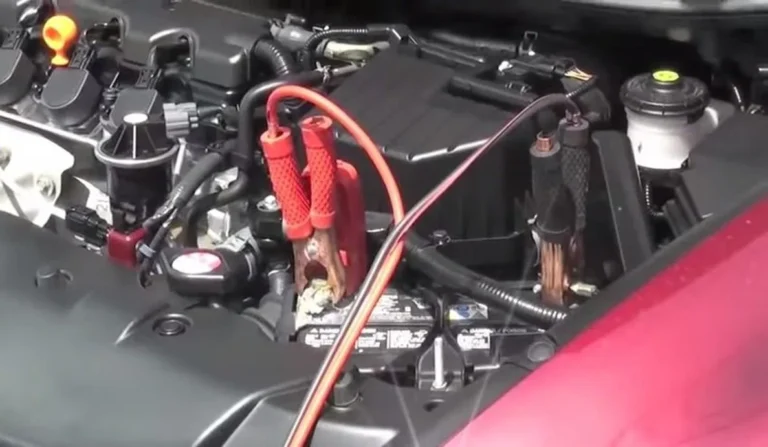
Clip the red clamp to the mower's positive terminal. Then clip the other red clamp to the donor battery's positive terminal. Keep the clamps from touching each other or any metal surface in between.
Step 4: Connect Black to Ground
Clip the black clamp to the donor battery's negative terminal. Then attach the final black clamp to an unpainted metal part of the mower frame, like an engine bolt or the chassis bracket near the battery.
Step 5: Start the Donor, Then the Mower
Start the donor car and let it idle for a minute. Now turn the mower key. If it cranks, let it run for 15 to 30 seconds before you disconnect anything.
Step 6: Disconnect in Reverse
Remove the black clamp from the mower frame. Then the black clamp from the donor. Then the red clamp from the donor.
Finally, the red clamp from the mower. Reverse order is just as important as the forward order. Skip it and you risk a voltage spike.
How to Jump Start Using a Portable Jump Pack Instead of Another Vehicle
A portable lithium jump pack is the cleaner option for most homeowners. No second vehicle, no fumes, no risk of accidentally feeding 14.5 volts of charging system voltage into a mower that only expects 12.
Why a Jump Pack Often Works Better
Most modern jump packs deliver a clean 12V pulse with no alternator ripple. They're also safer in enclosed spaces like a shed or garage. Aggregate user reviews indicate that 300 to 600 peak amps is enough for any riding mower under 25 horsepower.
The Procedure Is Identical
Same cable order, same grounding step, same reverse disconnect. The only difference is that you don't start a donor engine first. You just power on the jump pack and crank the mower.
When the Pack Isn't Enough
If the mower doesn't crank on the first try, wait 30 seconds and try again. Lithium packs need a brief recovery between high-current bursts. Two or three attempts is normal.
If it still won't turn over, the battery isn't your problem. Move to the troubleshooting section below.
The Correct Cable Order: Why Sequence Matters
Sequence is the most important thing most people get wrong. The order you connect and disconnect cables controls where the spark happens, and sparks near a battery are bad news.

The Connection Order
- Red to dead battery positive
- Red to donor positive
- Black to donor negative
- Black to dead mower frame (ground)
Why This Order
The final black clamp is the only one that creates a spark when you attach it. By grounding it to the frame instead of the battery, any spark happens away from the battery's hydrogen vent. This is the same principle outlined in the [U.S.
Department of Energy's idle-reduction and battery maintenance guidance](https://www.energy.gov), which prioritizes spark distance over conductor length when jump starting.
The Disconnection Order (Reverse It)
- Black from mower frame
- Black from donor
- Red from donor
- Red from mower battery
Disconnecting in reverse keeps any stray voltage from arcing across the battery terminals while the donor is still live.
What to Do If the Mower Clicks but Won't Turn Over
A click without a crank is the most common jump-start failure. The cables are on, the donor is running, and the mower still won't budge. Here's how to branch through the problem.
Check the Ground First
The black clamp needs solid metal contact. Paint, rust, or oil under the clamp blocks current. Move the ground clamp to a cleaner spot on the frame.
In our research, a bad ground is the single most common reason a jump "doesn't work."
Check the Cable Gauge
Cheap 10AWG jumper cables can't deliver the cranking amps a small starter motor demands. They heat up, voltage drops, and the starter never gets enough juice. Step up to 6 or 4 gauge if you regularly jump equipment.
Check the Solenoid
If you hear a click from the solenoid but no crank at the starter, the solenoid contacts may be burned. Tap the solenoid body lightly with a wrench handle while a helper holds the key. This old-mechanic trick sometimes frees stuck contacts long enough to start the engine.
Replace the solenoid if it works more than twice.
Diagnosing a Flooded Engine vs. a Dead Battery
A jump start can fail for reasons that have nothing to do with the battery. A flooded engine is the most common one in the spring, after a long winter of attempted starts.
What a Flooded Engine Sounds Like
The engine cranks normally but won't catch. You smell raw gasoline. The spark plug, when removed, is wet with fuel.
This isn't a battery issue. Jumping won't help.
The Fix Takes 10 Minutes
Pull the spark plug. Hold the throttle wide open. Crank the engine for 5 to 10 seconds with the plug out.
This blows out the excess fuel. Reinstall the plug (dry or new) and try again. Choke off, throttle at half.
It usually starts on the next pull.
Why It Happens
Each failed start washes raw gas past the piston rings into the oil. Three or four attempts and the cylinder is swimming in fuel. The fix is patience, not electricity.
Wait 10 minutes and let the fuel evaporate, then try a clean start.
Mistakes That Will Fry Your Mower's Electrical System
A lawn mower charging system isn't designed to absorb the same voltage spikes a car battery shrugs off. A single crossed cable can take out the regulator, the solenoid, or the stator in one bright flash.
Reversing the Cables Is the Big One
Red to negative and black to positive sends current backwards through every component. Diodes in the voltage regulator fail first, often permanently. Aggregate service-shop feedback indicates that reversed polarity is the number one cause of regulator replacements after a failed jump.
Skipping the Ground Step
Connecting both black clamps to battery posts creates a spark directly on the battery. Beyond the safety risk, it can also cause voltage spikes that damage sensitive electronics on newer mowers with hour meters or safety modules.
Running the Donor at High RPM
A car alternator at 2,000 RPM can push 14.8V into the mower's system. Most mowers regulate at 13.8 to 14.2V. The overshoot is small but cumulative.
Let the donor idle, don't rev it.
Leaving Cables Connected Too Long
Once the mower is running, disconnect promptly. Leaving the donor connected while the mower idles forces both charging systems to fight each other for voltage control. Twenty minutes of "just to be safe" is too long.
How Long to Let the Mower Run After a Jump Start
A jump start gets the engine running, but it doesn't fully recharge the battery. A riding mower alternator typically puts out 13.8 to 14.2V at idle, which is enough to top up a depleted battery slowly.
The 20-to-30-Minute Window
For a battery that was merely discharged (not deeply sulfated), 20 to 30 minutes of running puts back enough charge to restart the mower later that day. Don't shut it off before this window unless you're putting it on a charger.
Why a Short Idle Isn't Enough
Most mower stators produce only 5 to 15 amps of charging current. Compare that to a 300+ amp alternator in a car. The recharge is slow by design.
If you cut the engine after 5 minutes, the battery may not have enough charge to crank the next time.
Test Before You Trust It
Shut the mower off after the run time. Wait 10 minutes. Try to restart.
If it cranks strongly, the battery held the charge. If it barely clicks, the battery is sulfated or damaged and needs replacement.
When a Jump Start Won't Work: Signs of a Bigger Problem
Sometimes the battery isn't the problem at all. Knowing when to stop jumping and start diagnosing elsewhere saves time and money.
The Mower Cranks but Won't Fire
A healthy engine needs three things: compression, spark, and fuel. A jump start only addresses the battery side of the equation. If the engine cranks at full speed but won't catch, you're chasing fuel or spark.
Common Causes Beyond the Battery
- Bad spark plug. Cheap to fix, easy to test. Pull the plug, lay it against the engine block, and crank. No spark means a bad plug, a bad coil, or a bad safety switch.
- Stale fuel. Gas older than 30 days goes stale. Drain it, refill with fresh, and try again.
- Clogged fuel filter. A 5-minute swap on most mowers.
- Failed safety switch. Most mowers have 3 to 4 of these (seat, brake, PTO, reverse). One bad switch kills the whole starting circuit.
The Charging System Test
If the mower runs off a jump but dies shortly after disconnecting cables, the stator or regulator has likely failed. With the engine running, a healthy system reads 13.5 to 14.5V at the battery. Anything outside that range points to a charging fault, not a battery fault.
Quick Troubleshooting Flowchart: Find the Real Issue Fast
When the mower won't start, run through this decision tree in order. Each branch leads to the next layer of diagnosis.
Start Here: Does the Engine Crank?
If yes, the battery and starter are fine. The problem is fuel, spark, or air. Move to the spark-plug and fuel checks.
If no, continue below.
Does Anything Happen When You Turn the Key?
If total silence, check the safety switches and fuses before chasing the battery. A blown 20-amp fuse or a seat switch out of adjustment stops the starting circuit cold.
If you hear clicking or cranking, the battery is in the loop. Continue.
Will It Jump From a Donor?
If yes, the battery was simply discharged. Charge it, test it, and monitor. If it won't hold a charge after a full charge cycle, replace it.
If no, the issue is downstream of the battery. Check grounds, cables, solenoid, and starter motor in that order.
Does the Engine Catch but Stall?
Running off the jump but stalling when you disconnect the cables is a classic charging-system failure. Test voltage at the battery with the engine running. Less than 13.5V means the stator or regulator needs service.
FAQs About Jump Starting a Lawn Mower
Can I jump a lawn mower with a car?
Yes. A car battery is a 12V lead-acid battery, just like a riding mower. Use the same cable order, ground to the frame, and let the car idle.
Don't rev the engine while connected.
How long should I let a lawn mower run after jumping it?
Run it for at least 20 to 30 minutes to put a meaningful charge back into the battery. A short 5-minute idle won't restore enough cranking amps for a reliable restart.
Can you jump a push mower with no battery?
No. Most push mowers don't have an electric starter. They use a recoil pull cord.
If your push mower won't start, check the spark plug and fuel rather than reaching for jumper cables.
Will jumping a mower damage the car?
No, not if the cables are connected correctly. The mower draws less than 10 amps while cranking, well within a car's alternator capacity. Just disconnect the mower side first to avoid backfeed.
What if my mower clicks but won't turn over after a jump?
Check the ground clamp first. Move it to a clean, unpainted metal spot on the frame. If it still clicks, suspect the solenoid, the ground strap, or severely corroded battery terminals.
Can I jump a lawn mower with a portable jump starter?
Yes, and it's often the safest option. A 300 to 600 peak amp lithium jump pack delivers clean 12V without the alternator ripple of a running car. Same cable order applies.