How to jump start mercedes sprinter: Top guide
If you drive a Mercedes Sprinter long enough, you'll eventually face a dead battery. The good news is that learning how to jump start a Mercedes Sprinter isn't complicated once you know the quirks. The bad news is that doing it the wrong way can fry expensive electronics.
Most Sprinter models use a 12V AGM or EFB battery rated between 800 and 950 CCA, and the Battery Council International's group size standards (H6, H7, or H8) tell you exactly which one fits your van. As of 2026, Mercedes-Benz still routes the positive jump-start terminal through a dedicated post, not directly at the battery, which is why this process trips people up. Let's walk through it the way the manufacturer service docs actually describe it.
Quick Answer
Yes, you can jump start a Mercedes Sprinter using a donor vehicle or a lithium jump pack. Connect the red clamp to the positive jump-start terminal (usually under a red cap in the engine bay), then the black clamp to a chassis ground point. Wait 2 to 5 minutes, start the van, and disconnect in reverse order.
Why Mercedes Sprinters Are Trickier Than Other Vans to Jump-Start
Sprinters don't follow the textbook "pop the hood and clamp to the battery" routine that most cars use. Mercedes routed the jump-start posts through dedicated terminals in the engine bay, separated from the actual battery, to protect the SAM (Signal Acquisition Module) control units that manage almost every electrical system.
That design choice protects the electronics when everything's healthy. It also means that a careless owner can swap the cables and send voltage straight into a module that costs more to replace than the rest of the van's electrical system combined. The Mercedes-Benz USA owner's manual explicitly walks owners to the jump-start terminal rather than the battery for this reason.
The other wrinkle is that Sprinters use a battery management system (BMS) that tracks state of charge and battery age. When you jump-start or replace the battery without resetting the BMS, you can end up with persistent warning lights or an alternator that overcharges the new battery. That's a separate step we'll cover below, but it explains why "just connecting cables" is half the job on these vans.
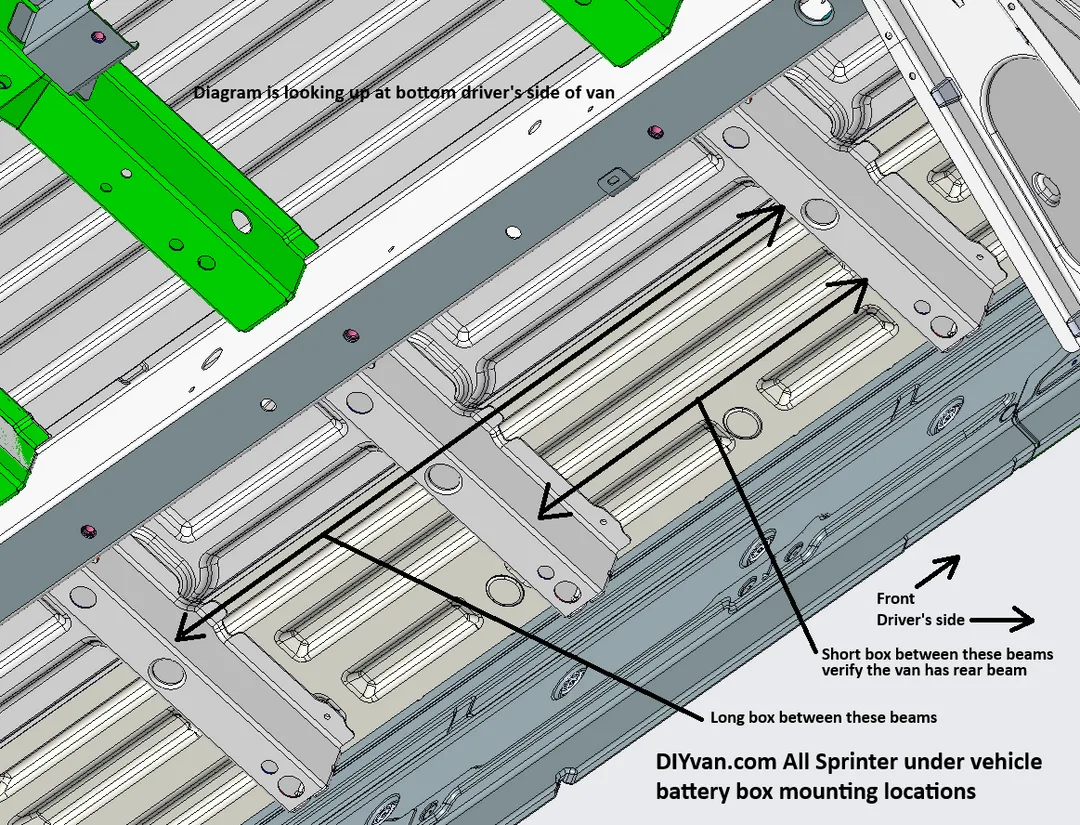
Where Is the Battery on a Mercedes Sprinter? (It Depends on Your Model Year)
Battery location is the single biggest source of confusion on these vans. Here's the actual split by generation.
NCV3 (2006–2018): Under the Driver's Seat
Most NCV3 Sprinters, both gas (M271 four-cylinder and V6) and diesel (OM651 and OM642 V6), hide the battery under the driver's seat base. You lift the seat, remove a plastic tray, and the unit sits in a vented compartment right under the seat cushion.
This setup keeps the battery out of the engine bay heat, which extends AGM and EFB life. It also means most owners have never seen their own battery, so they assume it's "somewhere under the hood" and start hunting for terminals that aren't there.
VS30 (2018+): Under-Hood or Auxiliary Setup
The newer VS30 Sprinter (the third-generation body that started with the 2019 model year in the US) moved the primary battery back under the hood on most configurations. Diesel models still ship with an auxiliary battery that handles the consumer loads, which is why a VS30 can refuse to start even after a successful jump.
If you're not sure which generation you have, check the VIN's model year and the engine cover. NCV3 has a more upright, cab-forward cab shape. VS30 has the rounded, more aerodynamic nose.
Battery location differs enough between the two that getting this wrong wastes time.
Diesel vs. Gas Engine Battery Differences
Diesel Sprinters, the most common configuration for cargo vans, RVs, and ambulances, use larger batteries with higher CCA ratings to handle glow-plug draw at startup. Gas Sprinters can usually get away with smaller batteries, but they still use the AGM or EFB design on most configurations.
If your diesel is a 2015 or newer model, there's a good chance it has an auxiliary battery as well, mounted under the floor or behind a panel. You'll need to identify both before you start pulling anything apart.
Finding the Jump-Start Terminal (Not the Battery Itself)
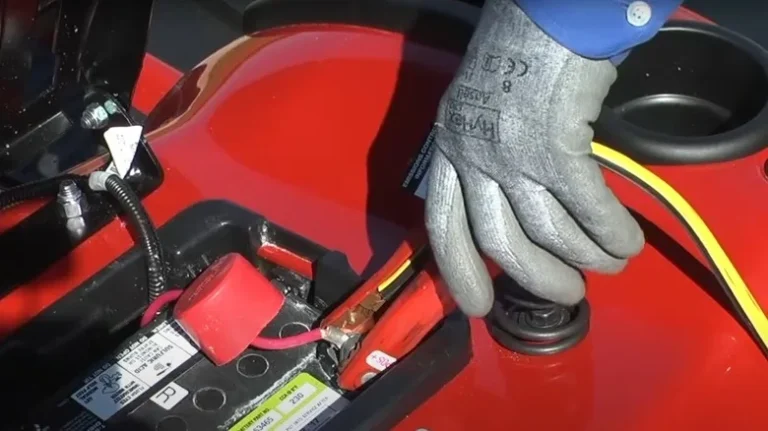
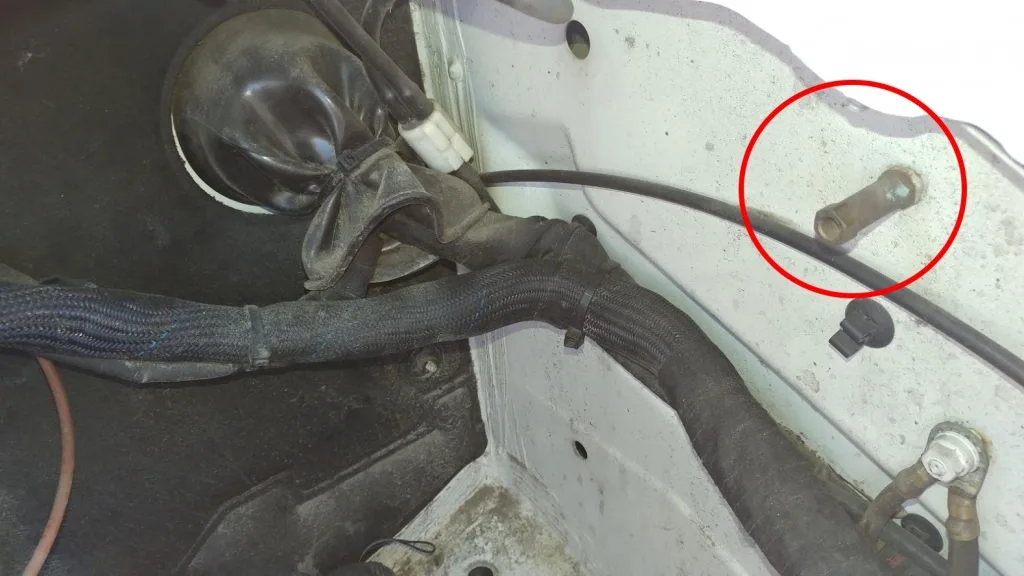
Even when you know the battery is under the seat, you don't connect the jump-start cables to it directly on most NCV3 and VS30 models. Mercedes added a remote positive terminal in the engine bay specifically for boosting, marked with a red cap and a "+" symbol, usually near the fuse box or firewall.
This is the only safe place to attach the red clamp on most models. The negative side doesn't go to a battery post at all. You clamp it to a solid, unpainted chassis ground point, like a bracket, bolt, or engine lift point, away from belts and fuel lines.
If you skip the dedicated post and clamp directly to a battery post that's still wired to the BMS, you risk voltage spikes the moment the alternator kicks in. That's what fries SAM modules and infotainment screens. The remote terminal exists to buffer that current through heavier factory wiring.
The owner's manual gives the exact location for each model year. If you've lost yours, the Mercedes-Benz USA site hosts current operator guides searchable by VIN.
Tools You Actually Need: Jump Pack vs. Donor Vehicle vs. Cables
The right setup depends on where you're stranded and what you have access to. Here's how each option stacks up.
What Size Jump Pack Works on a Sprinter (Peak Amps, Cable Gauge)
For a gas Sprinter, a lithium jump pack rated at 1,000 to 1,500 peak amps will usually get you going. Diesel Sprinters pull harder at startup because of the glow plugs and the higher compression, so you'll want 1,500 to 2,000 peak amps minimum.
Cable gauge matters more than peak-amp marketing claims. Anything labeled as "1,000 amps" but shipped with 6-gauge wire won't deliver that current over the length of a real cable. For a diesel Sprinter, use 4-gauge or thicker.
For a gas model, 6-gauge is fine in a pinch, but thicker is always better.
Best Jump Starter Picks for Diesel Sprinters
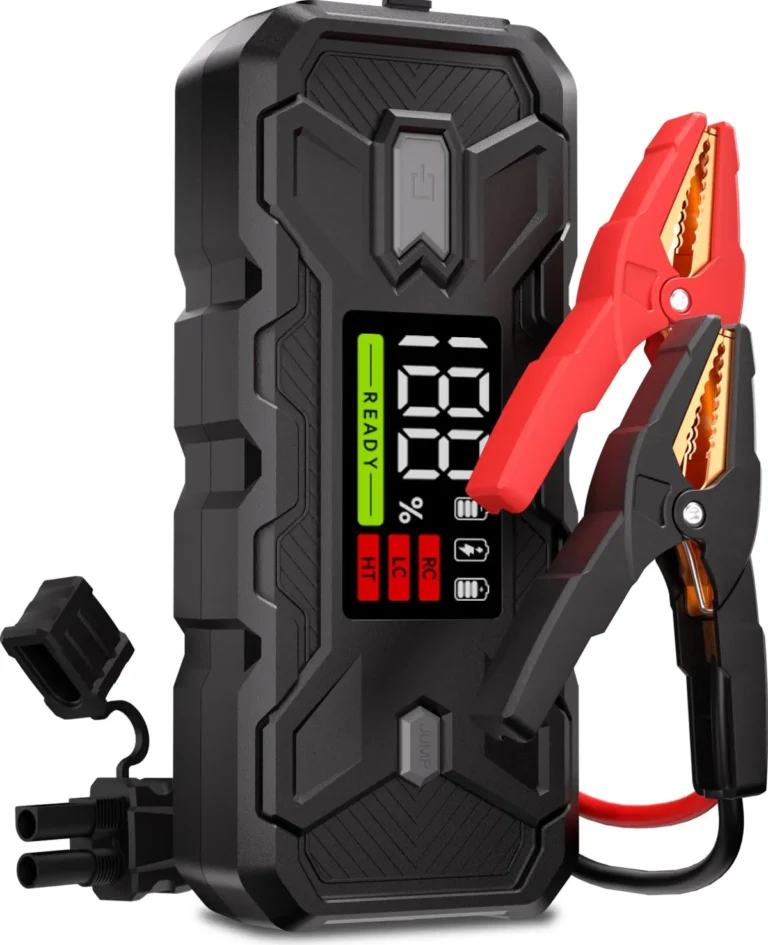
If you're buying a jump pack to keep in the van, lithium models from NOCO, Antigravity, and Audew all clear the 2,000-amp threshold needed for the 3.0L V6 diesel. Look for a unit that ships with a 4-gauge or heavier cable set and reverse-polarity protection, which is the single most common mistake when boosting in the dark.
| Tool | Peak Amps | Cable Gauge | Best For |
|---|---|---|---|
| Lithium jump pack | 1,500–2,000 | 4-gauge | Diesel Sprinters, solo recovery |
| Lead-acid booster | 800–1,500 | 4-gauge | Gas Sprinters, low-cost backup |
| Donor vehicle + heavy cables | N/A | 2 to 4-gauge | Any Sprinter, fleet lots |
If you're using a donor vehicle, run the donor engine at 2,000 RPM for a few minutes before you try to crank the Sprinter. A cold donor battery on a small sedan can't always deliver the amps a Sprinter diesel asks for.
How to Jump Start a Mercedes Sprinter: Step-by-Step Workflow
Here's the exact order the Mercedes-Benz Workshop Information System describes, condensed for a roadside situation.
Prep Steps Before You Connect Anything
Park the donor vehicle or set the jump pack on a stable surface close enough that the cables reach with some slack. Turn off both vehicles. Remove the key from the Sprinter's ignition and confirm the gear selector is in Park.
Put on safety glasses and pull the Sprinter's hood. Locate the red-capped positive jump terminal and pick a clean chassis ground point at least 18 inches away from the battery, fuel lines, and any moving belts. Wipe both contact points with a rag if they're corroded.
Connection Order (Positive First, Ground Last)
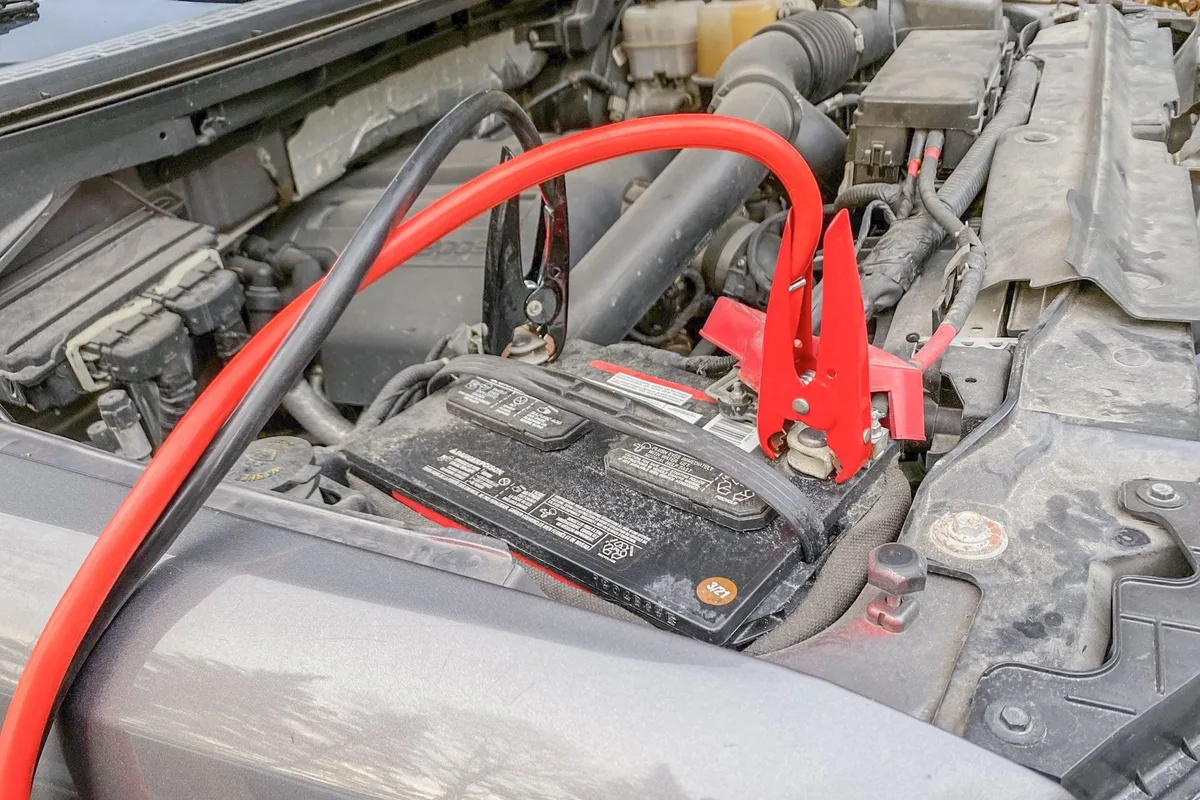
Connect the red clamp to the Sprinter's positive jump terminal first. Then connect the other red clamp to the donor battery's positive post or jump pack's positive terminal.
Next, connect the black clamp to the donor battery's negative post (or the jump pack's negative terminal). Finally, connect the last black clamp to the Sprinter's chosen chassis ground point, away from the battery and any fuel components. This order minimizes sparking near the battery.
Starting, Idling, and Disconnecting Safely
Power on the jump pack or start the donor vehicle and let it run for 2 to 5 minutes. This builds a surface charge on the Sprinter's dead battery so the alternator doesn't spike the moment it kicks in.
Crank the Sprinter for no more than 10 seconds at a time. If it doesn't catch on the first try, wait a minute and try again. Once it's running, leave the engine idling for 5 to 10 minutes before you disconnect anything.
Disconnect in reverse order: black chassis clamp off the Sprinter, black clamp off the donor, red clamp off the donor, red clamp off the Sprinter. Keep the cables clear of belts and fans during removal.
Jump-Starting a Sprinter Diesel (Glow Plug Load, Aux Battery)
Diesel Sprinters ask more from a jump-start than gas ones. When you turn the key, the glow-plug relay energizes for 2 to 8 seconds before cranking. That draw can hit 60 to 80 amps on top of the starter draw, which often pushes 250 to 400 amps.
A small sedan running as a donor can't always deliver both at once. If your donor vehicle's headlights dim sharply the moment you crank, the donor battery is the bottleneck. Either let the donor idle longer before the crank, or switch to a jump pack rated above 1,500 peak amps.
Then there's the auxiliary battery. Diesel Sprinters from roughly 2010 onward ship with a second battery that powers the cab electronics and, on camper builds, the house loads. If that battery is dead, the main jump-start won't get you going.
The fix is to either jump the auxiliary battery separately using the same terminal-to-ground method, or remove the auxiliary fuse and isolate it before boosting. Either way, identify whether your model has one before you start pulling fuses.
Jump-Starting a Sprinter Gas (4-Cylinder vs. V6)
Gas Sprinters are easier in most cases. The 2.0L four-cylinder and 3.0L V6 both pull less current at startup than the diesel, and there's no glow-plug step. A 1,000-amp jump pack handles most cases.
The only gas-specific gotcha is the start-stop system on later VS30 models. If the start-stop battery (sometimes labeled B5 in Mercedes documentation) drops too low, the main battery can still start the engine, but you'll get a start-stop error and a battery warning. A 30-minute drive usually clears it, but the BMS reset we describe below will silence it faster.
Common Mistakes That Fry the SAM module and Electronics
These are the failures we see reported most often in owner forums and roadside calls.
Connecting to the wrong post. The single most expensive mistake. If you clamp to a fuse box terminal instead of the dedicated jump post, you bypass the factory current protection and can spike a SAM module the moment the alternator comes online.
Reverse polarity. Red on black, black on red. The result is immediate and dramatic. Fuses pop, modules lock out, and on rare occasions the wiring harness itself is damaged.
A reverse-polarity-protected jump pack prevents this. Cables don't.
Cycling the key during a weak boost. If you crank for 10 seconds, get nothing, and immediately crank for another 10 seconds, you'll overheat the starter and drain the donor. Wait a full minute. Let the donor idle.
Try once more.
Skipping the BMS reset. The van may start, but you'll drive with a battery warning and the alternator may overcharge a new battery. Reset takes 2 minutes with the right tool.
What to Do After the Jump: BMS Reset, Idling, and Recharging
A successful jump-start isn't the finish line. The next 30 minutes decide whether the battery recovers or dies again tomorrow.
How to Reset the Battery Adaptation on a Sprinter
The BMS tracks battery age, state of charge, and current draw. When you jump-start or swap a battery, the BMS needs to relearn the new baseline. There are three common ways to do this.
On most 2019+ VS30 models, you can reset through the dash menu: Vehicle, Settings, Maintenance, Battery. On earlier NCV3 models, you'll need a scan tool like the iCarsoft i980 or the Mercedes STAR diagnostic tool. A budget OBD-II adapter with the right app will sometimes work too.
If you replace the battery, code the new battery spec into the BMS (CCA rating, AGM vs. EFB). Otherwise, the alternator charges to the old profile and shortens battery life.
Drive vs. Smart Charger: Which Recovers Faster?
Driving for 30 to 60 minutes brings the battery back to roughly 80% state of charge, which is enough to start the van the morning after. A smart charger (NOCO Genius 5, CTEK MXS 5.0, or Battery Tender Plus) takes 4 to 8 hours for a full charge and tops off cells the alternator can't reach.
If the battery was deeply discharged (below 11.8V resting voltage), a smart charger is the better move. Alternators aren't designed to recover deeply discharged batteries, and a long idle session won't get you back to full.
Battery Specs and Replacement Options
Choosing the right replacement battery matters more on a Sprinter than on a typical sedan because the BMS needs accurate specs to charge correctly.
Group Size, CCA, and AGM vs. EFB
Most NCV3 Sprinters take a Group 49 (H8) battery. The 4-cyl gas models can sometimes run a Group 48 (H6). VS30 models split between H6 and H7 depending on engine and option package.
CCA usually falls between 800 and 950 for OEM spec.
AGM batteries (Optima Yellow Top, Odyssey Extreme, Bosch S6) handle deep cycles better and last longer in vehicles with heavy parasitic draw. EFB batteries (the OEM-style spec on some 2018+ models) sit between AGM and flooded in cost and performance. For diesel Sprinters with auxiliary batteries or camper builds, AGM is worth the upcharge.
OEM vs. Aftermarket Battery Costs
| Battery Type | Typical CCA | Group Size | Approximate Cost (2026) |
|---|---|---|---|
| OEM Mercedes AGM | 850–950 | H6 / H7 / H8 | $280–$380 |
| Odyssey Extreme AGM | 850–950 | H6 / H7 / H8 | $260–$340 |
| Interstate EFB | 750–850 | H6 / H7 | $180–$240 |
| Budget flooded | 700–800 | H6 / H7 | $120–$160 |
Aftermarket AGM batteries match or beat OEM specs at lower prices. What you're paying for with the OEM sticker is the BMS coding done at the dealer, which a good scan tool can replicate at home.
Cold-Weather Jump-Starting Tips (Sub-Freezing Conditions)
Cold batteries lose roughly 35% of their cranking power at 0°F (-18°C), and diesel glow-plug draw climbs at the same time. Park the van nose-out so you have room to position a donor or jump pack without standing in traffic.
Warm the jump pack indoors before you walk outside; lithium packs lose capacity in extreme cold. Keep the donor vehicle running for at least 5 minutes before you crank, and let the Sprinter idle a full 10 minutes after it catches. If the battery was frozen before boosting, leave it alone.
A frozen battery can crack and leak acid when charged.
Safety Warnings You Shouldn't Skip
Always wear ANSI-rated safety glasses. Batteries off-gas hydrogen, and a single spark near the wrong end is enough to ignite it. Pull the parking brake and chock a wheel if you're on any kind of slope.
Never smoke near a battery being boosted. Remove rings, watches, and any metal jewelry that could bridge a terminal. If the battery is cracked, leaking, or visibly swollen, don't boost it.
Replace it and call for a tow if needed.
Troubleshooting When the Sprinter Still Won't Start After a Jump
If the engine cranks and doesn't catch, check the auxiliary battery if your diesel has one. A common failure pattern is a main battery that takes a boost, but an aux battery that won't relay current to the glow plugs.
If the engine doesn't crank at all, listen for a click at the starter. A single click means the solenoid is firing but the battery still doesn't have enough surface charge. Wait 5 more minutes and try again.
No click at all usually points to the EIS (Electronic Ignition Switch) not recognizing the key, which can happen when voltage drops below 9V during the boost. Try the spare key fob, since the original may have lost its rolling-code sync.
Frequently Asked Questions
Where is the battery on a Mercedes Sprinter?
On NCV3 (2006, 2018) Sprinters, the main battery sits under the driver's seat. On VS30 (2018+) Sprinters, it's typically under the hood, with a possible auxiliary battery on diesel models.
Can you jump start a Sprinter from another car?
Yes. Use a donor vehicle with the engine running and 4-gauge or heavier cables. Clamp the red lead to the Sprinter's positive jump-start terminal, not directly to the battery.
Why won't my Sprinter start even with a jump?
The auxiliary battery (if equipped) may still be dead, or the EIS module may need a spare key fob to resync. Low voltage can knock the rolling-code out of register.
How long should I idle my Sprinter after a jump?
Let it idle 10 to 15 minutes, then drive for 30 minutes or hook up a smart charger for 4 hours. A pure idle doesn't always reach full charge.
What size jump pack do I need for a Sprinter diesel?
At minimum, 1,500 peak amps with 4-gauge cables. Smaller packs work for gas models but usually fail on the diesel glow-plug draw.
Final Decision Guide: Jump Pack, Donor Vehicle, or Call Roadside Assistance?
If you're a solo driver on a winter road with no second vehicle in sight, a lithium jump pack rated at 1,500+ peak amps is the right tool. Keep it charged and stored above freezing, and check its state of charge every two months.
If you're in a fleet lot, a parking garage, or near another running vehicle, use the donor-vehicle method with 4-gauge cables. It's faster, and you don't depend on a battery that may have lost capacity sitting in your trunk.
Call roadside assistance if the battery is cracked, swollen, or leaking. If the engine cranks but won't catch even after a successful boost, the issue may be fuel-side (lift pump, primer, air in the lines on a diesel) and no amount of boosting will fix it.