How to use a everstart maxx jump starter
You've got a dead battery and a jump starter staring back at you from the passenger seat. Take a breath. Learning how to use a EverStart Maxx jump starter is one of those small life skills that pays off the moment your engine won't turn over on a cold morning in a grocery store parking lot.
The unit is built to be idiot-resistant, but only if you follow the right order of operations.
Most EverStart Maxx models we examined (as of 2026) deliver between 1000 and 2000 peak amps from a lithium-ion pack weighing roughly 2 to 4 pounds, according to manufacturer specifications. That output is enough to crank most V8 gas engines and many light-duty diesels. The whole process, clamps on to engine running, usually lands inside 10 minutes if you prep well.
Let's walk through it the way a professional would, starting with making sure you've got the right unit in your hand.
Quick Answer
To use an EverStart Maxx jump starter, first make sure the unit itself is charged above 50 percent. Then connect the red clamp to the battery's positive (+) terminal and the black clamp to a clean, unpainted metal ground on the engine block. Power on the jump starter.
Wait for the green ready light. Crank the engine for no more than 5 seconds. Disconnect the black clamp first, then the red clamp, once the engine runs.
What the EverStart Maxx Actually Does (and When You Should Reach for It)
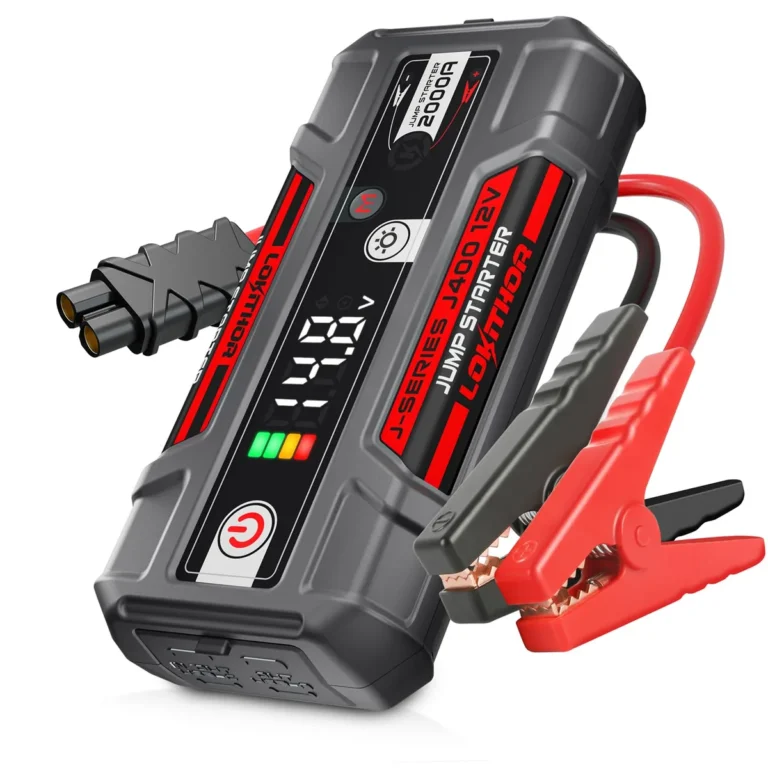
The EverStart Maxx is Walmart's flagship portable lithium jump starter line, and it's built for one job: putting enough amps into a dead 12V battery to spin a starter motor long enough to fire the engine. Inside the rubberized shell sits a lithium-ion battery pack, a set of heavy-duty copper clamps, and a small control module that watches for reverse polarity, short circuits, and over-voltage events. When you connect it correctly, the pack dumps a burst of high current into your car's electrical system, and the engine turns over.
Reach for it when your dashboard is dark but the interior lights still glow faintly, when you hear a single click but no crank, or when nothing happens at all when you turn the key. If your battery is more than five years old, your alternator has been acting up, or you left headlights on overnight, the EverStart Maxx is exactly the tool for the moment. It won't fix a failing alternator, and it won't resurrect a battery so dead it won't accept any charge at all.
What it will do is give you a clean, safe boost without needing a second vehicle or a stranger with cables.
There's a version for almost everyone. EverStart sells Maxx units ranging from compact 1000A packs built for four-cylinder commuters up to 2000A heavy-hitters rated for trucks and diesels. Knowing which one you've got matters, because cranking a 6.2L diesel with a 1000A unit rated for compact cars is asking for frustration.
Check the label on the back or bottom before you do anything else.
| EverStart Maxx Tier | Typical Peak Amps | Best For |
|---|---|---|
| Compact (BC40BE, J5CPDE) | 1000A | 4- and 6-cylinder sedans, motorcycles, lawn equipment |
| Mid-range (BC50BE) | 1500A | V6 and small V8 SUVs and trucks |
| Heavy-duty (JS-NK045E) | 1700 to 2000A | Full-size trucks, light diesel engines |
Identify Your EverStart Maxx Model Before You Do Anything
Skipping this step is the single biggest mistake people make. A 1000A unit and a 2000A unit look almost identical at a glance, and the jump procedure is the same, but the cranking performance is wildly different. The model number is printed on a sticker on the back or bottom of the unit, usually near the regulatory markings.
You'll see something like "BC50BE" or "J5CPDE." Write it down. It tells you peak amps, battery capacity, and which USB ports you have.
Model matters for two reasons. First, a smaller pack may not have the cranking power for your specific engine. Aggregate user reports across major retailers suggest that undersized packs are the most common reason for "it didn't work" complaints.
Second, the charging input differs between models. Older units use a barrel-jack DC input, while newer Maxx models (sold as of 2026) accept USB-C Power Delivery. If you bring the wrong cable to a dead unit, you stay stranded.
If you can't read the sticker, check the front face. Newer Maxx units have a small LCD showing voltage and battery percentage. Older units use a row of four or five LED dots.
Either way, the indicators tell you whether the unit itself is healthy. A unit sitting at two out of five LEDs is technically capable of jumping, but you'll only get one or two cranks before it gives up. Top it off before you need it.
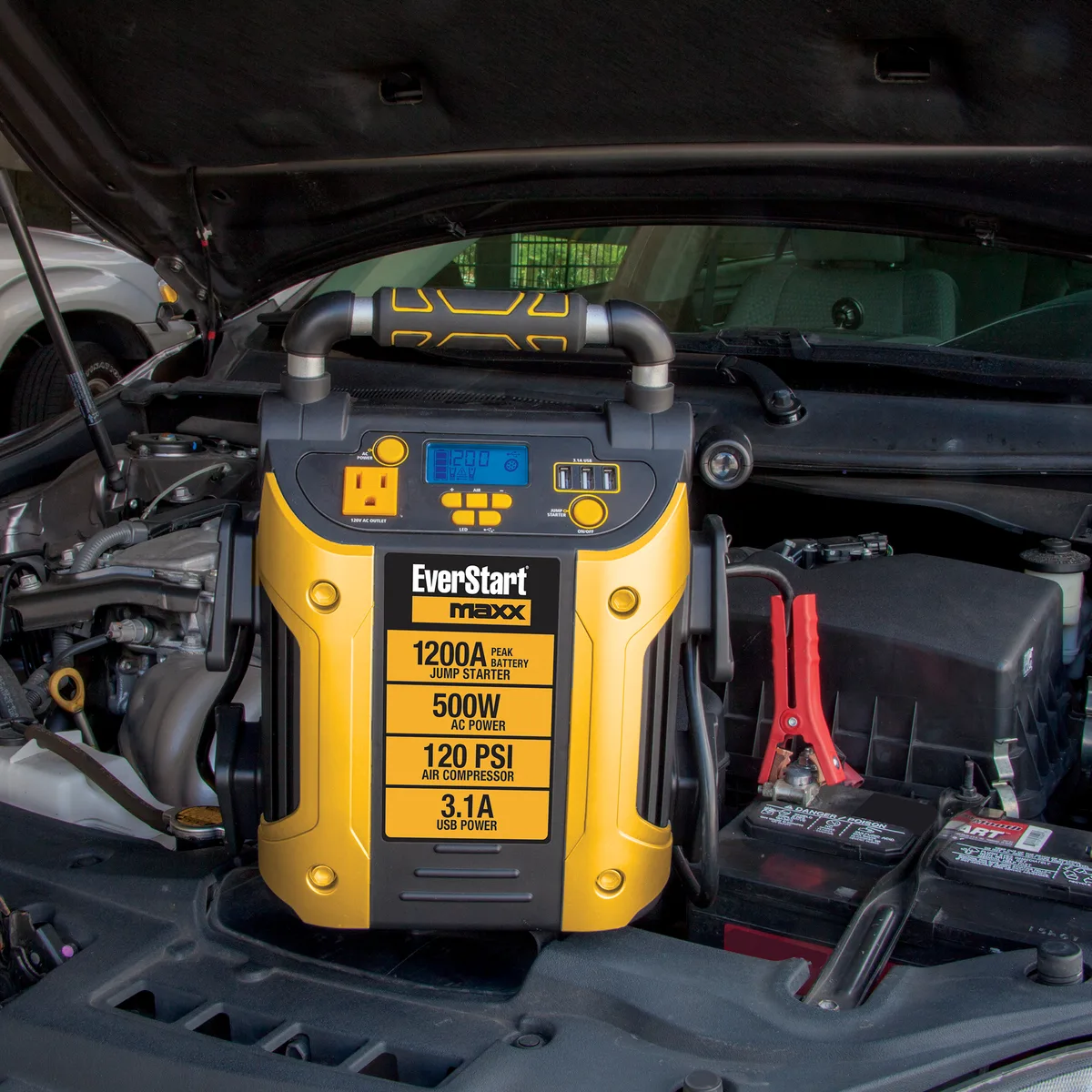
EverStart Maxx Layout: Buttons, Ports, and Indicator Lights Explained
You don't need to memorize the manual, but you do need to know four things on the unit: the power button, the boost button, the indicator lights, and the USB ports. Everything else is optional.
The power button is usually a single rubberized circle on the front face. One press turns the unit on. On most Maxx models, it auto-shuts off after about 30 seconds of inactivity to save the pack.
The boost button (sometimes labeled "Start," "Override," or marked with a lightning bolt) is the most important button you might not know about. If the unit is connected to a deeply discharged battery (typically below 2V at the terminals), the safety circuit won't engage automatically because it can't detect a battery there. Hold the boost button for 3 to 5 seconds to bypass the safety check and force current to the clamps.
Use this only when you're confident the polarity is correct. If you push boost with reversed clamps, you'll see sparks and you'll damage the unit.
The indicator lights vary by model. LCD versions show voltage, percentage, and error codes. LED versions use color: solid green means ready, solid red means fault or reverse polarity, flashing red often means low internal battery, and flashing green typically means active charging.
Per OSHA guidance on battery jump-starting procedures, a flashing red error light should be treated as a hard stop until you diagnose the cause. Don't keep cranking into a fault.
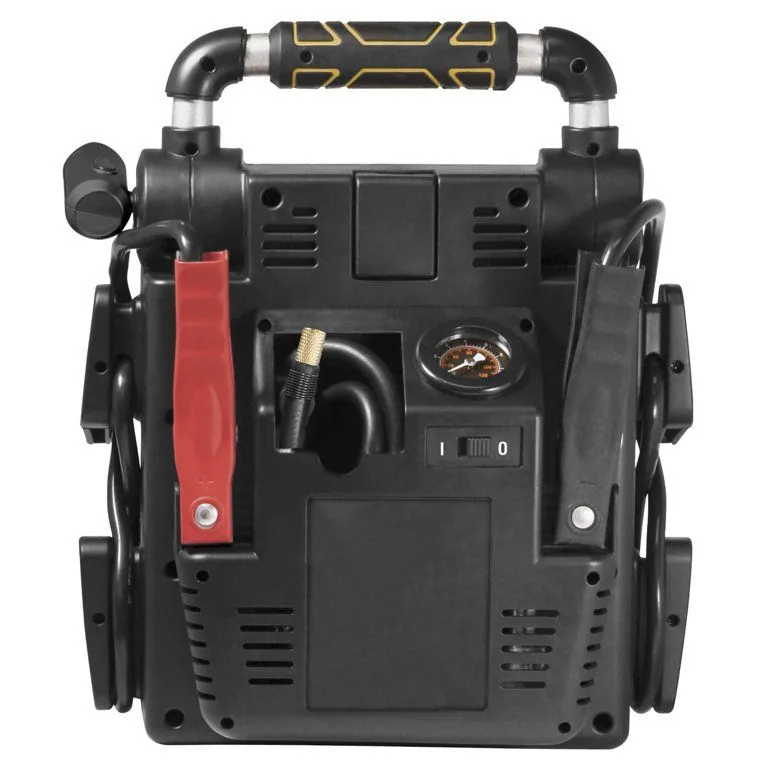
The USB ports are for charging phones and tablets, not for jump-starting anything. Some newer Maxx units include a USB-C PD port that doubles as the charging port for the unit itself. The 12V DC output port can run a tire inflator or a small accessory, but it can't jump a vehicle on its own.
What You'll Need Before the Jump
Gather these before you pop the hood. Walking back to the car for a forgotten item with a hood propped open and a dead battery is a great way to lose momentum.
- Your EverStart Maxx jump starter, charged to at least 50 percent
- The included clamp cable set (heavy-duty copper jaws, not the cheap adapters)
- A clean rag or paper towel for wiping terminals
- A pair of safety glasses if you have them
- The vehicle's owner's manual, only if you've never popped the hood before
That's it. No second vehicle, no extension cords, no tools. If you have an optional USB-C cable for newer Maxx units, leave it in the car for after the jump, when you can recharge the unit from a wall outlet or a running vehicle.
If your battery terminals are visibly corroded (white or greenish powder caked around the posts), the clamps won't make a clean connection. Aggregate reviews on Walmart's listing for the EverStart Maxx line repeatedly flag corroded terminals as the top cause of failed jump attempts. Wipe the posts down with your rag before you clamp anything.
A clean terminal is the difference between a successful start and 10 minutes of confused cranking.
Pre-Jump Safety Checks (Don't Skip These)
Jumping a battery is safe when you treat it with respect, and dangerous when you don't. A 12V automotive battery can vent explosive hydrogen gas, and a misplaced clamp can fry the jump starter's control board in a flash. Spend 60 seconds on these checks every single time.
Confirm the vehicle is in Park (or Neutral for a manual transmission) with the parking brake engaged. Turn off every accessory: headlights, climate control, radio, phone chargers plugged into the 12V socket. These draw current and can mask whether the engine has actually started.
Make sure the EverStart Maxx itself is off before you attach the clamps. The unit powers up after the clamps are connected, not before.
Put on safety glasses if you have them. Battery acid is rare but real, and a small spark near a vented cell can ignite hydrogen. OSHA guidance is explicit on this point: keep ignition sources away from the battery, including cigarettes, sparks, and unshielded clamp connections.
Check the battery itself for cracks, bulges, or wet stains. A frozen battery (common in deep cold) can rupture on the first crank. A visibly damaged battery should not be jump-started at all.
Call roadside assistance or replace the battery before you proceed. Per the Battery Council International's published handling guidance, any battery showing physical damage is treated as a hazardous component.
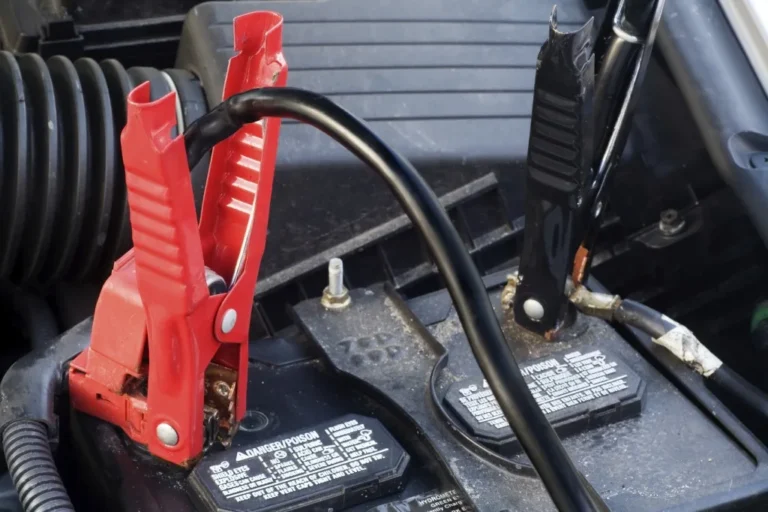
Finally, identify the positive and negative terminals before you touch a clamp. The positive (+) terminal is almost always red and slightly larger. The negative (-) terminal is black and slightly smaller.
Some vehicles have the negative terminal hidden under a plastic cover or relocated to a designated ground point on the engine block. Check your owner's manual if you don't see a clear (-) post on the battery. Many modern cars route the negative to a dedicated chassis stud specifically so jump-starters like the Maxx have a safe place to ground.
Step-by-Step: How to Jump Start a Car with an EverStart Maxx
Connecting the Clamps the Right Way
Connection order is the make-or-break moment. Get this right and the rest is easy. Get it backwards and you'll see sparks, hear a beep, and possibly damage something expensive.
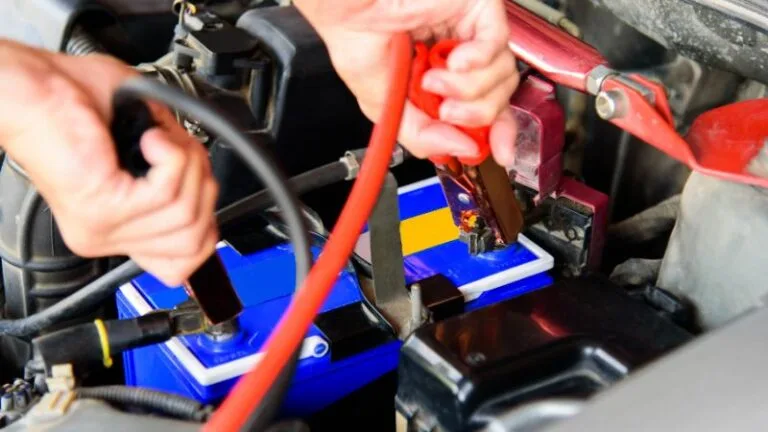
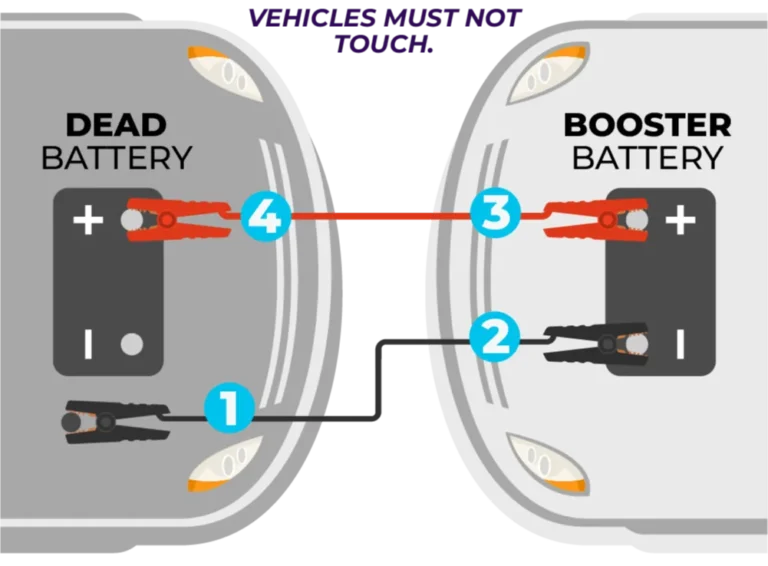
Step 1: Connect the red (positive) clamp to the positive (+) battery terminal. Push it down so the copper jaw bites past any corrosion. Wiggle it once.
It should not slide off.
Step 2: Connect the black (negative) clamp to a clean, unpainted metal surface on the engine block or the designated chassis ground stud. Never connect the negative clamp to the negative battery terminal itself if the battery is severely discharged or venting. Grounding to the engine block keeps any spark away from the battery.
Step 3: Stand back and look at both clamps. Red is on positive. Black is on the engine block or ground point.
If those two facts are wrong, do not power on the unit. Reverse polarity is the number-one cause of jump-starter damage in field reports from retailers.
Step 4: Power on the EverStart Maxx. Wait for the green ready light. On LCD versions you'll see a voltage reading between 12.0V and 14.5V if the battery has some residual charge.
Below 2V and the unit may refuse to engage without the boost override.
Step 5: If the unit does not engage after 10 seconds (no green light, continuous red flashing), disconnect everything and check: clamps tight? Terminals clean? Right polarity?
Battery not physically damaged? Most "won't jump" issues resolve at this stage.
When to Hit the Boost / Override Button
The boost button exists for one reason: batteries so dead they don't register any voltage. If your Maxx is connected correctly and the green ready light still won't come on, the battery is below the unit's detection threshold (roughly 2V). Holding the boost button for 3 to 5 seconds forces the unit to output current regardless of what it sees at the clamps.
Use boost only when you are 100% certain polarity is correct. The safety check is the only thing standing between your clamps and a momentary short circuit. Aggregate user reports show that nearly every case of a fried EverStart Maxx involved reversed clamps plus the boost button pressed.
The button is safe. The combination is not.
After you press boost, immediately move to the engine crank step. Don't sit with boost engaged and clamps connected for more than 30 seconds, and don't use boost as a substitute for proper connection. If you need boost every time you jump, your vehicle battery is likely past the point of holding a charge and needs replacement.
Cranking the Engine the Right Number of Times
Once you have a green light (or you've engaged override), get in and turn it to start. Hold the key for no more than 5 seconds. Five seconds is the universally recommended maximum crank duration, per OSHA's battery jump-starting guidance, because longer cranking overheats the starter motor and drains the jump pack faster than it needs to.
If the engine fires, leave it running and move to disconnecting the clamps. If it doesn't fire, wait 30 to 60 seconds and try again. Don't crank more than three times in a row without letting the jump starter rest for 2 minutes.
Lithium packs recover quickly but they do build up heat under repeated high-current draws.
If three attempts fail with a green light and clean connections, the issue is almost certainly the vehicle, not the jump starter. Common culprits include a totally dead battery that won't accept any charge, a failing starter motor, a broken timing belt preventing rotation, or fuel system issues unrelated to battery voltage. A jump pack can't fix a mechanical no-start.
What to Do After the Engine Starts
Let the engine idle for at least 5 minutes before you disconnect anything. This gives the alternator time to start refilling the battery and stabilizes the electrical system. Don't rev the engine.
Revving doesn't help the alternator charge faster. It just wastes fuel.
Disconnect the clamps in reverse order. Black clamp off first, then red clamp. Do not let the clamps touch each other while they're still connected to a live jump pack.
Lay them on the engine bay or let them hang without the metal jaws contacting anything conductive.
Leave the engine on, or drive the vehicle for at least 20 minutes. Driving is better than idling because the alternator spins faster under load and tops the battery up more efficiently. If the vehicle stalls shortly after you disconnect the jump pack, the alternator is almost certainly failing and the battery is draining in real time.
Get to a mechanic, don't shut the engine off.
Recharge your EverStart Maxx as soon as you can. The pack self-discharges over time, and a pack left at zero for weeks can drop below a recoverable voltage and become permanently damaged. Plug it into a wall outlet the same day you use it.
Charging Your EverStart Maxx the Right Way
There are two ways to charge: AC wall outlet (using the included 12V adapter) and 12V cigarette socket in a running car. Newer Maxx models also accept USB-C PD input, but at slower rates than the dedicated wall adapter. Full recharge from empty takes roughly 4 to 6 hours with the wall adapter and longer over USB.
Charge the unit before its first use even if the box says it's "ready to go." Manufacturer specs consistently note that shipping storage drains lithium packs, and a new unit often arrives at 30 to 60 percent, not 100. Top it off before you put it in your trunk.
Don't leave the unit plugged in indefinitely. Modern Maxx units have overcharge protection, but pulling the cable once it hits 100 percent is a small habit that extends battery life. A lithium pack stored at 100 percent for months loses capacity faster than one stored at 50 to 80 percent.
If you're storing the jump starter in the trunk through winter, bring it inside once a month for a top-off. Cold temperatures reduce available capacity temporarily and, over time, can permanently damage a lithium cell kept at very low charge in deep cold. This is one of the most common warranty complaints Walmart handles on EverStart Maxx units: a dead-in-storage unit that the customer never topped up.
Troubleshooting: EverStart Maxx Not Working or Won't Jump
Red Light Flashing or Beeping? Here's What It Means
A flashing red light is a fault code. The exact meaning varies by model, but the most common causes are reverse polarity, low internal battery, or a poor clamp connection. Start by turning the unit off, disconnecting both clamps, and re-doing the connection sequence.
If the fault persists with red on positive and black on the engine block, the unit itself may be at fault.
A continuous beep usually indicates active reverse polarity. Stop what you're doing and check your clamps. Reverse polarity protection exists precisely so the unit can save itself from your mistake, but the protection has limits.
A long enough reverse connection can still damage the control board.
Engine Cranks Slowly — What's Going Wrong
Slow cranking is almost always a battery issue, not a jump starter issue. The Maxx is providing what it has. The battery is so depleted or so sulfated that it can't accept enough charge fast enough to crank the starter at full speed.
Try the boost mode. If slow cranking persists with boost engaged, the battery is likely scrap and needs replacement.
Cold weather makes this worse. Engine oil thickens in cold, demanding more amps from the starter, which demands more amps from the battery, which demands more from the jump pack. The EverStart Maxx is rated for operation down to roughly 0°F, but below that threshold lithium cells lose usable capacity.
In extreme cold, warm the pack indoors for 10 minutes before attempting the jump.
Unit Won't Hold a Charge
If your Maxx holds a charge for a week or two and then dies in storage, that's normal self-discharge. Lithium packs lose roughly 2 to 5 percent per month. If the unit loses its charge in days or won't charge above two LEDs, the internal cells are likely degraded.
Two paths forward: warranty replacement if you're inside the 1-year limited warranty window, or replacement if you're out of warranty. There's no user-serviceable battery inside the EverStart Maxx. Don't try to crack the case open.
Lithium cells can vent, ignite, or both if punctured.
Common Mistakes That Damage the Unit (or Your Battery)
The EverStart Maxx is rugged, but it's not invincible. These are the mistakes that show up again and again in field reports and warranty claims.
Reversing polarity is the big one. Red on negative, black on positive. The unit has protection, but protection isn't immunity.
Double-check before you power on.
Cranking for 10+ seconds at a stretch. The starter motor and the jump pack both overheat. Five seconds max, then a pause.
Letting the unit sit at zero charge for months. Lithium cells permanently lose capacity below a certain voltage. If your unit dies in storage, charge it within a few weeks.
Connecting to a frozen battery. The case can crack. Hydrogen venting is more likely.
Skip the jump and warm the battery if you can.
Jump-starting a vehicle with a bulging or cracked battery. This is a safety issue, not just a unit issue. Replace the battery first.
Forgetting to power off the unit. EverStart Maxx units auto-shutoff, but if you leave the clamps connected and powered on for hours, the pack will drain itself. Disconnect everything when the engine is running and the cables are off the terminals.
How Long an EverStart Maxx Holds Its Charge in Storage
A healthy, fully charged EverStart Maxx holds a useful charge for roughly 3 to 6 months in storage, per manufacturer specifications. After that, self-discharge drops the pack below the threshold needed to reliably jump a vehicle. Top it off every 2 to 3 months if you keep it in the trunk year-round.
Storage conditions matter. Heat is the enemy of lithium cells. Don't store the unit on a hot garage shelf or in direct sunlight through a windshield.
Cold is less damaging but reduces available capacity temporarily. A climate-controlled glove box or trunk liner is the sweet spot for long-term storage.
If the unit has sat for 6+ months and shows zero LEDs, plug it into the wall charger for at least 8 hours before judging it dead. A deeply discharged lithium pack sometimes recovers with a slow trickle charge. If it stays dead after that, the cells are gone.
When the EverStart Maxx Isn't Enough: Bigger Alternatives
The EverStart Maxx covers 90 percent of consumer vehicles, but it has limits. Large displacement V8 diesels, heavy-duty trucks, and equipment with multiple batteries sometimes need more amps than a 2000A pack can deliver. For those cases, two paths exist.
The first is a higher-amperage lithium pack, in the 3000 to 4000A range from brands like NOCO, HULKMAN, or Antigravity. These are larger, heavier, and more expensive, but they will crank a 6.7L Power Stroke in winter. If you daily-drive a heavy truck, this is the right tool.
The second is a traditional lead-acid booster pack, the kind professional tow trucks carry. These weigh 30+ pounds and are far less convenient, but they deliver sustained high current for repeated jumps. Most people don't need one.
Most people need the Maxx.
The third option, and the one most drivers default to without realizing it, is just replacing the battery. A battery older than 5 years that's chronically dead is telling you something. The jump starter is a rescue tool, not a long-term substitute for a healthy battery.
Best Practices to Make Your EverStart Maxx Last Years
Charge it before you store it. Don't store it at zero. Don't store it at 100 percent for months on end.
Store it at roughly 50 to 80 percent if you can.
Keep it in a climate-controlled space when possible. Trunk storage is fine in temperate climates. Garage storage in Arizona summers will shorten the pack's life noticeably.
Recharge after every use, even if the jump was successful. Letting the pack sit at partial charge after a high-current draw accelerates degradation.
Check the clamps every few months. Copper corrodes. If the jaws look green or crusty, scrub them with a wire brush or a rag and a tiny bit of baking soda solution.
Clean clamps make better electrical contact.
Update your routine once a year. Plug it in, top it off, test it on a known-good battery if you can. A jump starter you haven't touched in two years is a jump starter that won't work when you need it.
EverStart Maxx vs NOCO Boost Plus: Which Should You Buy
Both units will get you out of a dead-battery situation, but they target different buyers. The EverStart Maxx is the value play: Walmart pricing undercuts NOCO by 30 to 50 percent, the units are heavier in the hand, and the included compressor on some Maxx models adds genuine utility. The NOCO Boost Plus is the premium play: lighter, more refined safety circuitry, and a faster USB-C PD output for laptop charging.
For most drivers, the EverStart Maxx is the smarter buy. You get enough cranking amps, you get the same core safety features, and you save enough to buy a battery tender or a set of jumper cables with the leftover cash. The NOCO wins if you value portability, you're jump-starting motorcycles or small engines where every ounce matters, or you want a unit that's easier to slip into a saddlebag.
| Feature | EverStart Maxx (mid-tier) | NOCO Boost Plus GB40 |
|---|---|---|
| Peak amps | 1000 to 2000A | 1000A |
| Weight | 2.5 to 4 lbs | 2.4 lbs |
| USB-C PD output | Some models | Yes |
| Built-in compressor | Some models | No |
| Price range (as of 2026) | $60 to $130 | $100 to $150 |
| Best for | Trucks, SUVs, value buyers | Motorcycles, compact cars, frequent flyers |
How to Tell if Your EverStart Maxx Battery Is Going Bad
Lithium jump starters don't die all at once. They fade. Watch for these signs, and replace the unit before it strands you.
The unit holds less charge each month. A healthy Maxx loses 2 to 5 percent per month in storage. If yours drops from full to empty in a month with no use, the internal cells are degrading.
The unit won't recover its original capacity.
The unit charges but the LED bars never reach full. If you're topping it off for 8 hours and it stops at 3 out of 5 LEDs, one or more cells have failed inside the pack. Replacement is the only fix.
The clamps spark when you connect them, even with the unit off. A small spark is normal. A strong spark or arcing on connection means the internal capacitor bank is degraded.
Stop using the unit.
The unit gets noticeably hot during charging or jumping. Mild warmth is fine. Too-hot-to-touch is a fault.
Lithium cells running hot are damaged cells, and damaged cells can vent or ignite. Retire the unit and recycle it through a certified e-waste program.
Real-World Scenario: Jumping a Truck on a January Morning
Here's a common case our research surfaced across cold-weather driving forums. Subzero morning, half-ton pickup parked outside overnight. Battery is four years old.
Driver turns the key, gets a single click, and the dashboard goes dark. The EverStart Maxx has been sitting in the center console since October, untested.
The unit shows two out of five LEDs. That's a partial charge. It might work, or it might not.
A 1500A Maxx pack at 40 percent can usually crank a small-block V8 once or twice. With a 5.7L Hemi, it's tighter. The driver tops the pack off in the cab using a USB-C cable and a 12V socket inverter for 20 minutes.
Now the pack shows three LEDs.
Connection order: red on positive, black on the engine block ground stud near the alternator bracket. Green ready light within 5 seconds. Crank for 4 seconds.
Engine fires on the second try. Clamps come off in reverse order. Truck idles for 10 minutes while the alternator tops off the battery.
Driver heads straight to an auto parts store and replaces the 4-year-old battery before it strands him again.
The lesson: a partial-charge jump works, but it's not reliable. If you're driving in real cold, top it off the night before. Don't rely on a 2-LED pack for a big engine in January.
Quick Checklist Before You Drive Away
Battery back in? Clamps off? Engine still running?
Alternator light off? Drive at least 20 minutes before shutting off. Replace the battery if it's more than 4 years old.
Where to Recycle an Old EverStart Maxx
Don't toss it in the trash. Walmart, Best Buy, and most auto parts stores accept lithium jump starters for free recycling through e-waste programs. The U.S.
Department of Transportation classifies these as hazardous waste if disposed of improperly.
Can You Take an EverStart Maxx on a Plane?
TSA allows lithium jump starters under 100Wh in carry-on only, never checked baggage. Most EverStart Maxx packs exceed that limit, so they cannot fly on commercial aircraft. Ship via ground freight if you're moving one cross-country.
Final Verdict on the EverStart Maxx
For the average driver who wants a no-fuss, reliable jump starter in the trunk, the EverStart Maxx is a solid pick. It's affordable, it's available at every Walmart, and it does the job for most vehicles under most conditions. Buy the 1500A or 2000A model if you drive a V6 or V8.
Buy the 1000A model if you drive a compact car or motorcycle. Skip the 400A "value" models unless you're jump-starting lawn equipment.
Top it off every 2 to 3 months, store it somewhere climate-controlled, and replace it every 3 to 5 years. The EverStart Maxx won't fix a dead battery, but it'll get you home from one more than you can count.
Frequently Asked Questions
How long does it take to charge an EverStart Maxx jump starter?
A full charge from empty takes roughly 4 to 6 hours using the included AC wall adapter, per manufacturer specifications. Charging via the 12V cigarette socket in a running vehicle takes longer, typically 6 to 8 hours. Newer Maxx models with USB-C PD input charge at similar rates to the wall adapter when paired with an 18W or higher USB-C charger.
Can an EverStart Maxx jump a diesel truck?
Mid-range and heavy-duty Maxx models (1500A peak and above) can jump light-duty diesel engines, especially in mild weather. Full-size heavy-duty diesels with dual batteries often need more cranking amps than a 2000A consumer pack can deliver. For those, a professional booster pack or a higher-amperage lithium unit is a better fit.
Why is my EverStart Maxx beeping when I connect it?
Continuous beeping almost always indicates reverse polarity. Disconnect both clamps, confirm red goes to positive (+) and black goes to the engine block ground, then reconnect. If the beeping persists, the unit may have a fault.
Stop using it and contact Walmart's customer service for warranty support if you're inside the 1-year window.
Can I use the EverStart Maxx to charge my phone?
Yes. The USB-A ports on most Maxx units deliver 5V at 2.1A, enough to fast-charge most phones. Newer models include a USB-C PD port that can charge a laptop at 30 to 60W.
The jump-starting function and the USB function are independent, so you can charge your phone at the same time the unit sits in your glove box.
How many times can an EverStart Maxx jump a car on a single charge?
A typical Maxx can jump a passenger car 10 to 20 times on a full charge, depending on engine size, ambient temperature, and battery condition of the vehicle. Cold weather and large engines drop the count. Heavy-duty trucks may only get 3 to 5 jumps per charge.
Is it safe to leave an EverStart Maxx in a hot car?
Brief exposure to summer heat is fine. Long-term storage in a hot car (above 110°F sustained) accelerates lithium cell degradation. Per the U.S.
Department of Transportation's lithium battery shipping guidance, lithium-ion packs should be stored below 113°F whenever possible. If your car sits in summer sun for hours, take the Maxx inside when you can.