How to jump start manual car: Honest Review
You turn the key and hear a single tired click. The dashboard lights barely flicker. If you drive a manual, you've got a hidden advantage most people don't know about: you can bring your car back to life without cables, without a donor vehicle, and without a mechanic.
Learning how to jump start a manual car comes down to knowing which of three methods fits your situation. SAE International's J537 standard sets the electrical benchmarks for safe jump-starting across 12V systems, and that standard is the backbone of every owner's manual we've reviewed. Pick the wrong method, connect the cables in the wrong order, or try to bump a car with a frozen battery, and you risk frying the ECU or cracking a battery case.
As of 2026, most manuals still roll, so let's get yours running again.
Quick Answer
To jump start a manual car, first identify your method. Use jumper cables from a donor vehicle, a portable jump starter pack, or a bump start (push start) if you have a slope or helpers. Connect positive cables first, then negative to a ground point.
Start the donor vehicle, wait one to two minutes, then crank the dead car. Disconnect in reverse order.
How to Tell If Your Manual Car Needs a Jump Start (Not a Repair)
Before you pop the hood, confirm the problem is a dead 12V battery and not something else. A jump start only helps when the battery has lost its charge. It won't fix a bad alternator, a failed starter motor, or a broken ignition switch.
The classic signs of a discharged battery are well known to most drivers:
- A rapid clicking sound when you turn the key, but the engine doesn't crank.
- Dashboard lights that dim heavily or flicker off as you try to start.
- Electronics (radio, interior lights, horn) that work weakly or not at all.
- A slow, lazy crank where the starter sounds like it's struggling.
If the engine cranks at normal speed but refuses to fire, the battery isn't your problem. You might be dealing with a fuel delivery issue, a faulty crankshaft sensor, or a bad ignition coil. Jumping it won't help, and it could even mask the real symptom.
Quick Battery Health Check with a Multimeter
Set a digital multimeter to DC volts. Touch the red probe to the positive (+) terminal and the black probe to the negative (−) terminal with the car fully off. Wait about 30 seconds for the reading to settle.
| Voltage Reading | Battery Condition | What To Do |
|---|---|---|
| 12.6V or higher | Fully charged | Jump start likely not needed; investigate other causes |
| 12.2V to 12.4V | Slightly discharged | Jump start should work fine |
| 11.8V to 12.1V | Significantly discharged | Jump start required; battery may be aging |
| Below 11.8V | Deeply discharged or dead cell | Jump start possible, but plan to replace battery soon |
If you don't have a multimeter, try turning on the headlights for two minutes and then cranking the engine. If the lights die the moment you crank, the battery has nothing left to give. That confirms you're dealing with a discharged battery, which is exactly the situation jump-start methods are designed to solve.
The Two Routes: Jumper Cables vs. Push Start vs. Portable Jump Starter
Once you've confirmed the battery is dead, you have three realistic ways to bring a manual car back to life. Each method has different requirements, and the right pick depends on what you have access to and where you're parked.

Here's the decision split, simplified:
If You Have a Donor Vehicle Nearby, Use Jumper Cables
This is the textbook method. It's fast, reliable, and works on virtually any manual car with a standard 12V lead-acid battery. You'll need a set of jumper cables (gauge and length are discussed later) and another driver willing to idle their car for a few minutes.
If You're Alone with No Cables, Try a Push Start (Bump Start)
A manual transmission lets you use the car's own momentum to spin the engine. If you have a slight downhill slope or a couple of people willing to push, this method requires zero equipment. It won't work on automatics, which is exactly why manuals have this backup.
A rolling start is the most underrated feature of stick-shift cars.
If You're Solo in a Parking Lot, Use a Portable Jump Starter
A lithium jump pack fits in a glove box and delivers 1000 to 2000 peak amps on demand. No donor car needed. No pushing required.
They're especially valuable for solo drivers, city dwellers, and anyone who parks far from help.
Quick Comparison Table
| Method | Equipment Needed | Best For | Limitations |
|---|---|---|---|
| Jumper cables + donor | Cables, second vehicle | Home, parking lots, anywhere with help | Requires a willing second driver |
| Push start | Slope or helpers | Rural roads, hillsides, quiet streets | Needs space and momentum (about 5 mph) |
| Portable jump pack | Lithium booster pack | Solo drivers, emergencies, urban areas | Pack must be charged beforehand |
Pick the route that matches your conditions. If you've got cables and a friendly driver, go with the jumper cable method. If you're stuck in a parking ramp with no signal and no slope, the jump pack is your best friend.
What You Need Before You Start (Tools and Conditions Checklist)
Preparation is what separates a clean 10-minute jump from a 30-minute scramble. Before you connect anything, run through this checklist. It covers both safety and success rate.
Tools and Materials
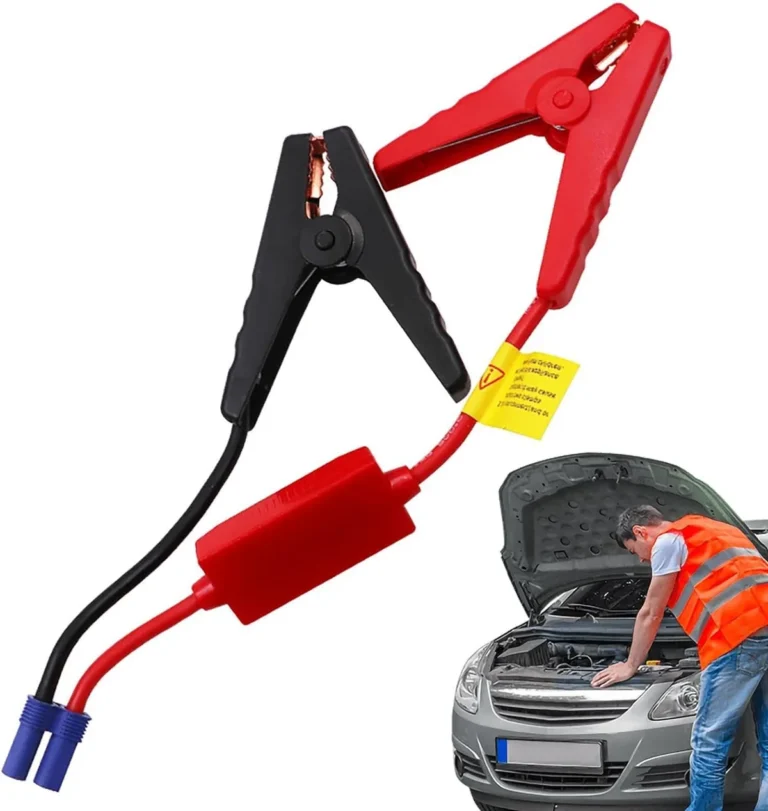
- Jumper cables rated 4 to 6 AWG, at least 12 feet long. Heavy-gauge copper-clad cables deliver current more efficiently than thin ones.
- Portable jump starter if you don't have a donor car. Look for 1000A peak amps minimum for small engines, 1500A to 2000A for V6s.
- Protective eyewear to shield against battery acid splashes or hydrogen gas ignition.
- Wire brush or terminal cleaner to remove corrosion if the terminals look crusty or white.
- Multimeter (optional) to verify battery voltage before and after the jump.
Conditions to Confirm Before Connecting
- Both vehicles are 12V systems. Never attempt to jump a 6V system from a 12V source or vice versa. Most modern cars are 12V, but it's worth a glance at the battery label.
- The dead battery is not cracked, leaking, or frozen. A frozen or damaged battery can explode when current is applied. If it's swollen or smells like rotten eggs, replace it instead of jumping.
- The vehicles are close enough for the cables to reach without stretching or straining the clamps.
- Both cars are in Park (automatic) or Neutral (manual) with the parking brake engaged.
- All electrical accessories are off. Headlights, climate control, radio, and phone chargers should be switched off on both cars.
If You're Push Starting
- A slight downhill slope or a few strong helpers.
- About 5 mph of rolling speed (roughly a fast jog pace).
- The ignition key turned to the "on" position (not "start").
- Second gear selected (more on why below).
If You're Using a Jump Pack
- The pack's charge level is above 50% (ideally 75% or higher).
- The clamps and indicator lights on the pack are clean and functional.
- You know where the battery terminals are (or where the manufacturer has placed remote jump posts).
Having these things in order keeps the jump fast, safe, and successful. Now let's get into the actual step-by-step.

How to Jump Start a Manual Car with Jumper Cables (Step-by-Step)
This is the most common method and the one most drivers will use at some point. It works on every standard 12V manual transmission vehicle. The steps below assume both cars are 12V lead-acid systems and both batteries are in factory locations under the hood.
Step 1: Position the Vehicles Correctly
Park the donor car nose-to-nose or side-by-side with the dead car. The goal is to get the batteries close enough that the cables can reach without tension. Turn both cars off.
Remove the keys. Engage both parking brakes.
Step 2: Identify the Terminals
Open the hoods. Locate the positive (+) and negative (−) terminals on both batteries. Positive is almost always red and slightly larger.
Negative is black. If the terminals are covered by plastic caps, flip them open.
If the dead battery is hard to reach (some manuals hide them under the airbox or a cover), many cars have a remote positive jump post in the engine bay. Check your owner's manual for the exact location.
Step 3: Connect the Positive Cable First
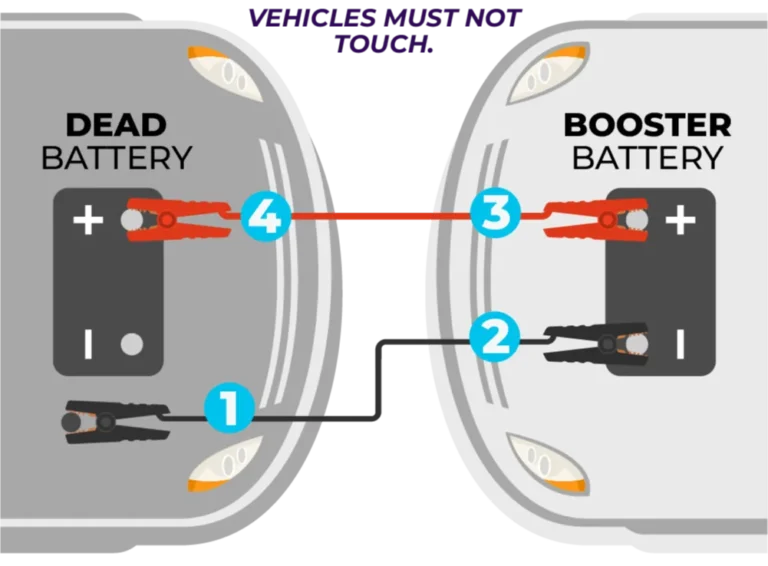
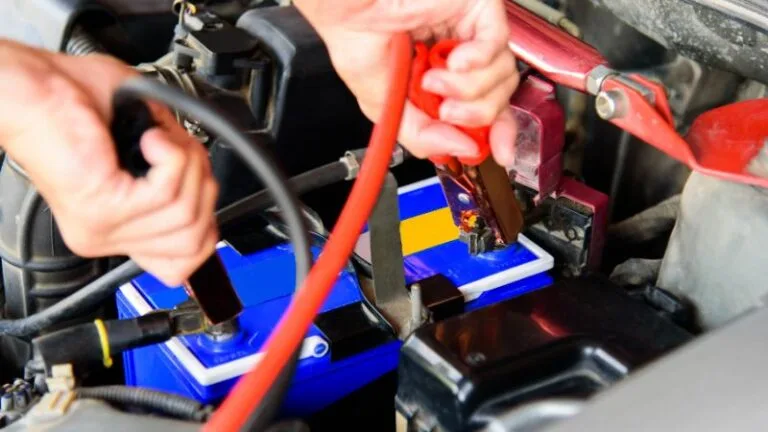
Attach the red (positive) clamp to the positive (+) terminal of the dead battery. Then attach the other red clamp to the positive (+) terminal of the donor battery.
Step 4: Connect the Negative Cable to a Ground Point (Not the Dead Battery)
This is the step most generic guides get wrong. Attach the black (negative) clamp to the negative (−) terminal of the donor battery. Then attach the other black clamp to an unpainted metal ground point on the dead car, like an engine bolt, bracket, or strut mount.
Never connect it directly to the dead battery's negative terminal.
Why? The dead battery can off-gas hydrogen. A spark at the terminal could ignite it.
Grounding to the chassis routes the current safely and reduces sparking near the battery.
Step 5: Start the Donor Vehicle
Start the donor car and let it idle for one to two minutes. Revving the engine slightly (to about 1500 to 2000 RPM) helps push more current through the cables, but a steady idle works fine for most situations.
Step 6: Crank the Dead Vehicle
Turn the ignition key on the dead car and crank for 5 to 10 seconds. If it doesn't start, wait 30 seconds and try again. Don't crank for more than 15 seconds at a time, or you risk overheating the starter motor.
Step 7: Once Started, Disconnect in Reverse Order
Leave both cars connected for about 30 seconds after the dead car starts. This stabilizes the electrical system. Then disconnect in reverse: black clamp from ground, black clamp from donor negative, red clamp from donor positive, red clamp from dead positive.
Step 8: Drive to Recharge
Drive the revived car for 20 to 30 minutes at highway speeds (or sustained RPMs above 1500) to let the alternator recharge the battery. Short trips or idling won't fully restore it. Per the SAE International J537 standard, automotive charging systems typically output 13.7 to 14.7 volts when the engine is running, which is the range needed to push current back into a depleted 12V battery.
If the car won't start after two or three attempts, the battery may have a dead cell or the alternator may be failing. At that point, a jump won't solve the underlying problem.
How to Bump Start (Push Start) a Manual Car with a Dead Battery
The bump start, sometimes called a push start or rolling start, is a manual transmission's secret weapon. It uses the car's momentum to spin the engine, which in turn spins the crankshaft and forces the pistons to fire. No cables, no donor vehicle, no electricity required.
When Push Starting Works (and When It Doesn't)
Push starting only works on manual transmissions. Automatics can't do it because there's no clutch to decouple the engine from the wheels. You'll also need either a slight downhill slope or at least one or two helpers willing to push.
The car needs to roll at roughly 5 mph or faster for the engine to turn over fast enough to fire.
Step-by-Step Push Start Procedure
- Turn the ignition key to the "on" position. Don't crank it to "start," just leave it in the running position so the fuel pump primes and the spark plugs are ready.
- Depress the clutch pedal fully and shift into second gear. Second gear is preferred over first because it reduces the shock to the drivetrain when the engine catches.
- Have helpers push (or let gravity do the work on a slope) until the car reaches about 5 mph.
- With the clutch still pressed, release it quickly and smoothly while gently pressing the accelerator. The sudden engagement should spin the engine.
- If the engine doesn't catch on the first try, press the clutch back in, let the car roll a bit more, and try again.
If the engine fires but immediately stalls, the issue might be a failing alternator rather than a dead battery. A jump won't fix that, and a push start only delays the problem.
How to Jump Start a Manual Car with a Portable Jump Starter Pack
Portable jump packs have become the go-to for solo drivers. A good lithium unit weighs 2 to 4 pounds, fits in a glove box, and can deliver 1000 to 2000 peak amps on demand. They're especially useful in parking garages, on road trips, or anywhere a second vehicle isn't available.
Step-by-Step Jump Pack Procedure
- Make sure the jump pack is charged. Most modern units have an LED indicator showing battery level.
- Connect the positive (red) clamp to the positive terminal of the dead battery.
- Connect the negative (black) clamp to an unpainted metal ground point on the engine block.
- Turn on the unit and wait 30 seconds for the capacitors to stabilize.
- Crank the engine. Most packs allow up to 10 seconds of cranking before auto-shutoff.
- Once started, disconnect the negative clamp first, then the positive.
Why This Method Works Well for Manuals
Manual cars often have higher compression engines, which can demand more cranking amps than a small 4-cylinder. Quality jump packs rated 1500A or higher handle larger engines without strain. Per manufacturer specs from major lithium pack makers, units with reverse-polarity protection and spark-proof clamps add a critical layer of safety that older copper cables lack.
What to Do Right After the Engine Starts (Drive, Idle, or Disconnect)
Once the engine fires, the next 30 minutes matter. Most drivers either shut the car off too soon (and stall again) or idle for hours (which barely recharges anything). Here's what actually works.
The 20 to 30 Minute Drive Rule
Drive the car at sustained speeds above 30 mph for at least 20 minutes. This gives the alternator enough time to push meaningful charge back into the battery. Alternator output typically sits between 13.7 and 14.7 volts when the engine is running, and that current needs sustained RPMs to flow back into a depleted battery.
Idling the car in your driveway for 20 minutes does almost nothing. The alternator's output at idle is minimal, and the battery barely recovers. Highway driving is the fast recharge.
When to Disconnect the Cables
If you used a donor vehicle, disconnect the cables once the dead car is running steadily. Leaving them connected for more than 2 to 3 minutes is unnecessary and can stress the donor's alternator if the dead battery has a dead cell pulling current.
If you used a jump pack, disconnect within 30 seconds of the engine firing. Most modern packs have auto-shutoff features to prevent backfeed.
Why Your Car Dies Again After a Jump (Alternator vs. Battery Problem)
A jump start solves a discharged battery. It doesn't solve the underlying reason the battery died in the first place. If your car dies again shortly after a successful jump, you have one of three deeper issues.
The Alternator Is Failing
The alternator's job is to recharge the battery while the engine runs. If it's failing, the car runs purely off battery power, which lasts 10 to 30 minutes before dying. Common symptoms include dimming headlights at idle, a battery warning light on the dash, and a whining noise from the engine bay.
The Battery Has a Dead Cell
Lead-acid batteries degrade over time, especially in hot climates or with frequent deep discharges. A dead cell causes the battery to hold surface charge but collapse under load. Jumping it works once, sometimes twice, then it fails completely.
Replacement is the only fix.
Parasitic Drain
Some electrical component is pulling power even when the car is off. Common culprits include trunk lights, aftermarket stereos, alarm systems, and phone chargers left plugged in. A mechanic can run a parasitic draw test to isolate the source.
The U.S. Department of Energy's vehicle maintenance resources cover the basics of parasitic loads and battery health in plain language.
Quick Diagnostic Table
| Symptom After Jump | Most Likely Cause | Fix |
|---|---|---|
| Car dies within 5 minutes | Alternator failure | Replace alternator |
| Car runs but won't restart later | Dead battery cell | Replace battery |
| Battery dies overnight repeatedly | Parasitic drain | Electrical system diagnostic |
| Car runs fine after 30 min drive | Normal, just discharged | Battery likely OK |
If you're seeing repeated failures, skip the jump and head to a mechanic. Jumping a battery with a dead cell multiple times can damage the alternator over time.
Jump Starting Mistakes That Damage Your Alternator or ECU
Modern cars run sensitive electronics that older vehicles didn't have. Engine control units, infotainment systems, and voltage regulators all assume a stable 12V to 14V supply. A sloppy jump can fry them in seconds.
Reverse Polarity
Connecting the positive cable to the negative terminal (or vice versa) sends current backward through the system. This can instantly destroy the ECU, blow fuses, or damage the alternator's diodes. Always double-check the polarity before the final connection.
Last Connection to the Negative Terminal
Connecting the final black clamp directly to the dead battery's negative post can create a spark near the battery. If hydrogen gas has accumulated, that spark can ignite it. Always ground the last connection to an unpainted metal surface away from the battery.
Cranking Too Long
Holding the key in "start" for 20+ seconds overheats the starter motor and stresses the donor vehicle's electrical system. Stick to 5 to 10 seconds per attempt, with 30 seconds of rest between tries.
Donor Engine Off
Some drivers connect cables and then try to start the dead car with the donor engine off. This pulls all the starting current from the donor's battery, which can leave both cars dead. Always run the donor engine for at least a minute before attempting the crank.
Cold Weather Jump Starting: What Changes Below Freezing
Winter is brutal on 12V batteries. Cold temperatures slow the chemical reaction inside the cells, reducing cranking amps by 20 to 40 percent at 0°F (−18°C). A battery that tested fine in October can fail by January.
Warm the Battery First If Possible
If the car is parked in a garage, a 30-minute space heater or even a warm engine bay helps. If it's parked outside, turn the headlights on for two minutes. This creates a slow chemical reaction that slightly warms the battery from within.
It won't work miracles, but it can help.
Use Heavy-Gauge Cables
Cold cables stiffen. Thin 10 AWG cables become almost unworkable in sub-zero temps and lose conductivity. Stick with 4 to 6 AWG cables with cold-weather insulation rated to at least −40°F.
Avoid Jump Starting If the Battery Is Frozen
A frozen battery can have ice crystals inside the cells. Applying current to a frozen battery can crack the case or cause an internal short. Check for a bulging case or ice on the terminals.
If you suspect it's frozen, bring it indoors to thaw or replace it.
Crank Longer but With Rest
Cold engines need longer cranking. Plan for 10 to 15 seconds per attempt with a full minute of rest. The starter motor needs that rest to cool between cycles.
Jump Starting a Manual Car with Corroded or Hard-to-Reach Battery Terminals
Not all batteries sit cleanly under the hood with shiny posts. Many manuals have batteries tucked behind fender liners, under seats, or buried under the air intake. Corrosion adds another layer of frustration.
Cleaning Terminals Before Connecting
White, blue, or green crust on the terminals is lead sulfate or copper corrosion. It blocks current flow. Mix a tablespoon of baking soda with a cup of water, scrub the terminals with a wire brush, and dry them before connecting.
Don't skip this step if the terminals look fuzzy.
Finding the Battery in Tight Engine Bays
If the battery is buried, look for a remote positive jump post. Most manufacturers place one near the fuse box or on a strut tower. The owner's manual shows the exact location.
Connecting to the remote post works just like connecting to the battery itself.
When the Terminal Clamp Won't Open Far Enough
Some clamps have a small jaw opening that can't fit over a thick terminal. Twist the clamp side-to-side while squeezing the handles to spread the jaws slightly. If that fails, use a portable jump pack with wider clamps designed for side-post or recessed batteries.
Jump Starting a Modern Manual Car with Sensitive Electronics
Cars built after 2015 often have smart charging systems, multiple ECUs, and battery management sensors. A jump start still works, but the steps deserve more care.
Look for the Manufacturer's Designated Jump Points
BMW, Mercedes, Volkswagen, and most newer models have specific jump-start terminals in the engine bay, usually marked with a "+" symbol on a red cover. These connect directly to the battery through a remote post, reducing the risk of voltage spikes at the battery itself.
Avoid Revving the Donor Above 2000 RPM
Modern alternators regulate voltage tightly. Revving the donor above 2000 RPM can push more than 15 volts through the cables, which can confuse sensitive ECUs in the dead car. A steady 1500 RPM idle is plenty.
Let the Electronics Stabilize After Cranking
Once the dead car starts, leave the cables connected for one to two minutes before disconnecting. This lets the ECUs see stable current and recalibrate. Disconnecting too fast can trigger fault codes or temporary warning lights.
Safety Rules: Battery Acid, Hydrogen Gas, and Reverse Polarity
Jump starting a car involves real chemical and electrical hazards. Skip these safety rules and you're risking acid burns, explosions, or fried electronics.
Wear Eye Protection
Batteries contain sulfuric acid. A cracked case or over-tightened clamp can splash it. Safety glasses or even sunglasses provide a baseline level of protection.
Aggregate user reviews of garage incidents show eye injuries are among the most common jump-start mishaps.
No Sparks, No Flames, No Smoking
Lead-acid batteries off-gas hydrogen, especially when discharged or recently charged. A spark near the battery can ignite the gas and cause the case to rupture. Keep cigarettes, lighters, and open flames well away from both batteries.
Remove Jewelry
Rings, bracelets, and watches conduct electricity. A ring touching both terminals at once creates a short circuit that can weld the jewelry to the battery and cause severe burns. Take them off before you start.
Double-Check Polarity Twice
Red to positive. Black to negative. This is the single most common cause of jump-start damage.
Verify the terminal markings before each clamp touches metal. Reversed polarity can destroy an alternator in under a second.
Keep Cables Away from Belts and Fans
The moment the dead car cranks, belts and fans start spinning. Loose cables draped across them get shredded or yanked out of your hands. Route the cables around the engine bay, not across the front of it.
How Long to Drive After a Jump to Fully Recharge the Battery
A jump start gets you running. It doesn't fully recharge the battery. Understanding the recharge timeline helps you avoid getting stranded again the next morning.
The 30-Minute Highway Rule
Driving at sustained RPMs above 1500 for 30 minutes pushes enough current back into a moderately discharged battery to handle a normal start the next day. Highway driving is ideal because the alternator spins fast and produces full output.
Short Trips Don't Count
Five 10-minute trips over a week won't recharge a deeply discharged battery. Each trip barely puts back what the next start uses. This is the most common reason batteries fail repeatedly in city driving conditions.
When to Replace Instead of Recharging
If the battery is more than four years old, deeply discharged (below 11.8V), or has needed multiple jumps in a few weeks, replacement is the smarter move. A new battery costs $80 to $200 in most markets, far less than another roadside breakdown.
Jump Start vs. Tow vs. Roadside Assistance: Which Is Worth It
Sometimes the smartest move isn't a DIY jump. Knowing when to call for help saves time and prevents damage.
When DIY Jump Makes Sense
- You have cables or a jump pack.
- You have a donor vehicle or a slope.
- The battery is the obvious cause (lights left on, cold morning).
- You're comfortable with the procedure and safety rules.
When to Call Roadside Assistance
- The battery is cracked, leaking, or smells like rotten eggs.
- The car won't start even after two or three jump attempts.
- You're alone in an unsafe location (busy highway, bad weather).
- You don't have equipment and don't have a way to push start.
Roadside services like AAA in the US or RAC in the UK charge $75 to $150 for a standard jump. Most insurance and new-car warranties include roadside coverage, so check before paying out of pocket.
When a Tow Is the Right Call
If the alternator has failed, a jump gets you running for 10 to 30 minutes, then the car dies again. That's a tow to a mechanic, not a DIY fix. The same applies to a snapped timing belt or a failed starter motor.
Best Jumper Cable Specs for Manual Cars (Gauge, Length, Clamps)
Not all jumper cables are equal. The right specs make the difference between a 2-minute jump and a frustrating 30-minute fight with stiff, undersized cables.
Gauge Matters More Than Brand
Lower AWG numbers mean thicker cables and better current flow. For most manual cars with 4-cylinder engines, 6 AWG is the sweet spot. For larger engines or trucks, 4 AWG is better.
Anything above 8 AWG is too thin for reliable jumping.
Length Sweet Spot
10-foot cables work for side-by-side parking. 12 to 16 feet covers most nose-to-nose scenarios. 20 to 25 feet is helpful for awkward parking lots but adds bulk and weight. Most drivers do best with 16 feet.
Clamp Quality
Look for copper-clad clamps with strong spring tension and wide jaw openings. Plastic-handled clamps insulate against accidental shorts. Spark-proof or shielded clamps add an extra layer of safety.
Specs at a Glance
| Spec | Recommended for Manual Cars |
|---|---|
| Gauge | 4 to 6 AWG |
| Length | 12 to 20 feet |
| Clamp material | Copper-clad, insulated handles |
| Insulation rating | At least −40°F / 105°C |
Best Portable Jump Starter Specs for Manual Cars (Peak Amps, Capacity)
A good jump pack is a long-term investment in not being stranded. Specs vary widely across price points, so here's what to focus on.
Peak Amps vs. Cranking Amps
Peak amps is the maximum burst the pack can deliver for a few seconds. Cranking amps is the sustained current over 30 seconds. For most manual cars with engines under 2.5 liters, 1000A peak is sufficient.
Larger engines need 1500A to 2000A peak.
Battery Capacity
Capacity is measured in mAh or watt-hours. A 15,000 mAh pack handles most compact cars. A 25,000 mAh pack covers larger engines and gives you multiple jumps per charge.
Safety Features
Look for reverse-polarity protection, spark-proof clamps, and overload protection. These features prevent the most common jump-start accidents and protect both the pack and the car's electronics.
Common Specs Worth Knowing
| Spec | Minimum for Manual Cars | Better Choice |
|---|---|---|
| Peak amps | 1000A | 1500 to 2000A |
| Capacity | 12,000 mAh | 18,000 to 25,000 mAh |
| Safety | Reverse polarity | Spark-proof + overload |
| Extras | USB charging | Air compressor, flashlight |
Jump Start Order: The Correct Sequence for Connecting and Disconnecting
The order in which you connect and disconnect the cables matters more than most drivers realize. The right sequence minimizes sparking, protects the donor's electrical system, and reduces the risk of voltage spikes.
Connection Order
- Red clamp to dead battery positive.
- Red clamp to donor battery positive.
- Black clamp to donor battery negative.
- Black clamp to ground point on dead car.
Disconnection Order
- Black clamp from ground point on dead car.
- Black clamp from donor battery negative.
- Red clamp from donor battery positive.
- Red clamp from dead battery positive.
This sequence keeps the final connection (and any resulting spark) away from the dead battery's terminals, which is where hydrogen gas can accumulate. Reversing the order increases the chance of igniting that gas.
Frequently Asked Questions
Can you push start a manual car in reverse?
Yes, in theory. If you're rolling backward down a hill or being pushed in reverse, the same bump-start procedure works. The transmission doesn't care which direction the wheels are turning as long as the engine spins fast enough to fire.
Most drivers prefer second gear regardless of direction.
Can you jump start a manual car in the rain?
Yes, as long as both batteries and the cable connections stay dry. Water on the terminals can create stray current paths and reduce conductivity. Wipe the terminals before connecting and keep the clamps out of standing water.
Rain itself isn't dangerous, but wet connections are.
How long does a jump-started manual car stay running?
If the alternator is healthy, the car will run indefinitely. If the alternator is failing, the car will run only as long as the battery holds charge, typically 10 to 30 minutes. Drive for 20 to 30 minutes after the jump to recharge the battery, then monitor whether the car starts reliably on its own later.
Is it bad to jump start a car multiple times in a row?
It's not ideal. Each jump stresses the donor's alternator and the dead battery. If the dead battery won't hold a charge after two or three attempts, the problem isn't the jump, it's a dead cell, a failing alternator, or a parasitic drain.
Repeated jumping without fixing the underlying issue can overheat the starter motor.
Do you connect positive or negative first when jumping a car?
Always connect positive first. The red (positive) clamp goes on the positive terminal of the dead battery first, then on the positive terminal of the donor battery. Negative clamps go on last, with the final connection to a ground point on the dead car, not the battery terminal.
This order minimizes sparking near the battery.
Use Cases and Best-For Scenarios
A jump start fits specific situations best. Use it when the cause is clearly a discharged battery, you have the right equipment, and conditions are safe. Skip it when the battery is damaged, the alternator is failing, or you're stranded in a hazardous spot.
Manual cars give drivers one extra option automatics don't: a bump start on a slope. Use that method when you're alone, you have no cables, and you can build 5 mph of momentum. For everyone else, keep a charged lithium jump pack in the trunk and a solid set of 6 AWG cables in the garage.
Final Recommendation
If you drive a manual car, carry a portable jump pack rated at least 1000A peak. Pair it with a 16-foot set of 6 AWG cables for donor-vehicle jumps, and learn the bump start procedure for true emergencies. Knowing all three methods turns a dead battery from a crisis into a 10-minute fix.