What is an irish jump start: The Best Guide
You've turned the key, heard that awful single click, and now you're staring at a dead dashboard. So what is an irish jump start, really? It's the same roadside recovery as anywhere else, just with the UK/Irish convention of "jump leads" instead of "jumper cables" and a few cable-order habits that local drivers tend to follow.
The core rule hasn't moved in decades. A healthy 12V donor battery feeds current into your flat battery through red and black leads. Your engine cranks, and the alternator takes over once it's running.
As of 2026, manufacturer specs from Yuasa and Banner still rate a healthy resting battery at 12.6V, and anything below 11.8V won't crank a starter motor. That gap is exactly what the jump start closes.
Quick Answer
An Irish jump start is jump-starting a car using jump leads in the UK/Irish cable-order convention. Red clamps go on positive terminals first. Black clamps go on the donor negative terminal, then an earth point on the dead car.
Crank for 10 to 15 seconds. Disconnect in reverse order.
When You Actually Need a Jump Start (Common Scenarios)
A jump start fixes one specific fault, a battery that's too flat to crank the starter. It does not fix a dead alternator, a failed starter motor, or a battery that's lost a cell. Knowing the difference saves you an hour of wasted cranking.
The signs your problem is a flat battery, not something worse:
- Single loud click when you turn the key, then nothing.
- Dashboard lights dim or flicker as you try to start.
- Radio and interior lights worked yesterday, dead today.
- Engine cranks slowly, like it's dragging through mud.
- Battery warning light is off once the engine runs.
If the engine cranks at normal speed but won't fire, you don't have a battery problem. You have a fuel or ignition issue, and jump leads won't help.
Common Scenarios on Irish Roads
Cold Irish winters are the classic trigger. Lead-acid batteries lose roughly 20% of their cranking power at 0°C, and a battery that was marginal in October dies in January. Aggregate AA Ireland patrol reports show the same winter spike every year.
Short trips kill batteries too. If your daily drive is under 15 minutes, the alternator never fully replaces the energy used to start the engine. Over a few weeks, the battery drifts below 12V and stops holding enough charge for the next start.
Then there's the accidental drain. Boot light left on, interior light stayed on overnight, phone charger plugged into a 12V socket for a week. These don't damage the battery.
They just flatten it.
The Cars, the Cables, and the Battery: What's Involved
Three things have to be in place before you touch a clamp: a donor car with a healthy battery, a set of jump leads rated for your engine size, and a flat battery that's structurally sound.
The Donor Vehicle
The donor car is your power source. Its engine stays off during the connection phase, so you're drawing straight from its resting voltage. Any petrol or diesel car with a healthy 12V system works.
The myth that "the donor must match the dead car" is wrong. What matters is battery voltage, and every road-going car runs a 12V system. Match engine size loosely if you can (a 2.0L diesel helps a 1.4L petrol more than the other way around), but don't refuse a smaller car just because it's smaller.
Jump Leads (The Cables)
Jump leads are heavy-gauge copper cables with insulated clamps at each end. They come in different thicknesses, lengths, and amp ratings. Get this wrong and the cable overheats.
| Specification | What to look for | Why it matters |
|---|---|---|
| Cable gauge | 4 AWG to 6 AWG | Thicker handles more current. 4 AWG is best for diesel and large petrol engines. |
| Length | 3 to 4 metres | Long enough to reach between two cars parked nose-to-nose without stretching. |
| Peak amortage | 400A minimum, 600A+ for diesel | Under-rated leads get hot and lose voltage. |
| Clamp quality | Solid copper, tight spring, full insulation | Loose clamps arc, spark, and waste power. |
Budget leads from €15 will start a 1.0L petrol in summer. They will not reliably start a 2.0L diesel in winter. Spend €30 to €40 and you'll have a set that handles anything.
The Flat Battery
The dead battery still needs to be physically intact. Cracked case, bulging sides, or strong smell of rotten eggs (sulphur) all mean the battery is dangerous, not just flat. Jump starting a damaged battery can crack it open or ignite hydrogen gas trapped inside.
Check the battery before connecting anything. If the case is wet, swollen, or smells off, the answer is a new battery, not a jump start.
Pre-Jump Checks: Decide If It's Safe to Proceed
Stop and run through this short checklist before you connect a single clamp. Most jump-start failures and a lot of damage happen because someone skipped this step.
Step 1: Inspect the Dead Battery
Look at the case. Look at the terminals. Smell the air around it.
| Check | Pass | Fail (don't jump start) |
|---|---|---|
| Case condition | Clean, dry, no cracks | Cracked, bulging, leaking |
| Terminal condition | Tight, slightly corroded is fine | Loose, melted, missing |
| Smell | Neutral | Rotten eggs (sulphur gas) |
| Voltage (if you have a multimeter) | 10V to 12.4V | Below 9V or above 13V |
A reading below 9V usually means a dead cell. A jump start might crank the engine once, but the battery won't hold charge. Drive straight to a garage.
Step 2: Position Both Cars
Park nose-to-nose or side-by-side with the bonnets nearly touching. The leads must reach both batteries without being stretched taut.
Both cars should be in neutral (or park for automatics). Handbrakes on. Engines off.
All electrical loads off, lights, radio, climate control, heated seats. Anything pulling current from the donor battery weakens the jump.
Step 3: Check the Leads
Look at the insulation for cracks or exposed copper. Open and close each clamp. The jaws should snap shut firmly.
If a clamp wobbles or the copper is showing, that lead is unsafe.
Step 4: Identify the Terminals
The positive terminal has a plus sign (+) and a red cover or cable. The negative terminal has a minus sign (-) and a black cable. If the markings are worn off, trace the cable: positive goes to the fuse box and starter, negative goes to the chassis or engine block.
The Irish Jump Start Procedure: Step-by-Step Order
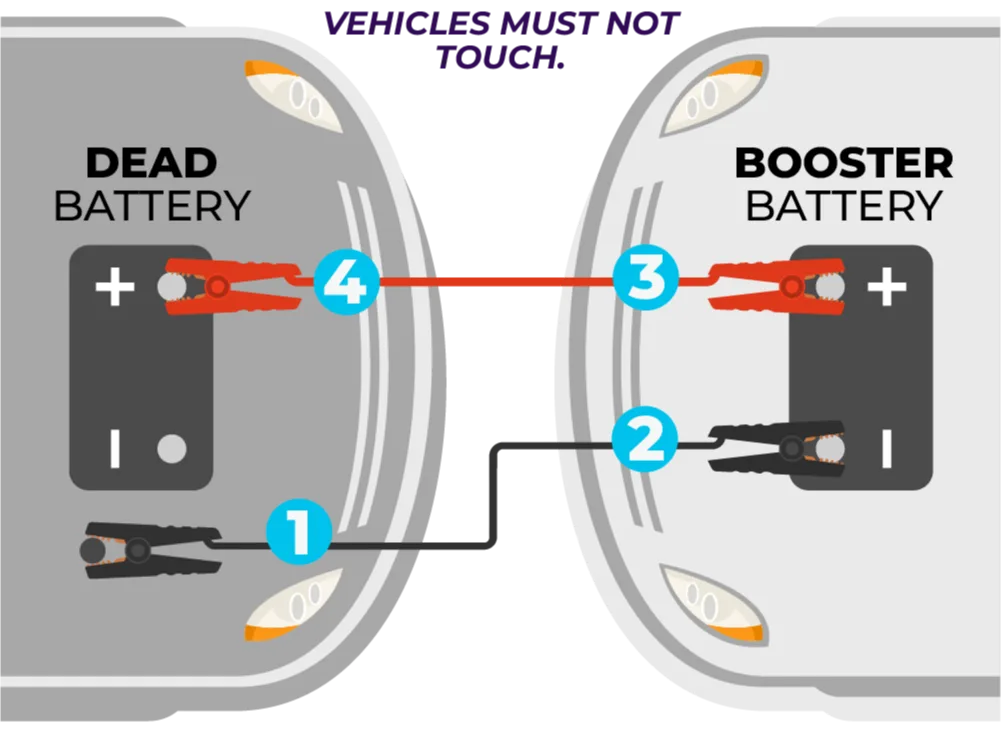
This is the standard Irish/UK sequence. The order matters, mainly because connecting the negative clamp last keeps any sparks away from the battery, where hydrogen gas can pool.
Step 1: Connect Red to Dead Positive
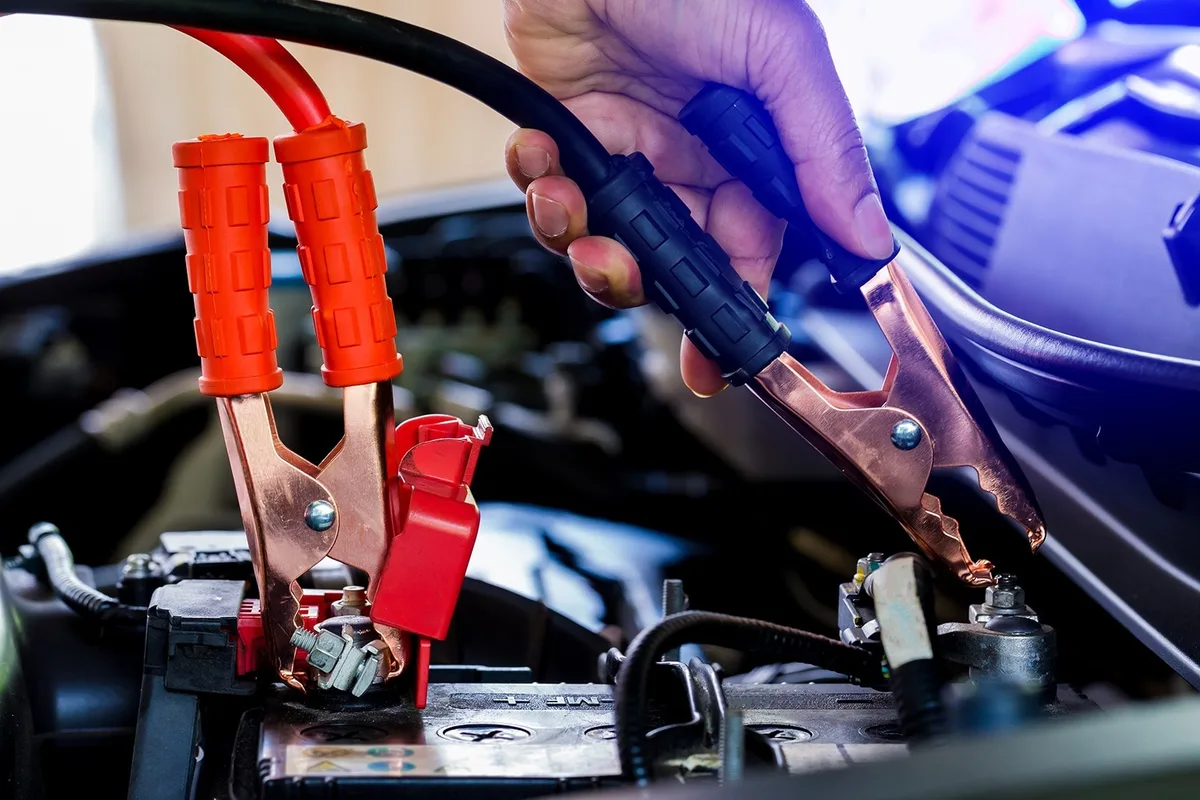
Clamp the red lead to the positive (+) terminal of the flat battery. Make sure the jaw bites the metal post, not the plastic cover. Wiggle it gently to confirm a tight grip.
Step 2: Connect Red to Donor Positive
Take the other end of the red lead and clamp it to the positive (+) terminal of the donor battery. Same check, same grip.
Step 3: Connect Black to Donor Negative
Clamp the black lead to the negative (-) terminal of the donor battery.
Step 4: Connect Black to an Earth Point on the Dead Car
Don't clamp the black lead to the dead battery's negative terminal. Clamp it to a bare metal part of the engine block or chassis, away from the battery, fuel lines, and any moving parts.
A good earth point is an unpainted engine bracket, a bolt head on the suspension turret, or the engine lift hook. You want a clean metal-to-metal contact.
Step 5: Crank the Engine
Start the donor car and let it idle for 2 to 3 minutes. This tops up the dead battery slightly and reduces the load on its own battery when you crank.
Turn the key on the dead car. Crank for no more than 10 to 15 seconds. If it doesn't fire, stop.
Wait 30 seconds, then try again. Three short bursts is the safe limit. If it still won't start, something else is wrong.
Step 6: Leave Both Engines Idling
Once the dead car runs, leave both cars idling. Don't disconnect yet. Let the flat battery take a slow charge for 2 to 3 minutes before you pull any leads.
Step 7: Disconnect in Reverse Order
Pull the black lead from the earth point on the dead car first. Then black from the donor negative. Then red from the donor positive.
Then red from the now-running car's positive terminal.
Keep the clamps apart as you remove them. Don't let a red clamp touch a black clamp or any metal part of the car while the other end is live. A short at this stage will weld the clamp to the chassis and fry electronics.
Step 8: Keep the Recovered Car Running
Drive for at least 30 minutes, or let it idle for 15 to 20 minutes. The alternator needs that time to put meaningful charge back into the battery. If the car won't restart after that, the battery is toast and needs swapping.
Connection Order: Red First, Black Last, Earth Point Matters
The cable order above isn't a quirk. It exists because car batteries vent hydrogen gas, especially when they're flat or recently jump-started. Hydrogen rises and pools around the battery top.
One spark at the negative terminal can ignite it.
Connecting the negative lead last, and to an earth point away from the battery, puts any spark somewhere safer. If a spark does happen, it's at a metal bracket, not over the vented gas.
Why the Earth Point Is on the Dead Car, Not the Battery
This trips up experienced drivers. The earth point on the dead car completes the circuit back to the donor battery, the same job the negative terminal would do. The reason we don't use the dead battery's negative post is spark distance.
A failed jump that arcs will arc at the clamp, and we want that clamp as far from the battery as the cable allows.
A loose, paint-free bolt or bracket on the engine block is ideal. Avoid the fuel rail, injection lines, or anything with "ECU" stamped on it.
Reverse Polarity: The One Mistake That Costs a Thousand Euro
Connect a red clamp to a negative terminal by mistake, even for a second, and you'll see what happens. Modern cars throw multiple fault lights. The ECU enters limp mode.
Some modules need reprogramming with dealer tools.
If you ever feel heat in a clamp the moment you connect it, stop. Don't finish the connection. Pull the clamp and start again.
That heat means reversed current, and the longer it stays, the more components fry.
Cranking the Engine: How Long and How Hard
Ten to fifteen seconds is the safe cranking window. Any longer and the starter motor overheats. The dead battery's voltage drops below what the donor can supply.
The donor battery starts sagging too.
If the engine doesn't catch on the first or second burst, something else is wrong. Possibilities include a flooded engine from repeated failed cranking, bad earth straps, or a starter motor pulling too much current.
Flooded Engine: The Smell Test
Hold the throttle to the floor and crank for five seconds with no fuel pump activation. This clears excess fuel from the cylinders. Try again with the key.
If it fires roughly and runs rough for a few seconds, you've cleared the flood.
If it doesn't fire at all, stop cranking. Continued cranking just floods it worse.
Disconnecting the Cables Safely
Reverse order is the only rule. Black from earth, black from donor negative, red from donor positive, red from recovered car positive. Keep the clamps from touching anything metallic or each other while the other end is still on a battery.
What Happens If You Disconnect Out of Order
The engine stays running, so the consequences are smaller than the connection phase. The main risk is a clamp shorting across the bodywork or another terminal. That spike can knock out a sensor or trigger a transient fault code.
Manufacturer service bulletins from Yuasa and Banner both emphasise reverse-order disconnection. It's not superstition. It's how workshops do it.
What to Do Right After the Engine Starts
Don't switch the engine off. Don't drive 200 metres to "warm it up" and call it done. The alternator needs sustained time to put meaningful charge back into a deeply discharged battery.
Drive It or Idle It, But Give It Time
A 30-minute drive at reasonable speeds (60 to 80 km/h on a motorway works) is the best recovery. The alternator output at cruise is roughly 50 to 70 amps, depending on the car.
An idle puts out 30 to 40 amps, but only after warm-up. A cold idle for 15 minutes barely tops up what the starter pulled out.
Check for Charging Voltage After 10 Minutes
If you can borrow or own a cheap plug-in OBD2 voltage reader, watch the live voltage. A healthy charging system sits at 13.8 to 14.4V when running. Anything below 13.5V means the alternator is weak.
Anything above 14.7V means the regulator is overcharging and the battery will cook.
For authoritative charging-system specs, the Road Safety Authority (RSA) Ireland publishes general vehicle roadworthiness guidance that includes electrical-system basics.
Jump Leads vs Jump Pack vs Calling the AA
Three recovery options exist for a flat battery. Each has its place, and the right choice depends on where you are, what you have, and how much you trust the battery afterward.

| Option | Best for | Cost in Ireland (2026) | Downside |
|---|---|---|---|
| Jump leads | Home garage, helping a friend, anywhere a donor car exists | €15 to €40 for the leads | Need a second car. Wet weather awkward. |
| Portable jump pack | Solo drivers, rural areas, no donor available | €60 to €150 | Limited cranking amps. Battery self-discharges if not topped up monthly. |
| AA Ireland / RAC patrol | No leads, no pack, or no confidence | Roughly €100 to €140 call-out | Wait time. |
| Battery charger (mains) | Overnight recovery at home | €30 to €80 | Slow. Useless on the roadside. |
Who Each Option Suits
Jump leads are the right call if you have a donor car handy, you know the procedure, and you trust the dead battery to take a charge. Most Irish households with two cars keep a set in the boot.
Portable lithium jump packs suit solo drivers, particularly those who travel rural roads. A good 1,000A peak pack will start a 2.0L diesel from flat. Charge it every two months or it goes flat itself.
AA Ireland patrols suit anyone without leads or a pack, or anyone who isn't sure the dead battery is actually safe to jump. The call-out fee covers diagnostics too, so you'll know if the battery is finished.
For European specification and safety standards on automotive batteries, the EN 50342 standard covers lead-acid starter battery requirements, including venting and terminal strength.
Common Mistakes Irish Drivers Make (ECU Damage, Wrong Earth Point)
Three mistakes cause most jump-start damage. Reversed clamps, earth on the dead battery terminal, and cranking a flooded engine for 30+ seconds.
Any of those can write off an ECU module. Repairs run €400 to €1,200 depending on the car.
The Earth Point Confusion
Halfords stores in Ireland still see the same error every winter. Black lead clamped to the dead battery's negative post. The connection works, the car starts, but the spark risk at the battery is real.
Move the black clamp to an engine bracket. Two extra seconds, full safety.
Costs: Jump Leads, Portable Packs, and Patrol Call-Outs
Budget roughly €25 for a solid set of 4 AWG leads that handle anything. A lithium jump pack worth buying runs €90 to €130. AA Ireland patrols cost €100 to €140 depending on membership.
Skipping the jump-start call-out for a €25 lead set is the cheapest insurance in motoring.
When a Jump Start Won't Work (Alternator or Bigger Battery Fault)
A jump start fixes a flat battery. It doesn't fix a dead alternator, a failed starter, or a battery with a dead cell. Three crank attempts and no fire means stop and diagnose.
Telltale Signs the Battery Is Finished
Engine starts after a long crank, then dies after 20 minutes. Battery light glowing on the dash. Voltage below 13.5V running.
These mean the battery isn't holding charge, and the car needs a new one.
For battery specs and replacement guidance, Yuasa's product documentation lists Ah ratings and CCA figures by vehicle application.
Safety Rules: Hydrogen Gas, Reverse Polarity, and Modern ECU Risk
Hydrogen gas vents from any lead-acid battery under heavy charge. A spark at the battery can ignite it. Reverse polarity on a modern car can fry multiple ECUs.
Wear safety glasses. Keep the black clamp off the dead battery. Stop if any clamp gets hot on connection.
Expert Tips from Years of Doing This Wrong
Keep a set of leads in the boot year-round. They weigh nothing. Top up a lithium jump pack every two months or it goes flat itself.
After any successful jump start, drive for 30 minutes minimum and book a battery test within a week.
A battery that needed jumping once will need it again soon. Plan for replacement rather than another roadside recovery.
Your Decision Guide: DIY or Call It In
If you have leads and a donor car, DIY is faster and gets the car mobile in under 10 minutes. If you're solo, in the rain, or unsure about the battery's condition, calling AA Ireland is the safer call.
Either way, get the battery load-tested within a week of any successful jump. A weak battery will leave you stranded again, often at the worst possible moment.
For general vehicle electrical safety and roadworthiness, the Road Safety Authority (RSA) Ireland publishes driver guidance worth a read before any roadside electrical work.
Frequently Asked Questions
Can You Jump Start a Car in the Rain?
Yes. Water doesn't conduct enough current to cause a problem at 12V. The risk everyone quotes (electrocution) only applies to high-voltage systems like EV traction packs or overhead power lines.
A standard 12V jump start in the rain is safe as long as both batteries are intact and you're not standing in a puddle with bare skin against a live terminal.
Does the Donor Car Need to Be Running While You Connect?
No. Most modern how-to guides from Yuasa and Banner recommend the donor engine off during connection, then started for 2 to 3 minutes before you crank the dead car. Connecting with both engines off reduces voltage transients when you crank.
How Long Should You Rev the Donor Car?
Revving the donor helps a little but isn't critical. A 1,500 to 2,000 rpm idle for 2 to 3 minutes is enough. Higher revs just spin the alternator faster and put slightly more current into the dead battery, but the difference is small compared to simply letting it idle.
What If the Car Starts but the Battery Light Stays On?
The battery light means the alternator isn't charging. Drive straight to a garage. The car will run on battery alone for 20 to 60 minutes depending on electrical demand, then die.
Don't keep driving and hope.
Can You Jump Start a Diesel from a Petrol Car?
Yes, with a caveat. Diesel engines need more cranking amps, especially in cold weather. A small petrol car with a weak battery will crank a diesel slowly.
Use thick leads (4 AWG) and let the donor charge the dead battery for 5 minutes before cranking. If the petrol donor's battery is marginal, it might not have enough reserve.
Is It Safe to Jump Start a Hybrid or EV?
Standard 12V jump start, yes, the small 12V auxiliary battery that runs lights and computers, not the high-voltage traction pack. The traction battery uses orange cables and runs at hundreds of volts. Don't touch those.
If the 12V battery in a hybrid or EV is dead, follow the manufacturer's procedure in the owner's manual, which usually specifies a dedicated jump point under the bonnet rather than the battery itself.