What size jump starter do i need
What size jump starter do I need is really a question about your engine, your climate, and how much safety margin you want. The wrong pick leaves you stranded on a dead morning. The right pick sits in your trunk and outranks the problem.
Most guides skip the math and just throw a peak amp number at you. We'll do better. Manufacturer specs and aggregate reviews, as of 2026, consistently show that matching jump starter output to your engine's cranking demand is the difference between a one-click start and a clicking starter you can't explain.
The two numbers that matter are peak amps (the marketing figure) and real cranking amps (the one that actually turns the engine).
Quick Answer
Match the jump starter to your engine's cranking amp demand. Then double it for diesel or cold weather. For most 4-cylinder and V6 cars, 1000 to 2000 peak amps is plenty.
For V8 engines and small diesel pickups, plan on 2000 to 3000 peak amps. Heavy-duty diesel trucks usually need 3000 peak amps or more.
Why Jump Starter Size Isn't One-Size-Fits-All
A jump starter that easily fires a 2.0-liter Civic on a 50°F morning might barely click a 6.7-liter Power Stroke at 10°F. The battery's chemistry, the engine's compression, the oil's viscosity in cold weather, and the parasitic drain from accessories all stack up against you.
Manufacturer specifications confirm that peak amp ratings are a 5-to-10-second burst figure, not sustained output. That's why two jump starters with the same "2000A peak" claim can perform very differently on the same engine. Real cranking amps, the load the unit can sustain for 10 to 30 seconds, are the number to trust.
Here's the rule of thumb that drives the rest of this guide:
- If you drive a small-to-midsize gas car, you can get away with a compact unit.
- If you drive a V8 SUV, full-size truck, or any diesel, you need serious output.
- If you live anywhere that drops below freezing for months, size up.
Skip this logic and you'll buy the wrong unit twice.
The Two Numbers That Actually Matter: Peak Amps vs Cranking Amps
Peak amps is the headline number on the box. It tells you the maximum current the lithium cells can deliver for a brief burst, usually under 10 seconds. It's impressive in ads.
It's also misleading on its own.
Cranking amps (sometimes called starting amps) is the current the unit can deliver for 30 seconds while keeping voltage above a usable threshold (typically 7.2V on a 12V system). That's the figure that determines whether your engine actually turns over.
A 1500A peak unit with strong cranking output will start a V6 in 20°F weather. The same unit's 1500A peak won't help you if the sustained output collapses under load.
Look at the fine print or the spec sheet. Reputable brands list both numbers. If a brand only quotes peak amps, treat it as a yellow flag.
| Spec | What It Measures | Why It Matters |
|---|---|---|
| Peak Amps | 5–10 second burst | Marketing headline, not real-world performance |
| Cranking / Starting Amps | 30 second sustained load | The number that actually starts your engine |
| Battery Capacity (mAh / Wh) | Total stored energy | Determines how many jumps per charge |
Also worth knowing: the Battery Council International sets the standard for cold cranking amps (CCA) on vehicle batteries. Jump starter output is rated against that same reference point.
Step 1: Identify Your Engine Type and Size
Before you can size the jump starter, you need to know what you're asking it to start. Three quick questions tell you almost everything:
- What's the engine displacement? (2.0L, 3.5L, 5.0L, 6.7L, etc.)
- Is it gas or diesel?
- Does your vehicle have a V6, V8, or another configuration?
You can find displacement on the spec sticker in the driver's door jamb, in the owner's manual, or with a quick VIN lookup at any parts store.
Engine size matters because displacement correlates with compression, and compression is what your starter motor has to push past on every cold start. A 1.5L 4-cylinder needs roughly half the cranking force of a 5.0L V8.
Diesel engines need even more. Their compression ratios run 15:1 to 20:1 versus 9:1 to 11:1 for gas. That's why a small diesel starter can pull 800 amps while a big gas V8 might pull 400.
Step 2: Match Amps to Gas vs Diesel Engines
Once you know your engine, the sizing decision gets simple. Here's how the tiers break down based on aggregate reviews and manufacturer specs.
| Vehicle / Engine | Recommended Peak Amps | Real-World Cranking Load |
|---|---|---|
| Motorcycle / Lawn mower / ATV | 300–800A | 100–200A |
| 4-cyl gas (1.5L–2.5L) | 800–1500A | 150–250A |
| V6 gas (3.0L–4.0L) | 1500–2000A | 250–350A |
| V8 gas (4.6L–6.2L) | 2000–3000A | 350–500A |
| Small diesel (3.0L–5.0L) | 2500–3500A | 400–700A |
| Heavy-duty diesel (6.0L+) | 3000–4000A+ | 800–1500A+ |
Two practical rules to keep in mind:
- Diesel rule: Size up by 50% to 100% over what you'd pick for a comparable gas engine. A 3.0L diesel needs more cranking power than a 5.0L gas V8.
- Battery voltage rule: Most cars and light trucks run 12V systems. Commercial trucks and some heavy equipment run 24V. Make sure your jump starter matches. Most consumer units are 12V only.
If you're not sure whether your vehicle is 12V or 24V, check the battery itself. It'll be printed on the case.
Step 3: Factor in Climate (Cold-Weather Derate)
Cold weather kills jump starter performance. A lithium jump starter that fires a V8 in October may click uselessly in January.
The reason is chemistry. Standard lithium-ion cells lose 20% to 40% of their usable capacity below 0°F. Lithium iron phosphate (LiFePO4) cells hold up better, losing around 10% to 20% in the same range.
Lead-acid jump starters actually hold cold-weather output better than lithium, but they weigh three times more.
The practical fix is simple: size up by one tier if you regularly park outside in sub-freezing weather. A driver in Minnesota who would normally need 1500A peak should pick a 2000A unit. A Texas driver in the same car can stick with 1500A.
Two cold-climate specifics worth flagging:
- Let the jump starter warm up inside your jacket for a few minutes before using it in extreme weather. Internal resistance drops fast as the cells warm.
- Keep it inside the cab, not the trunk, on long trips in winter. Trunk temperatures drop fast overnight.
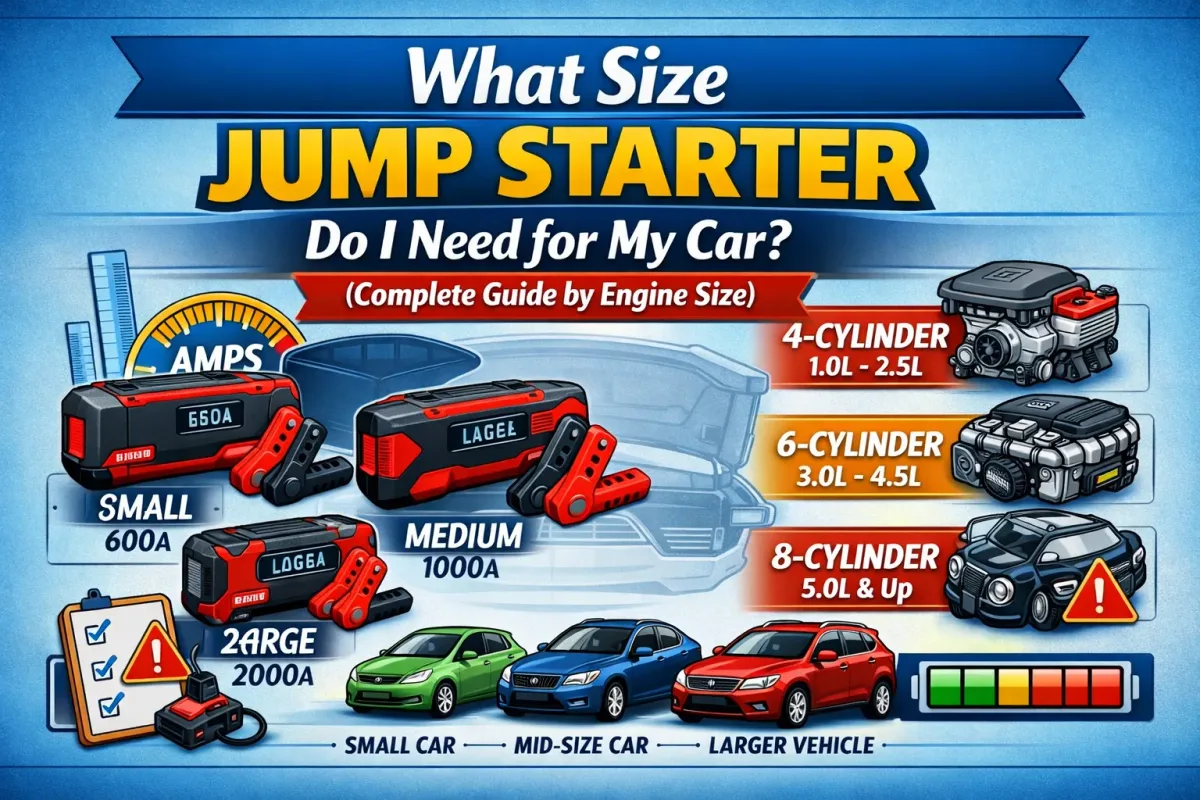
Jump Starter Size Chart by Vehicle Type
Use this chart as a quick reference when you've already pinned down your engine and climate. We've sorted it by common categories people shop for.
| Vehicle Category | Engine Range | Minimum Peak Amps | Recommended Peak Amps |
|---|---|---|---|
| Motorcycle / Scooter | up to 1.0L | 300A | 600A |
| Compact car | 1.5L–2.0L 4-cyl | 800A | 1500A |
| Midsize car / Sedan | 2.5L–3.5L V6 | 1500A | 2000A |
| Full-size sedan / Crossover | 3.5L–4.0L V6 | 1800A | 2500A |
| SUV / Pickup (V8 gas) | 5.0L–6.2L V8 | 2000A | 3000A |
| Light diesel (Sprinter, Transit) | 3.0L–3.5L diesel | 2500A | 3500A |
| Heavy-duty diesel pickup | 6.0L–6.7L diesel | 3000A | 4000A+ |
| 24V commercial truck | 24V system | N/A (12V unit won't) | dedicated 24V model |
For typical use, the "Recommended" column is what you want. The "Minimum" column is the smallest unit that will reliably start the vehicle under ideal conditions (warm engine, fresh battery, mild weather).
If your vehicle doesn't fit neatly into one row, round up to the next category. The cost difference between a 2000A and a 3000A unit is usually $30 to $60. The cost of being stranded on a cold morning is not.
Recommended Jump Starter Sizes for Common Vehicles
Here's where the chart meets the parking lot. These are the specific jump starter tiers we recommend for the vehicles people most often ask about.
For a Honda Civic, Toyota Corolla, or any 4-cylinder commuter: A compact 1000A to 1500A peak lithium unit is more than enough. These vehicles rarely pull more than 200A cranking, even in cold weather.
For a Ford F-150 with the 5.0L V8 or a Chevy Tahoe: Plan for 2000A to 2500A peak. The 5.0L Coyote and 6.2L EcoTec3 both demand real cranking amps, especially when the oil is thick.
For a Ford F-250 or Ram 2500 with the 6.7L Cummins: Go 3000A peak or higher. The 6.7L Power Stroke is similar. These diesels routinely pull 700A+ on cold mornings, and that's after the glow plugs have done their job.
For a Mercedes Sprinter 3.0L diesel: 2500A to 3500A peak. Sprinters are notoriously cranky on cold mornings because their battery placement and engine bay layout make heat soak tough.
For a Harley-Davidson, dirt bike, or lawn tractor: A small 400A to 800A peak unit handles it. These batteries are tiny and rarely pull more than 100A.
For a Class 7 commercial truck with a 24V system: A consumer lithium jump starter won't work. You need a dedicated 24V unit or a heavy-duty commercial booster.
Lithium vs Lead-Acid vs Capacitor: Which Chemistry Fits Your Use Case?
Not all jump starters run on the same internal battery. The chemistry inside the case changes weight, cold-weather performance, lifespan, and price.
Lithium-ion (Li-ion): This is what most modern portable jump starters use. Lightweight (often under 5 lbs), compact, and inexpensive. Cold-weather output drops noticeably below freezing.
Best for most car owners who park in a garage or mild winter climate.
Lithium iron phosphate (LiFePO4): A newer lithium chemistry with better thermal stability and longer cycle life. Holds more usable capacity in cold weather than standard Li-ion. Costs a bit more, lasts longer (often 2000+ cycles vs 500).
Best for cold-climate drivers and frequent users.
Lead-acid: The original jump box. Heavy (15 to 30 lbs), but holds cold-weather output well and costs less per amp. Common in shop environments, fleets, and roadside service trucks.
Best for pros who need rugged, all-weather output and don't mind the weight.
Ultracapacitor / supercapacitor jump starters: These don't store much energy but discharge extremely fast. They pull a small charge from your weak battery, then dump it back into the starter in one big pulse. Work in extreme cold.
Last almost forever. Best for shop techs and people who want zero battery degradation.
| Chemistry | Weight | Cold Performance | Lifespan | Best For |
|---|---|---|---|---|
| Li-ion | 2–5 lbs | Moderate | 300–500 cycles | Everyday car owners, mild climates |
| LiFePO4 | 3–6 lbs | Good | 2000+ cycles | Cold climates, frequent users |
| Lead-acid | 15–30 lbs | Excellent | 200–400 cycles | Pros, fleets, severe cold |
| Ultracapacitor | 4–8 lbs | Excellent | 100,000+ cycles | Shop use, extreme cold |
If you're choosing for a daily driver that lives in a temperate climate, lithium-ion still wins on the price-to-portability ratio. If you're choosing for a fleet or a sub-zero parking spot, pay the upcharge for LiFePO4 or lead-acid.
Compact, Mid-Size, or Heavy-Duty? Picking the Right Tier
Once you've nailed down amps and chemistry, the last choice is form factor. Most brands sort their lines into three tiers, and the differences matter more than the marketing implies.
Compact jump starters weigh 1 to 3 lbs. They fit in a glove box or center console and usually top out around 1500A peak. Best for motorcycles, commuters, and anyone who values trunk space over output.
Mid-size units weigh 3 to 6 lbs and deliver 1500A to 3000A peak. They typically include extras like USB charging ports, built-in flashlights, and sometimes a small air compressor. Best for SUV and truck owners who want one tool that does several jobs.
Heavy-duty units weigh 6 to 20+ lbs and start at 2500A peak. They often run on lead-acid or large LiFePO4 packs and include commercial-grade clamps with thicker gauge wiring. Best for diesel trucks, fleet use, and shop environments.
Pick the tier that matches your vehicle, not your aspirations. A 30-lb commercial booster in a Camry is overkill. A 1.5-lb compact unit in a Duramax is a coin flip at best.
Safety Features You Shouldn't Skip
A jump starter is high current and short distance from sensitive electronics. Modern cars run dozens of ECUs and CAN bus networks that don't take kindly to voltage spikes. The safety features on the unit itself are your buffer.
The non-negotiables:
- Reverse polarity protection: Stops current flow if you accidentally swap positive and negative. Saves your car's electrical system and the jump starter.
- Spark-proof clamps: Prevents arcing when you make contact. Standard on any reputable brand.
- Overcurrent and short-circuit protection: Cuts power if the clamps touch each other or if there's a wiring fault.
- Thermal protection: Shuts the unit down if the cells overheat during a long crank attempt.
- UL 2743 certification: The Underwriters Laboratories standard for portable lithium jump starters. Look for it on the box or in the spec sheet.
Two more features that aren't strictly safety but add real-world value:
- A voltage readout on the unit: Tells you the state of charge and confirms the clamps are connected correctly before you try to crank.
- A "boost" or "override" button: For severely depleted batteries below 2V, this forces current flow even when the unit's protection circuits think there's no battery to find. Genuinely useful for batteries that have been sitting dead for weeks.
Mistakes That Leave You Stranded Anyway
Sizing the jump starter right only helps if the unit works when you need it. Most failed jump stories trace back to one of these mistakes.
Forgetting to recharge the jump starter between uses. Lithium cells self-discharge slowly, but 6 to 12 months of sitting will leave most units flat. Charge it every 3 months at minimum.
Leaving it in a freezing trunk. Cold-soaked lithium cells deliver less current and can refuse to function entirely below their rated low temperature. Bring it inside overnight in winter.
Clamping to the wrong ground point. Modern cars have specific jump-start lugs away from the battery. Clamping directly to the battery post works on older cars but can ignite hydrogen gas on a vented battery.
Use the chassis ground lug if your car has one.
Trying to jump a frozen battery. The electrolyte can crack the battery case as it freezes and expands. A cracked battery leaks acid.
Don't crank it. Thaw it first, then try.
Confusing peak amps with cranking amps. We covered this already, but it's the most common buying mistake by a wide margin. Two units with the same peak number can perform very differently.
Skipping a load test. If your battery died once, it'll die again. Have it load tested at any auto parts store (free, takes 5 minutes) so you're not jump-starting the same dying battery for the next six weeks.
How to Jump Start a Car the Right Way (Step-by-Step)
Once the right unit is in your hand, the procedure itself takes less than 5 minutes. Here's the sequence that protects both the car and the jump starter.
- Confirm the jump starter is charged (LED readout should show 100% or full bars).
- Turn off the car's ignition and remove the key. Kill the AC, radio, and headlights to reduce parasitic draw.
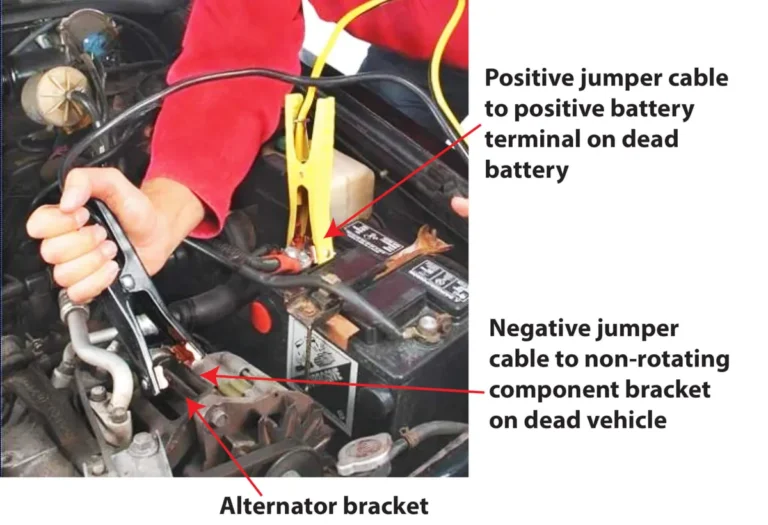
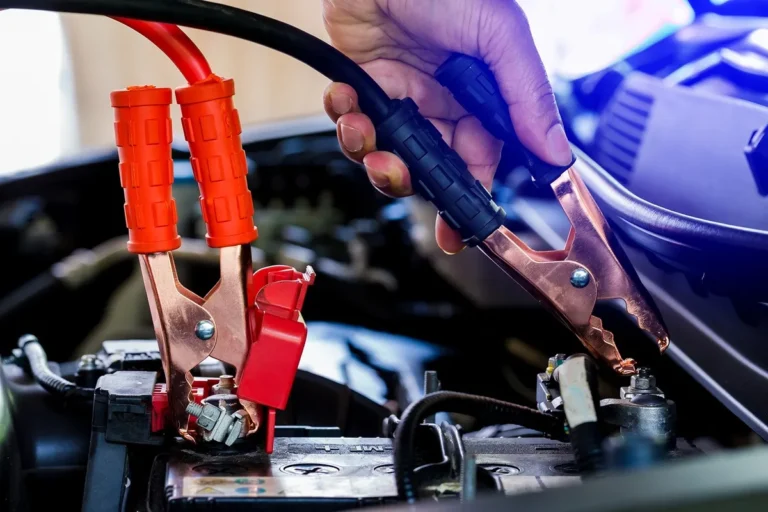
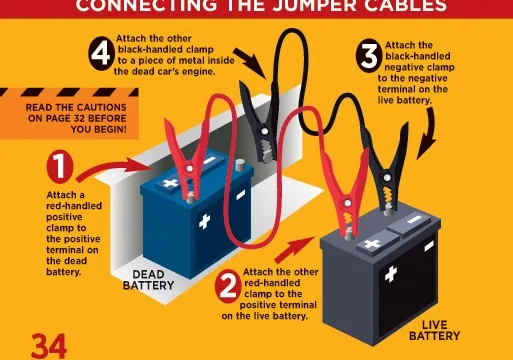
- Connect the red (positive) clamp to the positive terminal on the dead battery, or to the designated positive jump lug.
- Connect the black (negative) clamp to a clean, unpainted metal ground point on the engine block, away from belts and fuel lines. Not the negative terminal if the battery is vented or cracked.
- Power on the jump starter and wait 30 to 60 seconds for the BMS to handshake with the battery.
- Crank the engine for no more than 5 seconds. If it doesn't start, wait 30 seconds and try again. Three attempts max before giving the unit a rest.
- Once the engine starts, disconnect the black clamp first, then the red clamp.
- Let the engine idle for at least 20 minutes, or drive for 30+ minutes, to put charge back into the battery.
Jump Starter Maintenance and Storage Tips
A portable jump starter that's been sitting in your trunk for two years is roughly as useful as a brick. Maintenance is light, but it's not optional.
Charge it every 3 months if unused. Lithium cells lose roughly 2% to 5% per month to self-discharge. Storing at 0% for extended time can permanently damage the cells.
Store it between 32°F and 80°F. Heat degrades lithium cells faster than cold does. A garage in Phoenix is worse for the unit than a trunk in Minneapolis.
Inspect the clamps and cables before each season. Corroded clamps add voltage drop. Cracked insulation risks a short across the clamp housing.
Test it twice a year. Plug in a dead battery or use the unit's self-test mode (most modern units have one). Replace the unit if the cells won't hold above 50% capacity after a full charge cycle.
Air Travel and Transport Rules for Lithium Jump Starters
If you're flying somewhere remote with a jump starter in your bag, the rules are real and they're enforced.
The U.S. Department of Transportation classifies portable lithium jump starters as lithium battery packs, not consumer electronics. That puts them under specific watt-hour limits:
- Under 100Wh: Carry-on only, no airline approval needed.
- 100Wh to 160Wh: Carry-on only, airline approval required (varies by carrier).
- Over 160Wh: Forbidden on passenger aircraft, regardless of approval.
For context, most compact and mid-size jump starters land between 40Wh and 100Wh. Heavy-duty units can exceed 160Wh and can't fly.
Two practical notes:
- Pack the unit in your carry-on, never checked luggage. Lithium fires in cargo holds are a known risk category.
- Protect the terminals. Tape over the clamp ends or use the included case so they don't short against a phone or laptop in your bag.
Quick Reference: Amp Requirements by Engine
| Engine Class | Typical Cranking Load | Safe Peak Amp Range |
|---|---|---|
| 4-cyl gas (1.5L–2.5L) | 150–250A | 800–1500A |
| V6 gas (3.0L–4.0L) | 250–350A | 1500–2500A |
| V8 gas (5.0L+) | 350–500A | 2000–3000A |
| Small diesel (3.0L) | 400–600A | 2500–3500A |
| HD diesel (6.0L+) | 800–1500A | 3000–4000A+ |
Use this table as a final sanity check before you buy. If your engine sits at the top of its class or you live where winters are brutal, pick the higher end of the range.
Decision Guide: Putting It All Together
Start with your engine. If it's gas and under 4 liters, a 1500A lithium unit handles it. If it's a V8, a 6-cylinder diesel, or you live where winter is real, jump to 2500A.
If it's a heavy-duty diesel, 3000A peak is the floor.
Next, choose your chemistry. Mild climate and infrequent use: lithium-ion works. Cold climate or weekly use: LiFePO4 pays back the upcharge.
Shop or fleet use: lead-acid still wins on raw durability.
Finally, lock in safety. UL 2743 certification, reverse polarity protection, and spark-proof clamps aren't optional. They're the difference between a useful tool and a service ticket.
Frequently Asked Questions
Will a 1000 amp jump starter start a V8?
Yes, in mild weather with a fresh-but-discharged battery. A 1000A peak unit with strong cranking output (200A+ for 30 seconds) will turn most V8s. In cold weather or with a deeply discharged battery, you'll want 2000A peak minimum.
Aggregate reviews of undersized 1000A units against V8s show the most common failure is in winter.
How big of a jump starter do I need for a diesel truck?
Plan on 3000A peak or higher. Light-duty 3.0L diesels can sometimes start on 2000A peak in warm weather. The 6.0L to 6.7L diesels in HD pickups usually demand 3000A to 4000A peak.
Always size up for diesel, and double it for cold climates.
Can a jump starter be too powerful?
For a 12V vehicle, no. A 4000A jump starter won't damage a 4-cylinder car. The car's electrical system only draws what it needs.
The risk is in voltage, not amps. As long as the unit outputs the correct 12V (or 24V for commercial trucks), more amps just gives you more headroom.
Do lithium jump starters work in cold weather?
Standard lithium-ion units lose 20% to 40% of usable capacity below 0°F. LiFePO4 units lose less, around 10% to 20%. For routine winter use below freezing, choose LiFePO4 or lead-acid, and warm the unit indoors before use.
Ultracapacitor jump starters work in extreme cold but need a small residual charge in the dead battery to operate.
How many times can you jump a car on one charge?
A typical 1500mAh to 2000mAh lithium jump starter delivers 10 to 20 starts per charge on small engines and 3 to 6 starts on V8s. Larger LiFePO4 packs can deliver 20 to 40 starts. Cold weather cuts these numbers in half.
How long do portable jump starters last?
Standard lithium-ion units last 300 to 500 charge cycles, or about 3 to 5 years of typical use. LiFePO4 units last 2000+ cycles, roughly 7 to 10 years. Lead-acid jump starters last 200 to 400 cycles.
Storage conditions matter more than cycle count for lifespan.