How to jump start car with cables: Easy guide
A dead battery always seems to happen at the worst time. A grocery store parking lot. Outside your kid's school.
The first cold morning of the year. If you're figuring out how to jump.start car with cables, the procedure itself is straightforward. The connection order, the wait time, and the disconnect sequence haven't changed in decades.
The real challenge is knowing what to check first so you don't waste 20 minutes jumping a car with a different problem.
A few numbers worth knowing. A fully charged 12V automotive battery sits at 12.6 volts, and anything under 11.8 volts is deeply discharged. Most modern jumper cables are 4 to 6 AWG, which is thick enough for cars and light trucks.
The Battery Council International publishes the group-size and CCA standards that battery makers follow, so a "BCI Group 24" or "Group 48" label means something specific. As of 2026, AGM batteries have largely replaced flooded cells in new cars with start-stop systems, and they need slightly different handling. Let's get into what to check before you pull out the cables.
Quick Answer
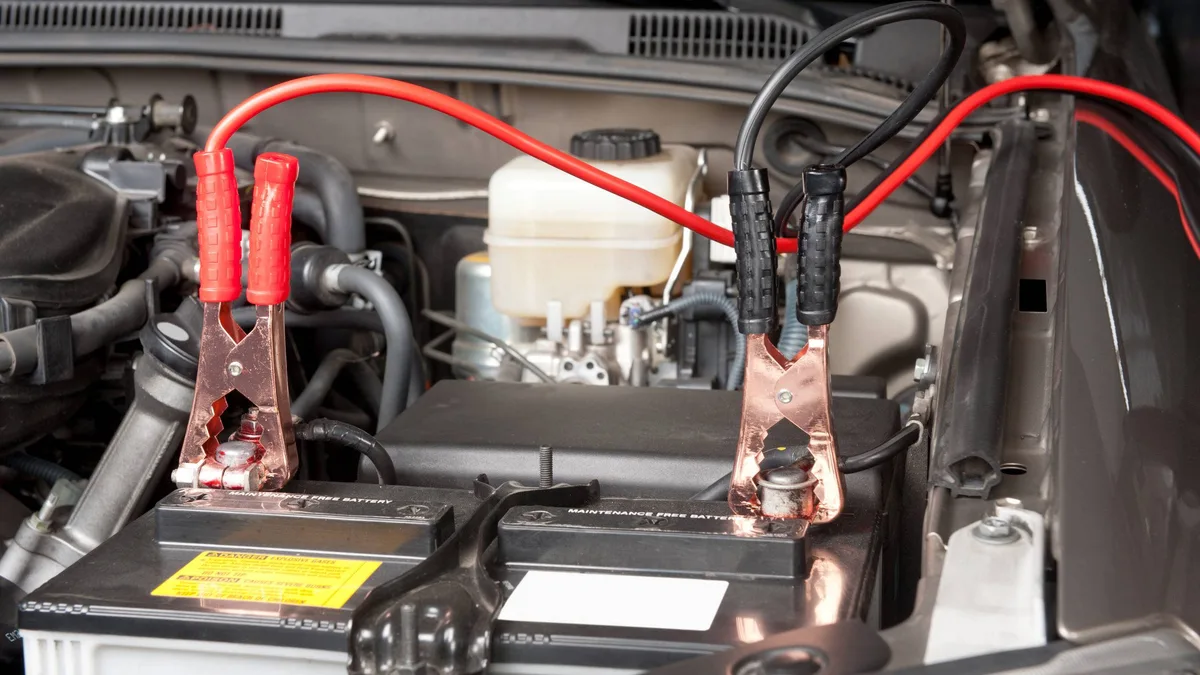
To jump.start car with cables, park a donor vehicle close to the dead one. Connect red to dead positive, red to donor positive, black to donor negative, and black to a ground point on the dead car. Start the donor, wait 2 to 5 minutes, then try the dead car.
Before You Touch the Cables: Is a Jump-Start Even What You Need?
Not every no-start problem is a dead battery. If you jump a battery that's actually fine, you mask a bigger issue like a failing alternator or a parasitic drain that leaves you stranded again hours later. A few quick checks tell you whether jumper cables will actually help.
Common Symptoms of a Dead Battery
- Clicking sound when you turn the key, but the engine doesn't crank
- Dim or completely dead interior lights and dashboard
- Radio, windows, and door locks unresponsive
- Engine cranks very slowly, like syrup
- Everything works until you try to start, then it dies
If the engine cranks at normal speed and the car still won't fire, the battery is probably fine. The problem is fuel, spark, or a sensor. Jump-starting won't help that.
When a Jump-Start Won't Help
Skip the cables if you see any of these:
- The battery case is cracked, swollen, or leaking fluid
- The terminals are loose, melted, or visibly damaged
- The battery is frozen (common in sub-zero climates; a frozen battery can crack or explode when charged)
- You see heavy white or blue-green corrosion caked on the posts
A frozen, cracked, or leaking battery needs replacement, not a jump. Per OSHA's battery handling guidance, a damaged lead-acid battery can release hydrogen gas or sulfuric acid, both real hazards.
The 30-Second Battery Check (Don't Skip This)
Before grabbing the cables, pop the hood and look at the battery. This takes 30 seconds and can save you from damaging a donor car's electrical system.
Voltage and Visual Cues
A healthy 12V battery reads 12.4 to 12.7 volts at rest. A cheap multimeter confirms it in seconds. If you don't have one, look at the built-in "magic eye" indicator on some batteries.
Green means charged, black or clear means low or dead.
Check the terminals next. Corrosion shows up as a white, blue, or greenish powder around the posts. A light dusting is normal.
A thick crust blocks current and prevents a solid clamp bite. You can scrape it off later with a wire brush, but don't try to jump a battery with heavy corrosion until you've cleaned it.
Battery Types You'll Encounter
| Type | What It Looks Like | Jump-Start Notes |
|---|---|---|
| Flooded lead-acid | Removable vent caps on top | Standard procedure, most forgiving |
| AGM (absorbed glass mat) | Sealed case, often labeled "AGM" | Sensitive to overcharging, don't rev the donor above 2,000 RPM |
| EFB (enhanced flooded) | Sealed, used in many start-stop cars | Treat like AGM, watch voltage |
| Gel cell | Sealed, usually in motorcycles or deep-cycle use | Use lower charging current, standard cables fine for cars |
Most cars built after 2015 with automatic start-stop use AGM or EFB batteries. The procedure is the same, but a brief idle on the donor (no revving) is gentler on these.
Jumper Cables, Jump Box, or Roadside Service? Picking Your Method
You have three real options when your battery is dead. Each fits a different situation.
| Method | Best For | Cost Range | Limitations |
|---|---|---|---|
| Traditional jumper cables + donor car | Home garage, parking lots, anywhere a second car is available | $15 to $80 for cables | Need a willing donor, both cars close enough to reach |
| Portable lithium jump starter | Solo drivers, road trips, no second car around | $50 to $200 | Must be charged, small ones won't start big V8s or diesels |
| Roadside assistance (AAA, insurance add-on, OnStar) | Anyone without tools or confidence to DIY | Often included in membership, $75 to $150 per call otherwise | Wait times of 30 minutes to several hours |
For most people, a set of decent 4 or 6 AWG cables stored in the trunk is the cheapest and most reliable option. If you drive a diesel truck, a large SUV, or any vehicle with a big V8, pay extra for thicker 2 or 4 gauge cables. A 10-gauge set from a discount store can overheat on a high-displacement engine.
When a Jump Box Beats Cables
A portable lithium jump starter is the right call if you commute alone, travel in remote areas, or simply don't want to flag down a stranger. Modern 1,000 to 2,000 peak-amp units can start a 6-liter gas engine from a backpack-sized box. The tradeoff is they must stay charged, and they lose capacity in extreme cold.
What You'll Need (And What to Skip at the Auto Parts Store)
You don't need much. Here's the practical kit list.
- Jumper cables, 4 to 6 AWG, at least 12 feet long (20+ feet is better for truck-to-truck)
- A donor vehicle with a healthy 12V battery of equal or larger capacity
- Safety glasses and gloves (optional but smart)
- A wire brush or old toothbrush for terminal corrosion
- A piece of stiff cardboard or a flashlight (for finding the ground point in dim engine bays)
Skip the "heavy-duty 500-amp" cables sold at gas stations. They usually use 8 or 10 gauge wire with thick insulation to look beefy. Genuine 4-gauge copper cable is heavier, more expensive, and noticeably stiffer.
That's the one you want.
How Long Do Jumper Cables Last?
Good cables last 10+ years if you store them dry and don't kink the wire inside the insulation. The failure point is almost always the clamp, which loosens over time and loses its bite on the terminal. If the clamp wiggles on the post instead of clamping tight, replace the cables.
Reading Your Battery and Terminals: Flooded, AGM, or Corroded?
Knowing what kind of battery you have shapes the entire jump-start process. A corroded terminal won't pass enough current to crank the engine, no matter how good your cables are. An AGM battery in a start-stop car needs a gentler approach than a 1990s pickup.
Spotting Terminal Corrosion
Corrosion usually shows up around the positive post as a powdery buildup. A light coat is normal and won't stop a jump. A thick, crusty layer (you can see it from a foot away) needs to come off first.
Disconnect the negative cable, then the positive, scrub the posts and clamps with a wire brush, reconnect positive first, then negative. Five minutes of cleaning beats an hour of wondering why the jump didn't work.
Identifying Your Battery Type Without a Label
If the label is unreadable, the case shape usually gives it away. A flat top with six removable vent caps is flooded lead-acid. A sealed top with a slight bulge and "AGM" or "EFB" stamped on the side is the modern type.
Motorcycles and lawn tractors often use a smaller battery, sometimes 6V on vintage British bikes, which needs different cables entirely.
Side-Mount vs. Top-Mount Terminals
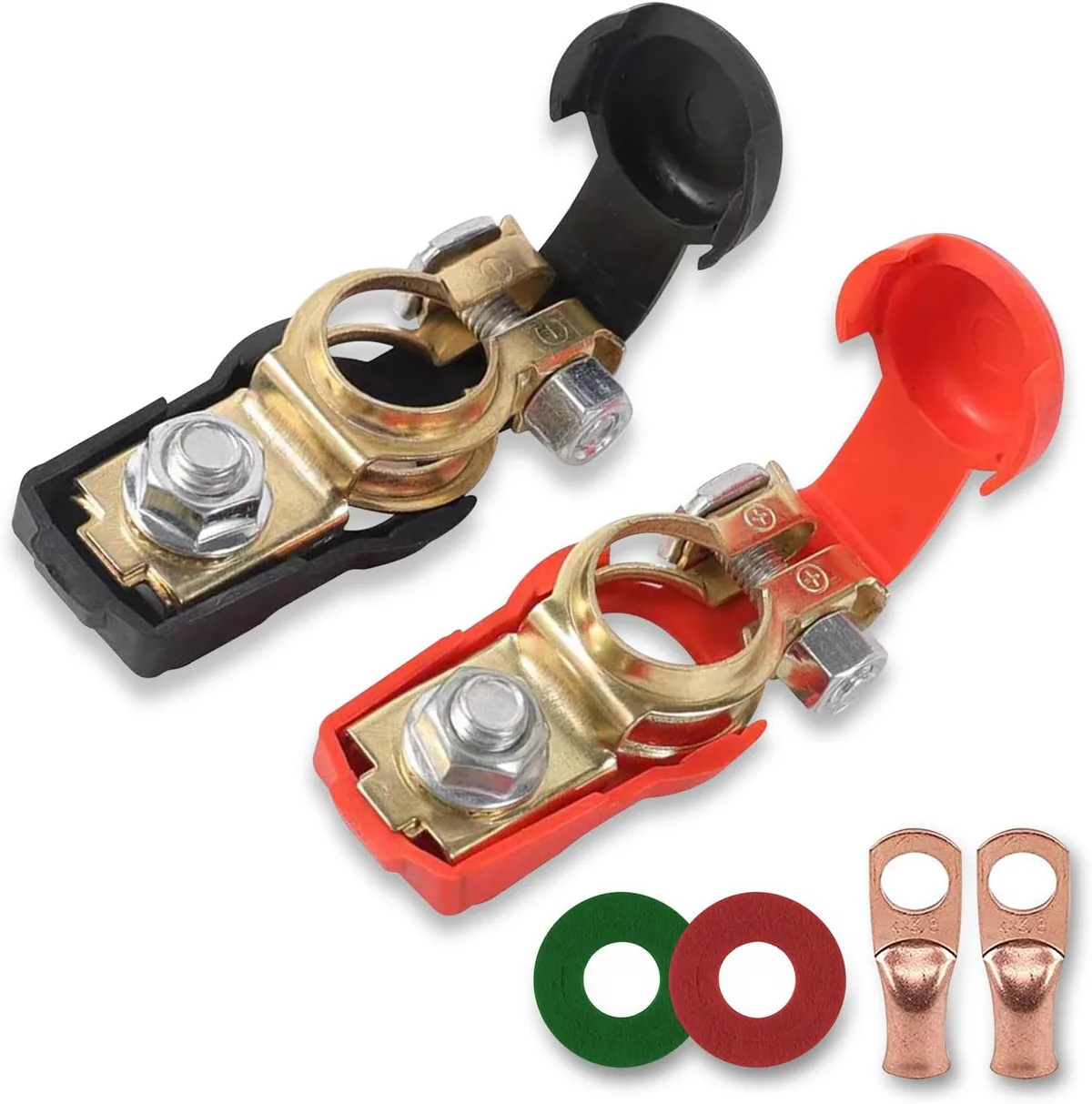
Some GM, BMW, and European cars have the positive terminal on the side of the battery rather than the top. The clamp still works the same way, but a side-mount terminal may need a smaller clamp jaw or an adapter. If your clamp won't seat properly on a side terminal, you're not making a solid connection and the jump will fail.
The Safe Jump-Start Procedure: Step-by-Step
Once you've confirmed the battery is the problem, the actual jump is straightforward. The sequence matters for safety, not just tradition. Reverse polarity can fry a $1,200 ECU in seconds, and a spark near the battery can ignite hydrogen gas venting from the cells.
Step 1: Position Both Vehicles
Park the donor car close enough that the cables reach both batteries without stretching. Engines off, parking brakes on, both cars in Park (or in gear for manual transmissions). Turn off headlights, climate control, and any plugged-in accessories on both vehicles.
These small loads pull current away from the dead battery during charging.
Step 2: Identify the Terminals
Positive posts are marked with a "+" and almost always have a red plastic cover or a red cable attached. Negative posts carry a "-" and use a black cable. If the markings are worn off, remember: the positive terminal is usually slightly larger in diameter.
Step 3: Connect the Cables in This Order
- Red clamp to the positive (+) terminal of the dead battery
- Red clamp to the positive (+) terminal of the donor battery
- Black clamp to the negative (-) terminal of the donor battery
- Black clamp to an unpainted metal ground point on the dead car (engine bracket, alternator bracket, or a designated ground stud)
The ground point on the dead car is critical. Never connect the final black clamp to the dead battery's negative post. A small spark is normal during the final connection, and that spark can ignite hydrogen gas venting from the battery.
A ground point away from the battery routes the spark safely.
Step 4: Start the Donor and Wait
Start the donor car and let it idle for 2 to 5 minutes. Don't rev the engine hard. A gentle 1,500 RPM idle is enough to send current across the cables.
Revving above 2,000 RPM can spike the donor's alternator output above 15 volts, which is hard on AGM batteries and modern electronics.
Step 5: Try the Dead Vehicle
Turn the key or press the start button on the dead car. If it starts within a few seconds, leave it running. If it doesn't, wait another 2 to 3 minutes and try again.
Three failed attempts usually means the battery is too far gone or there's another problem (bad ground cable, bad starter, or a short).
Connection Order Matters: Positive First, Ground Point Last
This is the part most generic guides rush through. The connection order is what separates a clean jump from a fried ECU or a battery explosion. Once you understand the logic, you'll never forget it.
Why the Order Works
The reason we connect positive first on both batteries is to keep the cables at the same potential as much as possible. The final black clamp is the one that creates the circuit, and it always goes on the dead car last because that's where the spark happens. Putting the spark at a ground point, away from the battery, keeps any hydrogen gas safely out of the picture.
What Happens If You Reverse Polarity
If you connect red to negative and black to positive, the donor's alternator pushes current backward through the dead car's electrical system. Fuses usually blow first, which protects the wiring. But many modern cars run a constant 12V feed to the ECU, infotainment module, and body control module.
A reverse polarity spike can take out modules that cost more than the entire battery.
Quick Memory Trick
Think "red to red, black to ground." The red cables go between the two positives. The black cable's only job on the dead side is to provide a safe ground for the spark. Once you say it that way, the four clamps almost connect themselves.
Starting the Dead Vehicle: Timing, Revving, and What If It Doesn't Turn Over
The wait time and the revving strategy both matter more than most people realize.
How Long to Charge Before Cranking
A lightly discharged battery (you left the headlights on for 20 minutes) usually starts in under 60 seconds of connection time. A deeply discharged one (the car has been sitting for a month) needs the full 5 minutes, sometimes longer. If the donor's headlights dim noticeably when you connect, the dead battery is drawing hard, which is a good sign the circuit is healthy.
Should You Rev the Donor?
A small rev to about 1,500 RPM is fine. It brings the alternator into its working range and pushes a few extra amps across. Beyond that, it doesn't help.
The bottleneck is the dead battery's ability to accept charge, not the donor's output. High revs also risk voltage spikes, especially on older cars with worn voltage regulators.
What If the Engine Won't Crank After 5 Minutes
Three things could be wrong:
- The dead battery is sulfated and can't hold a charge (common on batteries older than 4 to 5 years)
- The cables aren't making solid contact (wiggle each clamp and make sure the teeth bite into the post)
- The real problem isn't the battery at all (failing starter, bad ground strap, or a fuel issue)
If the dashboard lights come on bright but the engine still won't turn over, the starter is the prime suspect. A jump won't fix a bad starter.
Disconnecting the Cables Without Damaging Either Car
Disconnecting is just the connection sequence in reverse. But there are two extra details most guides skip: don't let the clamps touch each other during removal, and don't let a hot clamp land on either car's paint.
The Reverse Order
- Disconnect the black clamp from the ground point on the dead car
- Disconnect the black clamp from the donor's negative terminal
- Disconnect the red clamp from the donor's positive terminal
- Disconnect the red clamp from the dead battery's positive terminal
This keeps the same current path, just unwound. Touching the red and black clamps together while the other ends are still connected creates a dead short.
What to Do With Hot Clamps
Heavy current flow heats up copper. After a successful jump, especially on a deeply discharged battery, the clamps can be surprisingly warm. Set them on the ground, on a rag, or on a non-conductive surface.
Don't drape them over the battery or any painted surface while they're still hot.
What to Do If the Car Starts — And If It Doesn't
A successful start isn't the end of the story. You still need to figure out whether the battery just needed a boost or whether something bigger is failing.
If It Starts
Leave the engine running. Drive the car for at least 20 to 30 minutes to let the alternator recharge the battery. Highway driving is more effective than idling because the alternator spins faster.
A short 5-minute drive around the block usually isn't enough to recover a deeply discharged battery.
Check for warning lights. The battery light on the dashboard means the alternator isn't charging. If it stays on after a successful jump, the alternator is failing and the car will die again soon.
If It Doesn't Start
Give it one more 3-minute charge cycle and try again. If the second attempt fails, walk through this checklist:
| Symptom | Likely Cause | Next Step |
|---|---|---|
| No click, no lights, no power | Dead battery or bad connection | Recheck clamps, try a different ground point |
| Click but no crank | Weak charge or bad starter | Wait longer, then try again |
| Cranks slow but won't start | Battery still too low | Run donor at 1,500 RPM for 5 more minutes |
| Cranks fine, engine won't fire | Not a battery problem | Stop jumping, diagnose fuel or spark |
If the car refuses to start after three solid attempts, stop. Repeated cranking overheats the starter motor and can flood a gas engine. At that point, call for a tow or roadside service, or hook up a proper battery charger overnight.
Driving After a Jump: How Long to Recharge and When to Replace
A 30-minute drive usually brings a moderately discharged battery back to a usable state. A fully dead one needs an overnight charge on a real battery charger. If the car dies again the next morning, the battery has likely lost a cell and needs replacement.
A load test at any auto parts store confirms which one it is, and most will test for free. If the battery fails the test, replace it before it strands you again. A new Group 24, 35, 48, or H6 battery (whichever fits your vehicle) runs $120 to $250 as of 2026, depending on brand and CCA rating.
AGM versions sit at the higher end of that range.
Jump-Starting in Cold Weather, Heat, and Other Conditions
Cold kills batteries. Heat kills them faster, but the failure usually shows up in winter when a weak battery can't deliver cranking amps in freezing temps. Sub-zero weather can cut a battery's available capacity by 30% to 50%, which is why cars that started fine in October refuse to turn over in January.
In hot climates, the fluid inside flooded batteries evaporates faster, exposing the lead plates and permanently damaging the cells.
A battery that works in Texas in October might not work in North Dakota in February. The same battery, the same age, just different demands. If you live anywhere with real winters, a battery warmer or a 1 to 2 amp trickle charger during storage pays for itself the first time you avoid a no-start morning.
Jump-Starting Diesels, Hybrids, and Start-Stop Vehicles
Diesel engines need more cranking amps than gas engines, often 800 to 1,000 CCA, which means heavier cables. A standard 6-gauge set works for a 6.7L Power Stroke, but 4-gauge or 2-gauge gives you margin and faster cranking. Some diesel trucks have two batteries wired in parallel.
Jump the primary battery, and the secondary gets pulled along with it. Connect to the battery closest to the starter for the strongest current path.
Hybrids have a 12V auxiliary battery that handles accessories and the computer's wake-up. This is the one you jump, and the procedure is identical to a regular car. The high-voltage traction pack (200V to 400V on most hybrids) is color-coded orange and should never be touched.
Start-stop vehicles use AGM or EFB batteries specifically because they handle frequent engine restarts. The jump procedure is the same, but don't rev the donor above 2,000 RPM, and don't disconnect the jumper cables for at least 30 seconds after the engine starts. The battery management system needs that time to recognize the new state of charge.
Mistakes That Can Fry Your ECU or Blow Up Your Battery
Reversed polarity and a final clamp on the dead battery's negative post are the two biggest mistakes. Both are covered in the connection section above. Skip those, and you've already avoided 90% of the horror stories.
Other things to avoid: jumping a frozen battery, smoking near the battery, and leaning directly over it during the final connection. Each one turns a routine task into an emergency room visit.
When to Call a Pro Instead of Doing It Yourself
Call a pro if the battery is cracked, frozen, or the car won't start after three solid attempts. Also call if the dashboard lights up like a Christmas tree after a jump, which usually means a module got hit by a voltage spike. A mobile mechanic or tow to a shop is cheaper than a new ECU.
If you don't own jumper cables and don't have roadside coverage, the cost of a single tow often exceeds the price of a decent set of cables plus a portable jump box. The math favors buying the tools.
Quick Reference: Cable Gauge, Length, and Amperage Cheat Sheet
| Vehicle Type | Minimum Cable Gauge | Recommended Length | Notes |
|---|---|---|---|
| Compact car, 4-cylinder | 8 AWG | 12 feet | Light gauge acceptable for small engines |
| Midsize sedan, V6 | 6 AWG | 16 feet | Standard set handles most daily drivers |
| Full-size SUV, V8 | 4 AWG | 20 feet | Thicker cable, extra length for reach |
| Diesel truck, dual battery | 2 or 4 AWG | 20 to 25 feet | Heavy copper, high clamp pressure |
| Motorcycle / ATV | 10 AWG (or jump box) | 10 feet | Smaller clamps, lower amperage |
Cable gauge matters more than brand in our research. A genuine 4-gauge copper set from a no-name brand outperforms an 8-gauge set with a famous label every time.
Frequently Asked Questions
Can I jump a car in the rain?
Yes, as long as the cables and terminals stay dry. Voltage doesn't care about weather, but water on a clamp can cause a short or stray spark. Keep the connections tight and covered if you can.
How long should I let the donor car run before trying to start mine?
Two to five minutes is the standard range. Lightly discharged batteries recover in under a minute. Deeply discharged ones need the full five, sometimes longer.
Is it safe to jump a hybrid or EV?
The 12V auxiliary battery in most hybrids can be jumped the same way as a regular car. The high-voltage traction battery should never be touched. Check the owner's manual for the specific jump point, which is often under the hood but not on the main battery.
What if I only have a jump box, no donor car?
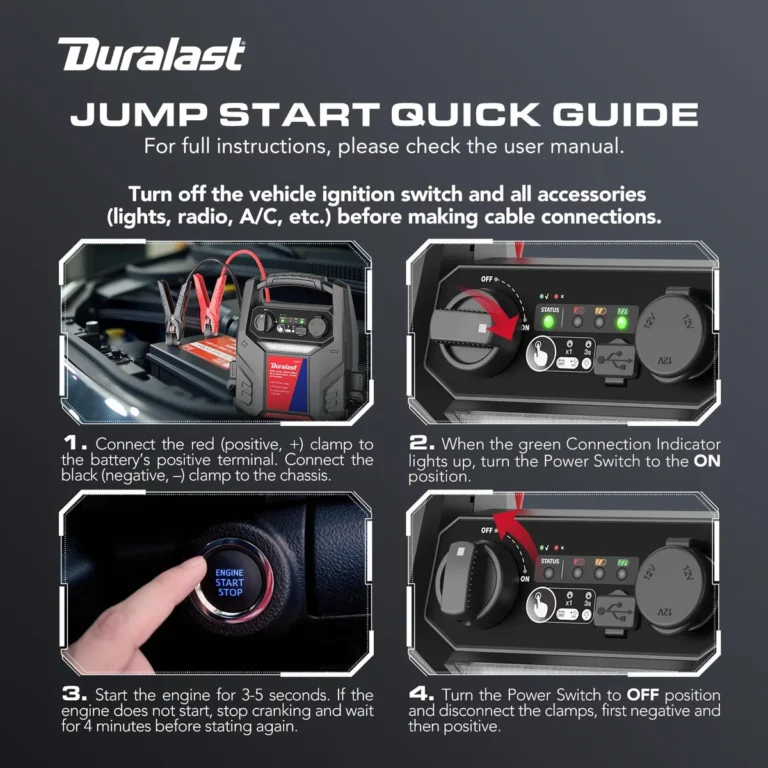
A jump box works the same way, except you connect the red clamp to the dead battery's positive and the black clamp to a ground point. No donor car, no donor sequence. Just make sure the box is charged and rated for your engine size.
Can jumping a car damage the donor vehicle?
Rarely, but a weak donor battery or a car with a failing voltage regulator can be stressed by the load. Modern cars with healthy alternators and batteries handle it without issue.
Do I need to replace my battery after a jump?
Not always. If the car started because you left the lights on, the battery is fine once recharged. If the car died after sitting for weeks, the battery is probably sulfated and due for replacement within a few months.
A load test at any auto parts store confirms which one it is, and most will test for free.