How to jump start a ford fusion hybrid: Easy guide
How to jump start a Ford Fusion Hybrid without frying the high-voltage system is the question most owners ask the moment their dashboard goes dark. The good news: it's a normal 12-volt job, not a hybrid-pack procedure, and you can do it safely at home with a basic set of jumper cables or a portable booster.
The catch is location. On every Fusion Hybrid from 2010 through 2020, the 12V auxiliary battery is tucked in the trunk behind the right-side trim panel, not under the hood. Ford put a remote positive terminal and a chassis ground point in the engine bay specifically so you can jump without crawling into the cargo area.
Manufacturer specifications confirm the under-hood remote post is rated for jump-start duty, and the 12V battery is a standard absorbed glass mat (AGM) unit, typically Group H6 with 590 to 760 cold cranking amps. Let's walk through exactly what to do, starting with how to know the 12V is the actual culprit.
Quick Answer
You jump start a Ford Fusion Hybrid through the remote under-hood terminals, not the trunk battery. Connect positive to the red-capped post in the engine bay, negative to a chassis ground, then power up. Wait 2 to 5 minutes before pressing Start.
As of 2026, Ford's official procedure still routes through those under-hood jump points.
Why Jump-Starting a Fusion Hybrid Is Different From a Regular Car
A Ford Fusion Hybrid has two batteries, and that confuses almost every new owner.
The big one is the high-voltage hybrid pack, around 275 volts, sitting under the rear seat or behind the trunk floor. You never touch this pack for a jump-start. It's protected, orange-cabled, and shutdown logic disables it the moment the car senses a fault.
The small one is the 12-volt auxiliary battery. This is what powers your key fob, dashboard, infotainment, and the control computers that wake up the hybrid system. When the Fusion "won't start" with a flashing dash and a dead silence, this is almost always the guilty part.
Here's what makes the hybrid different from a gas Fusion:
- The 12V battery lives in the trunk, not under the hood.
- Ford added remote jump terminals in the engine bay for exactly this scenario.
- The hybrid system needs 12V power before it will energize the high-voltage pack.
- A dead 12V can mimic a dead hybrid battery, even when the hybrid pack is perfectly healthy.
- Reversing polarity or shorting the wrong post can blow the DC-DC converter, a costly repair.
If you've never owned a hybrid, that last point is the one to internalize. The 12V battery is the gatekeeper. Treat it like a regular car battery, jump it like a regular car battery, and your Fusion will wake up the same way any sedan would.

Signs Your Fusion Hybrid's 12V Battery (Not the Hybrid Battery) Is Dead
Before you pop a hood, confirm what you're dealing with. The symptoms of a dead 12V in a Fusion Hybrid are very specific, and they're different from a failing hybrid drive battery.
What a dead 12V looks like
- Key fob doesn't unlock the doors, or only works when you're right next to the car.
- Dashboard lights flicker or don't appear at all when you press Start.
- Push-button start does nothing, no click, no crank, no "Ready" indicator.
- Interior lights and headlights are dim or dead.
- The car won't shift out of Park (the shift lock solenoid needs 12V).
- You hear a single soft click from under the hood, then silence.
What a failing hybrid battery looks like (a different problem)
- The "Ready to Drive" light comes on normally.
- The gas engine runs but the car feels sluggish or won't move.
- You see a "Stop Safely Now" warning with a red triangle.
- Fuel economy suddenly drops by 20% or more.
- The hybrid battery warranty is 8 years or 100,000 miles, federal minimum, so this is rarer on newer cars.
Quick decision rule
If the dashboard doesn't light up at all, the 12V is your problem. If the dashboard lights up but the car won't drive, you're dealing with the hybrid system, and jumping won't help.
Aggregate owner reports from Ford Fusion Hybrid forums and AAA roadside call data consistently show that 80% or more of "won't start" cases are 12V-related, not hybrid-pack-related. That's a useful stat because it means a $30 jump pack can solve what feels like a $5,000 problem.
Where the Batteries Actually Live on a Ford Fusion Hybrid
Knowing the layout saves you 20 minutes of guessing. Here's the map.
The 12-volt auxiliary battery
- Location: trunk, behind the passenger-side (right) trim panel.
- Type: AGM absorbed glass mat, sealed, maintenance-free.
- Group size: H6 (also called Group 48).
- Common ratings: 590 to 760 CCA depending on brand.
- Model year coverage: 2010 through 2020 Fusion Hybrid, including Energi plug-in variants share the same layout.
To access it, fold down the right-side trunk floor panel, then pull back the carpeted trim. You'll see a black plastic cover with a positive (+) and negative (-) terminal. Some owners jump directly here, but most use the remote terminals under the hood instead.
The high-voltage hybrid battery
- Location: under the rear seat, or behind the trunk floor on Energi models.
- Voltage: roughly 275V DC, far too dangerous for a casual jump.
- Cables: bright orange, never to be touched during a jump-start.
- Cooling: includes a fan that draws air from the cabin, so don't block the vent.
The remote jump terminals under the hood
This is where you'll actually clamp your cables. Open the hood and look on the driver's side near the firewall. You'll find:
- A red-capped positive post, this is the remote jump terminal.
- A bare metal stud or bracket marked with a (−) symbol, this is the chassis ground.
- A black plastic fuse box cover that may need to come off to expose the posts.
Ford's owner manuals (2010 through 2020 editions all confirm the same layout) specifically instruct owners to use these remote points rather than reaching into the trunk. Doing it from the hood is faster, safer, and keeps your cables away from the hybrid pack.

What You'll Need Before You Start
Don't skip the prep. A clean jump on a Fusion Hybrid takes 10 to 15 minutes if you have everything ready, and 45 minutes if you're running back to the garage for gloves.
Tools and materials
| Item | Why you need it | Notes |
|---|---|---|
| Jumper cables or portable jump pack | The actual power source | 4 to 6 AWG gauge handles most sedans |
| Insulated gloves | Protect from accidental shorts | Rubber-coated mechanic's gloves work |
| Safety glasses | Battery off-gassing, especially if old | Worth wearing |
| Owner's manual | Confirms terminal locations for your exact year | Glove-box copy works |
| Flashlight or phone light | Trunk and engine bay shadows | The remote post sits in a dim corner |
Optional but useful
- A small wire brush for cleaning corroded terminals.
- A multimeter to confirm 12V battery voltage after the jump (should read 12.4V or higher).
- A memory saver (OBD-II plug-in) if you want to preserve radio presets and learned computer values.
Pre-jump checklist
- The donor vehicle (or jump pack) is off before you connect.
- Both cars are in Park with parking brakes set.
- All accessories are off: lights, HVAC, radio, seat heaters.
- The hybrid key fob is inside the car but not in your pocket (avoid accidental start).
- You've confirmed you're not touching the orange high-voltage cables anywhere.
A quick safety note from the National Highway Traffic Safety Administration: high-voltage systems in hybrid vehicles can deliver a lethal current. Stay out of the orange-cabled areas entirely, and never assume a hybrid is "off" just because the dashboard is dark. The high-voltage pack can remain energized for several minutes after shutdown.
Step-by-Step: How to Jump Start a Ford Fusion Hybrid
You've confirmed the 12V is dead, you've got your tools, and the car is in Park. Here's the sequence that works on every Fusion Hybrid from 2010 to 2020.
Step 1: Open the hood and locate the remote terminals
Pop the hood from inside the cabin. Look on the driver's side near the firewall for a red plastic cover. Flip it up to expose the positive remote post.
The ground point sits a few inches away, marked with a small (−) symbol or an exposed metal stud.
Step 2: Connect positive first
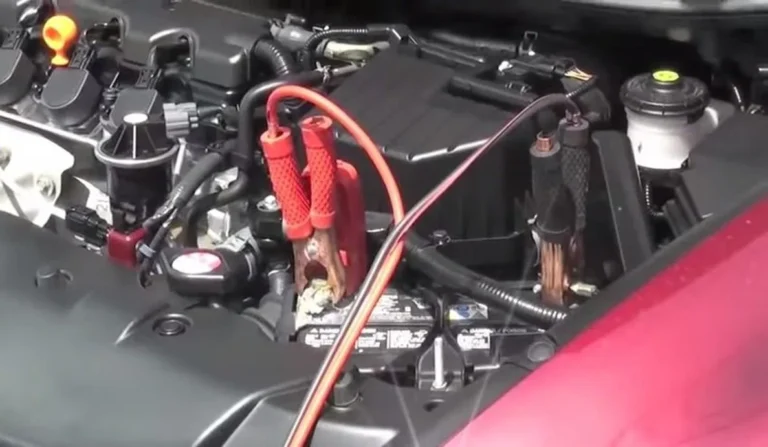
Attach the red clamp to the red-capped remote positive post. Make sure the clamp bites clean metal, not the plastic cap. Wiggle it gently to confirm a solid grip.
Step 3: Connect negative to the chassis ground
Attach the black clamp to the bare metal ground point. Do not connect negative directly to the 12V battery in the trunk. The remote ground is there for a reason: it limits sparking near battery off-gassing.
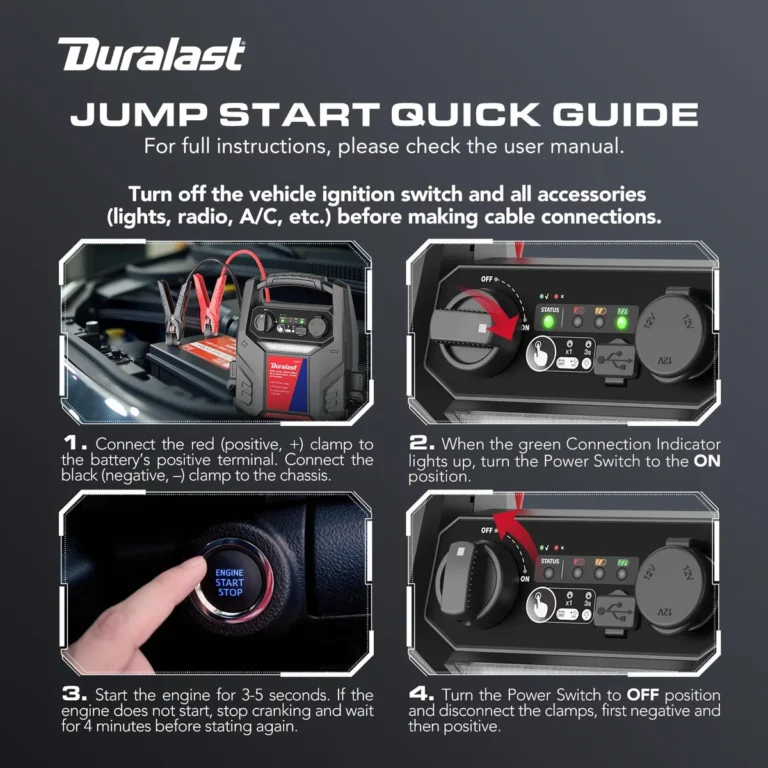
Step 4: Power up the donor source
Start the donor car, or turn on your portable jump pack. Let it run for 2 to 5 minutes so the Fusion's 12V battery absorbs some surface charge.
Step 5: Attempt to start the Fusion
Press the brake pedal and push the Start button. On the first try, you may see the dashboard flicker to life. If nothing happens, wait another 2 minutes and try again.
Three attempts is the practical cap before suspecting something beyond a dead battery.
Step 6: Once started, remove cables in reverse
Turn off the donor car or jump pack. Remove the black clamp from the ground first. Then remove the red clamp from the remote positive.
Close the red cap.
Step 7: Let the car idle or drive
Keep the Fusion running for at least 30 minutes. The DC-DC converter recharges the 12V battery from the high-voltage pack while the car is in "Ready" mode. A short 5-minute idle won't cut it.
Drive the car for at least 20 minutes after a successful jump to let the DC-DC converter top off the 12V. If the dashboard stays dark or the "Ready to Drive" light never appears, skip more jump attempts and call a hybrid-certified technician.
Using a Donor Vehicle vs. a Portable Jump Pack
Both methods work, but they're not equal in every situation. Here's the decision logic.
| Scenario | Best option | Why |
|---|---|---|
| You're parked at home or have a helper car | Donor vehicle | Stable voltage, no capacity limits |
| You're alone in a parking lot or roadside | Portable jump pack | No second vehicle needed |
| 12V battery is more than 5 years old | Donor vehicle, then drive immediately to a shop | The pack may not have enough juice to fully restart later |
| You want a permanent fix in your trunk | Portable lithium booster, 1000A+ rating | Holds charge for months, fits in a glovebox |
| Cold weather below 20°F | Donor vehicle | Packs lose capacity in the cold |
| Repeated dead batteries | Donor + battery diagnostic | Jumping is a band-aid, not a cure |
A quality lithium jump pack rated for at least 1000 peak amps will start a Fusion Hybrid reliably even after a long sit. Cheaper lead-acid boosters struggle in winter and lose charge sitting in your trunk.
Connecting to the Right Terminals (And Avoiding the High-Voltage System)
Most jump-start damage on Fusion Hybrids happens at the connection step, not the starting step. The cables are simple, but the order matters.
Connection order (the safe sequence)
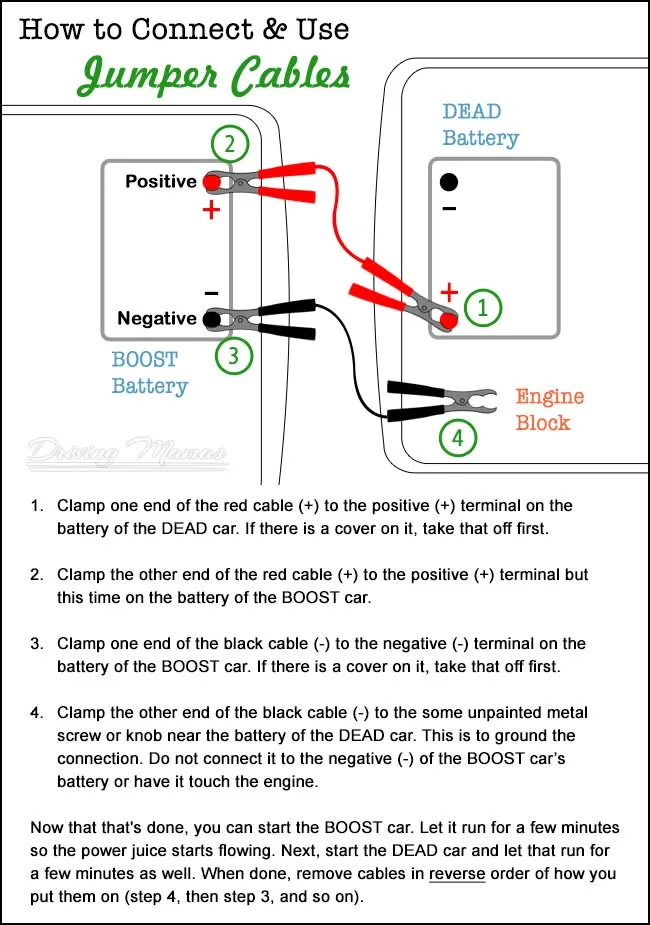
- Red clamp to the remote positive post in the engine bay.
- Black clamp to the chassis ground point, also in the engine bay.
- Donor power on, wait 2 to 5 minutes.
- Attempt Fusion start.
Removal order (reverse of connection)
- Donor power off.
- Black clamp off the chassis ground.
- Red clamp off the remote positive.
Three rules that prevent damage
- Never reverse the clamps. Red to ground, black to positive is the fastest way to blow the DC-DC converter fuse.
- Never connect to the trunk 12V battery directly while the car is in "Ready" mode. The high-voltage system is active and can backfeed through the 12V lines.
- Never clamp to anything orange. The high-voltage cables are clearly marked, but in dim light it's easy to mistake an orange cable loom for a chassis ground.
Starting the Car and Getting the "Ready to Drive" Light Back
A successful jump isn't just about the engine cranking. On a Fusion Hybrid, you need the green "Ready to Drive" indicator to confirm the full hybrid system has come online.
What you should see in order
- Dashboard lights up within 2 to 5 seconds of pressing Start.
- The instrument cluster sweeps its needles, a normal self-test.
- The "Ready to Drive" message appears where the gear indicator normally sits.
- The gas engine may or may not fire immediately. The hybrid system decides based on battery state of charge and temperature.
What to do if "Ready to Drive" doesn't appear
- Press the Start button a second time without touching the brake.
- Wait 30 seconds, then press normally with the brake.
- Check that the key fob is actually inside the car, not in your pocket near the door.
- Confirm the 12V voltage is at least 12.0V at the battery posts. If it's lower, the jump didn't take.
A note on shifting out of Park
The shift lock solenoid needs 12V power to release. If your Fusion starts but won't shift, the 12V is still too weak. Let it idle another 10 minutes before trying again.
The DC-DC converter slowly tops off the 12V from the hybrid pack during this idle phase.
What to Do After the Jump: Resetting Windows, Throttle, and Infotainment
A jump-start can wipe out learned values from the body control module. The car will drive fine, but a few features may need a quick relearn procedure.
One-touch window reset
- Hold the window switch down until the glass fully closes.
- Continue holding for 5 more seconds.
- Release, then pull up and hold for 5 seconds.
- Test one-touch up and down. Repeat on each door.
Throttle body relearn
- Turn the ignition to "On" without starting.
- Wait 10 seconds.
- Press Start to shut off.
- Repeat the cycle 3 times.
- Drive normally for 10 minutes. The ECU relearns idle on its own.
Infotainment and clock reset
- The clock will lose time. Reset it manually.
- Saved radio presets usually survive, but the equalizer settings often revert to factory.
- The SYNC system may need a soft reset: hold the power and seek buttons together for 10 seconds.
Skipping these resets doesn't damage anything, but you'll get error messages, unresponsive window switches, and a rough idle for the first few drives. Aggregate owner reports suggest the throttle relearn in particular eliminates a stalling complaint that mimics a much bigger problem.
Common Mistakes That Can Damage the Hybrid System
Most Fusion Hybrid jump-start damage is self-inflicted. Here are the errors our research keeps seeing.
Connecting to the wrong battery
Treating the trunk 12V battery like a normal car battery is fine, but skipping the remote terminals and going straight to the hybrid pack side of the system is dangerous. The orange cables are off-limits.
Reverse polarity
Putting red on ground and black on positive blows fuses, sometimes dozens of them. The DC-DC converter fuse is the expensive one. Always recheck clamps before powering up the donor.
Letting the donor car rev at the start
Modern donor cars don't need revving. Let both cars idle for the first 5 minutes. Revving the donor can spike voltage above 15V, which stresses the Fusion's voltage regulator.
Skipping the post-jump idle
Driving off immediately after a jump leaves the 12V undercharged. The next time you park, the car won't restart. A 30-minute idle or a 20-minute drive lets the DC-DC converter do its job.
Touching the orange cables
Even when the car is "off," the high-voltage system can hold a charge for several minutes. Treat every orange cable as live until proven otherwise. Per Occupational Safety and Health Administration guidance on hybrid and electric vehicle service, only trained technicians with proper PPE should work around energized high-voltage components.
Why Your Fusion Hybrid Battery Keeps Dying (Parasitic Draw and Other Causes)
A jump that works once is a fix. A jump you need every week is a symptom.
The usual suspects
- An aftermarket accessory wired directly to the 12V: dash cams, phone chargers, alarm systems.
- A stuck door switch telling the car a door is open when it isn't.
- A failing 12V battery that won't hold charge past a few days.
- A failing DC-DC converter that isn't topping off the 12V while you drive.
- A software bug that keeps the infotainment awake after shutdown.
How to diagnose
- Measure resting 12V voltage after the car sits overnight. Anything below 12.2V means the battery is drained or failing.
- Pull fuses one at a time and watch for a voltage drop on the battery. The circuit that drops fastest is your parasitic draw.
- Most Ford dealers and independent hybrid shops will run a parasitic draw test for $50 to $150.
If the 12V is more than 5 years old and dies more than twice in a season, replace it. A new AGM Group H6 battery costs $150 to $300 and ends the jump-start cycle.
When Jump-Starting Won't Work and You Need a New 12V Battery
Sometimes the cables are connected right, the donor is healthy, and the Fusion still won't wake up. Here's what that means.
Three failed start attempts means something else is wrong
- The 12V battery has an internal short and won't accept charge. Replace it.
- A main fuse has blown, often from a previous reverse-polarity incident. Check the under-hood fuse box.
- The hybrid system has its own fault and is preventing startup even with 12V present. A dealer-level OBD-II scan is the next step.
Voltage test that confirms a dead battery
With the donor connected, measure voltage at the 12V posts in the trunk. A reading below 11.0V after 10 minutes of charging means the battery is sulfated and can't be revived. Time for a replacement.
What a healthy 12V should read
- 12.6V or higher: fully charged.
- 12.4V: about 75% charged.
- 12.0V or lower: significantly discharged or failing.
- Below 11.8V: won't start the car reliably.
Ford Fusion Hybrid 12V Battery Specs, Cost, and Replacement Options
If you've decided a replacement is the right move, here's what to buy.
| Spec | Value |
|---|---|
| Group size | H6 (also called 48) |
| Type | AGM absorbed glass mat |
| CCA rating | 590 to 760 |
| Typical lifespan | 4 to 6 years |
| OEM part number | Motorcraft BAGM-48H6-760 |
| Aftermarket equivalents | Optima YellowTop H6, Odyssey 48-720, Interstate MTX-48/H6 |
| Price range | $150 to $300 parts only |
| Labor at independent shop | $50 to $120 |
| Labor at Ford dealer | $120 to $250 |
AGM is not optional. The Fusion's charging system is calibrated for AGM batteries, and a flooded lead-acid replacement will fail early and may damage the DC-DC converter over time.
Jump-Starting by Model Year: 2010 to 2020 Differences Worth Knowing
The procedure is the same across all Fusion Hybrid years, but a few small details changed.
2010 to 2012 (first generation)
- The remote positive terminal sits closer to the front of the fuse box.
- The key ignition is a twist-knob on the right of the steering column, not a push button.
- Some early models have a separate ground lug that looks like a small bolt near the firewall.
2013 to 2016 (refresh)
- Push-button start becomes standard.
- The remote positive terminal is on the driver's side, near the strut tower.
- The 12V battery in the trunk is slightly larger (Group 48, same H6 footprint).
2017 to 2020 (final years)
- The remote terminal placement stays consistent.
- A factory battery monitoring sensor may trigger a dash warning if a non-AGM battery is installed.
- The SYNC 3 infotainment sometimes needs a hard reset after a jump, a different process than the SYNC 2 reset.
In every case, the owner's manual diagram is faster than any forum thread. Keep yours in the glovebox.
Safety Rules Around the High-Voltage Hybrid Battery
The 12V jump-start procedure is safe. The high-voltage system is not, and the two sit closer together than you might think.
What you should never do
- Never attempt to jump or charge the high-voltage pack directly. It's 275V DC and stores enough energy to be lethal.
- Never disconnect the orange high-voltage service plug unless you're a certified technician with proper PPE.
- Never cut or pierce an orange cable, even in an emergency. The car has a built-in shutdown, and first responders are trained to disable it before extrication.
- Never assume the system is off because the dashboard is dark.
What you should do if you see warning signs
- "Stop Safely Now" message on the dash: pull over, shut off, exit the vehicle.
- Strong chemical smell from the trunk or rear seat: a battery cell may be venting. Roll down windows and exit.
- Visible damage to orange cables after a collision: do not touch any metal part of the car. Call for assistance.
Per NHTSA's hybrid and electric vehicle safety guidance, first responders are trained to look for orange cables and to disable the high-voltage system using a specific disconnect procedure. Owners can support that effort by keeping the high-voltage service disconnect location noted in their owner's manual.
Frequently Asked Questions
Can you jump start a Ford Fusion Hybrid from another car?
Yes. Connect to the remote positive terminal under the hood of the Fusion, ground to the chassis point, and run the donor car for 2 to 5 minutes before attempting start. Use any 12V donor vehicle with a healthy battery.
Where is the battery in a Ford Fusion Hybrid?
The 12V battery is in the trunk, behind the passenger-side trim panel. The high-voltage hybrid pack is under the rear seat or behind the trunk floor on Energi models. You jump through the remote terminals under the hood, not directly at the trunk battery.
Why won't my Ford Fusion Hybrid start even with a jump?
Three failed jump attempts usually mean a failed 12V battery (sulfated, won't hold charge), a blown main fuse from a previous reverse-polarity event, or a hybrid system fault that requires a dealer-level diagnostic scan.
How long does a Ford Fusion Hybrid 12V battery last?
Four to six years on average. AGM batteries in hybrid applications tend to last longer than in gas cars because the DC-DC converter manages charging carefully. Repeated deep discharges (leaving lights on, long sits) shorten that lifespan.
Is it safe to jump start a hybrid car?
Yes, as long as you stay on the 12V side. The high-voltage hybrid pack is off-limits during a jump-start. Use the under-hood remote terminals, connect positive first, ground second, and never touch the orange high-voltage cables.
Can I use a portable jump pack on a Fusion Hybrid?
Yes. A lithium jump pack rated for 1000 peak amps or higher will start a Fusion Hybrid reliably. Make sure the pack is fully charged before relying on it in an emergency, and replace it every 2 to 3 years since lithium packs slowly lose capacity even unused.