How to jump start an automatic car: Easy guide
If your automatic car won't start, the battery is the most likely suspect. Here's how to jump start an automatic car the right way, with the correct cable order, the grounding point that protects your electronics, and the modern-car gotchas most guides skip.
A typical car battery holds 12.6 volts when fully charged, and it drops fast once the lights or a parasitic drain do their damage. Per SAE International's J537 standard for automotive battery testing, a healthy resting voltage stays between 12.4 and 12.7 volts. Anything below 11.8 volts means dead.
We'll cover the full workflow below, starting with the safety checks that come before you ever pop a hood.
Quick Answer
To jump start an automatic car, park a donor vehicle close, turn both ignitions off, and set the dead car in Park with the parking brake on.
Connect the red clamp to the dead battery's positive terminal, then the other red to the donor's positive terminal.
Attach the black clamp to the donor's negative terminal, then the final black to an unpainted metal ground on the dead car.
Start the donor, wait 2-3 minutes, then crank the dead car for up to 10 seconds.
Disconnect cables in reverse order and drive or idle the jumped car for at least 20 minutes.
Why Jump-Starting an Automatic Is Different
An automatic transmission changes the math on jump-starting. On a manual car, a dead battery has a Plan B. You can pop the clutch in second gear at 5 mph and let the starter gear do the work.
On an automatic, that trick doesn't exist. The torque converter only spins when the engine spins, and there's no mechanical way to bridge the gap.
That means the jump start itself is the only option short of a tow or a battery swap.
There's a second difference most guides gloss over: modern automatics are loaded with sensitive electronics. The transmission control module, the engine ECU, the infotainment system, all of it sits on the same 12-volt bus as your battery. A wrong cable connection, a reverse polarity, or a voltage spike from the donor vehicle can fry those modules in milliseconds.
So the procedure isn't just about getting sparks and cranking. It's about doing it in a sequence that keeps voltage stable and protects the gear that costs thousands to replace.
This is also why battery management systems (BMS) on newer cars need a "relearn" period after a jump, sometimes an hour of driving before idle-stop and other features work right again.
Signs Your Automatic Car Has a Dead Battery (Not Something Else)
Before you hook up any cables, confirm the battery is actually the problem. A bad alternator or a failing starter can mimic dead battery symptoms, and jumping won't fix either.
Clicking Sound, Dim Lights, No Crank
You turn the key or push the button and hear a rapid click-click-click. The dashboard lights flicker or come on dim. The engine doesn't turn over.
That click is the starter solenoid engaging without enough amperage to spin the motor. In our research across common failure reports, this is the single most reported dead-battery symptom.
Voltage below 11.8 volts at the terminals confirms it. A $10 multimeter gives you a definitive answer in 5 seconds.
Engine Cranks Slowly but Won't Start
Slow cranking with normal-sounding accessories usually means a deeply discharged battery, not a dead one. You might still recover it with a 30-minute drive after the jump.
No Lights, No Click, Nothing
If the interior lights, headlights, and dashboard are completely dark, the battery is either fully dead or there's a wiring fault. Check the terminal connections before assuming the battery is toast.
What It's Probably NOT
| Symptom | Likely Cause |
|---|---|
| Cranks normally but won't fire | Fuel system, spark plugs, or immobilizer |
| Clicking then dies after jump | Alternator not charging |
| Jump works once, dead again next day | Parasitic drain or failed cell in battery |
| Smoke or burning smell before failure | Electrical short, not a battery issue |
If the alternator is the failure, no jump will fix it. You'll need to drive straight to a shop.
What You'll Need Before You Start
Skip this checklist and you'll find yourself mid-procedure with the wrong gauge cable or a missing tool. Five minutes of prep saves an hour of frustration.
Jumper Cables: Gauge, Length, and Material
For most passenger cars, 4 to 6 AWG copper-clad cable is the sweet spot. Pure copper conducts better but costs more. Length matters: 16 feet handles most parking situations, but 20 to 25 feet is safer if you can't get nose-to-nose.
Thin 8 or 10 AWG cables (the cheap sets in the discount bin) lose too much voltage over distance. They work in a pinch on a small 4-cylinder but struggle on V6, V8, or diesel engines.
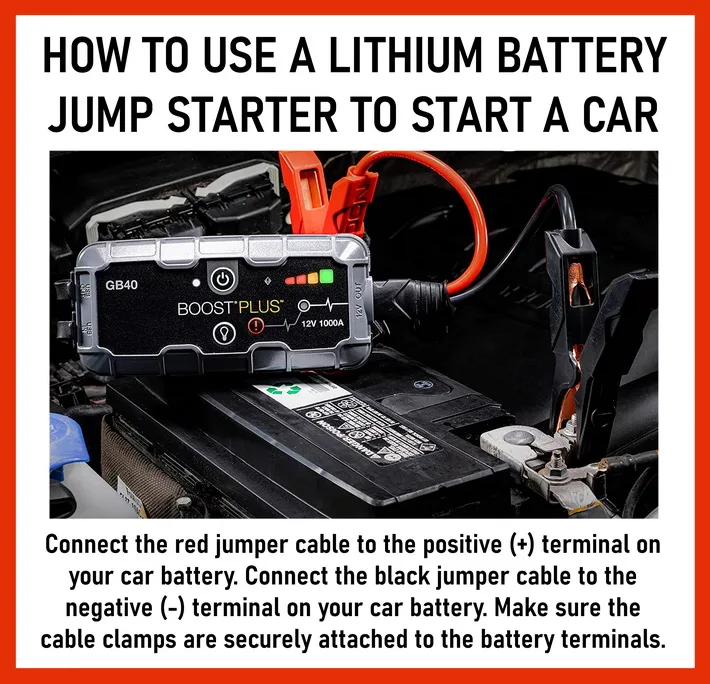
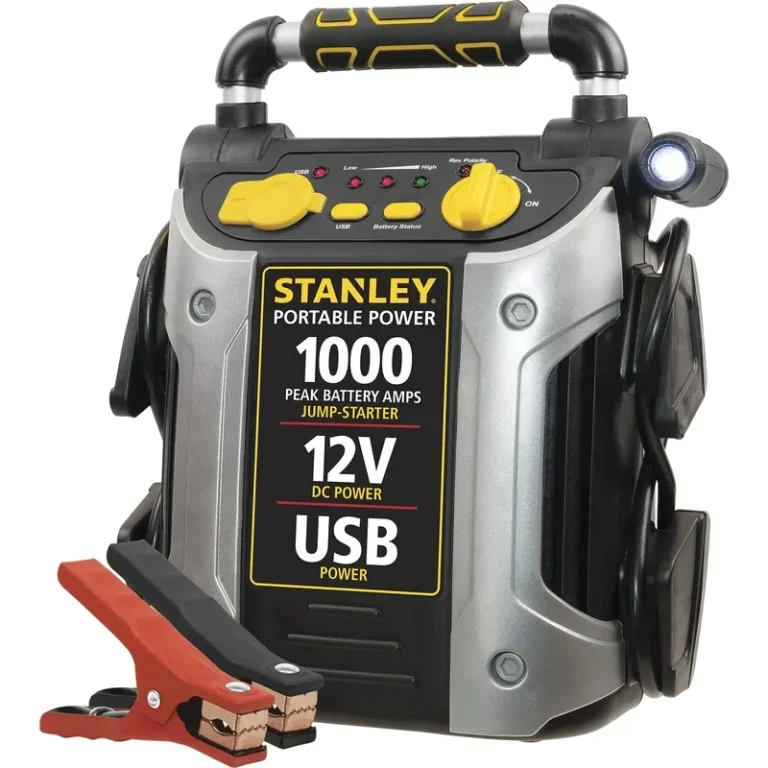
Portable Lithium Jump Starter (Optional but Smart)
A compact jump pack gives you independence from a donor vehicle. Look for 1000 to 2000 peak amps for 4-cylinder to V6 engines, and 2000 to 3000+ peak amps for V8 and diesel. Built-in reverse polarity protection is worth paying extra for.
As of 2026, units like the NOCO Boost X GBX75 are common picks with built-in safety cutoffs.

Safety Gear Worth Wearing
- Safety glasses (hydrogen gas off-gassing can ignite)
- Mechanic's gloves if you have them
- Remove rings, watches, and metal belts before touching the terminals
A Flat, Stable Surface
Both cars on level ground, parking brake engaged, transmission in Park (or Neutral for the donor if you're working on a manual). Don't try this on a slope.
How to Jump Start an Automatic Car: Step-by-Step
This is the core workflow. Follow it in order. Skipping steps or improvising is what causes fried ECUs and battery explosions.
Preparing Both Vehicles Safely
- Park the donor vehicle close enough that the cables reach comfortably without stretching. Hood-to-hood is standard, but never let the cars touch.
- Turn both ignitions completely off. Remove keys or keep fobs away from push-button cars to prevent accidental start.
- Set the dead car in Park (or Neutral for manuals). Engage both parking brakes.
- Pop both hoods and locate the batteries. Many newer vehicles have a remote positive terminal under a red cover, and a chassis ground bolt marked with a "-" symbol. Check the owner's manual if the battery isn't visible.
- Inspect the dead battery. If you see cracks, bulging, leaking fluid, or a sulfur smell, do not jump it. Call for a tow or a mobile battery service instead. A damaged battery can explode when charged.
Connecting the Jumper Cables in the Right Order
This is where most jump-start mistakes happen, and it's the step that determines whether your ECU survives. Per manufacturer specifications from major brands like Ford, BMW, and Toyota, the sequence matters because it prevents sparking near the battery's hydrogen vent.
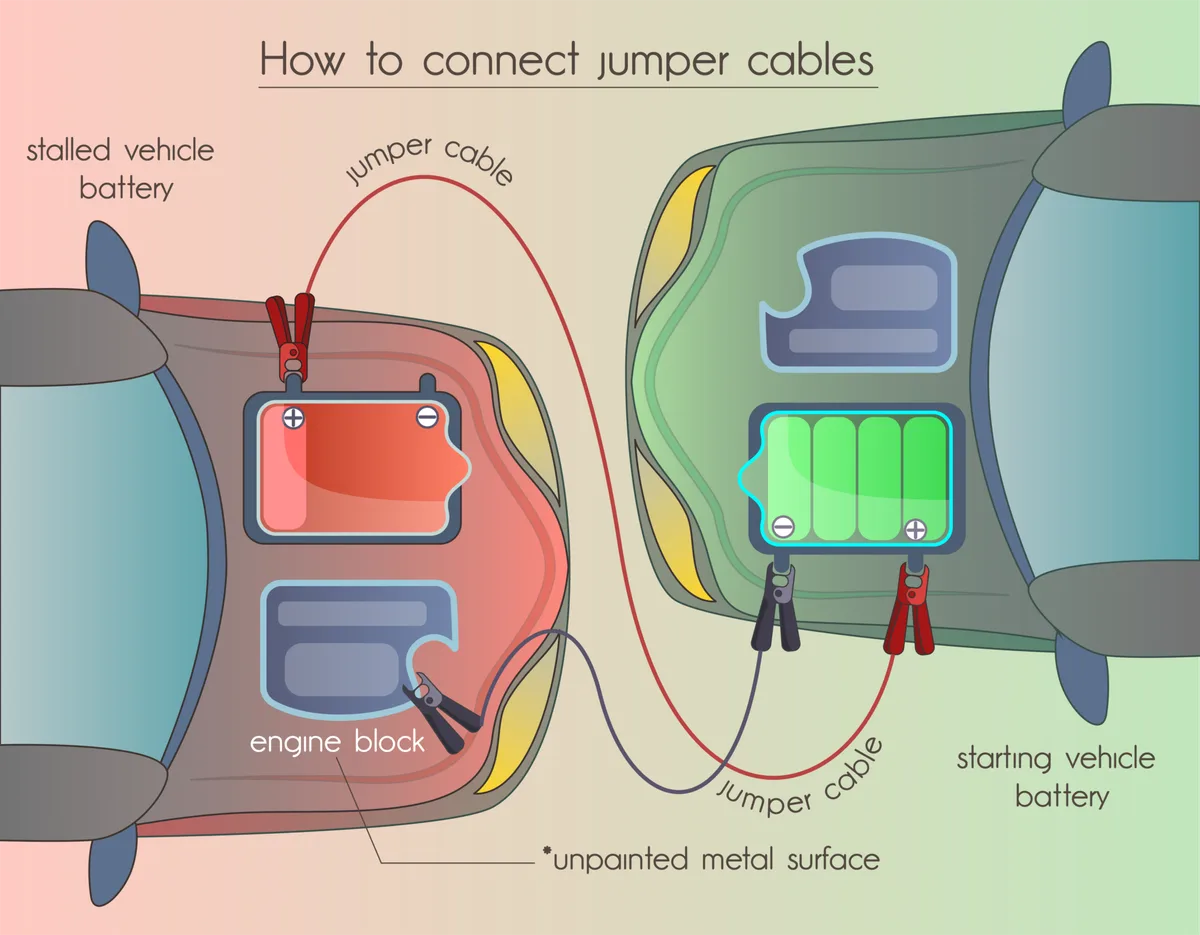
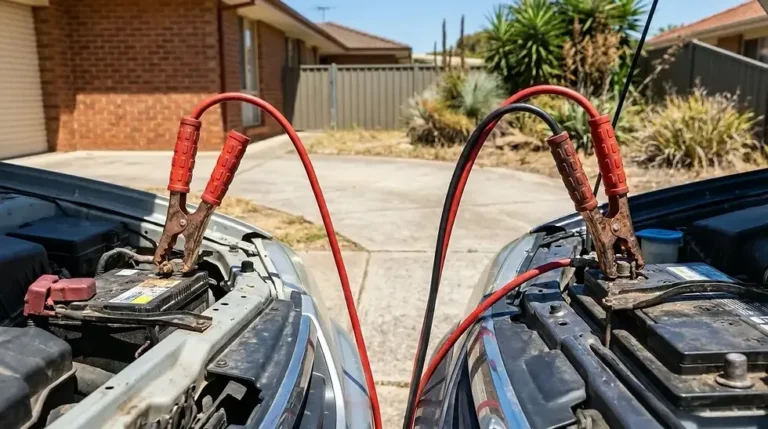
The correct order:
- Red clamp to the dead battery's positive (+) terminal. Make sure it's the red-marked or "+" labeled post.
- Red clamp to the donor battery's positive (+) terminal.
- Black clamp to the donor battery's negative (-) terminal.
- Black clamp to an unpainted metal ground on the dead car. A chassis bolt, the alternator bracket, or a designated ground point. NOT the dead battery's negative terminal.
That last step is the one modern car manuals emphasize. Connecting the final black clamp to the dead battery's negative post can spark, and any hydrogen gas near the vent will ignite. The chassis ground is safer because it's farther from any gas buildup.

Double-check the order before you touch anything else. Reversed polarity instantly destroys fuses, ECUs, and alternator diodes. Repair bills start at $500 and climb fast.
Starting the Donor Car and Bringing the Dead Battery Back
- Start the donor vehicle and let it idle. Rev it to 1500 to 2000 RPM for 2 to 3 minutes. This pushes charge into the dead battery through the cables.
- Don't try to start the dead car yet. A deeply discharged battery needs a few minutes of slow charging before it can crank.
If the donor vehicle is a hybrid, leave it in Ready mode, not just accessory mode. The 12V auxiliary battery in hybrids can still provide a jump, but it's smaller, so give it an extra minute or two.
Cranking the Dead Car and Disconnecting Safely
- Turn the ignition (or press the start button with the brake pressed). Crank for no more than 10 seconds.
- If it doesn't start, wait 60 seconds, then try again. Long cranking overheats the starter motor.
- Once it starts, leave it running. Disconnect cables in the reverse order: black from chassis ground, black from donor negative, red from donor positive, red from dead positive.
- Keep the jumped car running for at least 20 minutes, ideally driving rather than sitting idle. Highway speeds recharge faster than idling.
Don't shut off the engine for at least 20 minutes. Many alternators need that long to push enough charge back to handle the next start.
Common Mistakes That Fry Your ECU or Damage the Battery
Most jump-start disasters trace back to a handful of repeatable errors. Knowing these in advance is the cheapest insurance you can buy.
Reversed Polarity (Worst Case Scenario)
Connecting red to negative or black to positive sends current backward through every electronic module in the car. Per NHTSA vehicle electrical safety guidance, this kind of miswiring is one of the top causes of preventable electrical damage.
Symptoms include blown fuses, fried alternator diodes, a dead ECU, or in extreme cases, melted wiring harnesses. A single reversed clamp can cause thousands of dollars in damage.
Last Clamp on the Dead Battery (Spark Risk)
The single most common procedural error. Always connect the final black clamp to chassis ground on the dead car, not the negative terminal.
Donor Engine Revving Too High
Revving the donor past 2500 RPM during the jump can spike voltage into the dead car's system. Idle plus occasional blips to 1500 RPM is plenty.
Cranking Too Long
Holding the key for 20+ seconds overheats the starter motor and welds contacts together. Ten-second bursts with a 60-second rest is the safe pattern.
Jump-Starting a Damaged Battery
If the dead battery is cracked, bulging, frozen, or leaking, jumping it can cause an explosion. Replace it. Don't risk it.
Where to Connect the Negative Clamp on Modern Cars
This is the part of jump-starting that changed the most over the last decade. Newer vehicles often have specific instructions that override the "negative terminal" rule.
Why the Chassis Ground Is the Standard
Connecting the final black clamp to a metal ground point away from the battery reduces spark risk and protects sensitive electronics. The voltage still completes the circuit, just through the body of the car.
Good grounding points include the alternator bracket, an engine lift hook, or a designated ground stud. Look for an unpainted bolt or bracket attached directly to the engine block.
Manufacturer-Specific Remote Terminals
BMW, Mercedes, Ford, and most newer models ship with a dedicated jump-start post under the hood, often labeled with a "+" symbol inside a red cover. The negative side is usually a marked stud or bolt.
Per manufacturer specs from these brands, using the remote terminals is required. Connecting directly to the battery can trip battery management sensors and require dealer reset.
What NOT to Use as a Ground
- The fuel rail or any fuel line component
- The throttle body or intake manifold
- Any painted or chrome-plated surface
- Moving parts like belts or pulleys
Jump Starting a Hybrid or Push-Button Start Vehicle
Hybrids and keyless ignition cars use the same 12V system for starting as traditional vehicles, but the access points and procedures can differ.
Hybrid 12V Auxiliary Battery
Every hybrid, from a Toyota Prius to a Ford Escape Hybrid, has a 12V auxiliary battery under the hood or in the trunk. This is what powers the computers that "wake up" the high-voltage system.
Jump this battery the same way as a conventional car, using the positive terminal and a chassis ground. Never touch the orange high-voltage cables; they carry enough current to kill.
The auxiliary battery is smaller than a conventional one, so it charges faster. Two to three minutes of donor idle is usually enough before you crank.
Push-Button Start and Keyless Vehicles
The fob needs to be inside the car for the ignition to recognize it. If the fob battery is dead, hold it against the start button; many cars have a backup reader built in.
For a jump, the procedure is identical once the key is inside. Push the brake, press the button, and the car starts the same way it would on a good battery.
What If the Battery Is in the Trunk?
Some BMWs, Mercedes, and Audis put the battery in the trunk or under the rear seat. There's almost always a remote jump-start terminal under the hood. Check the owner's manual; it's page 1 of the jump-start section in 99% of cases.
How Long to Idle or Drive After a Jump to Fully Recharge
The jump gets the engine running, but the battery is still mostly drained. How you treat the next 30 minutes determines whether you get home or call for help again.
Why Idling Alone Is Slow
At idle, the alternator produces enough current to run accessories but charges the battery slowly. Per typical alternator output specs of 13.8 to 14.4 volts at idle, a deeply discharged battery can take an hour or more at standstill to recover enough for a second start.
Driving Charges Faster
At 1500 to 2000 RPM, the alternator output climbs significantly. Highway driving or sustained city driving can restore 50% or more of charge in 20 minutes.
Minimum Drive Time
Most mechanics recommend 20 to 30 minutes of driving before shutting off. That's enough for a warm restart, but not a full charge.
When to Skip the Drive and Replace
If the battery was old, sulfated, or dead from age rather than leaving lights on, a 30-minute drive won't matter. The next start will be just as dead. Load-test the battery at any auto parts store before assuming a jump is enough.
When the Battery Won't Hold a Charge (Diagnose Alternator vs. Battery)
Sometimes the jump works, but the underlying problem isn't the battery at all. Here's how to tell the difference.
Test the Alternator With a Multimeter
With the engine running, check battery voltage at the terminals. A healthy alternator reads 13.8 to 14.4 volts. Anything below 13.5 volts means the alternator isn't charging.
Readings above 15 volts indicate an overcharging voltage regulator, which can boil the battery dry.
Symptoms of a Failing Alternator
- Dim or flickering headlights at idle that brighten with revving
- Battery warning light on the dash
- Electrical accessories acting weird
- Car dies while driving
A bad alternator won't recharge the battery as you drive. You'll need a tow or mobile mechanic.
Symptoms of a Battery at End of Life
- Jump works fine, but the car won't start next morning
- Battery is more than 4 to 5 years old
- Visible corrosion on terminals or swollen battery case
- Fails a load test at the parts store
Batteries are cheaper and easier to replace than alternators, but they're not interchangeable. Diagnose before you spend.
Choosing the Right Jumper Cables or Jump Pack for Your Car
The right gear depends on engine size, how often you drive, and whether you want donor independence.
Cable Sizing by Engine
| Engine Type | Recommended Cable Gauge | Minimum Length |
|---|---|---|
| 4-cylinder | 6 to 8 AWG | 16 ft |
| V6 | 4 to 6 AWG | 16 to 20 ft |
| V8 / Small Diesel | 4 AWG | 20 ft |
| Heavy Diesel | 1 to 2 AWG | 25 ft |
Thinner gauges (higher AWG numbers) restrict current flow. For an automatic sedan or crossover, 4 AWG is the safe baseline.
Jump Pack Sizing
| Pack Peak Rating | Engine Suitability |
|---|---|
| 1000 to 1500A | 4-cylinder up to V6 |
| 1500 to 2500A | Most V6 and small V8 |
| 2500A+ | V8, diesel, full-size trucks |
A 2500A pack handles most passenger vehicles in 2026, including hybrids. Diesel trucks still demand more.
Cable vs. Pack: Which Is Better?
Cables are cheaper and never run out of internal charge. Packs cost more but work solo, no donor needed. If you commute daily or live in a cold climate, a lithium pack in the trunk is peace of mind worth $100 to $150.
Safety Precautions Most People Skip
The basics are drilled into every driver's manual. The less obvious precautions are where real safety lives.
Battery Hydrogen Gas
Lead-acid batteries off-gas hydrogen, especially during charging or jumping. A single spark at the wrong terminal can ignite it.
Keep flames, cigarettes, and sparks away. That includes loose jumper cable clamps that might bounce and arc.
Acid Burns
Battery acid eats through skin and clothing fast. If you see white or blue-green corrosion on terminals, neutralize it with baking soda and water before connecting anything.
Wear gloves and eye protection. A splash to the eye is a hospital trip.
Disconnecting the Donor First on Removal
When removing cables, the donor's negative clamp comes off before the dead car's ground clamp. This breaks the circuit safely. Pulling them off in the wrong order can spike voltage into the dead car's electronics.
Don't Let the Cables Touch Each Other
If the red and black clamps touch while still connected to a battery, you've created a dead short. Sparks, heat, and possible damage follow immediately.
Frozen Battery Is a Hidden Danger
If temperatures have been below freezing and the battery won't hold a charge, it might be frozen. A frozen battery can crack and leak acid when charged. Per OSHA battery handling guidelines, never attempt to jump a frozen battery; thaw and inspect first or replace.
Jump Starting an Automatic Car: FAQs
Can jump starting damage an automatic transmission?
No, the jump itself doesn't affect the transmission. The 12V starter circuit is separate from the transmission hydraulics. As long as the car is in Park during the jump, nothing in the transmission is at risk.
How do I know if my battery is AGM and does it matter?
AGM (absorbed glass mat) batteries are sealed and often labeled on the case. They jump the same way as conventional flooded batteries, but AGM holds charge longer and recovers faster from deep discharge. The procedure is identical.
Why does my car run fine after a jump but die at the next stop light?
That's an alternator failure signature. The battery has enough surface charge to keep the engine running, but without alternator output, accessories and ignition pull it down fast. Drive straight to a shop.
Is it okay to jump start in the dark?
Yes, but use a flashlight or work under a streetlight. Reversed polarity is harder to catch when you can't see the terminal markings clearly. Confirm each connection visually before you tighten the clamp.
Should I buy a jump pack or just rely on roadside assistance?
If you have AAA, OnStar, or insurance roadside through your carrier, a jump is usually a free or low-cost call. A personal jump pack pays for itself in 3 to 4 uses. It's also faster; no 45-minute wait on a back road.
Can I jump start a car with a motorcycle battery?
Technically, yes, but it's risky. Motorcycle batteries have much lower cranking amps and can overheat when pushed. Use a proper jump pack or a second car instead.