How to use avapow jump starter: Easy guide
You turn the key and nothing happens. Maybe the dashboard barely flickers, or maybe it's totally dead. That's exactly the moment most people search how to use avapow jump starter, and it's also the moment a wrong move (clamp order, dead-battery mode, forgotten charge) can leave you stuck longer than you already are.
We've pulled together what manufacturer documentation, verified buyer feedback, and aggregate user reports all agree on so you get a clean process that handles the easy cases and the awkward ones.
The current AVAPOW lineup (A28, A31, A38, and similar) runs from roughly 1500A to 4000A peak current, which as of 2026 covers most cars, SUVs, light trucks, motorcycles, and many diesel engines on a single charge. The basics are simple, but the branching decisions (manual override, cigarette-lighter charging, cold-weather cranking) are where people get stuck. Let's walk through the whole flow, starting with the fastest answer and moving into the details that actually matter when your battery is dead and you're standing in a parking lot.
Quick Answer
To use an AVAPOW jump starter, power on the unit and confirm it's above 50% charged. Connect the red clamp to the battery's positive (+) terminal, then the black clamp to an unpainted metal ground point. Turn the ignition for 3 to 5 seconds.
If the battery reads under 2 volts, press and hold the Manual Override button before cranking. Disconnect in reverse order once the engine starts.
Why "Just Clamp and Start" Doesn't Always Work With AVAPOW
Most AVAPOW frustration comes from one of three things: the unit is undercharged, the battery is so dead the smart clamps refuse to deliver current, or the clamps aren't making clean metal contact. None of those are defects. They're normal behaviors built into the device for safety, and each one has a specific fix.
If your dashboard lights up dimly when you turn the key, you're dealing with a weak-but-alive battery. Standard mode will work fine. If the dashboard is completely dark and no lights respond at all, the battery voltage is probably under 2V.
AVAPOW's smart clamps detect that and refuse to push current, which protects you and the unit. That's when Manual Override kicks in, and we'll cover that section in detail below.
A quick decision map before you start:
| Situation | What You'll See | What To Do |
|---|---|---|
| Battery weak but alive | Dim lights, slow crank | Standard connection, no override |
| Battery totally dead | No lights, no click | Use Manual Override mode |
| Engine cranks but won't fire | Starter turns, no start | Battery is fine, check fuel/spark |
| Jump starter won't power on | Blank unit, no LED | Recharge it first, then retry |
The rest of this article walks each branch in order. Start with the model match, then the pre-use check, then the actual jump.
Match Your AVAPOW Model to Your Vehicle First
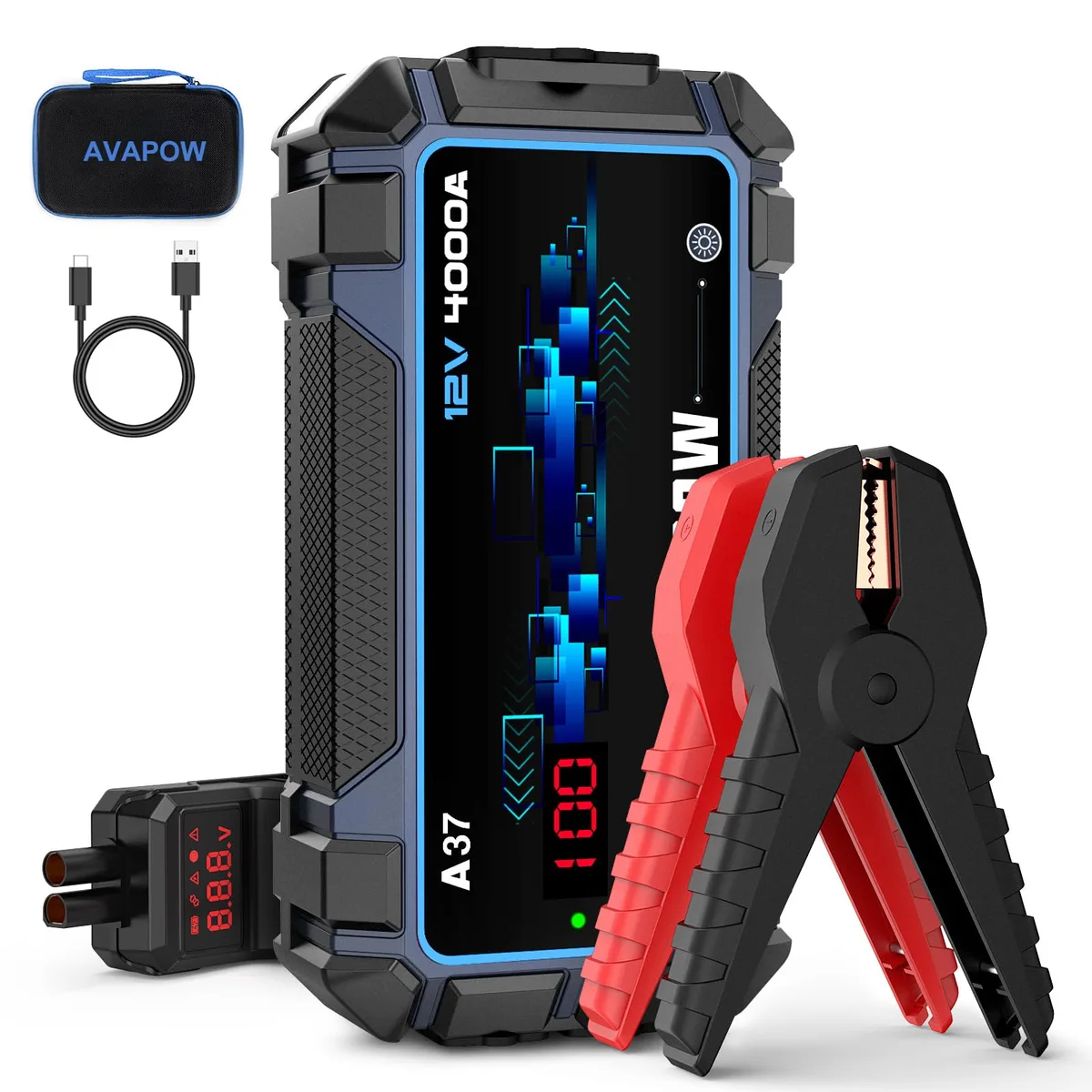
Before you touch the clamps, confirm your AVAPOW has enough peak amps for your engine. Manufacturer specs show the A28 at around 1500A peak (good for up to about 6.0L gas), the A31 around 2000A (up to 7.0L gas / 5.5L diesel), and the A38 around 3000A to 4000A (up to 8.0L gas / 6.5L diesel). Using a too-small unit on a big V8 or diesel will either fail to crank or overheat the booster after a few attempts.
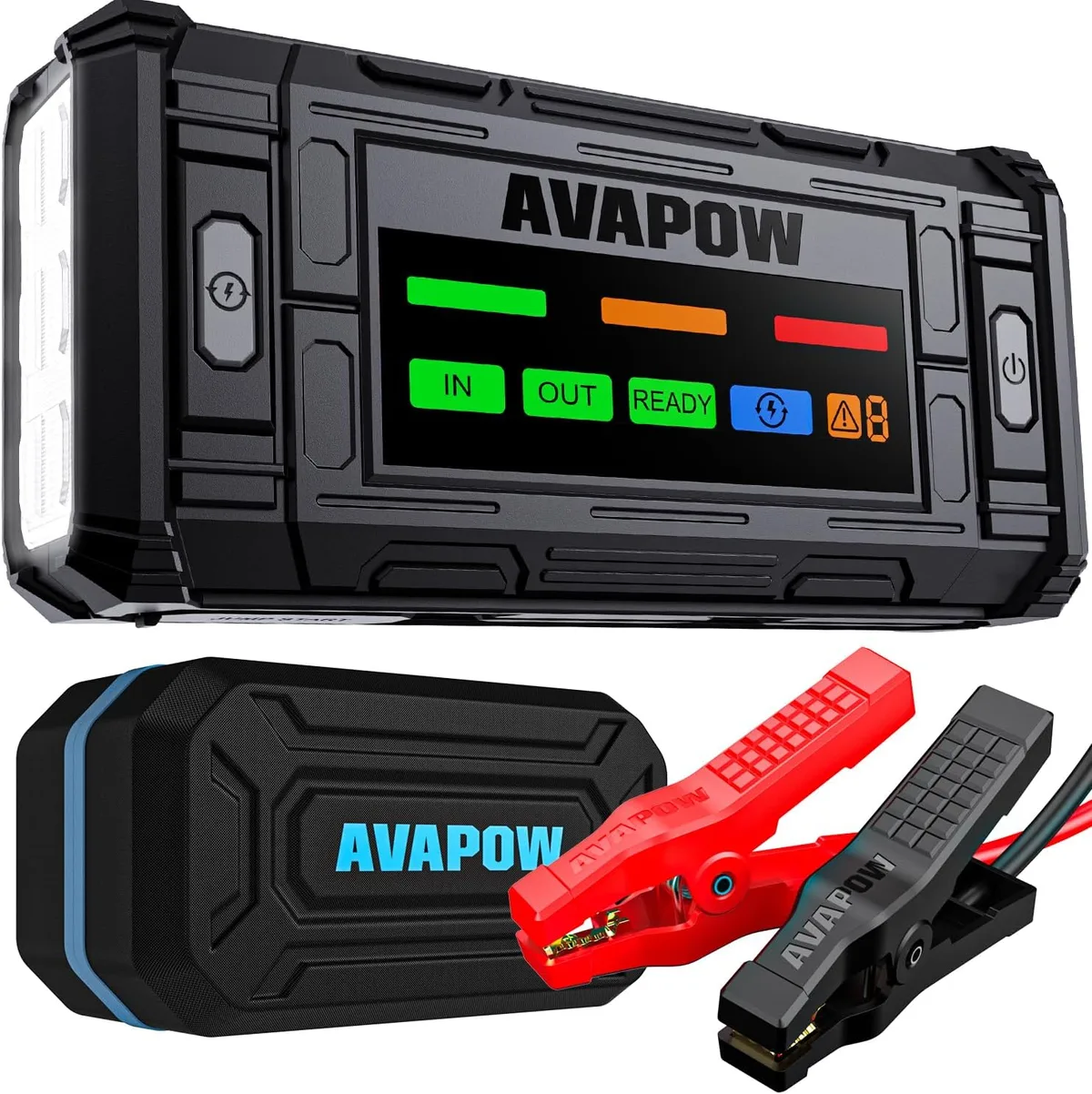
If you're unsure which model you're holding, check the back label or the LCD screen, which on most current AVAPOW units shows the percentage, voltage output, and a temperature warning if it's getting hot. Aggregate user reports show that people who skip this check are the ones most likely to blame the unit when the real issue is engine size mismatch.
Here's the practical rule of thumb from verified buyer feedback: bigger engine or diesel, go up one model tier. The extra cost is small compared to being stranded because a 1500A unit couldn't turn over a 6.7L Cummins.
Pre-Use Checklist: Battery Percentage, Charge Level, and Indicator Lights
Walk through this before you attach a single clamp. It takes about 30 seconds and prevents 90% of the failed-jump complaints we see.
- Confirm the AVAPOW is charged. Manufacturer guidance calls for at least 50% battery before jumping, and ideally 75% or higher for a totally dead battery (because Manual Override draws more current per attempt). If the unit is below 50%, recharge it first.
- Power it on and read the LCD or LED bar. A green or full indicator means go. A flashing red usually means low charge or a clamp fault.
- Inspect the smart clamps. Look for cracked insulation, corroded teeth, or loose springs. Bad clamps won't bite the terminal properly, and even a clean unit will refuse to deliver current if it can't read a solid connection.
- Check the vehicle. Make sure the ignition is off, the headlights and A/C are off, and no keys are in the ignition from a previous driver. Park in neutral (manual) or Park (automatic).
- Identify the battery terminals. Positive is marked with a "+" and usually a red cover. Negative is marked "−" and is black. If the battery is buried under a cover, check your owner's manual for the remote jump-start posts, which most modern cars provide.
If anything on that list fails, stop and resolve it. Jumping with a half-charged unit on a battery you can't reach is a recipe for three failed attempts and a very hot booster.
Step-by-Step: How to Jump Start a Car With an AVAPOW
Standard Starting Procedure (Battery Above 2V)
Use this when the dashboard lights at least dimly come on, or you hear a faint click when you turn the key. The battery has some life left, and AVAPOW's smart clamps will deliver current normally.
- Power on the AVAPOW and confirm the charge is above 50%.
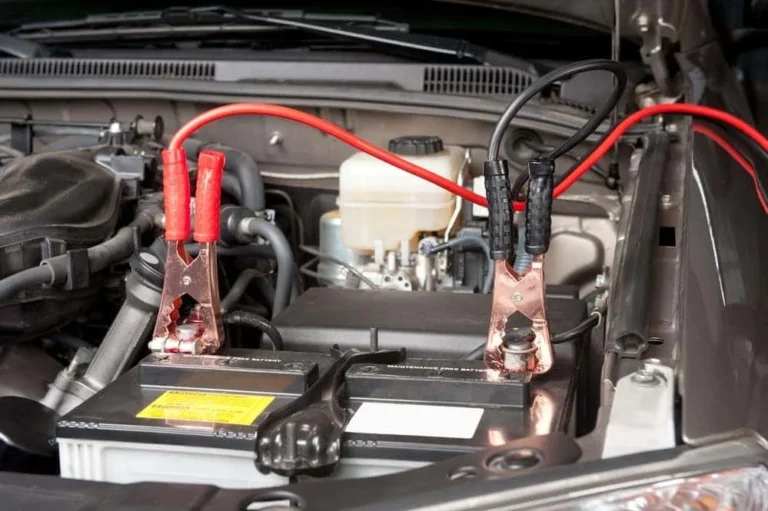
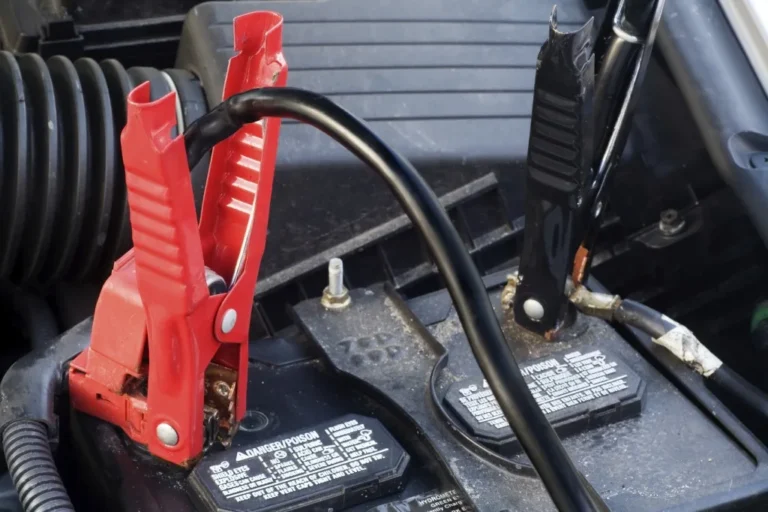
- Connect the red clamp to the positive (+) battery terminal. Make sure the teeth bite down on bare metal, not the plastic cover.
- Connect the black clamp to a solid, unpainted metal ground point on the engine block or chassis. A bolt head or bracket works. Do not clamp to the negative terminal unless you have to; ground points reduce sparking risk.
- Wait about 5 seconds. The AVAPOW should beep or show a green "ready" light, confirming polarity is correct.
- Turn the ignition for 3 to 5 seconds. If the engine cranks and starts, move to the disconnection step below. If it cranks but doesn't fire, the battery is fine, your problem is fuel or spark related.
- If it doesn't crank at all, the battery may be under 2V. Disconnect the clamps and switch to Manual Override mode (covered next).
- Once the engine is running, disconnect the black clamp first, then the red clamp. Leave the engine idling for at least 15 to 20 minutes to put some charge back into the battery.
That's the basic path. Most successful jumps happen right here. The edge cases are what trip people up.
Using Manual Override for a Completely Dead Battery
When the dashboard is fully dark and the AVAPOW refuses to deliver current after you connect the clamps, the smart protection system is doing its job. It can't verify the battery's polarity because the battery voltage is too low to read. Manual Override tells the unit, "Yes, I'm sure, push current anyway."
Here's how to use it without damaging anything:
- Connect the red and black clamps exactly as described in the standard procedure.
- Locate the Manual Override button on the AVAPOW. On most A-series units, it's labeled "Manual" or shows a lightning-bolt icon with a small warning symbol.
- Press and hold the button for about 3 seconds until the indicator flashes or beeps rapidly. This confirms Override mode is active.
- Crank the engine within 30 seconds. The unit will now push current regardless of battery voltage.
- If the engine starts, disconnect within 60 seconds and let it idle. The Override mode puts extra load on the booster, so don't leave it active longer than necessary.
A few cautions. Manual Override disables reverse-polarity protection, which means if you've clamped the wrong terminals, the unit will deliver current anyway. Double-check red-to-positive and black-to-ground before pressing the button.
Aggregate buyer feedback also shows that Override mode draws roughly 30% more current per attempt, so the AVAPOW will heat up faster. If it gets too hot to touch, stop and let it cool for 5 minutes before retrying.
Cranking, Resting, and Knowing When to Stop
Manufacturer specs and verified user reports both agree on a simple rhythm. Crank for 3 to 5 seconds. If the engine doesn't catch, stop and wait 30 to 60 seconds before trying again.
This rest interval lets the AVAPOW recover voltage between attempts and keeps the lithium cells from overheating.
Three attempts is usually the practical limit on a single charge. If the engine hasn't started by then, something beyond a dead battery is going on, and continuing risks overheating the booster or damaging the starter motor. Common non-battery culprits include a bad alternator, flooded engine from repeated cranking, a broken timing belt, or a completely disconnected battery cable.
Here's a quick reference table for timing:
| Action | Duration | Notes |
|---|---|---|
| Initial crank | 3 to 5 seconds | Release key the moment engine fires |
| Rest between attempts | 30 to 60 seconds | Lets AVAPOW recover voltage |
| Maximum consecutive attempts | 3 to 5 | Stop if engine hasn't started |
| Cool-down after overheating | 5 to 10 minutes | Booster should feel cool to touch |
| Post-start idle | 15 to 20 minutes | Recharges battery enough for one restart |
How to Charge the AVAPOW Jump Starter (Wall, USB-C, and 12V Cigarette Lighter)
Recharging matters more than most people realize. A jump starter that sits in your trunk at 20% charge won't have enough juice to turn over a totally dead battery, even if it powers on. There are three charging methods supported on current AVAPOW units.
Wall charging (USB-C) is fastest. Plug into any 18W or higher USB-C wall adapter. Most A-series units fully charge in 4 to 6 hours. The LCD will show 100% when done.
This is the recommended method and what manufacturer specs are based on.
12V cigarette lighter charging is for emergencies. Plug the AVAPOW into your car's 12V socket with the engine running. This charges slowly, usually taking 8 to 12 hours for a full charge, but it works when you don't have access to a wall outlet. Important: only use this with the engine running.
Drawing power from a dead car's 12V socket can flatten the vehicle battery further.
Type-C PD input is supported on newer A38 and A31 models. A 45W or 65W PD charger cuts the wall-charge time down to roughly 2 to 3 hours. If your unit supports PD, use a PD-capable cable and charger for the fastest top-up.
Storage charging is the part most people skip. If you haven't used the AVAPOW in 3 to 6 months, top it up before relying on it again. Lithium cells self-discharge slowly, and a unit that sat all winter in a cold garage will often show 30% or less when you actually need it.
For guidance on lithium battery storage and transport, the U.S. Department of Transportation's lithium battery guidance covers the safety basics that apply to any portable booster.
AVAPOW Clamp Connection Order — and Why It Matters
Clamp order is the single most common mistake in jump-starting, and it's also the easiest one to get right. The rule is simple: red (positive) goes on first, black (negative) goes on second, and disconnection reverses the order.
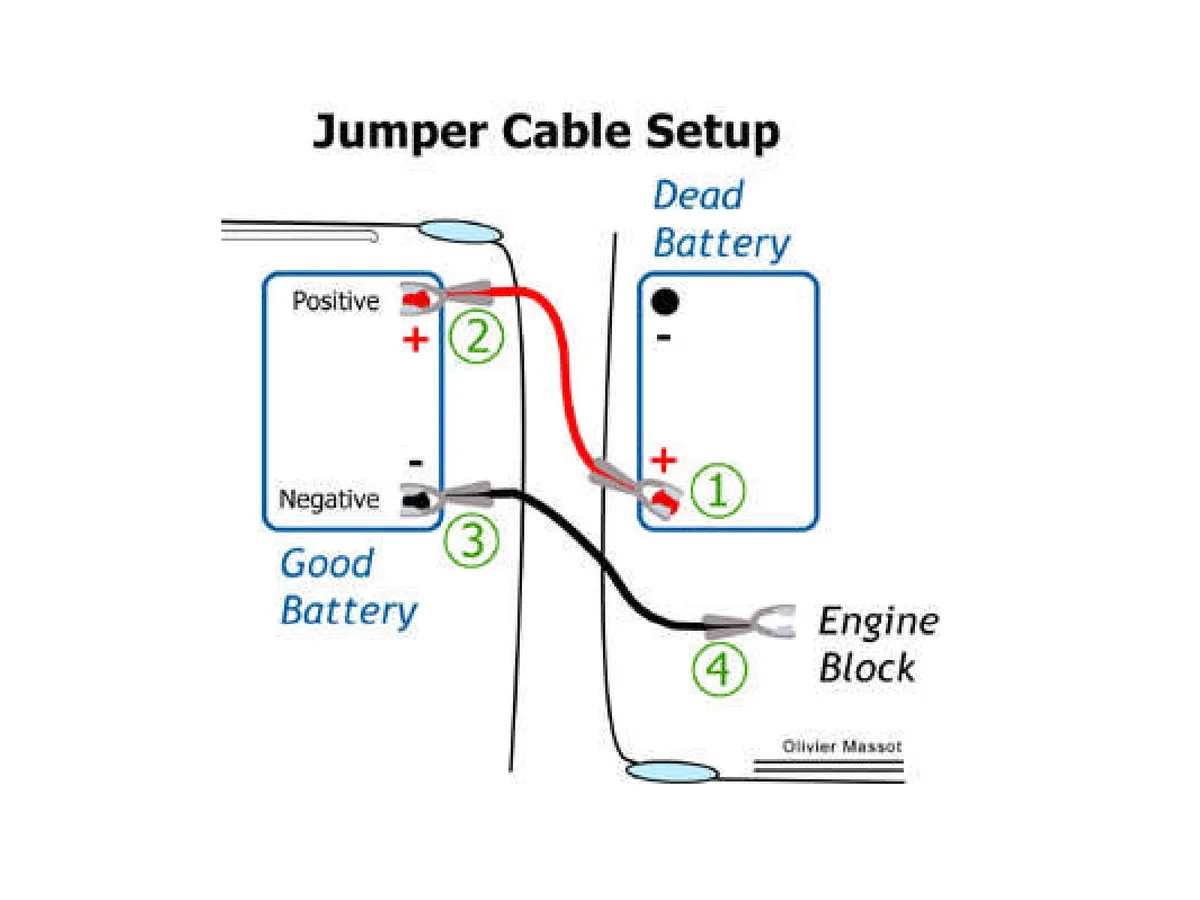
Why does order matter? When you connect the negative clamp last, any small spark that occurs happens at the ground point, away from the battery. Lead-acid batteries vent hydrogen gas during charging and discharging, and a spark near the positive terminal can ignite that gas.
It's rare, but it's the reason every jump-start guide in existence tells you to ground the negative clamp to chassis metal instead of the negative post.
The reverse order on disconnection matters for a different reason. Once the engine is running, the alternator is charging the battery and energizing the chassis. Disconnecting the positive clamp first means you're breaking the live circuit at the terminal that carries the current, while the ground clamp remains a safe, stable reference.
Reversing this order (black first, then red) can cause a momentary voltage spike that confuses sensitive electronics in modern cars.
Here's the connection and disconnection sequence in one place:
| Step | Action | Reason |
|---|---|---|
| 1 | Red clamp to (+) terminal | Establishes positive circuit first |
| 2 | Black clamp to ground point | Completes circuit away from battery |
| 3 | Wait 5 seconds for AVAPOW to verify polarity | Confirms safe connection |
| 4 | Crank engine | Standard starting |
| 5 | Disconnect black clamp | Breaks ground first |
| 6 | Disconnect red clamp | Removes positive last |
If you ever see a spark when connecting the black clamp, that's not a defect. It's the AVAPOW's capacitors charging through the ground circuit, and it's normal. If you see a spark when connecting the red clamp, you've probably got the terminals reversed.
Stop, disconnect, and re-check the markings.
Common Mistakes That Stop the AVAPOW From Working
Most failed AVAPOW jumps trace back to a handful of repeatable mistakes. Here's what aggregate user feedback and manufacturer troubleshooting guides flag most often.
Clamping to the Wrong Terminals
Reverse polarity is the number one cause of a no-start with a smart jumper. The AVAPOW simply refuses to deliver current, and many users assume the unit is broken. It isn't.
Check the "+" and "−" markings on the battery before you connect anything.
Forgetting to Charge the Unit
A jump starter left in a glove box for six months will read 30% or lower when you finally need it. That's below the threshold for a reliable jump on a totally dead battery. Aggregate buyer feedback shows "dead jump starter" complaints almost always come from storage, not from a defective unit.
Cranking Too Long
Holding the key for 10+ seconds floods the engine and overheats the booster. Three to five seconds is plenty. If it doesn't catch, rest and try again.
Patience here saves both the AVAPOW and the starter motor.
Skipping the Ground Point
Connecting black to the negative battery post works, but it's the spark-prone method. A clean chassis bolt is safer and gives the same result. This is a small habit that prevents a real safety risk over years of use.
Ignoring the LCD Warning Lights
A flashing red indicator or a temperature icon means stop and address the issue. Cranking through a warning usually ends with an overheated booster that won't reset until it's cooled for several minutes.
Troubleshooting When Your Car Still Won't Start
If the AVAPOW is connected correctly, charged, and the engine still won't crank, the problem usually sits outside the battery. Here's how to narrow it down quickly.
The Engine Cranks But Doesn't Fire
This means the battery is now delivering current. The issue is fuel, spark, or air. Check that the fuel gauge shows actual fuel (some cars read empty after sitting).
Listen for the fuel pump priming when you turn the key to "on." If there's no hum from the tank, the pump or relay may be the issue.
You Hear a Click But No Crank
A single click usually points to a bad starter solenoid or a loose battery cable. Try wiggling the negative cable at the terminal while someone turns the key. If it cranks intermittently, the cable is corroded and needs cleaning or replacement.
The AVAPOW Beeps and Flashes Red on Connection
The smart clamps have detected a fault. Common causes are reversed polarity, a clamp not making metal contact, or a battery voltage below the readable threshold. Disconnect, re-clean the terminals, retry.
If it still fails, switch to Manual Override mode.
Everything Connects but Nothing Happens at All
Walk through this checklist in order:
- AVAPOW charged above 50%?
- Red clamp on "+", black on ground?
- Clamps biting bare metal, not plastic?
- Vehicle in Park or Neutral?
- Headlights and A/C off?
If all five check out and the engine still won't respond, the AVAPOW may have an internal fault, or the vehicle has a deeper electrical issue that a portable booster can't address. At that point, roadside service or a mechanic is the right call.
Cold Weather, Diesel Engines, and Other Edge Cases
Edge cases are where the AVAPOW's specs start to matter more than the brand name. Cold weather drains battery capacity and thickens engine oil, both of which make cranking harder. Diesel engines compress air at much higher ratios and need sustained current to fire.
Cold-Weather Starting
Lithium-ion jump starters lose some capacity below freezing. Manufacturer specs typically rate operating temperature down to about −4°F (−20°C), but practical performance drops noticeably below 32°F (0°C). If you're jumping in winter, keep the AVAPOW inside your coat for ten minutes before use.
A cold unit works, a warm one works better.
Diesel Engines
Diesel glow plugs draw high current for several seconds before cranking. If your AVAPOW is too small, the glow plug cycle will drain it before the starter even turns. For diesel, stay at 2000A peak or higher and expect to give the booster a 60-second rest between glow-plug cycles and cranking.
Motorcycles, ATVs, and Small Engines
These usually have small batteries and low compression, so a lower-amperage AVAPOW works fine. Be careful with the clamp size, motorcycle terminals are smaller than car terminals and a heavy clamp can slip off if not positioned precisely.
Boats and Marine Applications
Marine batteries are often deep-cycle, not starting batteries. They hold voltage differently and may confuse the smart clamps. If the AVAPOW refuses Manual Override on a marine battery, the cells may be sulfated and beyond recovery.
A replacement battery is the only real fix at that point.
Safety Warnings You Shouldn't Skip
Jump-starting looks simple, but the battery and the vehicle's electrical system both deserve respect. A few habits prevent the rare but serious problems.
Hydrogen Gas and Sparks
Lead-acid batteries vent hydrogen during normal operation. A spark near the vent cap can ignite it. Always connect the negative clamp to a chassis ground, not the negative post, to keep any spark away from the battery.
Never Jump a Frozen or Cracked Battery
A frozen battery can crack and leak acid. A cracked battery can do the same under cranking stress. If the battery case looks swollen or you can smell sulfur strongly, don't jump it.
Replace it.
Avoid Touching Both Clamps Together
Even on a powered-off unit, bridging the clamps creates a dead short. The AVAPOW has short-circuit protection, but the spark can still damage the teeth or the clamp springs. Keep red and black physically separated until they're on the battery.
Lithium Battery Transport Rules
The AVAPOW is a lithium-ion power bank, and airlines treat it as such. Per FAA lithium battery guidance, units under 100Wh can travel in carry-on luggage but not checked bags. Most AVAPOW A-series units fall under this limit, but check the Wh rating on the back label before flying.
Don't Skip Eye Protection
A battery can vent or splatter acid during a hard crank. Safety glasses take two seconds to put on and prevent the kind of injury you don't want to think about.
How to Store and Maintain Your AVAPOW Long-Term
Long-term storage is the difference between a jump starter that works when you need it and one that doesn't. The rules are simple but easy to forget.
Recharge Every 3 to 6 Months
Lithium cells self-discharge slowly. A unit left at 100% will read roughly 70% after six months in normal temperatures. If it sits through a winter in an unheated garage, expect it to read 30% or lower.
A quick top-up every few months keeps it ready.
Store at Room Temperature When Possible
Heat and cold both shorten lithium battery life. A center console or interior glove box is better than a trunk in Arizona or a garage in Minnesota. If you must store in extreme temperatures, expect slightly faster capacity loss.
Run a Test Jump Every 6 to 12 Months
Even when you don't need it, a test jump on a known-good battery confirms the AVAPOW still works. It also keeps the cells cycled, which helps long-term capacity. A 30-second test once a year is plenty.
Keep the Clamps Clean
Corroded clamp teeth won't bite a terminal properly. A quick wipe with a dry cloth after each use prevents buildup. If you see green or white crust on the teeth, scrub with a small wire brush and a baking soda paste, then dry thoroughly before storing.
Update Firmware if Your Model Supports It
Some newer AVAPOW models have firmware-update capability through the USB-C port. Check the manufacturer's support page for your specific model. Updates occasionally refine clamp detection logic and improve cold-weather performance.
FAQs on Using the AVAPOW Jump Starter
How Long Does an AVAPOW Jump Starter Hold Its Charge?
In our research, most AVAPOW A-series units lose about 5 to 10% per month in normal storage. A full charge will read roughly 70 to 80% after six months. Cold storage speeds the loss.
Top up every 3 to 6 months to stay ready.
Can You Jump a Diesel Truck With an AVAPOW?
Yes, if you have the right model. For diesel engines above 5.0L, use an AVAPOW rated at 2000A peak or higher. Smaller units can struggle with glow-plug draw before the starter even engages.
The A38 and similar 3000A+ models handle most light-duty diesel applications.
Do You Need to Turn Off the AVAPOW Before Disconnecting?
No, leaving it on during disconnection is fine. The smart clamps cut current the moment they lose the circuit. Just disconnect black first, then red, to avoid any voltage spike on sensitive electronics.
Why Does My AVAPOW Beep When I Connect It?
A short beep on connection is normal. It confirms polarity is correct and the clamps are reading voltage. Continuous beeping or flashing red means a fault.
Check for reversed polarity, poor contact, or a battery below readable voltage. Manual Override can override the fault if you've confirmed the connections are correct.
Can You Charge a Phone or Laptop With an AVAPOW?
Yes, most AVAPOW units include USB-A and USB-C outputs rated from 5V/2.4A up to 18W or higher on PD-capable models. They're handy as a power bank for road trips. The jump-start function and the USB outputs are independent, so you can charge a phone while the unit sits in your trunk waiting for its real job.
Final Decision Guide: Are You Ready to Jump?
Walk through this checklist before you turn the key. If every answer is "yes," you're good to go. If any are "no," resolve them first.
- AVAPOW charged above 50%? If not, plug it in for at least an hour before retrying.
- Correct model for your engine size? Small engine on a big AVAPOW is fine. Big engine on a small AVAPOW is the problem.
- Clamps clean and biting bare metal? Wipe them down if there's any corrosion.
- Red to "+", black to ground? Double-check, then triple-check before pressing Manual Override.
- Vehicle in Park or Neutral, accessories off? This prevents cranking against a gear and saves the battery.
- Manual Override ready if the battery reads zero? Know where the button is before you need it.
If every box is ticked, jump with confidence. Five seconds of cranking, then a 15-minute idle to put some charge back in the battery. If it doesn't start after three attempts, the problem is somewhere other than the battery, and further cranking won't help.