What is jump start car: The Complete guide
What is jump start car, exactly? It's a fast way to crank a dead 12V battery using power from another battery, either in a second vehicle or in a portable pack, without removing the battery itself.
Here's the part most guides skip: that "dead" battery is usually just discharged, not ruined. A healthy 12V lead-acid battery sits around 12.6 volts at full charge and drops to roughly 11.8 volts when it's too weak to crank. SAE standards (J537) define how batteries are rated and tested, so manufacturer CCA (cold cranking amps) numbers actually mean something you can compare.
Jump starting supplies a temporary surge so your starter motor can spin the engine, then your alternator takes over and recharges the battery as you drive. Up next, we'll cover the gear you need before you touch a single clamp.
Quick Answer
Jump starting a car means using an external 12V power source to start an engine with a dead battery. You clamp jumper cables, or a portable jump pack, to the correct terminals in the right order. Then you crank, disconnect in reverse, and let the engine idle or drive to recharge.
Most cars need 150 to 400 amps to start in normal weather. Diesel trucks need 1,000 amps or more.
What Jump Starting a Car Actually Means (and Why Your Car Needed It)
Jump starting is the recovery move when your 12V starter battery has discharged below the voltage it needs to spin the engine. It does not charge the battery. It gives your starter motor a short burst of current so the engine turns over, then your alternator recharges the battery as the engine runs.
Most "dead battery" moments trace back to one of a handful of causes:
- A dome light, phone charger, or accessory left on overnight
- A battery that sat unused for weeks (classic cars, seasonal vehicles, motorcycles)
- Extreme cold, which cuts available capacity by up to 35% at 0°F
- A failing alternator that never topped the battery up between drives
- An aged battery (3, 5 years is typical service life) that no longer holds charge
If your dashboard dims, the engine gives a rapid clicking sound, or you get one weak crank and then silence, you're looking at the classic signature of a discharged 12V battery. The fix is a jump start, not a tow, when conditions are right (covered later in the safety section).
One key distinction that catches people out: jump starting a car is different from charging a car battery. A jump starts the engine now. A trickle charger refills the battery slowly over hours, and ideally overnight on a wall outlet.

How a Dead Battery Stops Your Car: The Quick Physics
Your battery has one main job: deliver a high burst of current (several hundred amps) to the starter motor for a few seconds. Once the engine spins, the alternator generates electricity and powers everything from the fuel injectors to the headlights.
Here's the chain when the battery is dead:
- You turn the key (or press the start button).
- The starter solenoid engages and demands 150-400 amps.
- Voltage drops below the threshold the starter can use.
- The solenoid clicks but doesn't spin, or you get one weak crank.
Once voltage falls below roughly 11.8V at the terminals, the starter can't do its job. Jump starting supplies that missing current from an outside source so the starter can spin the engine. Within a few hundred cranks the alternator is producing 13.8-14.4V and slowly refilling the battery.
A few physics points that influence the jump:
| Battery state | Voltage at rest | What happens when you try to start |
|---|---|---|
| Fully charged | ~12.6V | Engine starts normally |
| Partly discharged | 12.0-12.3V | Slow crank, may still start |
| Discharged | 11.5-11.8V | Clicking or single weak crank |
| Dead / sulfated | Below 11.5V | No response, electrical warning lights |
In our research on cold-weather failure rates, sub-freezing conditions make this worse because lead-acid batteries lose usable capacity and engine oil thickens, so the starter works harder at the exact moment the battery is weaker.
The Four Things You'll Need Before You Touch Anything
Preparation matters more than the actual clamping. AAA roadside data shows that a large share of jump-start failures trace back to skipped prep: loose connections, wrong terminal order, or accessories left drawing power during the attempt.
Here is your pre-flight list:
- Jumper cables or a portable jump pack. Cables work when a second vehicle is available. A jump pack works anywhere.
- Safety glasses and gloves. Battery acid and hydrogen gas are real hazards.
- Owner's manual (paper or app). Modern cars sometimes hide the jump points under a red cover in the fuse box. Some manufacturers specify an exact jump point away from the battery.
- A flat, stable surface. Don't try this on a slope. Put both vehicles in Park (or Neutral for manuals), parking brake on, accessories off.
A quick note on cable gauge, since it confuses most buyers:
| Cable gauge | Best for | Typical length |
|---|---|---|
| 4 AWG | Large V8, diesel, cold climates | 20-25 ft |
| 6 AWG | Most cars, SUVs, light trucks | 12-20 ft |
| 8 AWG | Small 4-cylinder engines | 8-12 ft |
| 10 AWG | Compact cars in mild weather | 8-12 ft |
Lower AWG means thicker wire and more current. Aggregate reviews report that 6 AWG is the sweet spot for most household jump-starting. Thinner 10 AWG cables can overheat when called on for a V8 in winter.
For a quick spot-check on AAA's battery and roadside service standards, you can confirm that most roadside pros use 4 AWG commercial cables for a reason. Thicker is safer when current is high.
Jump Starting With a Donor Car: Step-by-Step
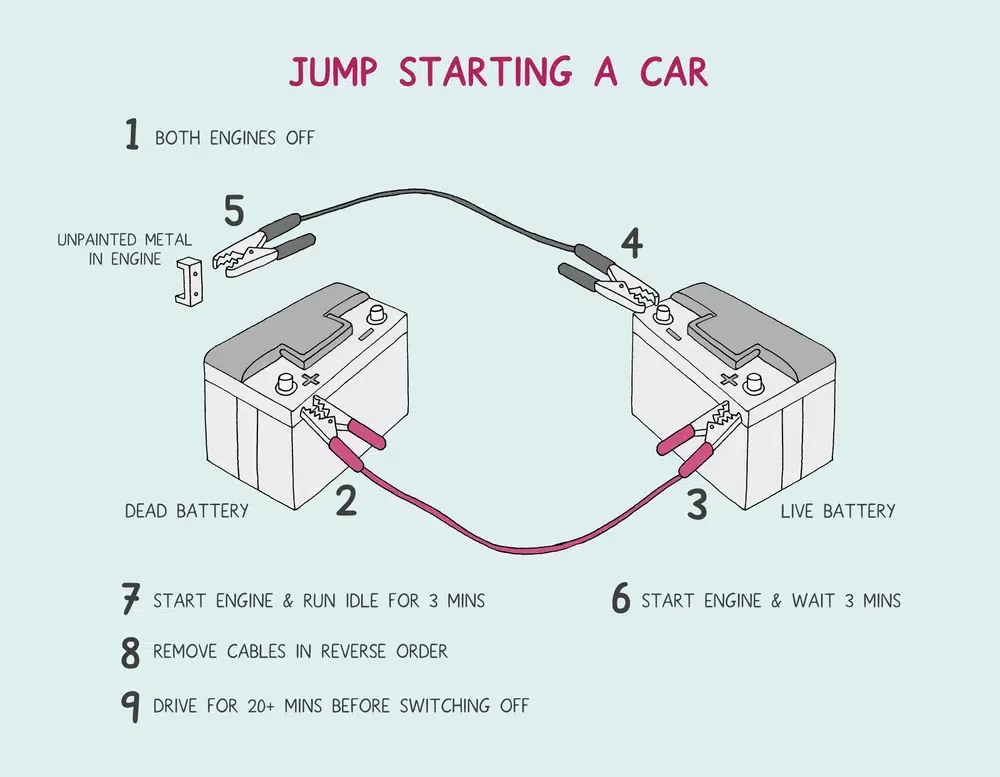
Two-car jump starting is still the most common method because most households have two vehicles and zero jump packs. Here's the order that protects your ECU, your battery, and your fingers.
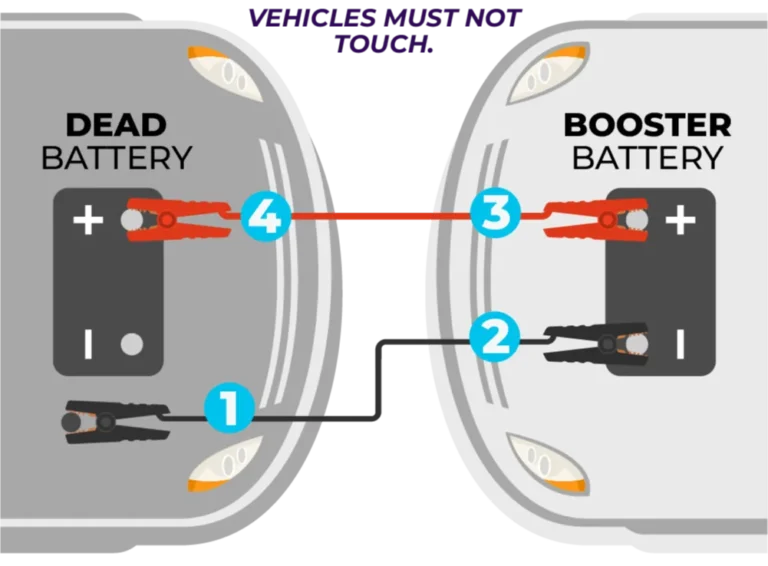
Park the donor vehicle close enough that the cables reach, nose-to-nose or side-by-side. Don't let the cars touch. Turn both ignitions off.
Pop both hoods.
Step-by-step: the safe order
- Identify the positive (+) and negative (−) terminals on both batteries. They're marked on the battery case. Positive is usually red, negative is black.
- Connect the red clamp to the positive terminal of the dead battery.
- Connect the other red clamp to the positive terminal of the donor battery.
- Connect the black clamp to the negative terminal of the donor battery.
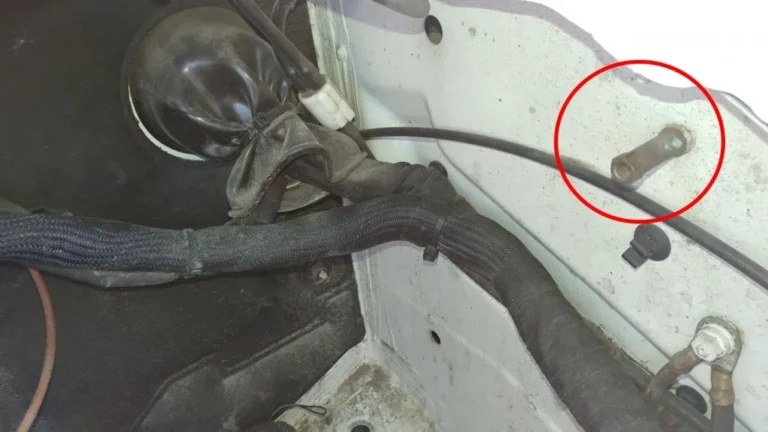
- Connect the last black clamp to a solid, unpainted metal ground on the dead car, away from the battery. A bracket, bolt, or engine lift point works.
- Start the donor vehicle. Let it idle for 2-3 minutes to push some voltage into the dead battery.
- Try to start the dead vehicle. If it doesn't crank within 5-10 seconds, stop and wait a minute before trying again.
- Once the dead vehicle is running, disconnect in reverse order: black from the ground, black from the donor, red from the donor, red from the dead battery.
- Keep the jumped car running or drive it for at least 20-30 minutes to top the battery back up.
Why the ground point on the dead car and not the negative post? Two reasons. A ground point away from the battery keeps any spark (and there will be a small one when you connect) away from hydrogen gas that can vent from the battery.
It also gives the current a clean return to the chassis ground.
A few condition-driven adjustments worth flagging:
- If the donor car is much smaller than the dead one (say, a 4-cylinder trying to jump a V8 truck): let the donor idle longer before cranking, 5-10 minutes.
- If it's below freezing: both batteries are weaker, so keep the donor running the whole time and don't crank longer than 10 seconds.
- If the dead car has an aftermarket alarm: disarm it before disconnecting, otherwise the alarm may trigger when voltage drops as you remove the clamps.
Jump Starting With a Portable Jump Pack: Step-by-Step
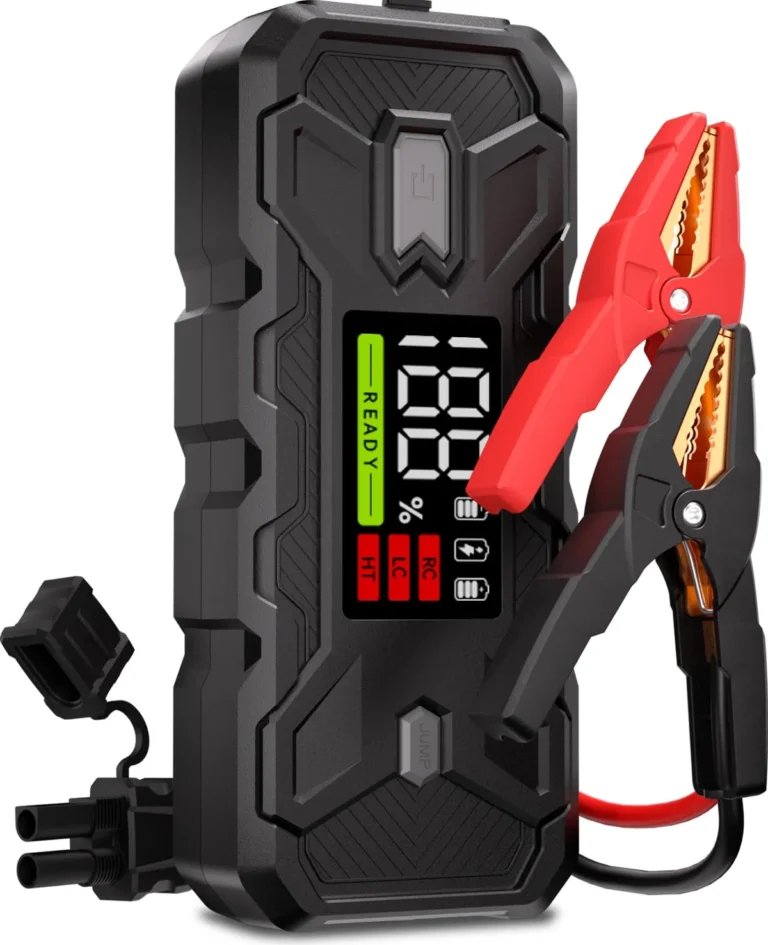
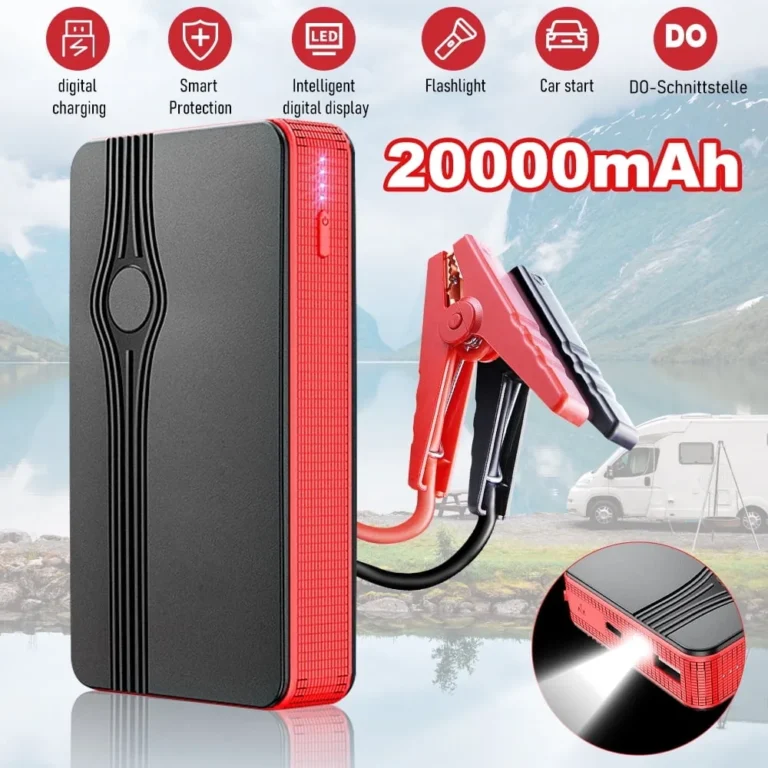
A portable jump pack is a small lithium (usually LiFePO4) battery with built-in jumper clamps. It's the right call when you're alone, in a parking lot, or far from a second car. Modern units from brands like NOCO, Antigravity, and Hulkower pack 1,000 to 3,000 peak amps into a box that fits in a glove box.
The sequence is the same logic as a donor car, minus the second vehicle.
Step-by-step: portable jump pack procedure
- Confirm the pack is charged. Most have an LED or LCD that shows battery level.
- Turn off the dead car's accessories (radio, lights, climate).
- Connect the red clamp to the dead battery's positive (+) terminal.
- Connect the black clamp to a clean ground point on the dead car, away from the battery.
- Power on the jump pack.
- Try to start the car within 5-10 seconds of the crank.
- Once the engine is running, turn off the jump pack.
- Disconnect the black clamp first, then the red.
- Let the engine run or drive for at least 20 minutes.
Most modern packs have reverse-polarity alarms and spark-proof clamps. If the pack beeps when you connect, you've got the clamps swapped. Stop and fix it.
A size match matters more than people think. Here's a quick rule of thumb:
| Engine size | Minimum peak amps |
|---|---|
| 4-cylinder gas | 150-300A |
| V6 gas | 300-600A |
| V8 gas | 600-1000A |
| Diesel (light) | 1000-1500A |
| Diesel (heavy) | 1500A+ |
Manufacturer specs indicate that undersized units may crank a small engine once but won't survive multiple attempts in cold weather. Pick a pack rated above your engine size for headroom.

The Order You Connect and Disconnect Cables (and Why It Matters)
The cable order isn't superstition. It's a safety protocol built around the chemistry of a lead-acid battery, which vents hydrogen gas during charging and discharging.
Hydrogen is explosive in the right concentration. The spark you get when you connect or disconnect a clamp can ignite it. So the rule is simple: make the final connection away from the battery, where any spark won't ignite vented gas.
Connecting order (positive first, negative last, away from battery):
- Red (+) to dead battery positive
- Red (+) to donor battery positive
- Black (-) to donor battery negative
- Black (-) to ground on dead car
Disconnecting order is the exact reverse:
- Black (-) from dead car ground
- Black (-) from donor battery negative
- Red (+) from donor battery positive
- Red (+) from dead battery positive
If you swap the order, two things can go wrong. You can short the positive clamp against the car's chassis while it's still connected to the donor, sending current through the metal body. Or you can spark directly on the dead battery, which is the gas-ignition risk.
Push-Button Start and Hybrid Vehicles: What's Different
Modern cars with push-button start and hybrid powertrains still have a 12V battery, but the jump procedure has small but real differences.
Push-button start vehicles (most 2015+ models):
- Press the brake, then press the start button to crank. No key turn.
- Some cars need the smart key fob placed in a specific spot (often the steering column or center console) if the fob battery is weak.
- The start button may need to be pressed twice in some cars: once for accessory mode, once for crank.
Hybrid vehicles (Toyota Prius, Ford Escape Hybrid, etc.):
- You jump the 12V auxiliary battery, NOT the high-voltage hybrid system.
- The hybrid battery under the rear floor is around 200V and must never be touched.
- The 12V battery location varies: under the hood, in the trunk, or under the rear seat.
- Always use the designated jump point, usually a red terminal cover in the fuse box.
Manufacturer guidance from Toyota and Honda is consistent: never assume the 12V battery is under the hood. Check the owner's manual for the exact jump point and the orange high-voltage cable routes to stay away from.
Jump Starting in the Rain, at Night, or on the Highway: Condition Adjustments
The procedure is the same. The conditions change the risk profile. Here's how to adjust.
Rain
A wet engine bay is generally fine for a 12V jump start. The system's voltage is too low to give you a dangerous shock. The bigger risk is corrosion on the terminals, which blocks current.
Wipe the terminals dry with a rag before clamping. Don't stand in a puddle while cranking.
Night
A flashlight in your mouth is a bad idea. Use a phone light or, better, a headlamp so both hands stay free. Identify terminals by color and the +/− marks, not just position.
Modern batteries sometimes hide the markings under grime.
Highway shoulder
If you're on a highway, the jump happens only after you've pulled fully off the road. Turn on hazard lights. Stand on the side away from traffic.
If a guardrail or barrier is within reach, stay behind it. AAA data shows roadside fatalities spike when drivers work in active lanes. If you can't safely reach the engine bay, call roadside assistance instead.
Cold weather (below freezing)
Cold batteries don't accept a jump as readily. Let the donor run longer (5-10 minutes). Crank for no more than 10 seconds at a time.
Wait 60 seconds between attempts. If the dead battery is more than 5 years old, it may not recover, even with a clean jump.
Mistakes That Can Fry Your ECU or Blow Up the Battery
Modern cars run dozens of ECUs (engine control units) that don't like sudden voltage spikes. The wrong jump sequence can cost you a $1,000+ repair. Here are the high-cost mistakes we see most often.
Reversing polarity (red on negative, black on positive):
A surge of current flows backward through the system. It can fry the alternator diodes, blow fuses, and damage the ECU. Some cars have reverse-polarity protection.
Many don't. If you hear a click and see a small spark when nothing should be live, you've likely crossed the clamps.
Connecting the last black clamp to the dead battery (instead of ground):
The spark lands directly on the battery, where hydrogen vents. Rare, but documented cases of batteries cracking or venting violently.
Cranks longer than 10 seconds:
The starter motor pulls 150-400 amps. Run it for 30 seconds and the windings heat up. Run it for a minute and you can weld contacts inside the solenoid.
If it doesn't start in 10 seconds, wait a full minute, then try again.
Letting the running donor touch metal on the dead car:
If the donor is still running and you touch a clamp to a metal bracket by accident, you can short it through the chassis. No drama, but the donor's electrical system takes the hit.
Jump starting a damaged or frozen battery:
If the battery case is bulging, cracked, or frozen solid (it can happen below -20°F), don't jump it. The case can rupture, spraying sulfuric acid. Call for a tow.
Smoking near the battery:
We shouldn't have to say this, but hydrogen + cigarette is a real problem. No smoking, no sparks from lighters, no open flames within a few feet.
Signs You Shouldn't Jump Start (Call a Tow Instead)
A jump start is the right call for a discharged battery. It's the wrong call for a battery that's actually failed. Here are the tell-tales that mean you should call for service instead.
| Symptom | Likely cause | Jump start? |
|---|---|---|
| Clicking, no crank | Discharged battery | Yes |
| Slow, single crank, then nothing | Severely discharged | Maybe, try once |
| Clicking plus burning smell | Stuck solenoid or seized starter | No |
| Battery case is swollen or cracked | Internal failure or freeze damage | No |
| Visible acid leak | Case rupture | No, tow to shop |
| Engine cranks fine, but won't fire | Fuel or ignition issue, not battery | No, different problem |
| Battery is more than 6 years old | Likely at end of life | Jump once, replace soon |
Jumper Cables vs. Portable Jump Pack: Which One to Use When
Both options do the same job. They shine in different conditions.
Cables win when:
- You have a second vehicle available
- You're jump-starting regularly (fleet, farm, family with multiple cars)
- You want the cheapest upfront cost ($20-$50 for decent 4 or 6 AWG)
- You're jumping diesels or large engines that need sustained current
Portable jump pack wins when:
- You're alone or no second car is nearby
- You're in a parking garage, remote area, or roadside pull-off
- You want one tool that handles phones, lights, and air compressors (many packs have USB ports, flashlights, even tire inflators)
- You have a small commuter car or motorcycle
Aggregate reviews report that a quality 1,500-2,000A lithium pack runs $80-$150 and lasts 3-5 years with occasional recharging. Cables are cheaper up front but need a second vehicle every time.
How to Pick the Right Jump Pack (Amps, Gauge, Size, Safety Features)
If you're going portable, focus on four specs and ignore the rest.
- Peak amps (not cranking amps): Peak is the burst. Match it to your engine size. Get more than you think you need.
- Battery chemistry: LiFePO4 (lithium iron phosphate) is safer and lasts longer than older lithium-ion for this use. Most premium packs sold as of 2026 are LiFePO4.
- Cable gauge on the clamps: Built-in cables are usually 8-10 AWG. Thicker is better, but on a pack the gauge is fixed.
- Safety features: Reverse-polarity alarm, spark-proof clamps, over-current protection, and a temperature sensor. These matter more than peak amp bragging rights.
Skip packs that don't show a clear amp rating, that don't list a battery chemistry, or that advertise "works on any vehicle" without engine-size guidance.
How Long to Drive After a Jump and When to Replace the Battery
Your alternator puts back roughly 5-10 amps of charging current at idle, more at higher RPM. A jump start doesn't refill the battery; it just gets the engine going. The slow recharge happens over the next 20-60 minutes of driving.
Driving vs. idling
Idling charges, but slowly. Highway driving at 1,500-2,000 RPM charges faster. Manufacturer specs indicate most alternators reach full output around 2,500 engine RPM.
So 20 minutes of highway driving recharges more than an hour of sitting in a parking lot.
When to replace, not jump
- The battery is over 5 years old and discharged twice within a month
- The case is bulging, even slightly
- Voltage stays below 12.4V after a full hour of driving
- The alternator warning light is on while running
- The battery won't hold charge overnight even with no accessories left on
A healthy battery sits at 12.4-12.7V after sitting overnight. Anything below 12.2V the next morning means the battery is on its way out.
Safety and Legal Warnings You Shouldn't Ignore
A jump start is low-voltage DC work. It's not as dangerous as household AC, but it has its own risks.
Personal safety:
- Eye protection. A cracked case can spray acid. Battery explosions are rare but documented.
- Remove rings and metal bracelets before clamping. A short across a wedding ring welds it to the terminal and burns the finger.
- Keep clamps from touching each other when one end is connected. A live clamp that touches another live clamp is a dead short.
Vehicle safety:
- Never jump a battery that's visibly damaged.
- Check the owner's manual. Some manufacturers (BMW, Mercedes, certain hybrids) specify a particular jump point. Deviating can void warranty.
- Match voltages. 12V to 12V only. Never jump a 12V car from a 24V truck system.
Legal and roadside:
- Highway work has rules. Hazard lights on, fully off the roadway, never in active lanes.
- OSHA guidance for battery acid (in commercial settings) calls for an eyewash within reach when handling industrial batteries.
- Some airlines restrict jump packs in checked luggage because of the lithium battery. Check current rules if you travel with one.
For official safety guidance, OSHA's battery handling page outlines the core hazards of lead-acid batteries in workplaces, which translate directly to DIY use.
Frequently Asked Questions
How long does it take to jump start a car?
The actual jump takes 2-5 minutes: 2 minutes of donor idle, plus a 5-10 second crank. The recharge that follows takes 20-60 minutes of driving. The jump itself is fast.
The recovery is the long part.
Can you jump start a car in the rain?
Yes. A 12V system is too low to give you a shock through wet skin. Wipe the terminals dry before clamping so you get a clean connection.
Don't stand in a puddle while cranking, just for general comfort and traction.
What if the car clicks but won't start?
Rapid clicking means the battery has some charge but not enough to spin the starter. Try the jump. One slow crank and silence usually means the battery is fully discharged.
Either way, a jump is the first step.
Can you jump start a hybrid?
Yes, but only the 12V auxiliary battery, never the high-voltage hybrid system. Use the manufacturer's designated jump point, usually a red terminal cover in the fuse box. The hybrid battery itself is off-limits.
How do you know if it's the battery or the alternator?
If the car starts after a jump and keeps running, the battery was the issue. If it dies again within minutes, the alternator isn't charging and the battery is just a symptom. A quick test: measure voltage at the battery with the engine running. 13.8-14.4V means the alternator is fine.
Below 13V means it's failing.
Is it bad to jump start a car multiple times?
A jump start is a recovery move, not a fix. If you're jumping more than twice in a month, the battery is failing or there's a parasitic drain. Get the battery and charging system tested at an auto parts store.
Most do it free.
Can a jump start damage a modern car's computer?
It can if the polarity is reversed or if the donor vehicle's voltage surges while cables are connected. Modern cars have surge protection, but it's not bulletproof. Following the correct connection order (positive first, negative to ground) keeps voltage spikes away from sensitive ECUs.
If you're jump-starting a 2018+ luxury car, check the owner's manual first.
Do you need to replace the battery after a jump start?
Not usually. A single discharge (left a light on, sat through a cold snap) doesn't kill a battery. If it holds charge and starts normally the next morning, you're fine.
Replace when the battery is 5+ years old, fails a voltage test after driving, or won't hold charge through the night.
Can you jump start a completely dead (0V) battery?
A battery that reads 0V has an internal short or is fully sulfated. A jump may start it once, but the battery won't hold the charge. Treat it as a one-time recovery and plan to replace the battery shortly after.
Is it safe to jump start from a running car?
Yes, and it's actually the preferred way. The donor's alternator provides a steady voltage during the entire procedure. Some guides say "turn the donor off," which only adds risk: a flat donor battery can leave two cars stranded instead of one.
What's the difference between jump starting and bump starting?
Jump starting uses an external 12V power source. Bump starting (also called push starting) uses a manual transmission in gear, with the car rolling or being pushed, so the engine spins mechanically without the starter. Bump starting only works on manual-transmission cars and doesn't help hybrids or automatics.
Why does my car still not start after a successful jump?
Three likely causes: a failing alternator that can't keep the engine running, a parasitic drain that pulled the new battery down overnight, or a problem that isn't the battery at all (bad starter, fuel pump, ignition switch). A multimeter test at the battery with the engine running tells you which one it is within 30 seconds.