What age do kids start jumping: Best Guide
Most parents type "what age do kids start jumping" into Google the moment their toddler looks at a step, points, and hesitates. It's one of those milestones everyone talks about, but no one quite agrees on the timing. Some kids launch themselves off the couch at 18 months.
Others wait until well past their third birthday to leave both feet off the ground at once. That's a normal spread.
What matters is the pattern. Pediatricians track jumping in layers, not as a single skill. Per the CDC's "Learn the Signs.
Act Early." developmental milestones (as of 2026), most children jump with both feet off the ground sometime between 24 and 30 months. From there, the skill branches out into forward jumps, hopping, and skipping over the preschool and kindergarten stretch.
Quick Answer
Most kids start jumping with both feet off the ground between 24 and 30 months. Forward jumping usually follows a few months later, around 2.5 to 3 years. Hopping on one foot typically shows up around 3.5 to 4 years, and skipping lands closer to 5 to 6 years.
The exact timing varies, but the sequence usually stays the same.
Why Jumping Milestones Matter More Than Most Parents Realize
Jumping is one of those "small" skills that quietly carries a lot of weight. It's a visible sign that your child's brain, balance, and leg strength are working together. That teamwork is called bilateral coordination, which just means both sides of the body syncing up.
The CDC uses milestones like jumping to flag potential motor delays early, because the skill pulls in balance, strength, and body awareness all at once.
It's also a foundation skill. Children who feel confident jumping usually climb stairs more steadily, navigate playgrounds with fewer falls, and pick up sports like soccer and gymnastics faster. Conversely, a delay in jumping often shows up later as clumsiness, fear of playground equipment, or reluctance to try new physical activities.
Here's what research has shown over time. Motor skills build on each other in a predictable order. Squatting comes before jumping in place.
Jumping in place comes before jumping forward. Jumping forward comes before hopping. Hopping comes before skipping.
The American Academy of Pediatrics tracks this sequence closely because skipping a step often signals a gap worth checking.
A quick reality check for worried parents. The milestone windows below are wide on purpose. A healthy, active child who jumps a little late is usually just fine.
The real concern patterns show up when multiple motor skills lag, or when a child shows no interest in physical play at all.
The Short Answer: When Do Kids Actually Start Jumping
The most common jumping milestone happens between 24 and 30 months. That's when most children first get both feet off the ground at the same time on purpose. Some kids get there as early as 18 months, especially if they've watched older siblings or have a trampoline at home.
Others hit it closer to 30 months and still fall right inside the typical range.
The CDC's milestone checklist for 2-year-olds includes jumping with both feet off the ground as a core expectation. By 30 months, your pediatrician will likely ask whether your child jumps, runs, and climbs low stairs. By 3 years, forward jumping off a low surface usually joins the list.
So if you're watching the calendar and your 22-month-old isn't jumping yet, take a breath. They're not behind. They're just early in the window.
The Different Types of Jumping (And Why Age Ranges Vary)
The word "jumping" hides at least five different skills. Pediatricians separate them because they develop at different ages and depend on different body systems. If you only track one type, you'll either worry too early or miss a real signal.
Here's the breakdown pediatricians and pediatric physical therapists work from:
| Jump Skill | Description | Typical Age Window |
|---|---|---|
| Jumping in place | Both feet leave the ground at the same time | 24 to 30 months |
| Jumping forward | Leaping forward off two feet | 2.5 to 3 years |
| Jumping down | Dropping from a low step with a controlled landing | 2.5 to 3.5 years |
| Hopping on one foot | Single-foot bouncing in place or forward | 3.5 to 4 years |
| Skipping | Alternating step-hop rhythm | 5 to 6 years |
Why the range? Each skill adds a new demand. Jumping in place needs enough leg strength to push off.
Jumping forward adds forward momentum and a soft landing. Jumping down adds height and the need to absorb impact. Hopping removes half the support.
Skipping chains a step and a hop into a rhythm, which is closer to a brain coordination task than a strength task.
If your child masters one but skips another, that's worth a conversation with the pediatrician. Usually it just means they need more practice. Sometimes it points to a balance issue that's easier to fix when caught young.
Age-by-Age Breakdown of Jumping Skills
Here's what to look for at each age, drawn from CDC milestones plus aggregate guidance from the American Occupational Therapy Association. The age windows overlap, so treat them as guides, not deadlines.
12 to 18 months: the warm-up
Children this age rarely jump with both feet off the ground, but they start building the pieces. They squat, stand back up, and cruise along furniture. You might see them bounce while holding your hands.
That's the foundation. They're loading their legs and learning to bend and straighten their knees, which is exactly what jumping requires.
18 to 24 months: getting airborne
This is when intentional two-foot jumping usually begins, especially for the more active toddlers. Many kids jump off the bottom stair or a low ottoman. They land hard, often with straight legs, and look surprised by their own impact.
That's normal. The CDC's 18-month checklist emphasizes walking up stairs with help, not jumping. By 24 months, two-foot jumping in place enters the picture.
24 to 30 months: the core milestone
Most children jump with both feet off the ground on purpose by 30 months. Jumping off low furniture, jumping over a line on the floor, and bouncing to music all count. If your 30-month-old is doing these things, you're right on track.
30 to 36 months: forward motion
Forward jumps on two feet usually show up here. Children this age start jumping off curbs, small steps, and playground edges with bent knees. The CDC's 3-year milestone for "jumping forward" typically lands in this range.
3 to 4 years: hopping begins
By age 3, most kids can stand on one foot briefly. By 4, hopping in place a few times becomes common. Skipping is still too much, but the body is ready to start training one-foot skills.
4 to 5 years: refining and combining
Children refine hopping, jump higher, and start combining skills. By 5, most kids can hop on one foot several times in a row. Skipping is around the corner.
5 to 6 years: skipping lands
Skipping requires the alternating step-hop rhythm, which depends on solid bilateral coordination. The CDC and most pediatric motor development references expect skipping to develop between ages 5 and 6. If your child skips earlier, great.
If they skip at 7, that's still inside a typical range.

If your child is hitting each skill within these ranges, they're tracking well. If they're missing more than one window by 3 to 6 months, that pattern is worth raising with the pediatrician at the next checkup.
Jumping Milestone Chart You Can Pin to the Fridge
Here's a printable snapshot of what to look for at each age. Pin it to the fridge so you can check in every few months without spiraling.
| Age | What to Expect | Quick At-Home Check |
|---|---|---|
| 12 to 18 months | Squats, stands, cruises furniture | Can they squat to pick up a toy and stand back up without using furniture? |
| 18 to 24 months | First two-foot bounces, often off a low surface | Do they bounce off the bottom step with you nearby? |
| 24 to 30 months | Consistent two-foot jumps in place | Do they jump when you say "jump" over a line on the floor? |
| 30 to 36 months | Forward jumps off low heights | Can they jump off a 4-inch step with bent knees? |
| 3 to 4 years | Hops in place briefly | Can they hop on one foot once or twice? |
| 4 to 5 years | Hops several times in a row | Can they hop across the room on one foot? |
| 5 to 6 years | Skipping emerges | Can they skip with one foot stepping and the other hopping? |
A simple rule of thumb. By their third birthday, most children jump forward and off low surfaces. By their fourth birthday, hopping should appear in some form.
By the time they start kindergarten, skipping is usually part of the mix. None of these have to happen on the exact day, but the general order holds.

How Jumping Actually Develops (The Hidden Mechanics Behind the Skill)
Jumping looks simple, but it's actually four systems working together at the same time. When one is lagging, the skill takes longer to show up.
Leg strength
Your child needs enough lower-body strength to push their body weight off the ground. The main movers are the calves, quadriceps, glutes, and hip flexors. Squatting is the prerequisite.
If your child can't squat and stand back up easily, jumping is going to take longer to land.
Balance
Balance comes from the vestibular system in the inner ear, plus proprioception, which is the body's sense of where it is in space. Jumping requires both. Kids who are still building proprioception hesitate before low drops, or land stiff-legged because their body can't read the floor quickly.
Bilateral coordination
This is the brain's ability to send the same signal to both sides of the body at the same time. It's also the foundation for skills like catching a ball, riding a bike, and skipping. Pediatric occupational therapists call it a "building block" skill because so much else depends on it.
Soft landing control
This one comes last. Children who are new to jumping land with straight legs because their muscles can't yet absorb impact. As their core and leg strength improve, they start bending their knees on landing.
This shows up around 3 to 4 years for most kids.
If your child jumps but lands with totally rigid legs every time at age 3 or older, that's a soft cue worth mentioning to the pediatrician. It usually resolves with practice on grass or carpet. Sometimes it points to core weakness that responds well to pediatric physical therapy.
Signs Your Child Is on Track vs. Slightly Behind
Most parents want a clean checklist, so here's a quick side-by-side of "on track" versus "watchful waiting."
| Signal | On Track | Worth a Conversation |
|---|---|---|
| Jumps both feet off ground by 30 months | Yes | — |
| Lands stiff-legged at 24 months | Normal early form | — |
| Lands stiff-legged past age 3 | — | Mention at next checkup |
| Jumps forward by 36 months | Yes | — |
| Hops on one foot by age 4 | Yes | — |
| Skips by age 6 | Yes | — |
| Avoids stairs or low climbs at 3+ | — | Mention at next checkup |
| Only uses one leg to "jump" past age 4 | — | Mention at next checkup |
| Frequent falls during normal play at 3+ | — | Mention at next checkup |
The patterns matter more than any single number. Pediatricians look for clusters of delays, not isolated ones. One late skill usually resolves.
Two or three late skills together deserve a closer look.
Red Flags: When Late Jumping Deserves a Pediatric Look
A single late jump milestone is rarely cause for alarm. Pediatric developmental specialists typically look for these patterns instead:
- No two-foot jumping by 36 months. The CDC milestone window has closed and there's still no airborne moment.
- Strong preference for one leg. After age 4, a child who only jumps off one leg or refuses to put weight on one leg is showing an asymmetry worth checking.
- Persistent toe-walking combined with delayed jumping. This combination can signal a tight Achilles tendon or other orthopedic issue. Pediatric evaluation helps sort it out.
- No interest in physical activity at all. If a child avoids stairs, climbing, and rough play entirely past age 3, ask the pediatrician about it. Sensory processing differences sometimes show up here.
- Losing motor skills they once had. Any regression deserves prompt pediatric attention, full stop.
If any of these sound familiar, your pediatrician will likely screen for developmental coordination disorder and, depending on the pattern, refer to a pediatric physical therapist or occupational therapist. Early intervention (often starting before age 3) consistently produces better outcomes than waiting.
Safe Ways to Encourage Jumping at Every Age
Encouragement matters, but safety sets the foundation. A toddler learning to jump needs a forgiving floor. A preschooler hopping for the first time needs space and supervision.
Here's how to set up jumping practice that builds skill without injury.
Set the surface
Hard tile and concrete are unforgiving. Carpet, grass, padded play mats, and foam tiles are better choices for first attempts. Low-pile rugs work well too.
The goal is a surface that absorbs a bit of shock so early landings don't discourage practice.
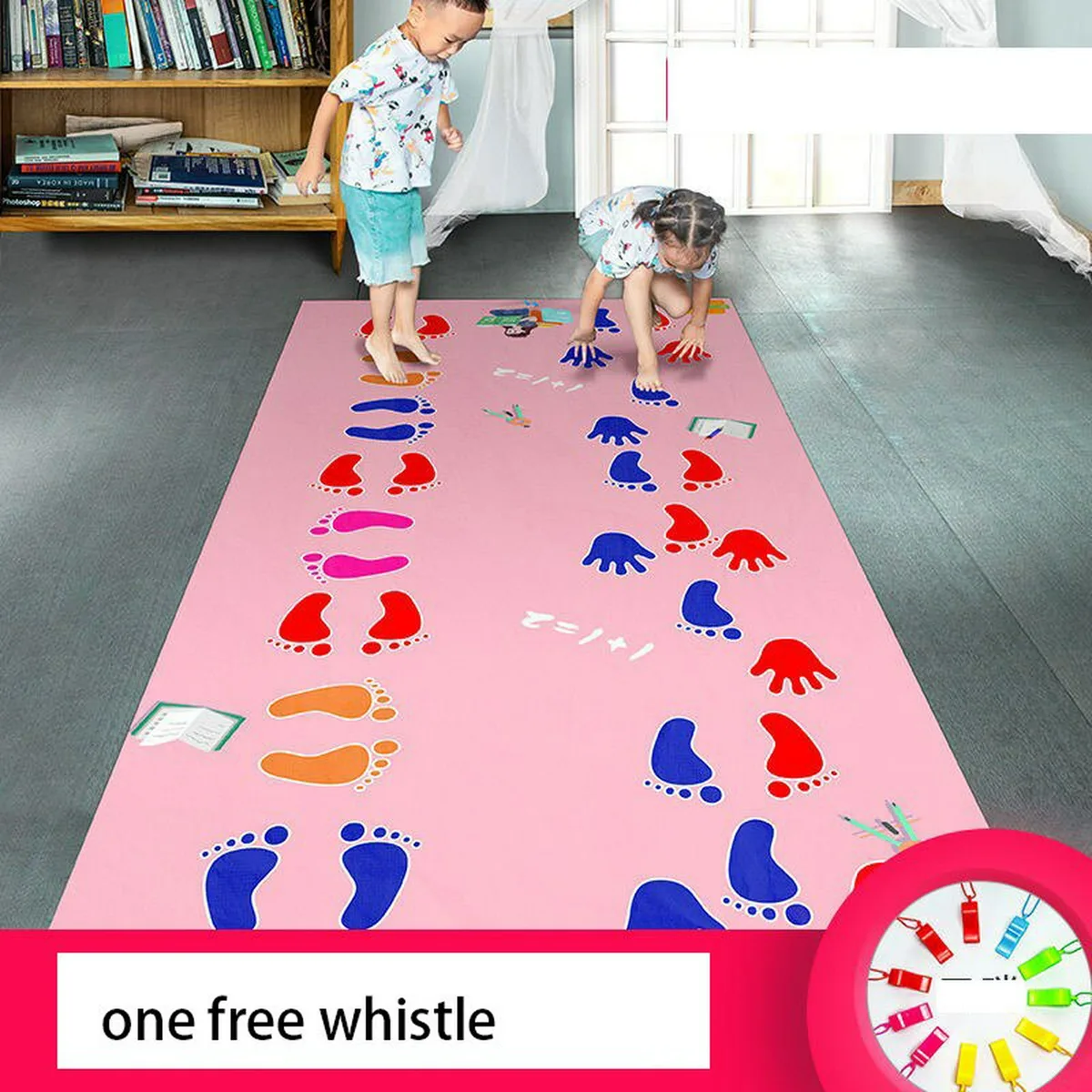
Use chalk lines and tape
Painter's tape on the floor is a free, easy tool. Draw lines and ask them to jump over them. Start with a flat line on the ground.
Move to a low obstacle like a pool noodle. This builds the "launch" pattern without needing height.
Try bubble jumps
Blowing bubbles and asking your child to "pop" them mid-air is a classic occupational therapist trick. Kids love it, and it teaches them to launch upward, which is exactly the motion they need for later skills like hopping.
Build a mini landing gym
A few couch cushions stacked at the edge of a step turn a small drop into a safe practice moment. Kids learn soft landings on a foam target rather than hard tile. This trains knee bend and confidence at the same time.
Keep sessions short
Three to five minutes of focused jumping play, several times a day, beats one exhausting 20-minute session. Toddlers and preschoolers learn motor skills in short bursts. Their nervous system consolidates the pattern during downtime between practice.
A final safety note. The AAP recommends keeping children under 6 off full-size trampolines. Mini indoor trampolines with handlebars are a common alternative, but only with constant adult supervision and a padded surround.
Most pediatricians prefer floor-based play for skill building because it carries less injury risk.
Floor Play, Trampolines, and Barefoot vs. Shoes
Three setup questions come up constantly in pediatric motor development conversations. Here's how to think through each one.
Floor play vs. trampoline
Floor play wins for most kids, especially under age 6. It's lower-impact, easier to control, and doesn't require special equipment. Trampolines build air awareness and leg power, but the AAP has consistently flagged them as a leading cause of pediatric injury.
If you use one, stay close, avoid flips, and stick to one jumper at a time.
Barefoot vs. shoes
Barefoot is usually better for skill building. Your child's foot needs to grip, balance, and adjust to the surface. Shoes with stiff sides or thick soles dampen that feedback.
At home, barefoot or non-slip socks are fine. Outdoors, lightweight flexible shoes with rubber soles work well.
Indoor vs. outdoor
Both work. Outdoor play on grass gives a natural forgiving surface and more room to move. Indoor play on carpet gives year-round practice and a controlled environment.
Most kids benefit from both. The best surface is the one they'll actually use without you having to chase them down.
Common Mistakes Parents Around Jumping
A few patterns show up over and over in pediatric visits. None of these are disasters, but each one slows down skill building.
- Worrying too early. Checking the milestone chart at 18 months and panicking when your child isn't jumping yet is common and unnecessary. Most kids don't jump until 24 months or later.
- Holding their hands to "help" them jump. Lifting a toddler and bouncing them teaches the feeling of motion, but not the launch pattern. It can also mask whether they have the strength to do it themselves.
- Skipping floors and jumping straight to heights. Kids benefit from learning to launch on flat ground before they drop from any height. The launch comes first, the drop second.
- Over-shoeing. Stiff sneakers or heavy boots limit the foot's natural grip and balance work. Barefoot time at home gives the foot the practice it needs.
- Avoiding practice out of fear. It's tempting to keep your child off anything they could fall off. But protected children often take longer to build strength and balance. Supervised risk is part of healthy motor development.
How Jumping Connects to Bigger Skills
Jumping isn't just about jumping. It's the foundation underneath a long list of motor skills your child will use for the rest of their childhood.
- Playground safety. A child who can jump down from a 12-inch ledge with bent knees handles slides, low climbers, and curbs with more confidence and fewer falls.
- Sports readiness. Soccer, gymnastics, dance, and martial arts all build on a jumping foundation. Kids who skip this stage often struggle with the takeoff mechanics later.
- Balance and posture. Jumping trains the vestibular system and core in a way that walking and running don't. The brief moment of weightlessness forces the body to readjust quickly.
- Confidence. A child who trusts their body to launch and land tries more new physical play. That trust carries into bigger physical challenges later.
In short, it's not just a milestone. It's a foundation.
What Pediatricians and Therapists Actually Look For
Pediatricians and pediatric therapists don't just check whether a child can jump. They watch how they jump. The quality of the movement carries as much information as whether it happened at all.
- Symmetry. Does the child push off both feet evenly, or favor one side?
- Knee bend on landing. Soft knees mean good impact absorption. Rigid legs often mean weak core or underdeveloped proprioception.
- Arm position. Swinging the arms up to help with takeoff is the natural pattern. Arms held still or pinned at the hips can indicate coordination gaps.
- Confidence. A child who hesitates at a low step and needs coaxing is showing a different pattern than a child who launches without thinking. Both can be normal.
If your pediatrician suggests a referral to a pediatric physical therapist or occupational therapist, that's not a worst-case outcome. It's a tool. Early sessions usually focus on strength, balance, and confidence through play.
Most kids move through quickly and come out stronger.
What to Do This Month Based on Your Child's Age
Here's a quick lookup. Match your child's age and act on it.
| Child's Age | What to Watch For | Best Next Step |
|---|---|---|
| Under 18 months | Squatting, standing, cruising | Floor play, squat-and-stand games |
| 18 to 24 months | First two-foot bounces | Bubble pops, soft cushion drops |
| 24 to 30 months | Consistent two-foot jumping | Chalk line jumps, music bouncing |
| 30 to 36 months | Forward jumping | Low step drops, obstacle course play |
| 3 to 4 years | Hopping begins | One-foot balance games, hopscotch |
| 4 to 5 years | Refining and combining | Hopping races, agility games |
| 5 to 6 years | Skipping emerges | Skipping practice, jump rope prep |
That's the framework. Use it month by month, not day by day.
Frequently Asked Questions
What is the earliest age a child can jump?
Some children jump with both feet off the ground as early as 18 months, especially active kids with older siblings. Most pediatric sources don't consider it a milestone until 24 months. The CDC's 2-year checklist is where this milestone formally lands.
Should a 2-year-old be able to jump?
Yes. The CDC's milestone checklist for 2-year-olds includes jumping with both feet off the ground as a core expectation. Some children get there just after their second birthday, which still falls inside the typical range.
When should I worry about my child not jumping?
If your child shows no two-foot jumping by 36 months, mention it to the pediatrician at the next visit. Also worth flagging: persistent toe-walking, refusing to bear weight on one leg, or losing motor skills they once had.
Are trampolines okay for teaching toddlers to jump?
The AAP recommends keeping children under 6 off full-size trampolines. Mini indoor trampolines with handlebars are safer but still need constant adult supervision. Floor-based play on soft surfaces is the lowest-risk option for skill building.
Does late jumping mean my child has a developmental delay?
Not necessarily. Many children who jump late catch up quickly with practice. Pediatricians look at patterns of multiple motor skills, not just one.
If other skills like running, climbing, and balance are on track, late jumping is usually just a slower path through the same sequence.