How to jump start mercedes sprinter van: Easy guide
If you've ever walked up to your Mercedes Sprinter, turned the key, and heard nothing but a sad click, you already know the panic. Dead battery, kids in the back, work van that won't start, and a tow bill that can easily run $200 to $500 for a Class B vehicle. Here's how to jump start a Mercedes Sprinter van safely, using the right tools and the correct procedure for your specific model year and engine.
The Sprinter is not like most cars. The main battery is often buried under the seat, not under the hood, and the factory recommends a dedicated ground point instead of the negative terminal. Get this wrong and you risk frying the SAM module or ECU, which can cost over $1,500 to replace.
As of 2026, Mercedes-Benz still publishes these jump-start warnings in the owner documentation, and per Battery Council International (BCI) battery group sizing standards, most Sprinters take an H6, H7, or H8 12V battery rated between 800 and 1,100 cold cranking amps (CCA). Let's walk through exactly how to do this the right way.
Quick Answer
Connect the red jumper clamp to the dead Sprinter's positive battery terminal. Connect the black clamp to a solid unpainted ground point, not the negative post. Wait 60 to 120 seconds.
Start the donor vehicle, then start the Sprinter. Disconnect in reverse order. Drive for 30 minutes to recharge.
Where Is the Battery on a Sprinter Van? (Locate It Before You Do Anything)
Most Sprinter owners assume the battery is under the hood. It's usually not. On the vast majority of NCV3 (2007 to 2018) and VS30 (2019+) Sprinters sold in North America, the main 12V battery lives under the driver's seat.
On some European and right-hand-drive models, it shifts to the opposite side.
Here's how battery placement breaks down by generation:
| Sprinter Generation | Common Years | Main Battery Location | Notes |
|---|---|---|---|
| T1N (Dodge / Freightliner) | 2002 to 2006 | Under driver's seat | Often a flooded lead-acid group 49 battery |
| NCV3 (Mercedes / Freightliner / Dodge) | 2007 to 2018 | Under driver's seat (some under passenger) | AGM battery common in diesel models |
| VS30 (Mercedes) | 2019 to current | Under passenger seat on many trims, driver's side on others | Under-hood jump point still exists for convenience |
Some VS30 vans also have an auxiliary battery under the hood. That battery runs accessories like the radio, alarm, or fridge pre-wiring, and it can also be the cause of a no-start situation if the main battery is fine.
To access the under-seat battery, you'll typically need a T40 or T45 Torx driver. The seat bolts into the floor, and there's usually a plastic cover or carpet flap hiding the terminals. Slide the seat forward, lift the cover, and you'll see a red plastic boot over the positive (+) terminal and a black lead on the negative side.
Don't see a battery at all? Check under the hood. Late-model VS30 Sprinters place a remote positive jump post and a marked ground stud near the firewall, specifically so you can jump without going inside the cabin.
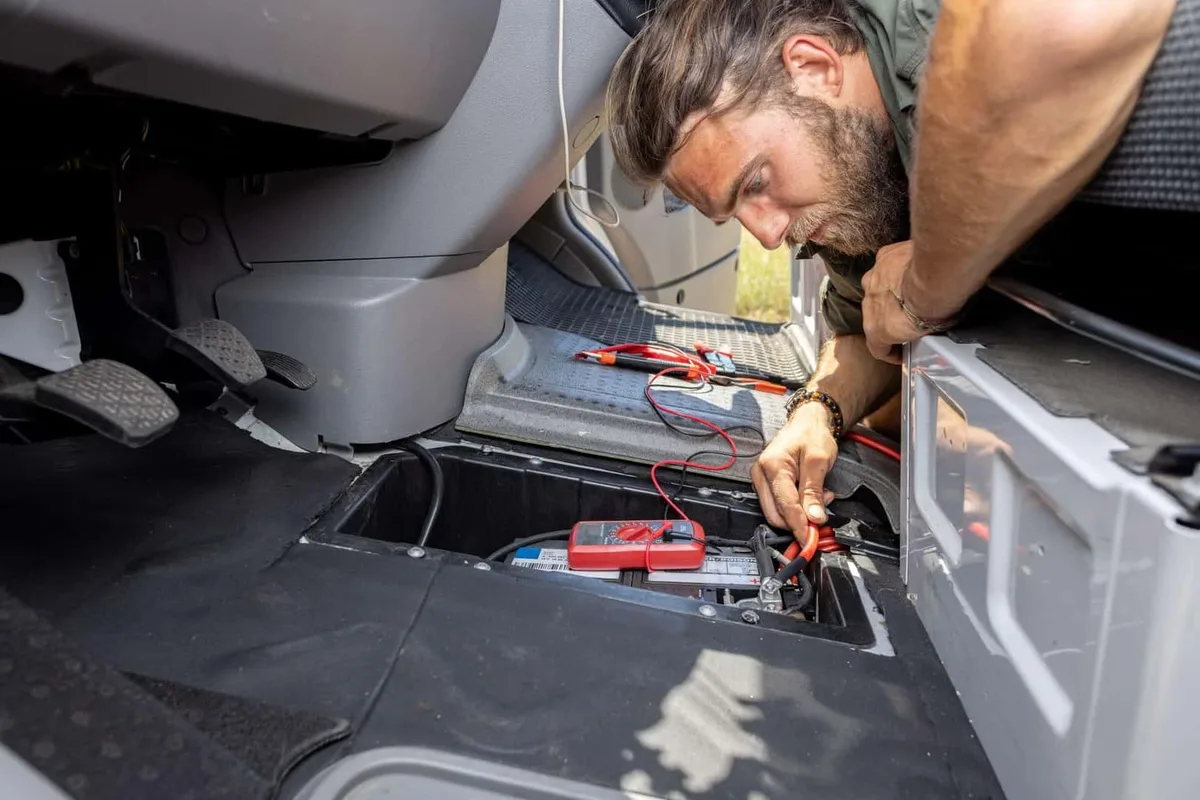
What You'll Need: Tools and Jump Pack Specs That Actually Work on a Sprinter
A set of cheap 10-gauge jumper cables from a gas station will not cut it on a Sprinter. Diesel Sprinter starter motors draw 400 to 600 amps during cranking. A weak cable run drops voltage at the clamp, and you end up with a no-start situation even with a donor vehicle hooked up.
Here's what actually works:
| Tool | Minimum Spec for Gas Sprinter | Minimum Spec for Diesel Sprinter |
|---|---|---|
| Jumper cables | 6 AWG, 16 ft, 600A rating | 4 AWG or 2 AWG, 20+ ft, 800A+ rating |
| Lithium jump pack | 1,000 peak amps | 1,500 to 2,000+ peak amps |
| Battery clamps | Copper or brass jaws, insulated handles | Same, but heavier jaw tension preferred |
| Torx driver | T40 and T45 | T40 and T45 |
| Safety gear | Safety glasses, nitrile gloves | Same |
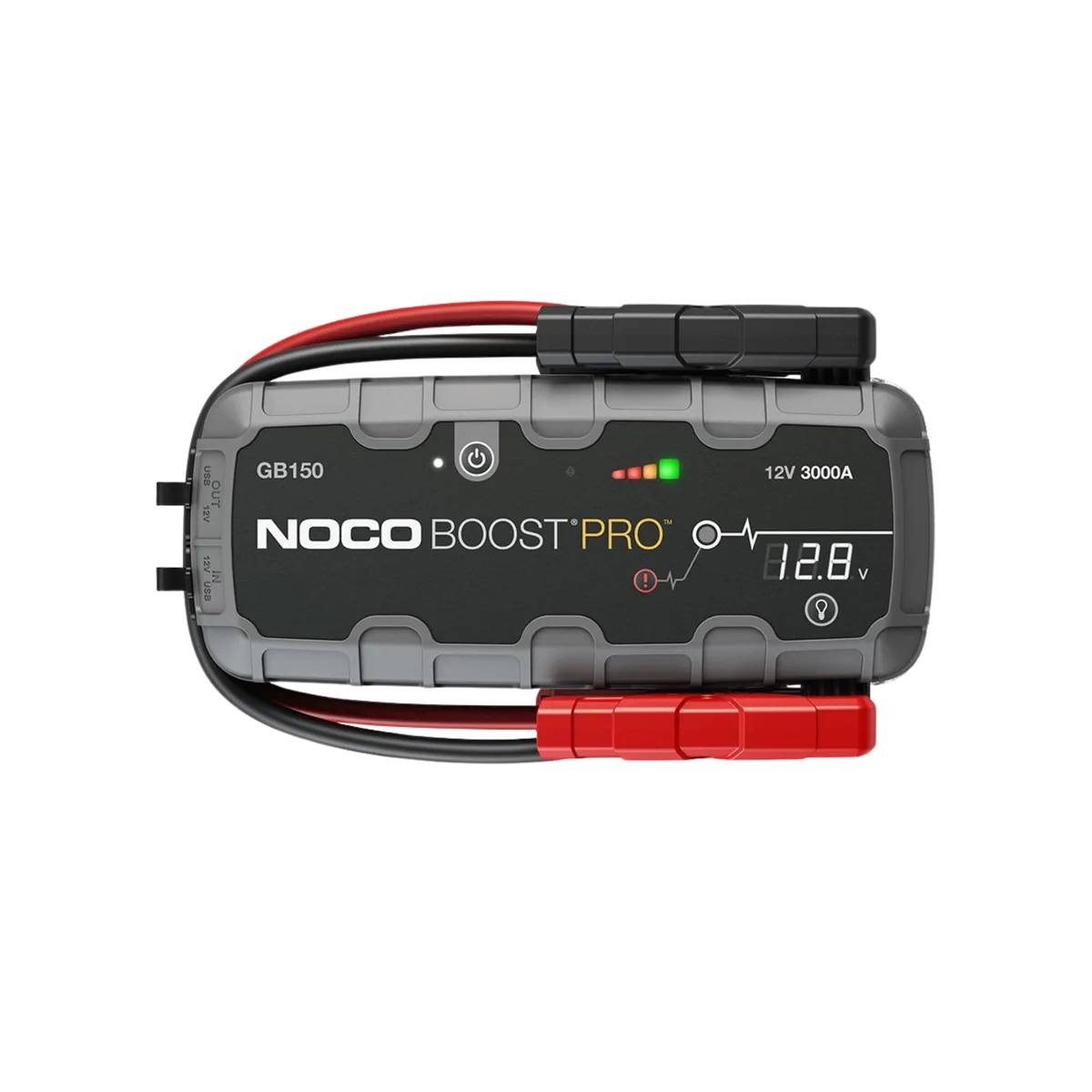
If you're using a jump pack, the unit needs to be rated for the engine size. The NOCO Boost Pro GB150 and similar 3,000-amp units are widely recommended in owner forums and aggregate reviews for Sprinter diesel applications. Smaller 1,000-amp consumer packs often struggle to crank a cold 3.0L V6 diesel.
If you're using another vehicle, match the donor battery size or bigger. A small 4-cylinder car battery can technically jump a Sprinter, but you'll need to let it charge for several minutes before cranking.
Sprinter Battery Specs and Voltage Numbers to Know
Voltage tells you a lot before you ever connect a clamp. A healthy Sprinter battery sits at 12.4 to 12.7 volts when at rest. Below 11.8 volts and the battery won't crank the starter.
Below 10.5 volts, the battery is either deeply discharged or dead.
Here's the voltage cheat sheet:
| Reading at Rest | What It Means |
|---|---|
| 12.6 to 12.7V | Fully charged, healthy battery |
| 12.2 to 12.4V | Partially discharged, will still start |
| 11.8 to 12.0V | Heavily discharged, may or may not crank |
| Below 11.5V | Deeply discharged, almost certainly won't crank |
| Below 10.5V | Dead cell or completely failed battery |
| 0V on dash, lights on | Surface charge only, battery is dead |
While the engine is running, the alternator should push 13.8 to 14.4 volts across the terminals. If you jump the van and the gauge reads under 13.5V, the alternator may be failing and the battery won't recharge on its own.
For battery replacement, BCI group sizing applies. Most NCV3 diesels use an H8 (also called Group 49 in some catalogs) AGM battery at around 850 to 950 CCA. VS30 gas models often use an H6 or H7.
Always check the existing battery's group number before buying a replacement.
How to Jump Start a Mercedes Sprinter (Step-by-Step)
This is the main workflow, and it changes slightly depending on whether you have a gas or diesel engine, and whether you're using a jump pack or a donor vehicle. Read both paths before you start.
Gas Sprinter (2.0L M274) Jump Start Procedure
The 2.0L turbo gas engine in VS30 Sprinters (2019+) draws less cranking amps than the diesel. A standard 1,000+ peak amp jump pack will usually get the job done, even in cold weather.
Step-by-step:
- Park both vehicles close enough that the cables reach, but don't let them touch.
- Turn off both vehicles. Remove the key from the Sprinter's ignition.
- Access the battery under the driver's or passenger's seat, depending on your trim.
- Pull the red plastic cover off the positive (+) terminal.
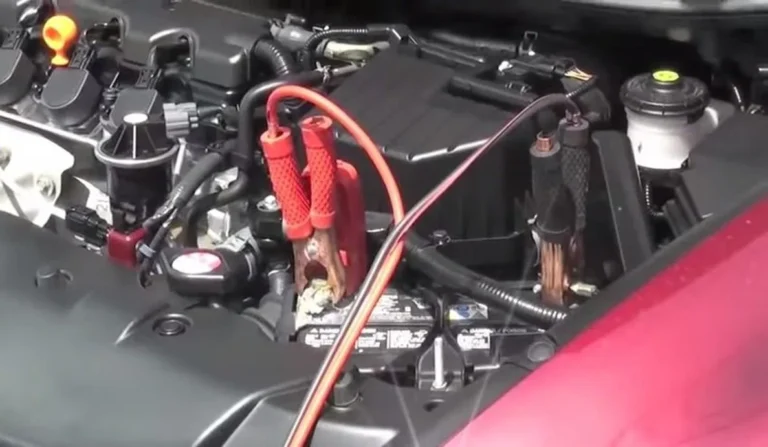
- Connect the red clamp to the positive terminal.
- Connect the black clamp to a solid ground point (see next section).
- If using a donor vehicle, start the donor and let it idle for 2 to 3 minutes.
- Crank the Sprinter for no more than 10 seconds at a time.
- If it doesn't start, wait 60 seconds and try again.
- Once started, disconnect in reverse order: black clamp first, then red.
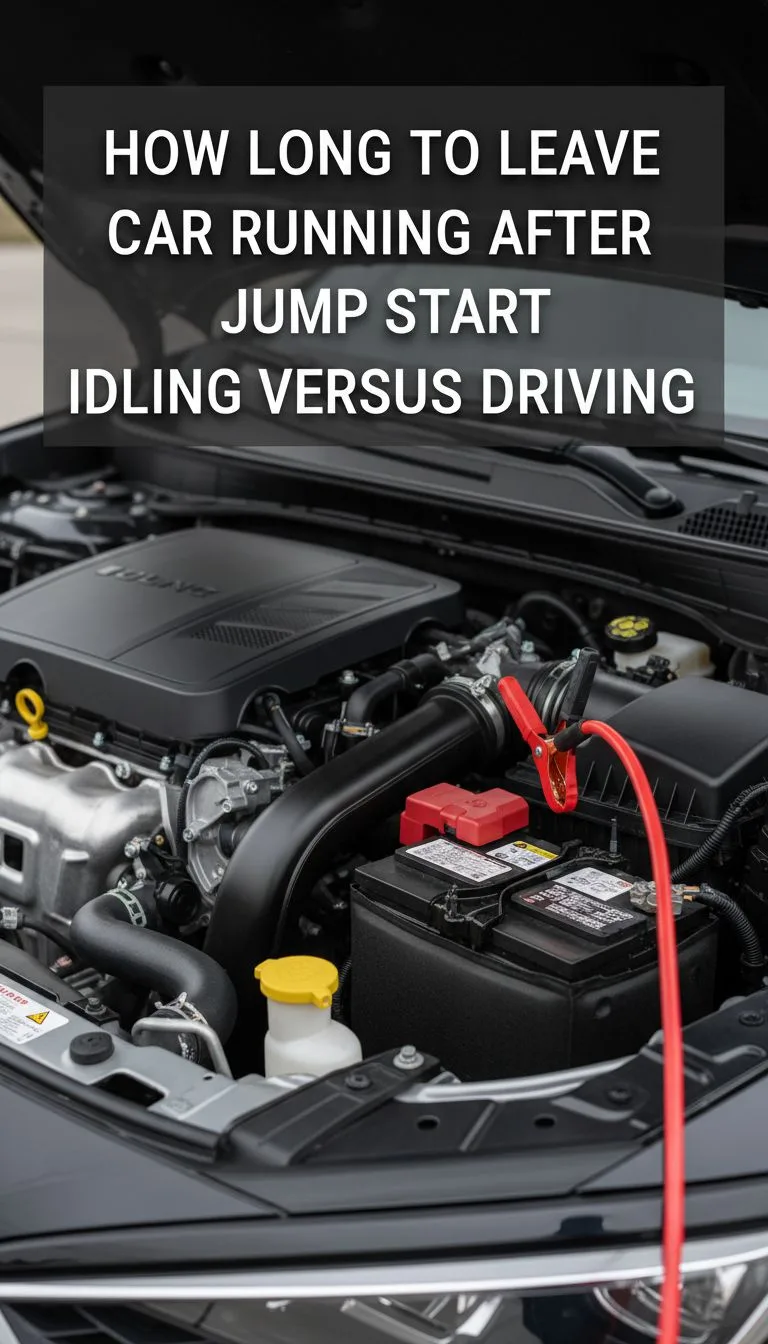
- Leave the engine running for at least 20 minutes to recharge the battery.
Diesel Sprinter (2.1L OM651 / 3.0L OM642) Jump Start Procedure
The 2.1L four-cylinder diesel (OM651) and the 3.0L V6 diesel (OM642) both draw significantly more current during cranking. Cold weather makes it worse because the glow plugs pull 60 to 100 amps before cranking even begins.
Step-by-step:
- Access the under-seat battery.
- Turn the key to position II (on) and wait for the glow plug light to go out. This pre-heats the cylinders and reduces cranking load.
- Connect the red clamp to the positive terminal of the dead battery.
- Connect the black clamp to a solid ground point, never the negative post.
- If using a donor vehicle, rev the donor to 2,000 RPM and wait 3 to 5 minutes to push charge into the dead battery.
- Crank for up to 15 seconds. Listen for the engine to catch.
- If it doesn't catch, wait 90 seconds and try again. Three attempts max before stopping to diagnose.
- Once running, let it idle for 20 to 30 minutes. Don't shut it off for at least 15 minutes or the battery may not have enough charge to restart.
Using a Jump Pack vs. Another Vehicle: Key Differences
The procedure is the same, but the timing and prep are different.
With a jump pack, you don't have a donor to keep running. Many lithium jump packs have a "boost" mode that bypasses the internal voltage check and forces a full-power output. Use it if the first crank doesn't catch.
With a donor vehicle, you have a continuous supply of charging current. The trick is letting the donor push enough amps into the dead battery before you crank the Sprinter. Two minutes minimum, five minutes if it's cold.
In both cases, the order of operations is identical: red to positive, black to ground, wait, crank, disconnect in reverse.
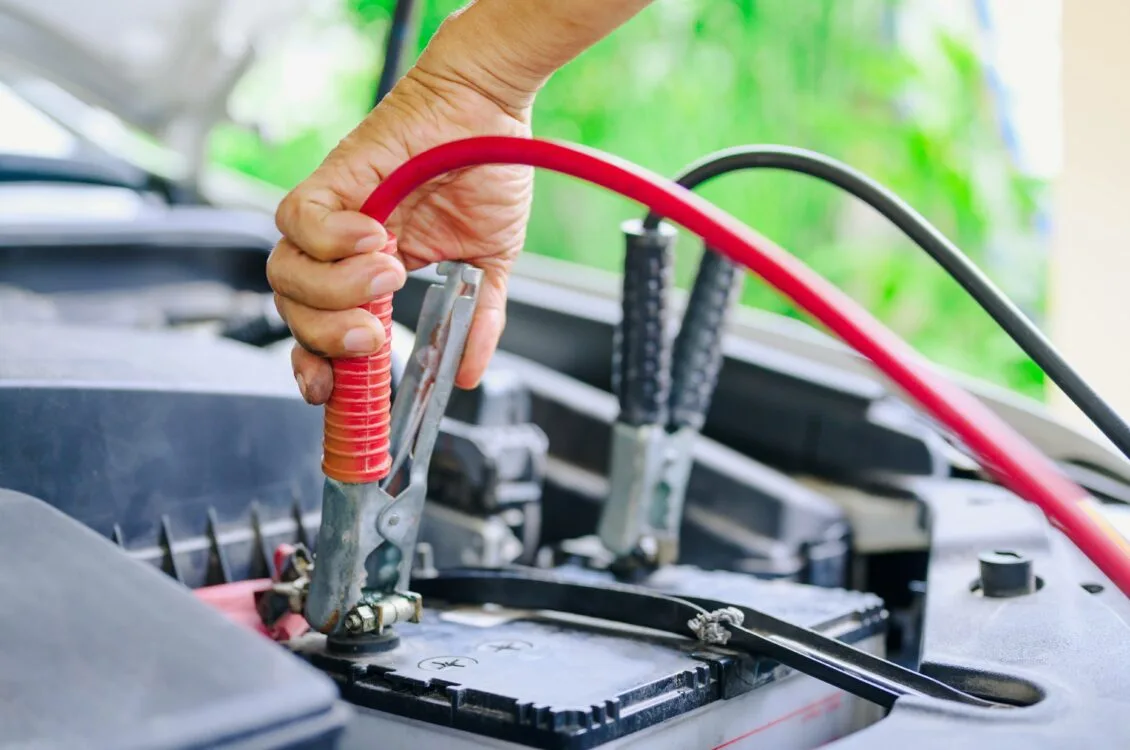
Where to Connect the Negative Cable on a Sprinter (Why This Matters)
This is the single biggest difference between jumping a Sprinter and jumping a Toyota Camry. On most late-model Mercedes vehicles, the factory service documentation recommends a dedicated ground point instead of the negative battery post.
The reason comes down to the SAM modules. SAM stands for Signal Acquisition Module. It's the body control computer that runs everything from the headlights to the wipers to the central locking.
When you connect the final negative clamp to the negative post, you create a direct path through the battery. If the dead battery has a shorted cell or a reversed polarity, that fault energy flows straight through the SAM and into the ECU.
By connecting to a chassis ground point instead, the fault energy dissipates through the body metal. The SAM stays protected.
Where to find a good ground point:
- An unpainted metal bracket attached to the seat frame or seat rails.
- The engine lift hook on the front of the engine (gas models).
- A factory ground stud near the firewall, usually marked with a small ground symbol.
Look for shiny, clean metal. If the area is painted, corroded, or covered in undercoating, scrape it back with a wire brush before clamping. A poor ground connection is the #1 reason a jump fails even when everything else is hooked up correctly.
Jump Starting Through the Under-Seat Battery vs. Under-Hood Jump Points
On VS30 Sprinters (2019+), Mercedes-Benz added dedicated jump posts under the hood. These are typically a red plastic cover near the firewall on the passenger side and a black ground stud nearby. They're labeled "+" and "-" or with a battery symbol.
These posts are wired directly to the main battery under the seat via a heavy-gauge cable. Using them is faster because you don't have to pull up the seat or mess with the Torx bolts.
Here's when to use each:
| Jump Point | Best For | Pros | Cons |
|---|---|---|---|
| Under-seat battery terminal | Direct connection, full voltage transfer | Highest reliability, no cable resistance | Requires Torx driver, seat access |
| Under-hood jump posts | Quick access, no tools needed | Faster setup, cleaner terminals | Slight voltage drop through the underbody cable |
| Direct negative to negative | Older Sprinter models, some T1N vans | Works in a pinch | Risk to SAM module if battery is shorted |
For cold-weather or high-compression diesel starts, the under-seat direct connection is the most reliable. The under-hood posts are perfectly fine for routine dead-battery situations.
Mistakes That Fry the SAM Module and ECU
After researching dozens of owner forum threads and Mercedes service bulletins, a clear pattern of mistakes shows up. These are the most common ways people damage expensive electronics while jump-starting a Sprinter.
- Connecting negative to negative on a battery with a shorted cell. The fault current flows backward through the SAM and damages the internal circuits. A new SAM unit runs $900 to $1,800 with programming.
- Reversing polarity (red to negative, black to positive). Even a brief reversal can pop multiple modules. The body control unit, radio, and instrument cluster are all vulnerable.
- Cranking for 30+ seconds at a time. The starter motor overheats, and the sustained current draw can spike the alternator's voltage regulator when it finally starts.
- Using cigarette lighter "jump boxes" with under 400 peak amps. They may show green lights, but they can't deliver the current a diesel starter demands. The result is a half-crank that drains both batteries and gives a false sense of progress.
- Touching the red and black clamps together while connected. This creates a direct short that can weld the clamps, melt the insulation, and ignite hydrogen gas venting from the battery.
- Leaving the donor vehicle running with the cables connected for 30+ minutes after a successful start. Modern alternators can push 14.4V, and a small voltage spike during disconnect can arc back into the system.
If you hear a pop, see sparks at the clamps, or smell burnt plastic, stop immediately. Disconnect the donor and inspect the wiring before trying again.
What to Do After the Jump: Resets, Codes, and Warning Lights
Getting the Sprinter started is only half the job. Late-model Mercedes vehicles store memory in modules that need a reset after a voltage drop. Skip these and you'll have a running van with a locked radio and windows that don't auto-roll.
Radio CODE Reset
If the radio displays "CODE" or "ENT" after the jump, you'll need the radio security code. This came with the original owner's manual packet. If you don't have it, a Mercedes dealer can pull it using the VIN, often for a small fee.
To enter the code:
- Turn the ignition to position I (accessory).
- Press the power button to turn the radio on.
- Use the number keys to enter the code.
- Hold the "OK" or "TP" button to confirm.
If you enter the wrong code three times, the radio locks for an hour. Don't guess. Pull the code from Mercedes-Benz or check the glovebox paperwork.
One-Touch Window Reset
The one-touch up/down feature resets whenever the battery disconnects. You'll notice the windows only work manually until you recalibrate them.
To reset:
- Close the window fully using the manual switch.
- Hold the switch in the up position for 5 seconds.
- Release, then hold again for another 5 seconds.
- Test the one-touch function.
Repeat for each window. The sunroof also needs a similar reset on most VS30 trims.
ESP/BAS and Throttle Adaptation Reset
After a deep discharge, you may see the ESP (Electronic Stability Program), BAS (Brake Assist), or check engine light stay on. The throttle body also loses its idle adaptation.
To reset:
- Start the engine and let it idle for 10 minutes. Don't touch the gas pedal.
- Turn the steering wheel lock to lock three times slowly.
- Drive at 30+ mph for 10 minutes, including some steady throttle and some light braking.
- Shut off the engine and restart.
Most warning lights clear after this drive cycle. If the ESP/BAS light stays on, you'll need an OBD-II scanner with Mercedes-specific software to clear the codes, or a visit to a shop.
Common Sprinter Starting Problems That Look Like a Dead Battery
Sometimes the battery reads fine and the van still won't crank. These are the issues that masquerade as a dead battery but require a different fix.
If you turn the key and hear a single loud click but nothing else, the starter solenoid is likely engaging but the starter motor isn't turning. On the 3.0L V6 diesel, this often points to corroded main battery cables rather than a dead cell. The cable ends oxidize inside the insulation where you can't see them.
Voltage reads normal at the posts but drops to 9V at the starter under load.
If you turn the key and hear rapid clicking, the classic dead-battery symptom is real. Confirm by jump-starting. If it starts with a jump, the battery is the problem.
Replace it.
If nothing happens at all, no clicks, no lights, no response, check the main fuse box under the hood. A 200A mega-fuse on the positive cable protects the entire electrical system. If it blows, the van is electrically dead until it's replaced.
This fuse blows during improper jump attempts, which is one more reason to take the procedure seriously.
Glow Plug Relay Failure (Diesel)
The OM651 and OM642 diesels depend heavily on the glow plug system for cold starts. The relay that controls the glow plugs sits on the firewall on most NCV3 models and under the battery tray on VS30 diesels.
When the relay fails, the glow plug light on the dash either flashes rapidly or never appears. The engine will still crank, but it won't fire in cold weather. You may get a start in mild summer conditions, which is why this issue often gets misdiagnosed.
Manufacturer replacement parts run around $120 to $180, with aftermarket units available for less. The relay swap itself takes about 30 minutes with a 10mm socket. Once replaced, the glow plug light should appear for 2 to 4 seconds on a cold start and 1 second on a warm start.
Auxiliary Battery Issues
VS30 Sprinters often run a second battery under the hood to power accessories like the auxiliary heater, radio presets, alarm, and any pre-wired components for RV or fleet upfits. If this battery dies, the main battery may be fully charged, but the van can still refuse to crank.
Test both batteries separately with a multimeter. The auxiliary battery should read the same 12.4 to 12.7V as the main. Below 12V, it's gone bad.
Some owners disconnect the auxiliary battery during long storage to prevent parasitic drain from killing both batteries at once.
A trickle charger or Battery Tender maintainer on both batteries during extended downtime prevents this entirely.
SAM Module Faults
The SAM (Signal Acquisition Module) is the body control computer, and a faulty SAM can mimic a dead battery in subtle ways. The dome lights still work, the key fob still unlocks the doors, but the ignition does nothing when you turn the key.
Other SAM symptoms include flickering interior illumination, random warning lights that come and go, and accessories behaving erratically. The window regulators, wipers, and central locking all run through the SAM, so any combination of these failures is a strong clue.
Dealer-level diagnostics with XENTRY or STAR Diagnostic tools are required to confirm. Independent shops with Mercedes-compatible scanners can also pull SAM fault codes. A new SAM runs $900 to $1,800 plus programming, which is why protecting the original through proper jump-starting technique is worth the effort.
Best Jump Starters for a Mercedes Sprinter Van
If you regularly drive a Sprinter, a portable jump pack is a smart investment. The right one turns a stranded-no-start situation into a five-minute fix instead of a tow-truck wait.
Look for these specs:
| Spec | Gas Sprinter | Diesel Sprinter |
|---|---|---|
| Peak amps | 1,000A | 2,000 to 3,000A |
| Capacity | 12,000 mAh minimum | 18,000 mAh or higher |
| Clamp output | 400A continuous | 600A continuous |
| Safety | Reverse polarity, spark-proof | Same plus surge protection |
The NOCO Boost Pro GB150, Antigravity XP-10, and HULKMAN Alpha85 consistently show up in owner community recommendations for diesel-class vehicles. Always confirm the manufacturer's tested engine displacement rating before buying. A pack rated for 7-liter gas engines may not have the cranking capacity for a 3.0L V6 diesel under heavy load.
Jump Pack vs. Jumper Cables vs. Calling Roadside Assistance
Each method has its place.
| Method | Best For | Downside |
|---|---|---|
| Lithium jump pack | Solo travel, remote job sites | Higher upfront cost |
| Heavy-duty jumper cables | Home driveway, friend nearby | Requires a willing donor vehicle |
| Mercedes-Benz Roadside Assistance | Active warranty period | Wait times vary, tow if jump fails |
| AAA or third-party roadside | Out of warranty, urgent | Provider may not know Sprinter specifics |
Per Mercedes-Benz USA terms, new Sprinters include complimentary roadside jump-start coverage. Confirm the current coverage window directly with the program before relying on it.
A high-output lithium jump pack pays for itself the first time it saves you a tow. For fleet operators running several Sprinters, having one in each van is standard practice.
Sprinter-Specific Safety Warnings You Shouldn't Ignore
A lead-acid battery vents hydrogen gas during charging. The off-gassing accelerates under jump-start conditions because of the high current flow. Hydrogen becomes explosive at concentrations above 4% in air.
Manufacturer guidance and UL certification standards for lithium jump packs outline the key safety practices.
Always wear safety glasses. Battery acid in the eye is a medical emergency. Keep open flames, cigarettes, and sparks well away from the battery during a jump.
Make sure the parking brake is engaged and the transmission is in Park or Neutral.
Remove any metal jewelry before working near the terminals. A wedding ring bridging the positive post and a ground stud will weld itself in place and cause severe burns.
After any jump, leave the engine running for 15 to 30 minutes. Don't shut it off too soon, or the battery won't have enough charge to crank the next start.
Maintenance and Long-Term Storage Tips to Prevent the Next Dead Battery
A dead battery is usually a symptom, not the root cause. A battery that dies once will die again unless you fix what's draining it. Parasitic draw on a Sprinter is normally 30 to 50 milliamps when parked.
Anything above 80 mA means something is staying awake when it shouldn't.
Common culprits include aftermarket alarm systems, dash cameras wired directly to constant power, RV fridge controllers, and any accessory left plugged into the auxiliary 12V outlets. Unplugging phone chargers and dash cams before parking solves half of these cases.
For vans that sit for more than two weeks, a Battery Tender or NOCO Genius maintainer on both batteries keeps them topped up without overcharging. This is the single best defense against coming back to a dead Sprinter after a long trip or storage period.
Frequently Asked Questions
Can I jump start a Sprinter from a regular car?
Yes. Let the donor car idle for 3 to 5 minutes before cranking the Sprinter. A small four-cylinder battery will recharge the dead battery slowly, so patience matters more than cranking power.
Will jump starting a Sprinter void the warranty?
No, as long as it's done correctly per the owner's manual. Improper jump starting that damages the SAM module or ECU is not warranty-covered, so following the negative-to-ground rule matters.
What happens if I connect the negative clamp to the negative post?
Most of the time, nothing bad happens. The risk appears when the battery has a shorted cell or reversed polarity. In that case, the fault current flows through the SAM module instead of dissipating through the chassis ground.
A new SAM runs $900 to $1,800 with programming.
How long should I let the Sprinter run after a jump?
At least 20 minutes of idling or 30 minutes of driving. Anything shorter and the battery may not have enough charge to crank the next start.
Is it safe to jump start a Sprinter in the rain?
Yes, as long as the battery terminals are clean and the cables are in good condition. Water on the battery itself is fine. Standing water in the engine bay is a separate hazard and should be avoided.
Can I use a solar panel to maintain my Sprinter battery?
Yes. A 10 to 20W solar panel with a charge controller connected directly to the battery works well for vans parked outside. Make sure the panel is weatherproof and the controller is rated for AGM batteries if your Sprinter has one.
Final Take: A Reliable Jump Start Without the Tow Truck
A Sprinter jump start comes down to three things. Locate the right battery access. Use a heavy-duty cable or jump pack rated for the engine size.
Connect negative to a clean ground point, not the negative post.
Get those right and the rest is simple. Red to positive, ground to clean metal, wait, crank, disconnect in reverse. Drive for 30 minutes to recharge, then reset the radio, windows, and throttle adaptation.
Carry a quality lithium jump pack in the van, especially for diesel models. The $200 to $300 investment beats a $300 to $500 tow every time. Keep a T40 or T45 Torx in the glovebox for seat access.
And when in doubt, a qualified Mercedes specialist is a safer call than risking a SAM module you can't afford to replace.