How to jump start a subaru outback: Best guide
A dead battery never happens at a good time. If you're sitting in a parking lot in your Outback with nothing on the dash and a click instead of a crank, here's the good news: learning how to jump start a Subaru Outback takes about 10 minutes once you know your specific model's battery layout.
The Outback uses a standard 12V lead-acid battery, typically rated between 550 and 760 CCA depending on engine and trim. The tricky part is that Subaru has shifted the battery location, added a remote jump-start terminal, and rolled out start-stop electronics on newer models, which means the exact procedure depends on your year. As of 2026, Outbacks from 2018 onward use start-stop systems that require a slightly different connection sequence to avoid fault codes.
Quick Answer
To jump start a Subaru Outback, connect the red clamp to the dead battery's positive terminal or the red remote jump-start stud. Attach the other red clamp to the donor battery's positive post. Connect the black clamp to the donor battery's negative post.
Ground the final black clamp on an unpainted metal bracket on the dead car. Start the donor, wait 2 to 3 minutes, then crank the Outback.
Where to Start: Find Your Outback's Battery Layout First
Before you touch a single cable, you need to know what you're looking at. The Outback has moved things around over the years, and the wrong assumption is the #1 cause of an ECU fault code after a jump.
Here's the quick breakdown by generation:
| Model Years | Battery Location | Remote Jump Terminal? | Notes |
|---|---|---|---|
| 1994 to 2004 (1st to 3rd gen) | Engine bay, driver's side | No | Standard posts |
| 2005 to 2014 (4th and 5th gen) | Engine bay, driver's side fender | Some trims | Red plastic cover |
| 2015 to 2019 (5th gen refresh) | Engine bay, passenger side | Yes, standard | Use remote stud |
| 2020 to 2026 (6th and 7th gen) | Engine bay, passenger side | Yes, required for start-stop | AGM battery |
If your Outback is 2015 or newer, there's almost always a red plastic flap on the passenger side near the firewall. Lift it, and you'll find a dedicated jump-start stud. This is the correct positive attachment point, not the actual battery terminal buried deeper in the tray.
Manufacturer specifications indicate this setup exists so you can jump the car without leaning over the battery itself, which reduces the risk of sparking near hydrogen gas vents. It also keeps the factory terminal cover in place, which protects the often-overlooked vent tube on AGM batteries.
Why This Step Matters So Much
Modern Subaru electrical systems run a battery management sensor (BMS) directly on the negative terminal. If you disconnect or bypass it during a jump, you can throw a charging-system fault that requires a dealer-level scan tool to clear. The remote stud exists specifically to avoid this.
Use it.
If you're dealing with a 2005 to 2014 Outback without the remote stud, you're fine connecting directly to the positive post. Just be careful not to touch the BMS clamp with your wrench or cable.
Why Your Outback Won't Start (And Whether You Can Jump It)
Not every "won't start" is a dead battery, and jumping a car with a different underlying problem can leave you stranded again 20 minutes later. Before you hook up cables, rule out the easy stuff.
The Telltale Signs of a Dead Battery
- Dome lights and headlights are dim or dead when you turn the key.
- You hear a single click or a rapid clicking from under the hood, not a heavy crank.
- The dashboard lights flicker but the engine doesn't turn.
- The infotainment screen is completely black.
If any of these match, you almost certainly have a battery below ~11.9V, which is well within jump-start territory.
Signs It's NOT the Battery
- The engine cranks at full speed but never fires. That's fuel or spark, not battery.
- You hear a whirring or grinding sound with no click. That's a starter issue.
- Battery is dead, but the car dies again immediately after the donor is disconnected. That's an alternator problem.
- The car starts fine after a jump but is dead again 24 hours later. That's parasitic draw.
Jumping a car with a bad alternator can give you a 30-minute window to reach a shop. Jumping a car with severe parasitic draw just burns through two batteries instead of one. If your situation matches those last two bullet points, a jump is a temporary band-aid, and the real fix needs to happen within the next few days.
Per Subaru service bulletins, the most common parasitic draw culprits on Outbacks are aftermarket dash cams hardwired to constant power, trailer wiring modules, and stuck relay switches in the rear gate. If your battery is on its third jump in six months, one of those is likely the reason.
Pre-Jump Safety: What to Check Before You Touch a Cable
A jump start is a low-voltage, low-risk procedure if you respect the basics. Skip these and you risk acid burns, a fried ECU, or a cracked battery case.
Do a Quick Visual Inspection
Crouch next to the battery tray and look at the case. If you see any of these, do not jump the car:
- A bulging or swollen battery case. That means it's frozen or severely overcharged.
- Green or white crusty buildup on the terminals in large amounts. Light corrosion is fine.
- Liquid around the base of the battery. That's acid leaking.
- A smell of rotten eggs. That's hydrogen sulfide from a venting or overcharged battery.
If the case is wet, cracked, or smells like sulfur, the battery needs replacement, not a jump. Tow it instead.
Personal Safety
Wear safety glasses and gloves if you have them. Battery acid is roughly 37% sulfuric acid and will burn skin and pit clothing. Remove rings, watches, and metal bracelets before handling cables.
A wedding ring across a 12V terminal won't kill you, but it'll brand you for life.
Keep your face out of the direct line over the battery while making connections. Hydrogen gas vents from the caps during charging, and a single spark can ignite it.
Park and Prep Both Vehicles
- Both cars in Park (or Neutral for a manual), parking brake engaged.
- Donor car running, headlights off to avoid voltage spikes.
- Heater, radio, lights, and any USB chargers off in the dead car.
- Cables untangled and laid out so the clamps don't touch each other mid-connection.
That's the safety checklist. If anything on it fails, resolve it before you proceed.
Tools You Need: Jumper Cables vs. Portable Jump Pack
You have two real options here, and which one is better depends on your situation. There's no single "right" answer.
Option 1: Traditional Jumper Cables
Copper-clad cables, 4 to 6 AWG gauge, 10 to 20 feet long. That's the spec you want. Cheaper 8 AWG cables struggle to push enough current through for a 2.5L or 2.4L turbo engine in cold weather.
Pros:
- Cheap. A solid set runs $25 to $50.
- No batteries to charge or maintain.
- Works as long as you have a donor vehicle nearby.
Cons:
- You need a second running car.
- Cheaper cables can melt under high cranking load.
- Heavier and bulkier to store.
Option 2: Portable Lithium Jump Pack
Compact battery packs rated 1000 to 2000 peak amps. They clamp onto your battery the same way cables do, but draw from their own internal lithium cell.
Pros:
- No donor car needed. Huge win in parking garages, rural areas, or solo trips.
- Light. Most are under 5 pounds.
- Doubles as a USB power bank and flashlight.
Cons:
- Costs $60 to $150 for a quality unit.
- Lithium cells lose capacity in extreme cold, so performance drops below 0°F.
- Needs to be kept charged. A jump pack at 30% won't start your car.
Quick Recommendation
If you drive an Outback and live anywhere with winters below freezing, a portable jump pack is the smarter long-term buy. If you mostly drive in mild climates and have a second vehicle at home, a set of quality cables is fine. Many Outback owners carry both.
| Tool | Best For | Typical Cost |
|---|---|---|
| 4 AWG jumper cables, 15 ft | Home garage, mild climates | $30 to $50 |
| Lithium jump pack, 1500A peak | Solo driving, cold weather, off-grid | $80 to $150 |
| Battery terminal brush | Cleaning corrosion before clamping | $5 to $10 |
Aggregate user reviews indicate that cheaper jump packs below $40 tend to fail within a year or two. The sweet spot for Outback owners sits in the $90 to $130 range.
Identifying Your Outback's Battery Location by Model Year
This is where most people get tripped up. Subaru moved the battery between generations, and even within a generation, the layout can vary by trim or engine.
1994 to 2004 (1st to 3rd Gen Outback)
The battery sits front-and-center on the driver's side of the engine bay, often right behind the headlight. It's a standard top-post setup with no remote terminal. You'll see two terminals, a red plastic cover over the positive, and a black cable on the negative.
Easy access. No surprises.
2005 to 2014 (4th and 5th Gen Outback)
Still driver's side, but tucked deeper into the fender well. On most trims, the air intake box sits in front of it, so you may need to remove the intake duct or simply reach over it. Some 2010 to 2014 models got a remote positive stud near the firewall.
If yours has the red plastic flap, use the stud.
2015 to 2019 (5th Gen Refresh)
The battery moved to the passenger side of the engine bay to balance weight for the new EyeSight camera system. There's a dedicated red-covered remote jump terminal near the firewall. Use this.
Don't reach for the actual battery posts unless you've removed the air filter housing.
2020 to 2026 (6th and 7th Gen Outback)
Same passenger-side location, but the battery is now an AGM (absorbed glass mat) unit, and start-stop is standard on most trims. AGM batteries charge at a higher voltage than flooded cells, so the BMS is more sensitive. The remote jump stud is the only connection point you should use.
Manufacturer specs confirm that jumping from the actual battery terminals on a 2020+ Outback can trigger a BMS relearn procedure that takes 8 to 16 hours of driving to fully reset. Use the stud and you avoid that.

If your model year sits in a transition window and you're not sure which layout you have, pop the hood and look for a red plastic flap that lifts up. If you see one, that's the remote stud, and that's what you use. If you don't see one, you have the older top-post setup, and the battery posts themselves are fine to clamp onto.
How to Jump Start a Subaru Outback (Step-by-Step)
Here's the actual procedure. We'll cover the cable order and the starting sequence in detail. This assumes you've already confirmed your battery location from the section above.
Step 1: Position the Vehicles
Park the donor car close enough that the cables reach comfortably, but make sure the two cars are not touching. Metal-to-metal contact between running vehicles creates a ground path that can confuse electrical systems.
Both cars in Park, parking brake engaged, ignitions off (except the donor, which should be running at the end of the prep).
Step 2: Identify the Terminals
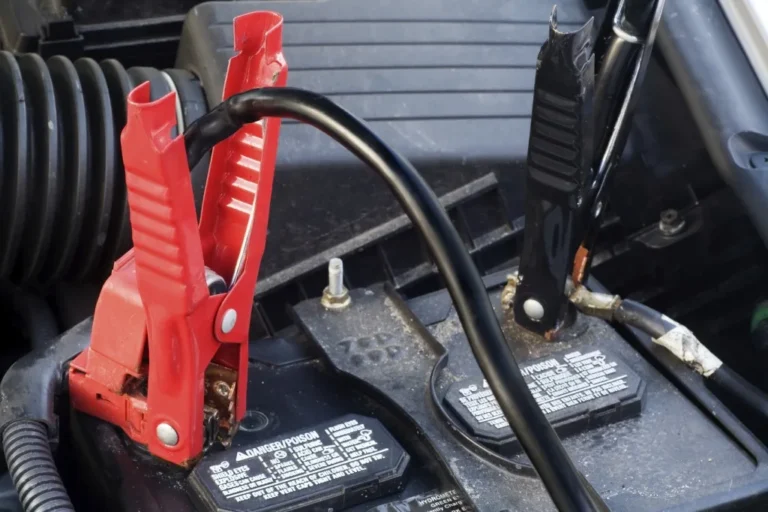
On the Outback (dead car):
- Positive: red cover or red remote stud.
- Negative: black post or unpainted metal bracket on the engine block, away from the battery itself.
On the donor car:
- Positive: red cable or "+" symbol on the battery.
- Negative: black cable or "-" symbol.
The Subaru owner's manual specifies using a designated ground point on the engine block rather than the negative terminal on the dead car. This is because of the BMS sensor we mentioned earlier.
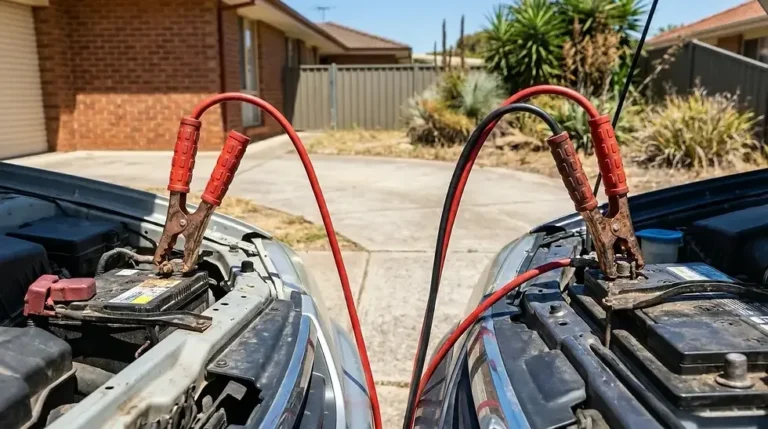
Step 3: Connect the Cables in This Exact Order
- Red clamp to dead car's positive terminal or remote stud.
- Red clamp to donor car's positive terminal.
- Black clamp to donor car's negative terminal.
- Black clamp to unpainted metal ground on the dead car (engine bracket, alternator bracket, or strut tower bolt).
The order matters. Connecting the donor negative first creates a spark risk at the donor battery. Connecting the dead car's positive first keeps the spark as far from hydrogen gas as possible.
Step 4: Start the Donor Car
Run the donor at around 2000 RPM for 2 to 3 minutes. This pushes surface charge into the dead battery and warms the cells slightly, which improves cranking performance.
If it's below freezing, give it a full 5 minutes. Cold batteries accept charge slowly.
Step 5: Try to Start the Outback
Turn the key (or press the start button). On most Outbacks, you need to press the brake pedal before pressing start. Crank for no more than 10 seconds at a time.
If it doesn't fire on the first try, wait 30 seconds, then try again. Three failed attempts means something else is wrong, and continuing just overheats the donor's alternator.
Step 6: Disconnect in Reverse Order
- Black clamp from the dead car's ground point.
- Black clamp from the donor car's negative.
- Red clamp from the donor car's positive.
- Red clamp from the dead car's positive or remote stud.
Keep the clamps from touching each other or any metal surface as you remove them.
Step 7: Keep the Outback Running
Do not turn the Outback off right away. Drive it for at least 20 to 30 minutes, or let it idle at 1500 RPM for the same amount of time. This recharges the battery enough to start the car again on its own.
If you shut it off immediately, you'll be jumping it a second time in a few hours.
Jump Starting Outbacks With Start-Stop or EyeSight (2018+)
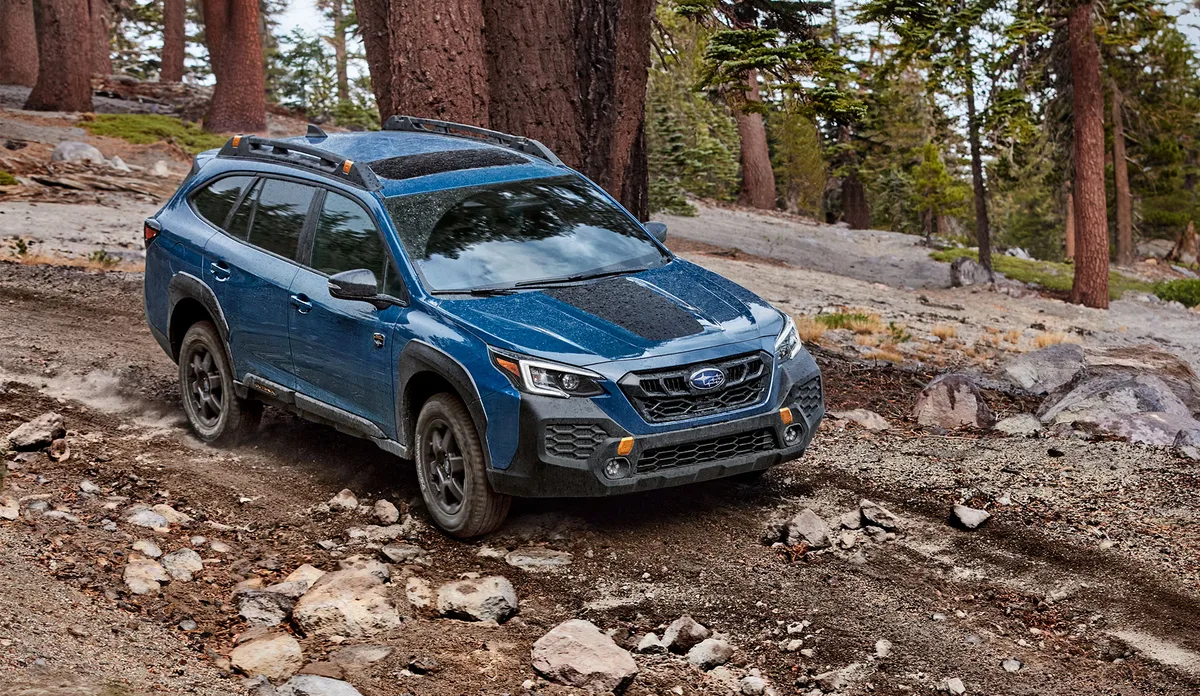
If your Outback has the EyeSight safety suite or the start-stop system that kills the engine at red lights, you need to handle the jump differently. The electrical system on these models is more sensitive, and the wrong sequence can leave you with a dashboard full of warning lights.
Why Start-Stop Changes the Rules
Start-stop uses an AGM battery with a BMS sensor mounted directly on the negative terminal. It monitors state of charge, temperature, and health. A sudden external voltage jump can confuse the sensor and put the system into a "learn" mode.
EyeSight adds a stereo camera system powered off the same electrical bus. If voltage dips too low during cranking, EyeSight can throw a "temporary disabled" error that clears only after a full shutdown and restart cycle.
The Right Way to Jump a 2018+ Outback
- Use the remote positive stud under the red cover. Do not connect to the battery post itself.
- Connect the ground to the engine lift point or alternator bracket, not the negative terminal.
- Let the donor charge for a full 5 minutes before attempting to start.
- Press the brake pedal and push the start button. Do not turn the key on older push-button models without pressing the brake first.
- Once started, leave the engine running for at least 30 minutes.
After the jump, you may see EyeSight disabled, check engine, and battery sensor warnings on the dash. Most of these clear within 10 miles of driving. If they persist for more than 50 miles, a dealer scan tool can reset them.
Aggregate owner feedback on Subaru forums confirms that connecting to the battery posts directly on 2020+ Outbacks is the single most common cause of persistent BMS fault codes after a jump. Stick with the remote stud.
Connecting the Cables the Right Way (Order Matters)
The cable connection order isn't arbitrary. It's designed to push any spark as far from the battery as possible.
The Connection Order
| Step | Clamp | Where | Reason |
|---|---|---|---|
| 1 | Red (+) | Dead car's positive or remote stud | Furthest from donor battery |
| 2 | Red (+) | Donor car's positive | Completes the positive side |
| 3 | Black (−) | Donor car's negative | Completes the negative side |
| 4 | Black (−) | Engine ground on dead car | Spark lands here, away from hydrogen vents |
The Disconnection Order
Reverse it. Black from the engine ground first, then donor negative, then donor positive, then dead car positive. This avoids creating a stray path through your wrench or the chassis while you work.
Common Mistakes to Avoid
- Don't connect the final black clamp to the dead battery's negative post. Use the engine bracket.
- Don't let the clamps touch each other while either end is connected. A short across the clamps can weld them shut and fry the donor's alternator.
- Don't crank the dead car for more than 10 seconds at a time. Let the starter cool for 30 seconds between attempts.
- Don't skip the donor charging time. A "dead" battery with zero surface charge needs 2 to 5 minutes of donor-side charging before it'll crank at full speed.

Starting the Engine and Disconnecting Safely
Once everything is connected and the donor has been running for a few minutes, you're ready to fire up the Outback.
Starting Sequence
- Make sure the Outback is in Park with the parking brake on.
- Press the brake pedal (required on push-button models).
- Turn the key or press the start button.
- Release as soon as the engine fires. Don't keep cranking.
If the engine cranks but doesn't start within 5 to 10 seconds, stop. Wait 30 seconds, then try again. Three failed attempts means either the battery is too far gone to accept a jump, or there's a fuel or spark issue unrelated to the battery.
Disconnection
Once the Outback is running:
- Turn off any high-draw accessories (heated seats, rear defroster, AC).
- Disconnect in reverse order (ground first, positives last).
- Keep the cables clear of moving engine parts as you remove them.
- Don't shut the Outback off yet. Let it idle or drive immediately.
If you disconnect the cables while the engine is off, you'll lose the surface charge that helps the battery recover. The car might not restart.
After the Jump: Charging, Driving, and Resetting the Car
The jump got you moving. Now make sure it sticks.
Charging Time
Idling at 1500 RPM for 30 minutes puts roughly 15% to 25% charge back into a depleted battery. A 45-minute highway drive is better. Anything less than 20 minutes total runtime, and you're gambling on whether the car will start next time.
Reset the Accessories
After a battery disconnect or deep discharge, the Outback loses some of its learned settings. These are the common ones to reset:
- Clock and date in the infotainment screen.
- Radio presets and audio equalizer settings.
- Power window auto-up feature (roll each window down and back up, holding the button for 3 seconds at the top).
- Sunroof position memory (if equipped).
- EyeSight camera calibration (may require a short drive at 25+ mph to reinitialize).
The radio anti-theft lockout on older Outbacks (pre-2015) requires a four-digit code from your owner's manual or the dealer. If you've lost both, the dealer can retrieve it from the head unit serial number.
Battery Health Check
Within 24 to 48 hours of the jump, stop by any auto parts store. They run a free battery load test that tells you:
- The resting voltage (should be 12.6V or higher).
- The CCA capacity under load.
- Whether the battery can hold a charge.
If the battery fails the load test, replace it. A battery that needs a jump more than twice in a year is at end of life. Don't wait for the third jump in a parking lot at midnight.
Common Mistakes That Damage the ECU or Battery
Some mistakes turn a 10-minute fix into a $1,200 repair.
Electrical Damage Risks
- Connecting the final negative clamp to the dead battery's negative post. The spark can ignite hydrogen gas and damage the BMS sensor.
- Reversing polarity. Red to black and black to red. This fries fuses, the alternator, and on newer Outbacks, the battery management module.
- Cranking for more than 10 seconds at a time. Overheats the starter motor and the donor's alternator.
- Skipping the donor charging phase. Trying to crank a battery with zero surface charge just dumps load on the donor system without actually jump-starting anything.
Physical Damage Risks
- Leaning over the battery during the final connection. If a spark occurs and ignites hydrogen, you don't want your face six inches above it.
- Smoking near the battery. Same reason.
- Jumping a frozen or cracked battery. The heat of cranking can expand a frozen battery and rupture the case.
- Using damaged cables with exposed wire. The exposed copper can short to the chassis mid-connection.
Post-Jump Damage Risks
- Shutting the engine off within 5 minutes of the jump. The alternator hasn't had time to push enough charge back, and the car dies again.
- Driving only a short distance before parking. Same problem, scaled up.
- Ignoring dashboard warning lights after the jump. EyeSight disabled, charging system warning, and battery sensor alerts should clear within 10 miles. If they don't, get a dealer scan.
Subaru technical bulletins note that BMS-related fault codes account for a significant percentage of post-jump service visits. Most are avoidable by using the remote jump terminal and not touching the negative post directly.
Jump Starting in Extreme Cold vs. Extreme Heat
Temperature changes everything about how a jump-start works. Here's what to adjust based on conditions.
Sub-Freezing Conditions (Below 32°F)
- Battery capacity drops by roughly 20% at 32°F and up to 50% at 0°F.
- Oil thickens, increasing cranking load.
- Donor charging time should be 5 minutes, not 2.
- A fully frozen battery cannot be jumped safely. Bring it inside to thaw for 8+ hours before attempting.
If your Outback sat outside at -10°F for two days, the battery may simply be too cold to accept charge. Bring the battery indoors and warm it to at least 40°F before jumping.
Extreme Heat (Above 100°F)
- Heat accelerates battery fluid evaporation and internal corrosion.
- A hot battery that's dead is often a battery that's reached end of life.
- The risk during a jump is acid boiling under the caps. Listen for a hissing sound and don't jump if you hear one.
- Heat also raises resting voltage slightly. A "healthy" 12.6V reading in summer can mask a battery that's actually at 60% capacity.
Best Practice by Climate
| Condition | Pre-Jump Step | Donor Charge Time | Crank Limit |
|---|---|---|---|
| Mild (40 to 80°F) | None | 2 minutes | 10 seconds |
| Cold (0 to 32°F) | Warm battery indoors | 5 minutes | 8 seconds |
| Sub-zero (below 0°F) | Thaw battery fully | 5+ minutes | 6 seconds |
| Hot (above 100°F) | Check for hissing | 2 minutes | 10 seconds |
Per SAE J537 battery testing standards, cold-cranking performance is rated at 0°F. If your battery is below its rated CCA at that temperature, it's due for replacement.
When a Jump Won't Work: Battery vs. Alternator vs. Parasitic Draw
A jump start only solves one of three common dead-battery causes. Knowing which one you have determines whether you need a $150 battery or a $600 alternator.
The 30-Minute Test
After a successful jump, drive for 30 minutes, then shut the car off. Wait 5 minutes, and try to restart.
- Car starts fine? Battery is healthy. The original drain was probably a one-time accessory left on.
- Car won't restart? Battery isn't holding charge. Either the battery is dead or the alternator isn't charging it.
Alternator Diagnosis
With the car running, use a multimeter or visit an auto parts store to check the charging voltage across the battery terminals.
| Reading | Diagnosis |
|---|---|
| 13.8 to 14.4V | Alternator is healthy |
| Below 13.5V | Alternator is undercharging |
| Above 14.8V | Alternator is overcharging, will cook the battery |
| Fluctuating wildly | Voltage regulator failure |
A failing alternator can take a perfectly good battery down to dead within a few days. If your battery keeps dying but tests healthy, the alternator is the prime suspect.
Parasitic Draw Diagnosis
The normal parasitic draw on a Subaru Outback is 20 to 50 milliamps. That's enough to keep the clock and radio presets alive without draining the battery for weeks.
If your draw is 100+ milliamps, something is staying awake when it shouldn't be. Common culprits on the Outback:
- Aftermarket dash cams hardwired to constant power.
- Trailer wiring modules.
- Stuck relay in the rear gate or fuel door.
- Damaged wiring harness from off-road use.
A mechanic can pull the parasitic draw with a clamp meter and start pulling fuses one at a time to isolate the circuit. It's a 30-minute to 2-hour job depending on the cause.
Signs You Need a New Battery Instead of a Jump
Some batteries can be revived. Others are at end of life and need to go. Here's how to tell the difference.
Clear Replacement Signals
- Battery is more than 5 years old in a temperate climate, or 3 years old in a hot climate.
- The case is bulging, cracked, or leaking.
- The terminals are so corroded they crumble when you touch them.
- Voltage drops below 10V during a load test at any auto parts store.
- The battery has needed two or more jumps in the past six months.
If any of these match, save yourself the next jump and replace the battery now.
Replacement Battery Specs for the Outback
| Model Year | Group Size | CCA Rating | Battery Type |
|---|---|---|---|
| 1994 to 2004 | 35 | 550 to 650 | Flooded |
| 2005 to 2014 | 35 | 550 to 650 | Flooded |
| 2015 to 2019 | 35 | 650 to 760 | Flooded or AGM |
| 2020 to 2026 | 35 | 760 | AGM (start-stop) |
Group 35 fits all Outback generations. The CCA rating climbs with each generation as electrical loads (EyeSight, infotainment, start-stop) increase.
A quality replacement battery costs $150 to $280 depending on the brand and CCA rating. Interstate, Optima, and Odyssey are the most common aftermarket choices that meet or exceed Subaru OEM specs.
Recommended Battery Specs and Replacement Costs for the Outback
If you've decided replacement is the right move, here's what to look for.
Flooded vs. AGM
Pre-2015 Outbacks use flooded lead-acid batteries. They're cheap, reliable, and don't need a special charger. For these models, a standard flooded cell is fine.
2015 to 2019 Outbacks can use either flooded or AGM. AGM lasts longer and handles deep discharges better, which matters if you have a start-stop system or a parasitic draw issue.
2020+ Outbacks with start-stop require AGM. A flooded battery in these models will fail within a year or two because the BMS expects AGM charge characteristics.
Spec Targets by Use Case
| Use Case | Recommended CCA | Battery Type |
|---|---|---|
| Mild climate, no start-stop | 550+ | Flooded |
| Cold climate, no start-stop | 650+ | AGM preferred |
| Start-stop, mild climate | 760 | AGM required |
| Start-stop, cold climate | 800+ | AGM required |
| Heavy accessory load (camping, audio) | 760+ | AGM |
Cost Expectations
A flooded 35-group battery runs $120 to $180. An AGM equivalent runs $180 to $280. Dealer installation adds $50 to $100, but most auto parts stores install for free if you buy the battery from them.
Skip the dealer markup unless you specifically need the OEM Subaru battery for warranty reasons. Aftermarket AGM batteries from Interstate, Optima, or Odyssey perform identically to OEM at a lower cost.
Best Portable Jump Starters for the Subaru Outback
If you decide a jump pack makes more sense than relying on cables, here's what to look for.
Minimum Specs
- 1000 peak amps minimum. The Outback's 2.5L engine needs 400 to 500 amps to crank in mild weather and 600+ in cold.
- 1500 to 2000 peak amps for cold climates.
- Smart jumper cables with reverse polarity and spark protection.
- At least 8000 mAh internal capacity so the unit holds charge for 6+ months.
- USB output for charging phones in emergencies.
Top Categories
| Category | Example Specs | Best For |
|---|---|---|
| Compact (under 1 lb) | 1000A peak, 6000 mAh | Glove box, mild climates |
| Mid-size (1 to 3 lbs) | 1500A peak, 12000 mAh | Trunk, mixed climates |
| Heavy-duty (3+ lbs) | 2000A peak, 18000 mAh | Cold climates, diesels |
For most Outback owners, the mid-size category hits the sweet spot. Compact units are great for motorcycles and small cars but struggle with a 2.4L turbo in January. Heavy-duty units work great but are bulky and expensive.
Charging and Storage
A jump pack left in a hot car all summer loses 30% to 50% of its charge. Check it every three months and top it off. Most units have a built-in gauge or a button to check capacity.
Store it inside the cabin if possible, not the trunk. Extreme temperature swings shorten lithium battery life.
Frequently Asked Questions
Where is the battery on a Subaru Outback?
The battery sits in the engine bay. On 1994 to 2014 models, it's on the driver's side. On 2015 and newer Outbacks, it's on the passenger side near the firewall.
A red-covered remote jump-start terminal is standard equipment on most 2015+ models, and that's the connection point you should use.
Can you jump start a Subaru Outback in the rain?
Yes, rain doesn't make a jump-start dangerous. The 12V system is too low to conduct through wet skin, and the cables are insulated. Just avoid standing in a puddle while making the connection, and don't let the clamps sit in standing water.
Standard precautions apply: no smoking, no sparks, no leaning over the battery.
How long should I drive my Outback after a jump?
Drive for at least 20 minutes, ideally 30. The alternator needs that runtime to push enough charge back into the battery for the next start. If you only drive 5 minutes and shut the car off, the battery won't have enough charge to restart the engine.
Will jump starting my Outback mess up the radio or computer?
Sometimes. The Outback's infotainment and ECU can lose learned settings during a deep discharge. Window auto-up, radio presets, the clock, and EyeSight camera calibration may all need to be reset.
None of this is permanent damage, and most settings clear themselves within a short drive. Persistent error codes after a jump usually indicate a connection mistake and require a dealer scan to reset.
What's the difference between the battery terminal and the remote jump terminal?
The remote jump terminal is a dedicated stud wired directly to the positive battery post but located away from the battery itself. It exists so you can connect jumper cables without reaching into the battery tray or leaning over the battery vents. Subaru's battery management system is sensitive to direct connection, so using the remote terminal avoids triggering BMS fault codes after the jump.
Can I jump start my Outback from another Subaru?
Yes, and it's one of the best donor vehicles out there. Subaru electrical systems are very similar across models, so voltage matches cleanly. Just make sure the donor is also a 12V system (all modern Subarus are), and follow the same cable order as you would with any donor car.